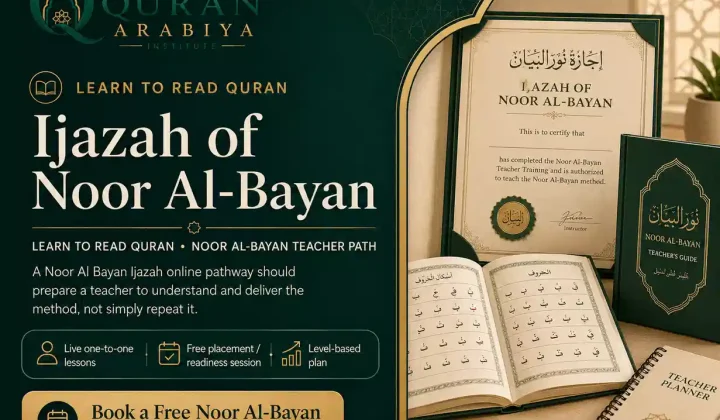
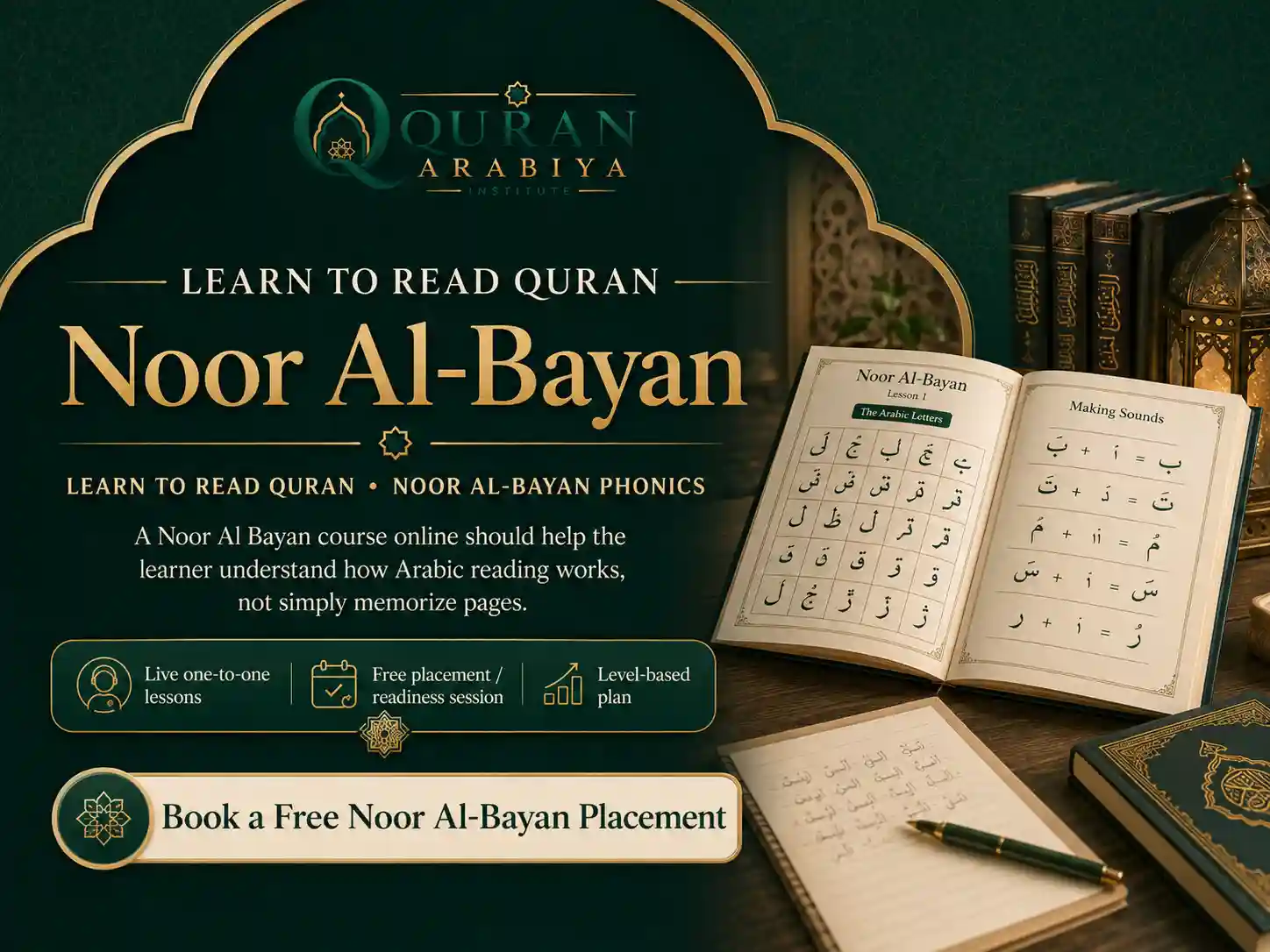
A Noor Al Bayan course online should help the learner understand how Arabic reading works, not simply memorize a set of pages. The method is useful when letter recognition, sound, blending and word reading need to be built in a deliberate sequence. At Quran Arabiya Institute, the free trial can identify whether the learner needs the full Noor Al Bayan reading method or only a specific stage before moving into Quranic or broader Arabic text.
Noor Al Bayan for beginners begins with the script foundation, but the purpose is to create a chain from seeing a symbol to reading a word independently. Each stage should make the next one easier rather than feeling like an unrelated worksheet.
The teacher therefore checks both accuracy and independence. Knowing the answer after it has been modeled is different from being able to decode it on first sight.
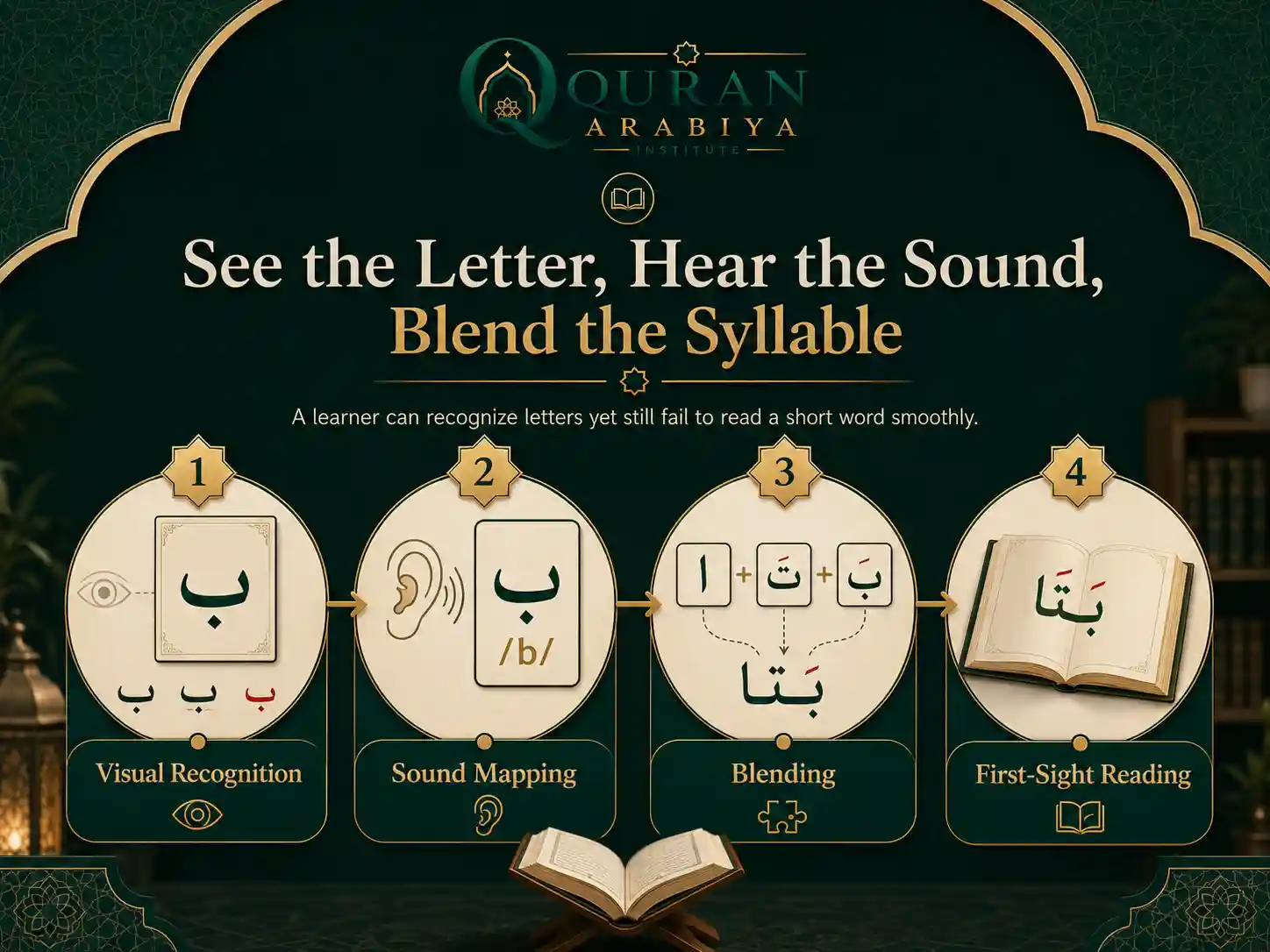
Start by recognizing the visual symbol and its connected form reliably. In live one-to-one practice, the teacher mixes positions and examples so the learner identifies the letter rather than one memorized presentation. This stage is ready when the learner can find the same letter quickly when its surrounding shapes change.
A stable reading system connects three pieces: visual recognition, sound production and blending. If one is weak, the learner may recognize letters but still be unable to read even a short word smoothly.
Lessons can isolate the weak step, practise it in a small unit, and then rebuild the whole chain. This is more efficient than repeating an entire page without knowing what is causing the hesitation.
Reading signs become useful when the learner stops treating each one as a separate theory fact and starts responding to it automatically on the page. The course gradually increases the number of variables the learner must hold at once.
Accuracy remains the gate. The teacher does not increase complexity simply because the learner has “seen” the rule before.
The Noor Al Bayan reading method should move beyond isolated syllables. Word construction, short sentence reading and mixed examples test whether decoding is becoming flexible enough for real text.
Unfamiliar examples matter. If the student can read only the exact practice line they repeated, the skill is not yet portable.
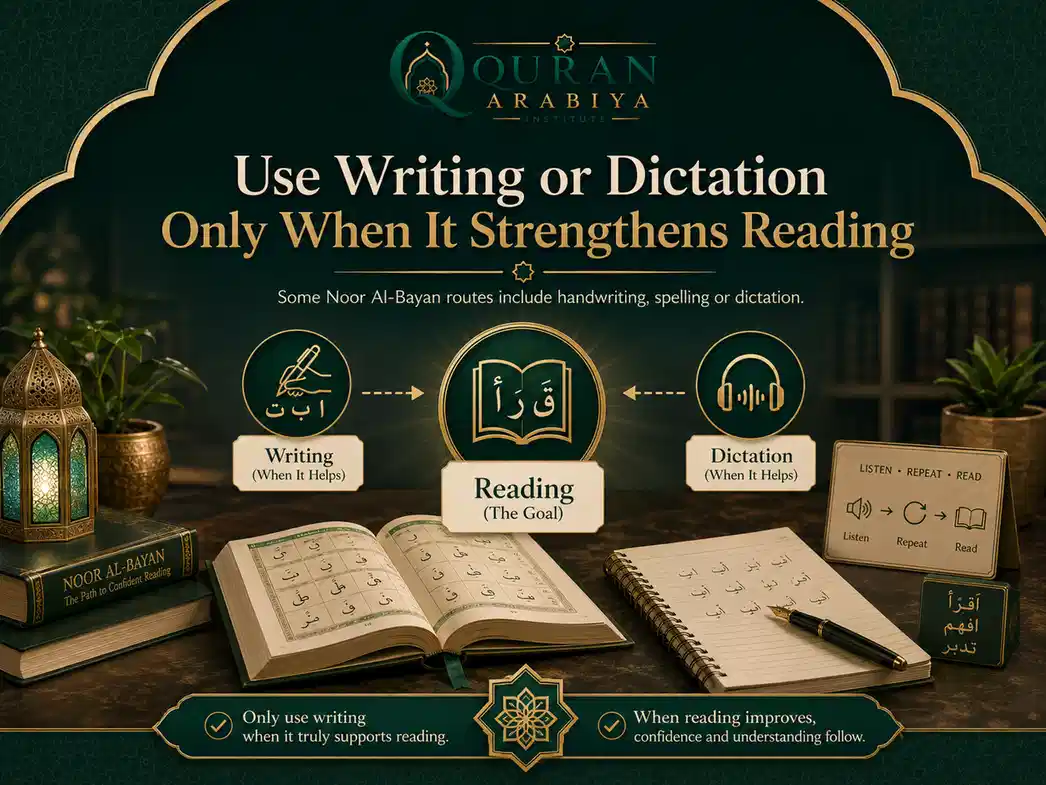
Some Noor Al Bayan teaching routes include handwriting, spelling or dictation as additional literacy practice. Those tools can be useful when they strengthen visual memory, letter discrimination or sound-to-symbol awareness.
They should not be promised as a fixed feature unless they are included in the confirmed course plan. For a learner whose primary goal is Quran reading, reading remains the priority.
Start by using Noor Al Bayan when the learner’s priority is Quran access. In live one-to-one practice, the teacher keeps reading and Quran transfer central while using the phonics structure only as far as it supports that goal. This stage is ready when the learner can approach selected Quranic words without the lesson drifting into unrelated language study.
Recognize the letter despite position and visual variation.
One useful feature of a broader phonics route is that the learner can practise the same reading mechanism on different kinds of Arabic examples. That can reveal whether the learner understands the code rather than memorizing a narrow set of Quranic forms.
When the goal is the Mushaf, Quranic examples increase progressively so the student learns to handle the density and visual conventions of real Quran pages.
The same method can be delivered differently. Children may need shorter activities and more visible scaffolding. Adults often want concise explanation of why a pattern works. Non-Arabic speakers may need extra sound comparison and repetition.
Noor Al Bayan classes online in a one-to-one setting allow the teacher to change the amount of prompting without changing the learning target.
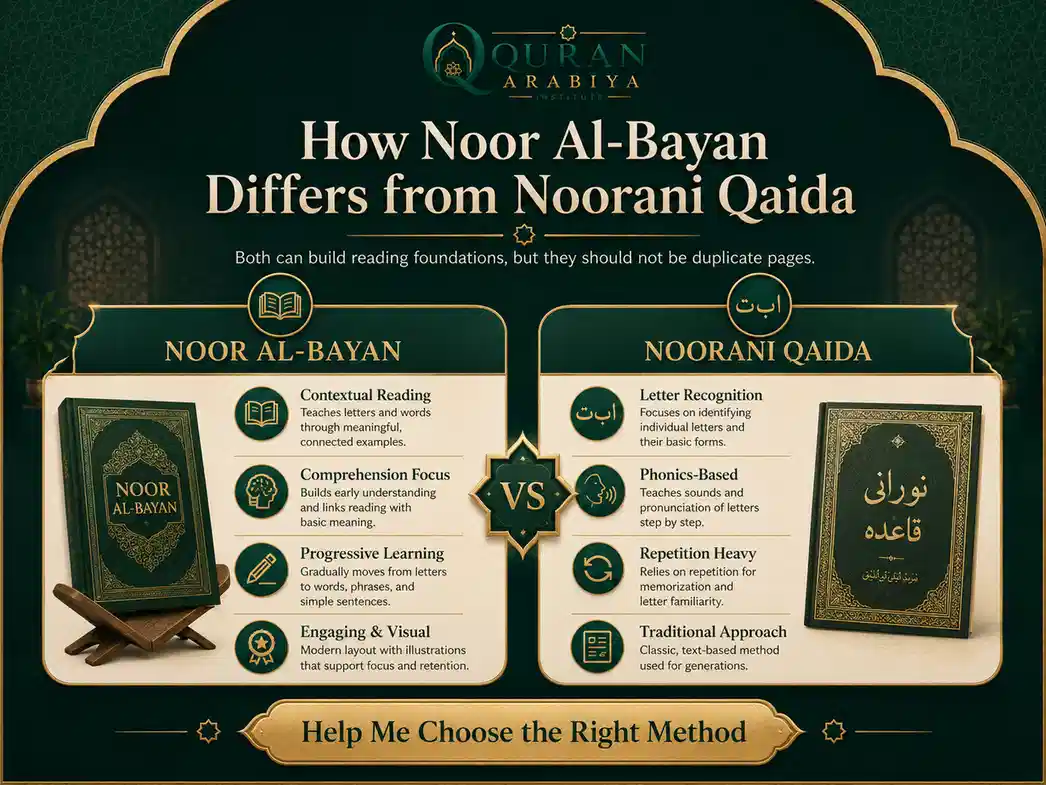
Both can build a foundation for reading, but they are not the same page. Noorani is usually presented as a concentrated Quran-reading sequence. Noor Al Bayan can be positioned as a broader phonics/literacy route that supports both Quranic and general Arabic decoding.
The choice should come from placement and learner fit, not from claiming that one method is universally superior.
A strong progress check changes the example. The student may read the same sign with a new letter, a known letter in a new position, or a word that was not practised in advance.
That type of transfer test tells the teacher when to review, when to advance and when the learner is ready for more independent reading.
If you want to learn Noor Al Bayan online, the free trial can identify whether the method matches your current gap and whether you need the full sequence. The teacher can check letters, vowels, blending, connected forms and a short text sample where appropriate.
The result is a starting recommendation rather than a generic enrollment into “level one.”
Choose a reading method because it fits the learner, not because the name is familiar. Book a free Noor Al Bayan placement lesson and identify the first reading skill that needs to become independent.
No. The method can be adapted for adult beginners and non-Arabic speakers as well as children.
It builds Arabic reading through letter-sound recognition, vowel patterns, blending, word reading and progressively more independent text reading.
Yes. It can start from the alphabet, although learners with partial skills should be placed at the first weak stage rather than automatically restarting.
Yes. The teacher can keep the route focused on reading and Quran transfer. Optional writing or dictation should be used only when they support the agreed goal.
No. Noor Al Bayan builds decoding and reading foundations. Tajweed focuses on rules and precision of recitation after the learner can read sufficiently.
Course structures and editions can vary. It is safer to define progress by skills mastered rather than promise a universal number of levels.
No. A guided Mushaf transition may still be necessary. Readiness should be checked on unfamiliar Quranic passages, not book completion alone.
Yes. The route can stay focused on reading skills and Quran transfer while still using the phonics structure of the method. Writing or broader literacy activities should be used only when they support the agreed reading goal.
No. Some teaching routes use them as support tools, but they should not be treated as a fixed promise unless they are part of the confirmed plan. Reading remains the priority when that is the learner’s main objective.
The teacher can begin at the stage where sound-to-symbol knowledge stops becoming usable word reading. There is no educational benefit in restarting stable letter recognition simply because the method has an earlier chapter.
The learner should read the same pattern with a new letter, in a different position or inside an unfamiliar word without being told the answer first. Transfer checks reveal whether the skill is genuinely available.
Move when word and sentence decoding is stable enough for selected Quranic text and the learner can handle unfamiliar examples with decreasing support. A guided Mushaf bridge may still be needed after the method foundation.
Yes. One-to-one lessons allow the teacher to change explanation, repetition and sound comparison while preserving the reading target. Adult presentation should remain direct rather than child-oriented.
Yes. State the method during matching so the academy can consider relevant teacher experience together with schedule, learner level and current availability.
If you are considering Noor Al Bayan course online, start with a live assessment rather than choosing a level by guesswork. The teacher can confirm the first useful skill, the best-fit route and the next step without making promises that depend on individual progress.