ABOUT QURAN ARABIYA INSTITUTE

Quran Arabiya Institute — Structured Online Learning for Quran, Arabic & Islamic Studies

Quran Arabiya Institute is an online learning institute for Quran, Arabic and Islamic Studies. Serious learning becomes easier when the learner knows where to start, what the next step is, why the teacher is correcting something, and how progress will be reviewed.
At Quran Arabiya, you can study Quran, Arabic and Islamic Studies through live one-to-one lessons built around a clear starting point, a suitable teacher and a learning route you can follow with confidence. You should be able to see why you can trust the learning experience: clear teacher credentials, transparent course choices and progress that you and your family can understand.
Start Clearly

Find the learner's real starting point before deciding pace or depth.

WHY WE EXIST

Why Quran Arabiya Institute Exists

Many learners do not lack motivation; they lack a clear route. A child may move between teachers who use different reading methods. An adult may know Tajweed terminology but still repeat the same recitation mistakes. An Arabic learner may study grammar without deciding whether the real goal is speaking, Quranic comprehension or classical text reading.
Quran Arabiya Institute exists to reduce that confusion. Your course should match the exact skill you want to build, instead of reducing every learner to a broad label such as beginner, intermediate or advanced.
A child still decoding Quranic script

The right response is not to label the child simply as a beginner and move faster. The teacher needs to see whether the gap is letter recognition, vowels, blending or connected reading, then choose a reading route that protects later Tajweed and Hifz work. A clear starting point prevents advanced content from hiding a foundation problem.

About-us
OUR WORKING MISSION

The Quran Arabiya Mission: Clarity, Access and Responsible Progress

The Quran Arabiya mission is to make structured Quran, Arabic and Islamic learning accessible to children and adults through live online teaching while protecting academic clarity. Accessible does not mean academically vague, and structured does not mean forcing every student through the same speed.
Clarity

Clarity means the learner can see what is being worked on now and why it matters. The teacher should be able to explain the immediate priority without burying the learner under every possible rule or topic. A clear route turns feedback into a next step instead of leaving correction as a list of mistakes.

STRUCTURE WITHOUT RIGIDITY

What “Structured Learning” Means at Quran Arabiya

Structured learning protects the order of the journey while allowing the teaching to respond to the learner. Placement comes before pace, sequence matters, live correction matters for performance skills, practice belongs inside the plan, and progress should be reviewed through observable performance rather than attendance alone.
Placement before pace

Placement asks what the learner can actually do before deciding how fast to move. A teacher may need to distinguish script recognition from reading, rule knowledge from applied recitation, or grammar familiarity from real language use. The result is a starting point tied to evidence rather than a vague beginner, intermediate or advanced label.

THREE SUBJECT PILLARS

Three Subjects Under One Institute — Without Blurring Their Jobs

Quran, Arabic and Islamic Studies can support one another, but they are not interchangeable. The course map exists to protect that distinction so a conversational Arabic learner does not receive a Quranic grammar route and a child who still cannot decode script is not pushed into an advanced Tajweed syllabus.
Quran

Quran study can include reading foundations, recitation, Tajweed, Hifz, Muraja'ah, Ijazah-related preparation and Qira'at. The route should match the learner's current performance instead of assuming that every Quran learner needs the same mix at the same time. Reading, memorization and specialist recitation remain distinct goals even when they support one another.

THE LEARNING LOOP

The Quran Arabiya Teaching Method

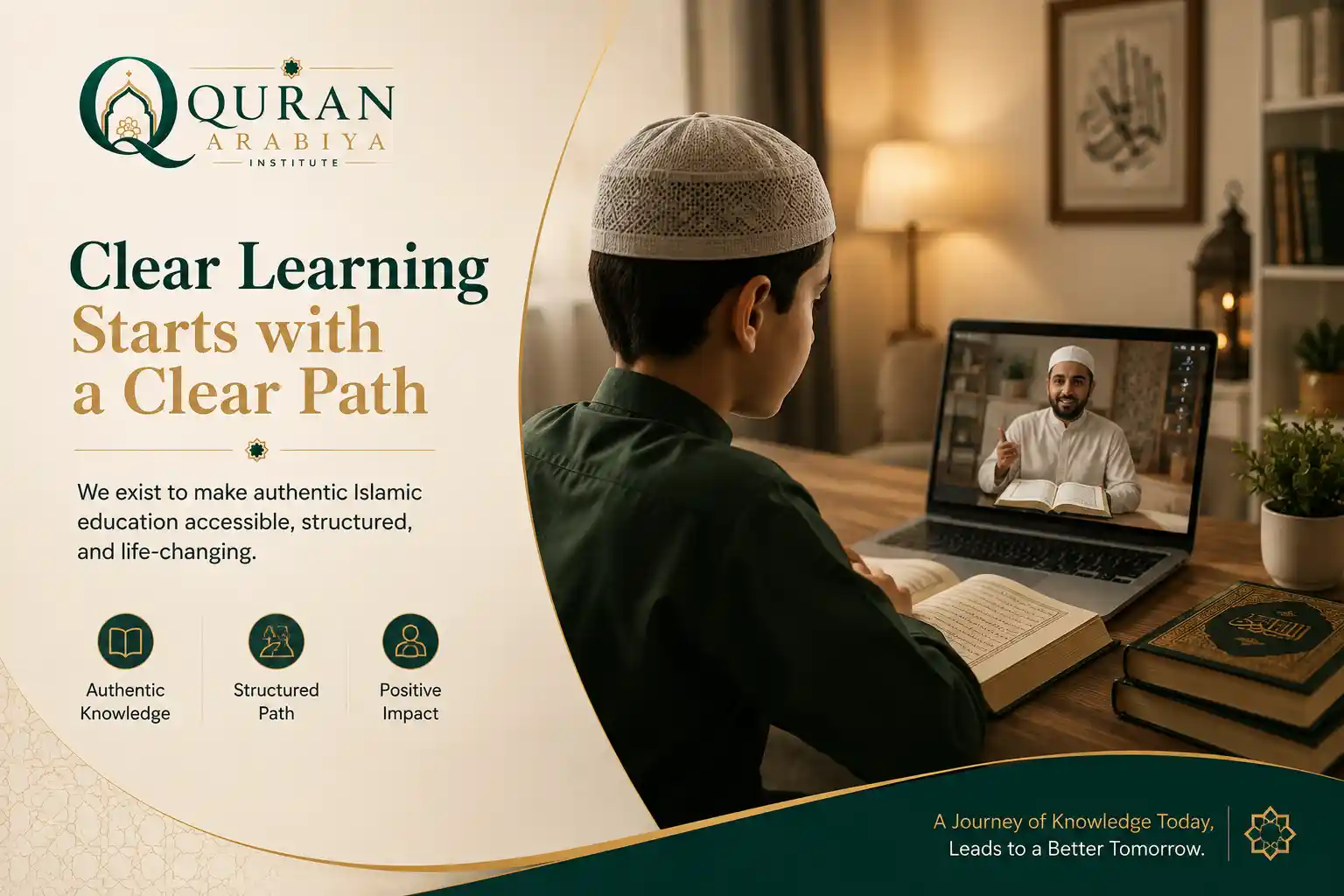
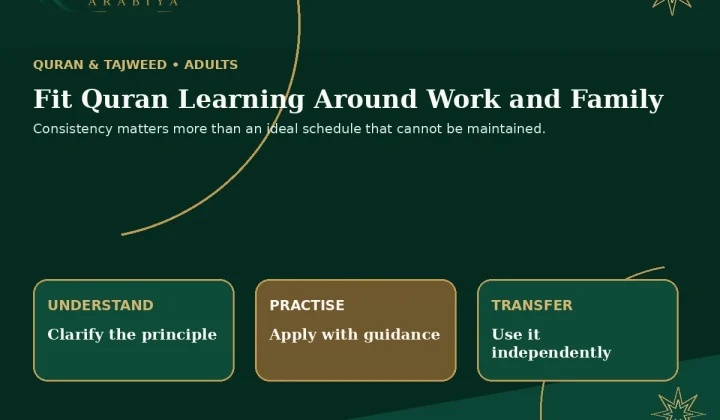
The Quran Arabiya teaching method is built around a repeating loop: observe the learner, identify the immediate problem, explain only what is needed, practise with correction, assign a manageable next task and review whether the skill transfers to new material.
One-to-one teaching makes the loop more responsive. The structure comes from the course objective; the adaptation comes from the learner in front of the teacher. This is how the institute can remain organized without treating different students as copies of one another.
Observe

See or hear what the learner can actually do before correcting or assigning more work.
About-us 1
TEACHER EVIDENCE, NOT DECORATION

The Teacher Matters as Much as the Curriculum

A strong curriculum can still fail when the teacher cannot explain, correct or connect with the learner. Quran Arabiya treats teacher information as evidence: academic grounding where verified, subject specialization, teaching style, best-fit learner and relevant credentials only when confirmed.
Parents and adult learners should be able to request a teacher preference and use the trial to assess fit. The most impressive biography is not automatically the best match for every student.
Academic grounding

Teacher profiles should make academic grounding visible only where it has been verified. The goal is not to collect impressive labels, but to help the learner understand the teacher's preparation for the subject being requested. Evidence should remain specific enough to check and update when circumstances change.

WHO WE SERVE

Who the Quran Arabiya Online Academy Is Designed For

The Quran Arabiya online academy is designed for children, teenagers, adults, complete beginners, returning learners, non-Arabic speakers, new Muslims and families with more than one learning goal. Some students need one focused course; others need a connected plan across Quran, Arabic and Islamic Studies.
The important point is not to force every learner into a bundle. Combined study should be chosen because it solves the learner’s goals, not because the academy wants to sell more subjects.
ChildrenTeenagersAdultsNew MuslimsFamiliesReturning Learners
Different starting points

One institute, but not one forced route.

TRUST THROUGH BOUNDARIES

What We Will Not Promise

These boundaries are part of quality. They make the promises that remain more believable: live guidance, a defined course route, transparent teacher information, a trial before commitment and a plan that can be reviewed.
No fixed-time memorization guarantee

Memorization depends on current reading ability, accuracy, review capacity, lesson frequency and what the learner can sustain outside class. A responsible plan can set a process and review progress, but it should not promise that every learner will complete Hifz within the same fixed number of months. The route must respond to evidence.

PLANS THAT CAN CHANGE

Learning Plans Should Be Reviewable, Not Permanent by Default

A student can outgrow a course, need a different lesson length, change goals or respond better to another teaching style. A good online academy needs a process for that. Progress reviews should ask whether the current route still matches the learner’s performance and circumstances.
This is also why the free trial is useful at the beginning: it creates an initial evidence point instead of asking the student to purchase first and diagnose later.
Start from evidence

The initial route should reflect what the learner can already do, the goal being requested and any practical constraints such as age or schedule. The free trial can create a useful first evidence point without asking the learner to purchase before the academy understands the need. This makes the first plan an informed starting decision, not a permanent label.

ABOUT QURAN ARABIYA

Frequently Asked Questions

No. The institute has separate learning families for Quran, Quran-reading foundations, Arabic Language, Advanced Arabic, Islamic Sciences and Islamic History.

Placement, defined course objectives, ordered skills, live correction or explanation, practice, review and deliberate decisions about when to progress or change route.

No. The course objective stays stable while one-to-one teaching can adjust pace, examples, repetition and practice load to the learner.

Yes. A connected plan can combine subjects when the goals justify it, while each subject keeps its own outcome and progression.

No. Ijazah is a specialist authorization with its own teacher, recitation or memorization standards. A general course certificate or attendance record should never be presented as the same thing.

Yes. Adult beginners and returning learners can use the trial to identify a respectful starting point without being expected to know Arabic or Tajweed terminology first.

Use the Our Teachers page to review specializations and fit, then request a teacher or use the free trial to test the match.

Use the course catalogue and category pages for curriculum detail. The About page is intentionally focused on the institute’s mission, method and standards.

No. Structure gives the course a clear objective, prerequisites and progression logic, while one-to-one teaching can adapt pace, examples and practice around the learner in front of the teacher.

The starting point should come from the learner’s current ability, requested goal and live teacher observation where appropriate. The aim is to identify the skill that most needs attention before choosing pace or depth.

Yes. A learner can outgrow a course, need a different lesson length, change goals or respond better to another teaching style. Reviews should ask whether the current route still matches performance and circumstances.

No. Quran Arabiya does not treat attendance or a fixed number of months as a guaranteed learning outcome. Progress depends on the learner, the skill, review capacity, practice and the evidence seen in actual performance.

The blog is a learning library for practical guides, terminology and home-study support. It should help learners understand the next question while live lessons remain the place for observation, correction and individualized guidance.

Use the free trial to discuss the learner’s level and goal, experience the teaching approach and clarify the likely next step. You can then compare the teacher route, course direction and pricing with better information.
POPULAR LEARNING PATHS

Explore Courses That Match Your Goal

SEE THE METHOD IN A REAL LESSON

Start with a Clearer Learning Decision

Read the teacher profiles, explore the learning system, or use the free trial and let the learner’s actual starting point guide the next step.
Chat with us