Structured preparation and supervised recitation can be part of the course. The teacher keeps the recitation route clear and retests corrections later during formal preparation, while keeping the correction target narrow and clear. Move forward when corrections remain stable; final Ijazah still depends on the qualified teacher.
Start the complete Quran recitation only after readiness is established. The teacher keeps the recitation route clear and retests corrections later during formal preparation, while keeping the correction target narrow and clear. Move forward when corrections remain stable; final Ijazah still depends on the qualified teacher.
Name the recitation being read before the formal route begins. The teacher keeps the recitation route clear and retests corrections later during formal preparation, while keeping the correction target narrow and clear. Move forward when corrections remain stable; final Ijazah still depends on the qualified teacher.

Complete memorization is not the defining requirement of the recitation Ijazah route; Hifz Ijazah is a separate page.
No. Authorization depends on meeting the supervising teacher’s required standard.
No. Beginners should first build strong reading and Tajweed.
A course certificate can record participation/completion; an Ijazah is specific scholarly authorization by a qualified teacher.
Yes, but each Riwayah/route has its own requirements and should be treated as a distinct advanced path.
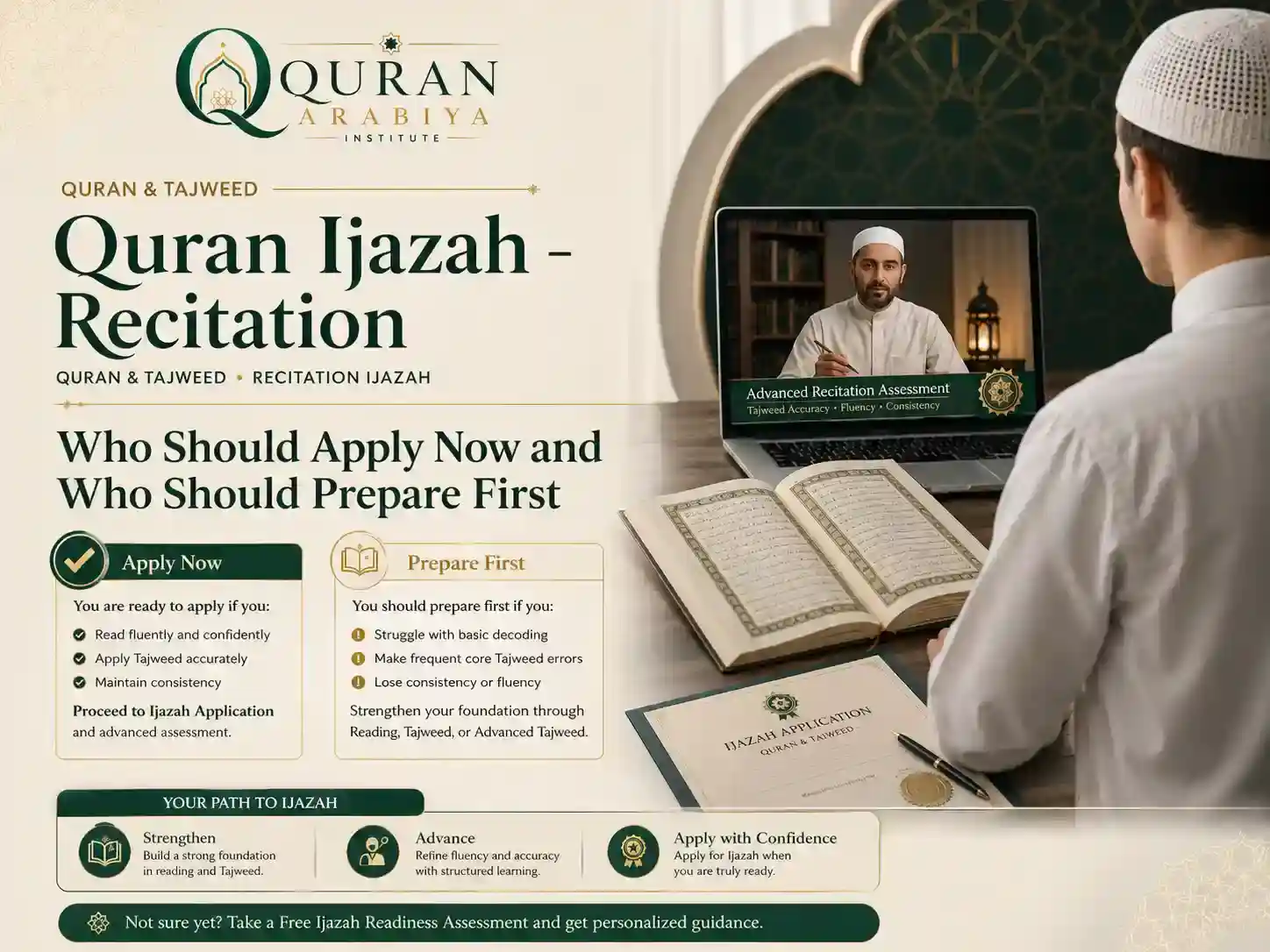
The teacher should assess fluency, Makharij, Tajweed, stopping and recurring errors to decide whether the learner is ready. Preparation may be recommended before formal presentation begins.
The exact Riwayah and route should be defined before the formal journey begins. Authorization is specific in scope, so the teacher and learner should be clear about what is being presented.
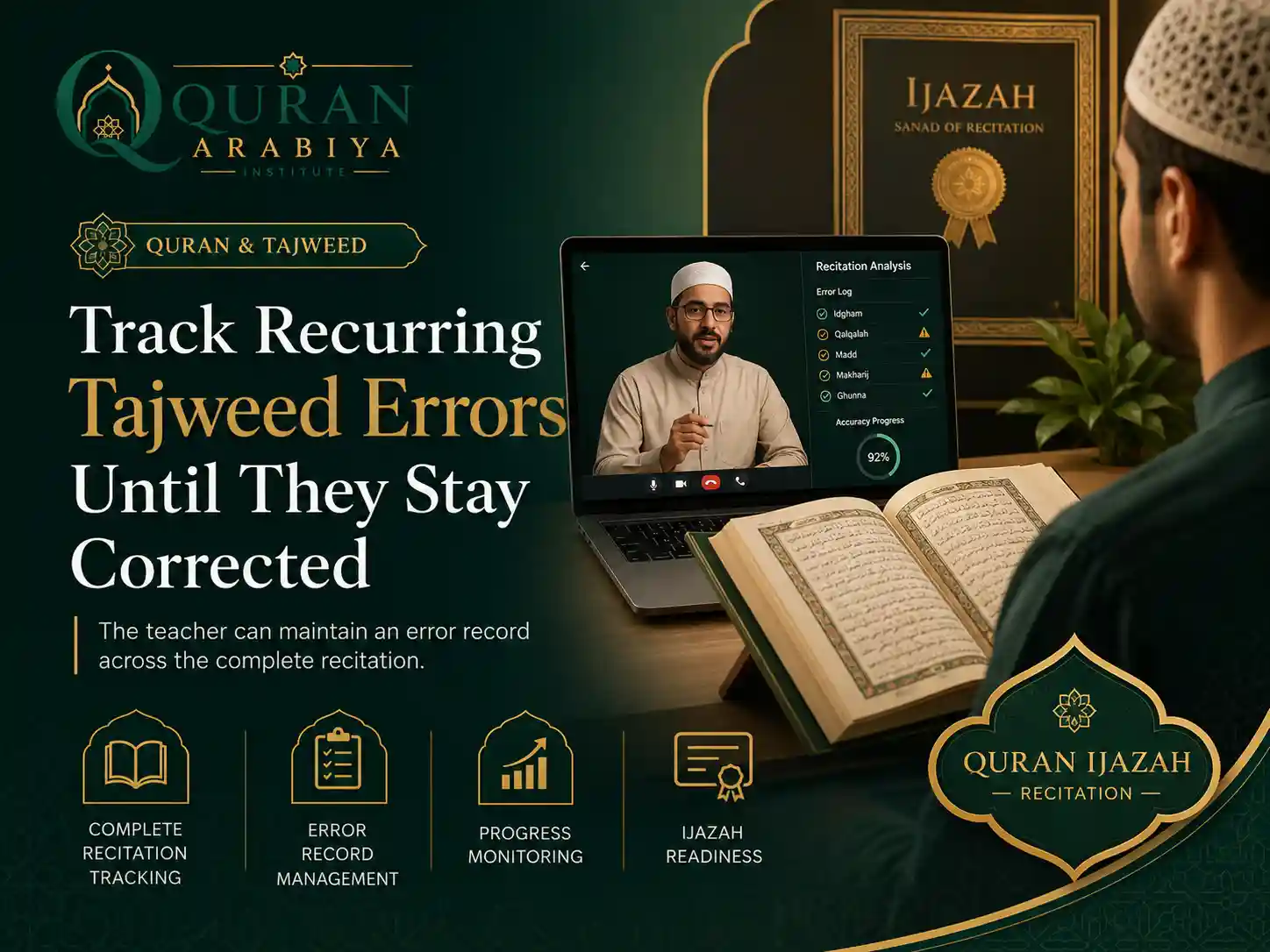
Recurring Tajweed and recitation errors can be recorded, corrected and retested later in different passages. The goal is stable correction across the Khatmah, not a one-time perfect word.
Yes. Appropriate stopping, breath planning and clean restarting are part of controlled continuous recitation and may be included according to the teacher’s standard.
Yes. Course participation or completion and scholarly authorization are different outcomes. The qualified issuing teacher decides whether an Ijazah can be granted.
There is no responsible fixed promise because readiness, error patterns, lesson frequency and the teacher’s required standard affect the journey. Final authorization is teacher-dependent.
A change may be possible, but the exact authorization route and what a new teacher requires should be clarified. Ijazah is tied to the qualified teacher and the accepted recital within the stated scope.
The assessment should identify the most useful preparation route, such as adult Tajweed or advanced Tajweed, rather than starting a formal Khatmah prematurely.
Yes, if you meet the prerequisites and study under a qualified teacher for that route. A later Riwayah or wider Qiraat study is a separate advanced pathway.