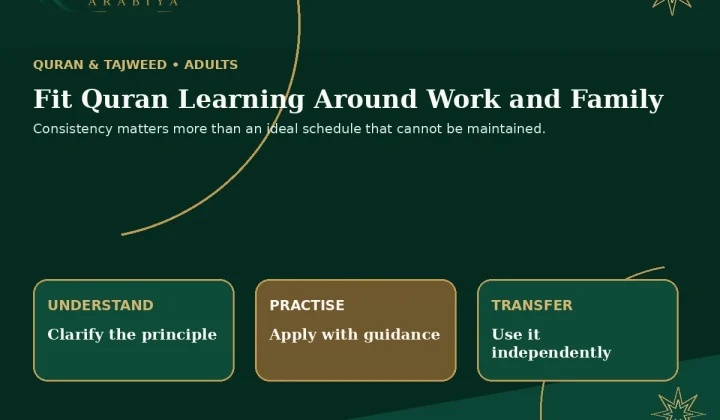

Compare nearby letters and hear what changes between them. The teacher isolates the pattern, practises it deliberately, then retests it in connected Quran recitation, while keeping the correction target narrow and clear. Move forward when the correction remains stable in a different passage with less prompting.
Length should remain controlled during continuous recitation. The teacher isolates the pattern, practises it deliberately, then retests it in connected Quran recitation, while keeping the correction target narrow and clear. Move forward when the correction remains stable in a different passage with less prompting.

Separate a recurring pattern from a one-time slip. The teacher isolates the pattern, practises it deliberately, then retests it in connected Quran recitation, while keeping the correction target narrow and clear. Move forward when the correction remains stable in a different passage with less prompting.


Not necessarily. You need enough Quran reading ability to work directly on recitation; the assessment will show whether reading should be strengthened first.
No. Theory explains corrections; live recitation and repeated application are central.
Yes, if articulation is the main bottleneck.
That is exactly where one-to-one correction can focus on the gap between knowledge and consistent application.
When core pronunciation and common rules remain stable in connected recitation and the remaining issues are genuinely higher level.
Read a short passage at your normal pace so the teacher can hear established habits rather than a rehearsed performance. The audit can map Makharij, Sifaat, Madd, Ghunnah, stopping and recurring transfer problems.
The lesson should prioritise a small number of high-impact patterns rather than interrupt every word. Concentrated correction makes it easier to practise, retest and prove that a change is becoming stable.
Yes, at the appropriate level. Breath planning, stopping signs and clean restarts can be trained as part of accurate continuous reading without claiming that the course replaces specialist study of the subject.
A useful task may be one articulation contrast, several Quran words and a short passage containing the same feature. That gives the next live lesson something precise to verify.
That gap is a core reason for practical one-to-one Tajweed correction. The teacher can move from a short rule explanation to guided application and then a longer passage where the same rule must survive normal recitation.
Yes, when a few Makharij or Sifaat patterns are affecting many words. The teacher can organise practice around the recurring pattern rather than treating every mistake as unrelated.
A correction is stronger when it appears in a different word or Surah later, not only immediately after the teacher models it. Retesting is part of the method.
Only if your recitation has reached the required advanced standard and a qualified teacher confirms readiness. Ijazah is a separate route with its own expectations and teacher-dependent authorization.
Yes. Your goal, current level, schedule and requested male or female teacher preference can be considered during matching, subject to availability.