QURAN & TAJWEED • ADVANCED APPLIED TAJWEED

Advanced Tajweed Course Online for Precise Makharij, Sifaat & Mastery of Recitation Rules

Advanced Tajweed is not simply “more rules.” It is the stage where a learner with a sound foundation begins to control fine details consistently across long, unfamiliar and demanding recitation. This advanced Tajweed course online focuses on precision: refined Makharij and Sifaat, subtle recurring errors, complex rule interaction, stopping and starting, and the ability to keep corrections stable under normal recitation pressure.

Advanced Tajweed Starts Where Basic Accuracy Is Already Stable

Readiness comes first. Can you read fluently enough for the teacher to evaluate Tajweed rather than decoding? Are common rules applied without constant prompting? Do the main Makharij stay stable in connected recitation? If elementary errors still dominate the lesson, the learner will usually progress faster by stabilizing core Tajweed first.

Fluent Reading

The passage can be read continuously enough for the teacher to evaluate advanced recitation rather than basic decoding.

Core Rules Hold

Common Tajweed rules remain generally stable without continuous teacher prompting.

Main Makharij Are Reliable

Core articulation stays recognizable across connected words and normal recitation flow.

Subtle Errors Are Now the Bottleneck

The remaining problems are finer contrasts, interactions, stopping, breath or micro-errors rather than elementary reading.

Not sure you are ready?

The assessment should tell you whether the correct next step is Adult Tajweed, genuine advanced correction, a classical matn or Ijazah preparation.

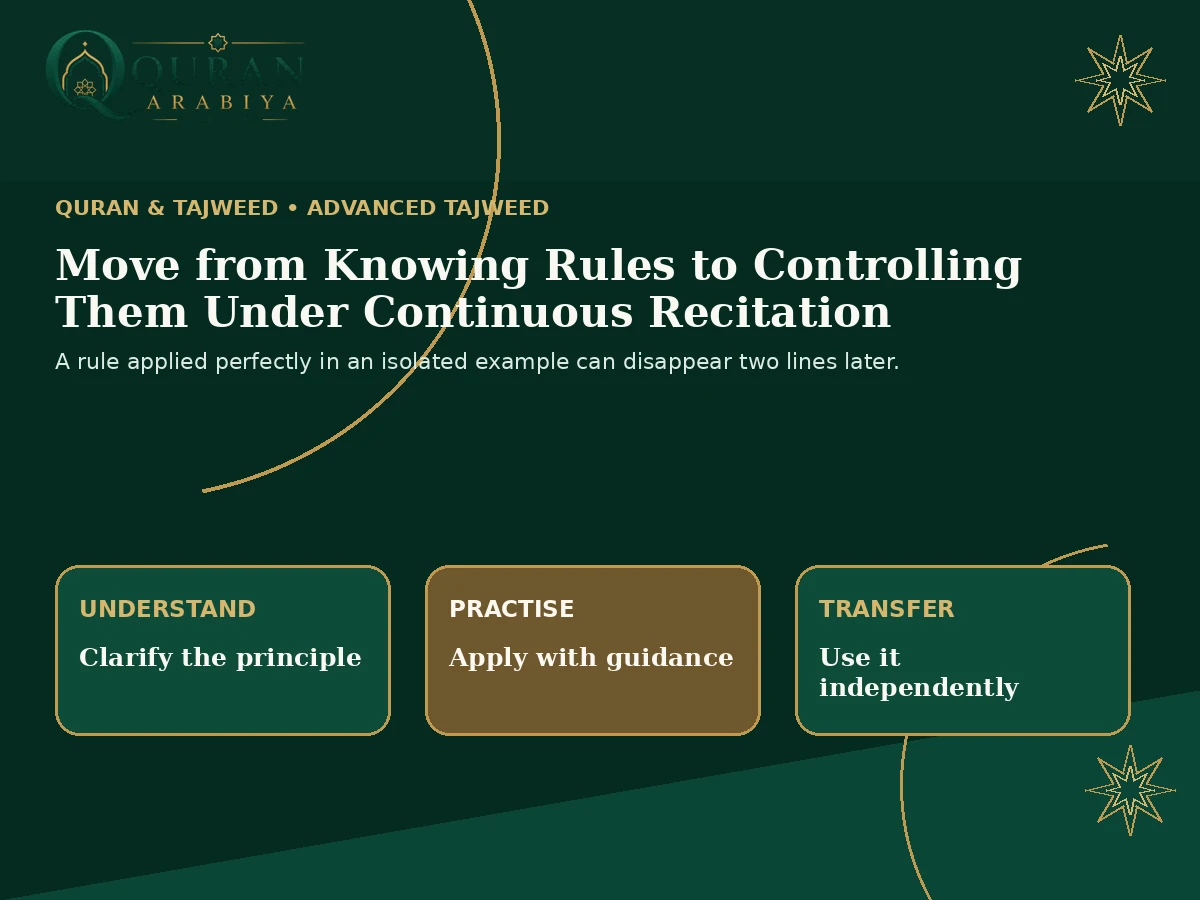
Move from Knowing Rules to Controlling Them Under Continuous Recitation

A rule applied perfectly in an isolated example can disappear two lines later. Advanced Tajweed classes should test transfer. Practice the feature in short examples, then read a longer passage where articulation, rule interaction, breath and fluency compete for attention.

The test is not whether you can do it once

The real test is whether the correction remains available after passage length, breath, fluency and other rules begin competing for attention.

Isolate

Stabilize the target feature in a controlled example.

Extend

Increase phrase length so more variables compete for attention.

Reduce Prompting

Let the recitation continue with fewer interruptions.

Re-Test

Check the same feature later in another passage before calling it stable.

Refine Makharij and Sifaat at the Level of Fine Contrasts

An advanced Makharij course should move beyond “where is the letter produced?” into the qualities that distinguish neighboring sounds. The learner can compare articulation in different contexts and notice when pressure, softness or speed changes the letter. This is where Makharij and Sifaat advanced work becomes audible rather than theoretical.

Contrast Neighboring Sounds

Compare similar letters until the audible distinction is clear under different word contexts.

Track Pressure & Softness

Notice when speed, tension or breath changes the Sifaat that should remain stable.

Test Across Positions

A letter that is correct in one position may weaken in another; advanced practice checks variation.

Return to Long Recitation

Fine articulation only counts when it survives real Quran flow, not just a short drill.

Control Complex Madd, Ghunnah, Idgham and Assimilation Patterns

At a higher level, the challenge is consistency across contexts. The teacher can identify places where length becomes unstable, Ghunnah is exaggerated or reduced, or merging/clarity patterns are not executed cleanly. The course should prioritize patterns that actually appear in the learner’s recitation.

Prioritize what actually breaks in your recitation

Advanced study should not become a catalogue of rare rules. The strongest sequence is built around the patterns that repeatedly lose control in real Quran reading.

Madd Stability

Keep length controlled when surrounding rules and breath demands change.

Ghunnah Balance

Avoid both exaggeration and underproduction across different contexts.

Idgham Precision

Control merging where transitions become difficult at natural speed.

Assimilation / Clarity

Keep transitions clean when neighboring sounds compete for articulation.

Use Waqf and Ibtida to Protect Meaning and Fluency

Advanced reciters need more deliberate breath and stopping decisions. Work can include longer passages, suitable stops, clean restarts and avoiding breath-driven choices that damage recitation quality. This is advanced applied discipline, not a substitute for specialized scholarship in the subject.

Plan Before the Stop

Read ahead enough to avoid a breath decision that creates a weak or unsuitable stopping point.

Protect the Stop

End the phrase without letting breath pressure distort the final sounds or the quality of recitation.

Restart with Control

Resume from a point that restores coherent recitation rather than simply choosing the nearest convenient word.

Detect Lahn Jali, Lahn Khafi and Repeating Micro-Errors

Advanced Quran recitation correction becomes valuable when the teacher does more than interrupt. The learner should know the type of error, what triggers it and what drill can target it. An error log helps show what has stabilized and what still appears under pressure.

Lahn Jali — Clear Error

An obvious error needs immediate clarity: what changed, why it matters and how to rebuild the correct reading.

Lahn Khafi — Subtle Error

A finer Tajweed weakness may only appear under certain transitions, lengths, Sifaat or stopping conditions.

Repeating Micro-Error

A small detail that returns across passages is treated as a pattern, not as another isolated interruption.

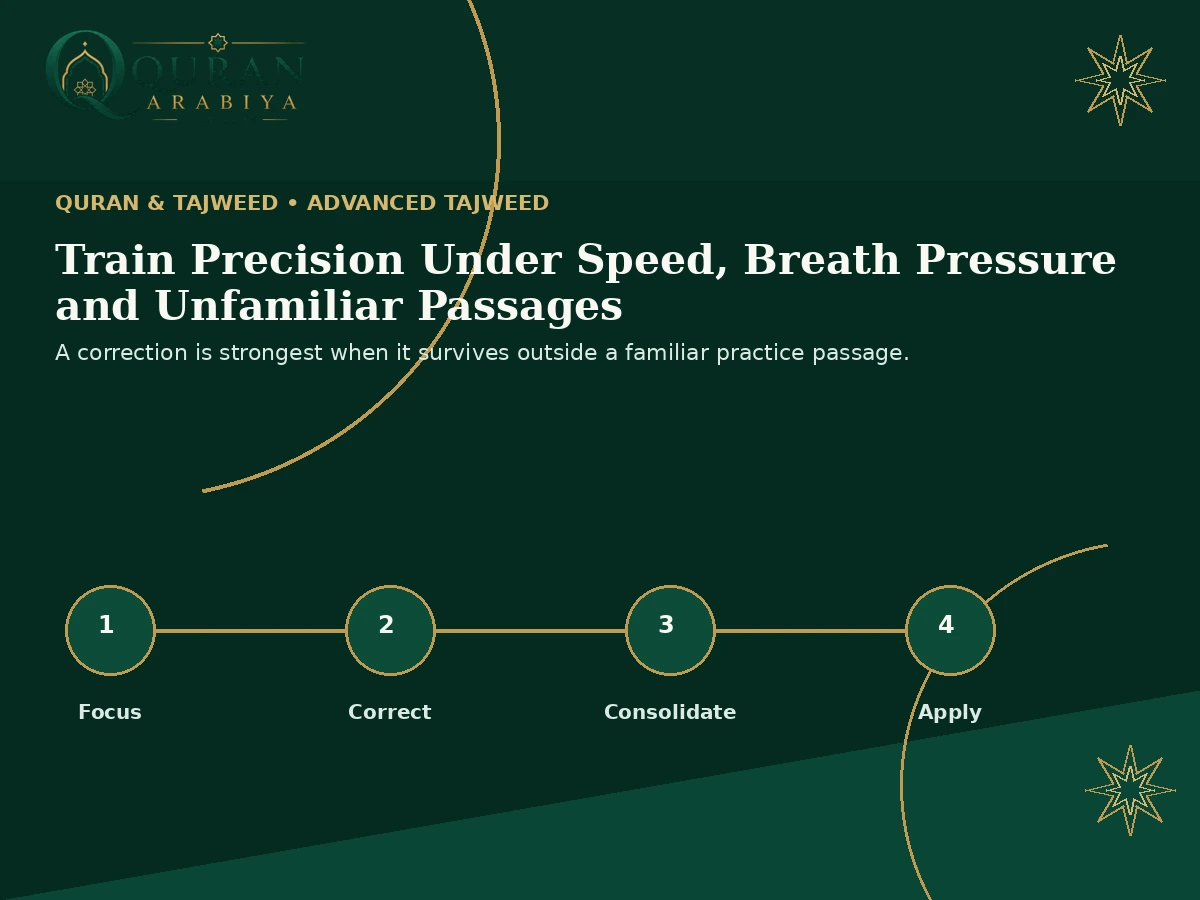
Train Precision Under Speed, Breath Pressure and Unfamiliar Passages

A correction is strongest when it survives outside a familiar practice passage. The teacher can use unfamiliar selections, longer breath units or passages containing several target features. A Tajweed mastery course should create controlled difficulty so the student can prove precision.

Precision under pressure is the signature of this page

The learner is not rushed for the sake of speed. Difficulty is increased only enough to reveal whether fine control is becoming independent.

Longer Breath Units

Keep accuracy when breath planning begins to compete with articulation and rule control.

Unfamiliar Passages

Test whether the correction belongs to the learner—not merely to one memorized practice passage.

Several Target Features

Combine more than one corrected feature and watch whether they remain stable together.

Natural Recitation Pace

Increase pace only enough to expose whether precision still survives outside a slow drill.

Use a Transfer Scorecard—Not a List of Rules Covered

Advanced progress is easier to judge when the same correction is tested under different conditions. The scorecard is not a public grade; it is a practical way to see whether a skill is becoming independent.

Precision

Can the target sound or rule be produced correctly in the first place?

Consistency

Does it remain correct across different examples rather than only once?

Transfer

Does it survive a longer or unfamiliar passage without constant prompting?

Self-Correction

Does the learner begin to notice and repair the error independently?

Choose the Next Specialist Route: Ijazah, Tuhfat or Al-Jazariyyah

Advanced Tajweed can lead toward formal recitation Ijazah, classical foundation through Tuhfat, or deeper advanced matn study through Al-Jazariyyah. These routes solve different intents and should stay separate; the assessment helps choose the right one.

Stay in Advanced Tajweed

Stay here while subtle corrections still need to become stable under continuous, unfamiliar and demanding recitation.

Quran Ijazah — Recitation

A formal authorization route when the required recitation standard is reached and teacher approval is appropriate.

Tuhfat Al-Atfal

A dedicated classical foundational matn route for learners whose next goal is structured study of the text.

Al-Jazariyyah

A separate advanced classical-matn route for learners ready for deeper textual Tajweed study.

What Progress Should Look Like

Advanced improvement should remain stable under changing conditions, not disappear as soon as the practice passage changes.

Readiness-Based Advanced Plan

The course begins from demonstrated recitation control, not from the word “advanced” in the course title.

Finer Makharij / Sifaat Control

Subtle sound and quality corrections become more reliable across different contexts.

Stable Long-Passage Application

Corrections survive longer, unfamiliar passages with less teacher prompting.

Stronger Breath & Stopping Discipline

Where appropriate, stopping, restarting and breath choices interfere less with recitation quality.

The final outcome is route clarity

You leave with a clearer recommendation: continue advanced correction, move into a classical matn, or prepare for a formal Ijazah route.

Start with a Free Advanced Recitation Assessment

Request a free advanced recitation assessment to determine whether your next step is still core Tajweed, genuine advanced correction, a classical matn or Ijazah preparation.

1. Read Naturally

Use a normal passage and normal pace rather than preparing a polished performance.

2. Test Fine Control

Listen for Makharij/Sifaat, rule interaction, breath, stopping and subtle recurring errors.

3. Add Pressure

Use a longer or less familiar selection to see whether corrections survive outside the easiest conditions.

4. Choose the Route

Leave with a recommendation based on demonstrated readiness, not on ambition alone.

Related Quran & Tajweed Courses

Use sibling courses only when the learner’s primary intent changes. This protects the Advanced Tajweed page from becoming an Adult Tajweed, matn or Ijazah page.

Quran Recitation & Tajweed for Adults

Use this route if core rule application, basic Makharij or connected-recitation accuracy is still unstable.

Tuhfat Al-Atfal Tajweed Course

For a dedicated classical foundational matn route rather than broad advanced applied correction.

Al-Jazariyyah Tajweed Course

For advanced classical-matn study once that textual route—not applied correction—is the primary goal.

Quran Ijazah – Recitation

For formal teacher-dependent recitation authorization after the required standard is reached.

Frequently Asked Questions About the Advanced Tajweed Course

Questions advanced learners commonly ask about readiness, fine Makharij/Sifaat, complex rule interaction, Waqf/Ibtida, error classification, pressure testing, classical matn study and Ijazah.
Learners whose Quran reading and core Tajweed are stable enough to focus on finer recitation control.
You should be able to read continuously, keep common rules generally stable and demonstrate reliable core articulation. The assessment checks whether subtle correction—not basic decoding—is now the main bottleneck.
No. This is an applied advanced Tajweed route; Al-Jazariyyah is a dedicated classical-matn page.
No. Tuhfat is a separate classical foundational matn route. It can be recommended when that becomes the learner’s actual goal.
No. Ijazah is a separate formal route requiring teacher approval after the required standard is met.
Yes, if fine Makharij/Sifaat control is the main advanced weakness.
If elementary rule or articulation errors dominate, the Adult Tajweed course may be a more efficient route before moving into advanced pressure testing.
The main difference is transfer under pressure: subtle corrections are tested across longer, unfamiliar passages, competing rules, breath and natural recitation pace.
At an appropriate advanced level, work can include deliberate stopping, breath planning and clean restarts without claiming to replace specialized scholarship in the subject.
By whether subtle corrections remain stable across different passages and conditions with less prompting.
You read naturally, the teacher checks fine control and recurring patterns, adds an appropriate transfer test and recommends the most suitable next route.
No. A familiar polished passage can hide the very patterns an advanced assessment is trying to discover.
They help show whether the correction belongs to the learner’s recitation skill or only to one practiced selection.
They help classify obvious and subtler errors so correction can be prioritized and targeted rather than delivered as a stream of unrelated comments.
A focused error log can be used to see which subtle patterns have stabilized and which still return under pressure.
Yes, when those patterns are genuinely present in the learner’s recitation and deserve priority.
It moves beyond identifying articulation points into fine contrasts, letter qualities, context changes and whether precision survives real recitation.
No. This is an advanced applied recitation route, not a teacher-certification claim. Learners considering teaching may benefit from the precision work, but formal teaching credentials are a separate matter.
Yes, if the learner reaches the required recitation standard and a qualified teacher considers the formal Ijazah route appropriate.
Yes. As one subtle pattern stabilizes, another may become the priority, or the assessment may show that a matn or Ijazah route now fits better.

Prove Precision Beyond the Practice Passage

If your core Tajweed is already stable, the next challenge is not collecting more rules. It is keeping fine corrections reliable when the passage gets longer, unfamiliar and more demanding.