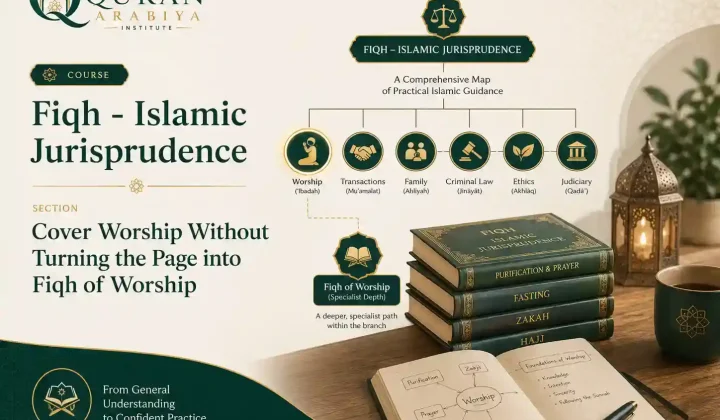
An Usul Al Fiqh course online studies the principles and methods behind Islamic legal reasoning. Fiqh asks about practical rulings and their organized application; Usul Al-Fiqh asks how jurists understand evidence, classify legal language, relate sources and build disciplined methods for deriving or evaluating rulings within a scholarly tradition.
For learners searching for Islamic legal theory course, principles of Islamic jurisprudence course, sources of Islamic law course or Usool Al Fiqh classes, Quran Arabiya Institute should make one boundary explicit from the beginning: studying Usul develops methodological understanding, but an introductory course does not qualify a student to issue fatwas or perform independent Ijtihad.
Learn Usul Al Fiqh online becomes far easier once the student sees the difference. Fiqh contains practical juristic outcomes and chapter-based rulings. Usul is the toolbox/methodology scholars use when reasoning from texts and recognized legal principles within their tradition.
Fiqh helps you study practical rulings, while Usul Al-Fiqh helps you understand the principles and methods scholars use when reasoning from evidence. Knowing that difference makes it easier to choose the course that matches your goal.

Learn Usul Al Fiqh online becomes far easier once the student sees the difference. Usul is the toolbox/methodology scholars use when reasoning from texts and recognized legal principles within their tradition. The aim is to understand the principle clearly enough to recognize where it applies.
Introductory Usul courses commonly discuss the Quran and Sunnah and, depending on the scholarly school/text, other evidences such as Ijma and Qiyas. The learner should understand not only the names but how a methodology treats evidence and why legal reasoning requires rules.
The exact source taxonomy and order must match the confirmed Usul text or teacher rather than a generic internet infographic.
The learner should distinguish the course explanation from independent source authentication or personal interpretation. Guided study keeps evidence connected to scholarly scope.
Usul often includes categories of commands, prohibitions, general and specific wording, unrestricted/restricted expressions and other principles of legal language depending on the syllabus. These concepts help students see why juristic reading is more disciplined than quoting one translation line.
Arabic terminology can be introduced with English explanation, while advanced study may require stronger Arabic.

Usul often includes categories of commands, prohibitions, general and specific wording, unrestricted/restricted expressions and other principles of legal language depending on the syllabus. These concepts help students see why juristic reading is more disciplined than quoting one translation line. The aim is to understand the principle clearly enough to recognize where it applies.
Usul Al-Fiqh provides a framework for understanding that juristic disagreement can arise from evidence, language, authenticity, reconciliation, methodology and other disciplined factors. A course can demonstrate that with controlled examples without turning into a debate over every contemporary ruling.
This is valuable for learners who previously experienced differences as random contradiction.
A teacher can take a simplified example and ask which Usul principle is relevant, what information would need to be verified and why a conclusion cannot be drawn from one isolated phrase. The point is to understand method.
The course should explicitly avoid marketing exercises as “derive your own rulings,” because formal Ijtihad and fatwa require far deeper qualifications.
A useful checkpoint is to explain the idea in the learner’s own words, identify one example, and know when a deeper specialist course is the better next step.
Usul Al-Fiqh provides a framework for understanding that juristic disagreement can arise from evidence.

Advanced Usul study may depend on stronger Arabic, Fiqh familiarity, Hadith/source awareness and the ability to follow a classical text. A learner who lacks those prerequisites can still begin foundations but should know what later depth requires.
That creates a realistic academic pathway rather than an exaggerated promise of instant advanced scholarship.
The trial can check previous Fiqh/Arabic study, the learner’s reason for choosing Usul and whether they want a beginner conceptual course or a specific classical text. The academy should also state the Usul tradition/madhhab framing when relevant.
Once those facts are verified, the page can safely become more specific about sources, terminology and examples.

Can explain the difference between Fiqh and Usul Al-Fiqh.
Understands why legal sources require disciplined interpretive methods.
Recognizes introductory categories of legal language in the verified syllabus.
Can follow controlled examples of juristic methodology without claiming independent Ijtihad.
Identifies the Arabic/Fiqh prerequisites needed for deeper Usul study.
Book a free trial to check your Fiqh/Arabic foundation and confirm the Usul text, tradition and level before starting a legal-theory study path.
It is the discipline of principles/methods used in Islamic legal reasoning and understanding evidences within scholarly jurisprudential traditions.
No. Fiqh focuses on practical rulings; Usul focuses on principles, sources and methods.
These commonly appear in introductory Usul curricula, but the exact treatment and additional sources depend on the verified text/tradition.
Foundations can be explained in English, but stronger Arabic becomes increasingly important for advanced legal-theory study.
No. The course is educational and does not qualify a learner for independent Ijtihad or fatwa authority.
Adults/advanced teens with some Islamic/Fiqh background who want the methodology behind juristic reasoning rather than another set of practical rulings.
The learner does not need to repeat every introductory point automatically. The starting conversation can identify what is already stable, what is only familiar by name and which concept needs the first focused explanation or practice.
Private teaching lets the teacher adjust vocabulary, pace, examples and questioning without changing the academic goal. It also creates space to stop on a misunderstood concept, check it from another angle and continue only when the learner can explain it more independently.
The page follows a defined scope and routes deep sibling intent outward. Do not imply the course qualifies the learner for independent Ijtihad, fatwa issuance or legal authority. Before regular lessons begin, we confirm the text, scholarly framework and level of Usul study so you know which principles and sources will be covered. If your main goal is practical rulings, choose the dedicated Fiqh course instead. This protects both learning clarity and the SEO role of the dedicated specialist courses.
The course can explain relevant evidence and terminology at the level required by the subject, while avoiding claims beyond the confirmed text, teacher or syllabus. High-trust topics remain guided study rather than independent fatwa, hadith grading or personal interpretation.
No. The course is educational and should keep its scholarly scope clear. Personal rulings, estate cases, legal/tax questions or independent authentication require the appropriately qualified person and the full facts of the real case.
The trial can identify current knowledge, goals, preferred depth and the most suitable route before regular enrollment. It is used as a placement and fit step, not as guaranteed certification, a fatwa session or a promise of fixed completion time.
Progress should be visible in understanding and application rather than chapters finished. A useful checkpoint is whether You are making progress when you can explain the difference between Fiqh and Usul Al-Fiqh and show, in simple examples, how legal principles guide the understanding of evidence. understands why legal sources require disciplined interpretive methods.
The next step should follow the skill or science that becomes dominant. Own Usool Al Fiqh classes, Islamic legal theory course and principles of Islamic jurisprudence intent. General Fiqh owns practical rulings; inheritance/worship keep their own applied scopes. Once that role has been fulfilled, the teacher can recommend the most relevant specialist route instead of expanding the course beyond its intended scope.
If you are considering Usul Al Fiqh course online, begin with the concept or study gap that matters most now. The free trial can clarify your current level, intended depth and best-fit route without inventing a certificate, fixed duration or specialist ruling that has not been verified.