An Al Arabiyyah Bayna Yadaik course online is most valuable when the textbook becomes a source of real language practice rather than a sequence of pages to finish. The series is widely used for integrated Fusha learning, especially speaking and listening alongside reading and writing. In one-to-one lessons, the teacher can place you at the right point, slow down or accelerate individual skills, and turn each unit into listening, retrieval and communication practice that goes beyond memorising the dialogue.
A named curriculum gives learners a visible sequence, recurring lesson logic and a stable body of vocabulary and texts. Bayna Yadaik is particularly attractive to students who want formal Arabic with a strong communicative component rather than a grammar-only route.
The advantage is structure; the risk is following the book mechanically. The teacher’s job is to preserve the sequence while making sure the learner can actually use the language.

A named curriculum gives learners a visible sequence, recurring lesson logic and a stable body of vocabulary and texts. Bayna Yadaik is particularly attractive to students who want formal Arabic with a strong communicative component rather than a. The aim is to turn the same language into usable reading, listening, speaking or writing rather than leave it as a completed exercise.
Having previously “studied Book 1” does not necessarily mean the language in it is active. Placement can sample reading, listening, vocabulary and short speaking tasks from material around the learner’s claimed level.
If the learner recognises familiar pages but cannot respond to equivalent new prompts, targeted review may be more useful than automatically moving to the next volume.
A useful check is whether the learner can reuse the same language with less support in a different task. That transfer matters more than simply recognizing the example that was practised in the lesson.
Conversation material works best in stages. The learner can first listen for the situation and key information, then notice target expressions, answer comprehension questions and reuse the language in a similar but changed exchange.
This prevents the common pattern of reading a dialogue fluently while being unable to understand the same phrases when heard unexpectedly.
Having previously “studied Book 1” does not necessarily mean the language in it is active. Placement can sample reading, listening, vocabulary and short speaking tasks from material around the learner’s claimed level. The aim is to turn the same language into usable reading, listening, speaking or writing rather than leave it as a completed exercise.
New vocabulary is reviewed through recall, categorisation, questions and substitutions rather than translation alone. The teacher can ask the learner to use an old word in a new sentence, retrieve it from an image or choose between close expressions.
Reappearance across later lessons is important. A word becomes part of the learner’s language when it survives after the page has changed.
Bayna Yadaik introduces structures through context. The teacher can highlight a pattern after the learner has met it in dialogue or text, explain only what is needed, then return immediately to examples and production.
Deeper theoretical grammar belongs in the Advanced Arabic category. Here, grammar is valuable because it helps the student understand and produce the curriculum language more accurately.
A useful check is whether the learner can reuse the same language with less support in a different task. That transfer matters more than simply recognizing the example that was practised in the lesson.
New vocabulary is reviewed through recall, categorisation, questions and substitutions rather than translation alone.
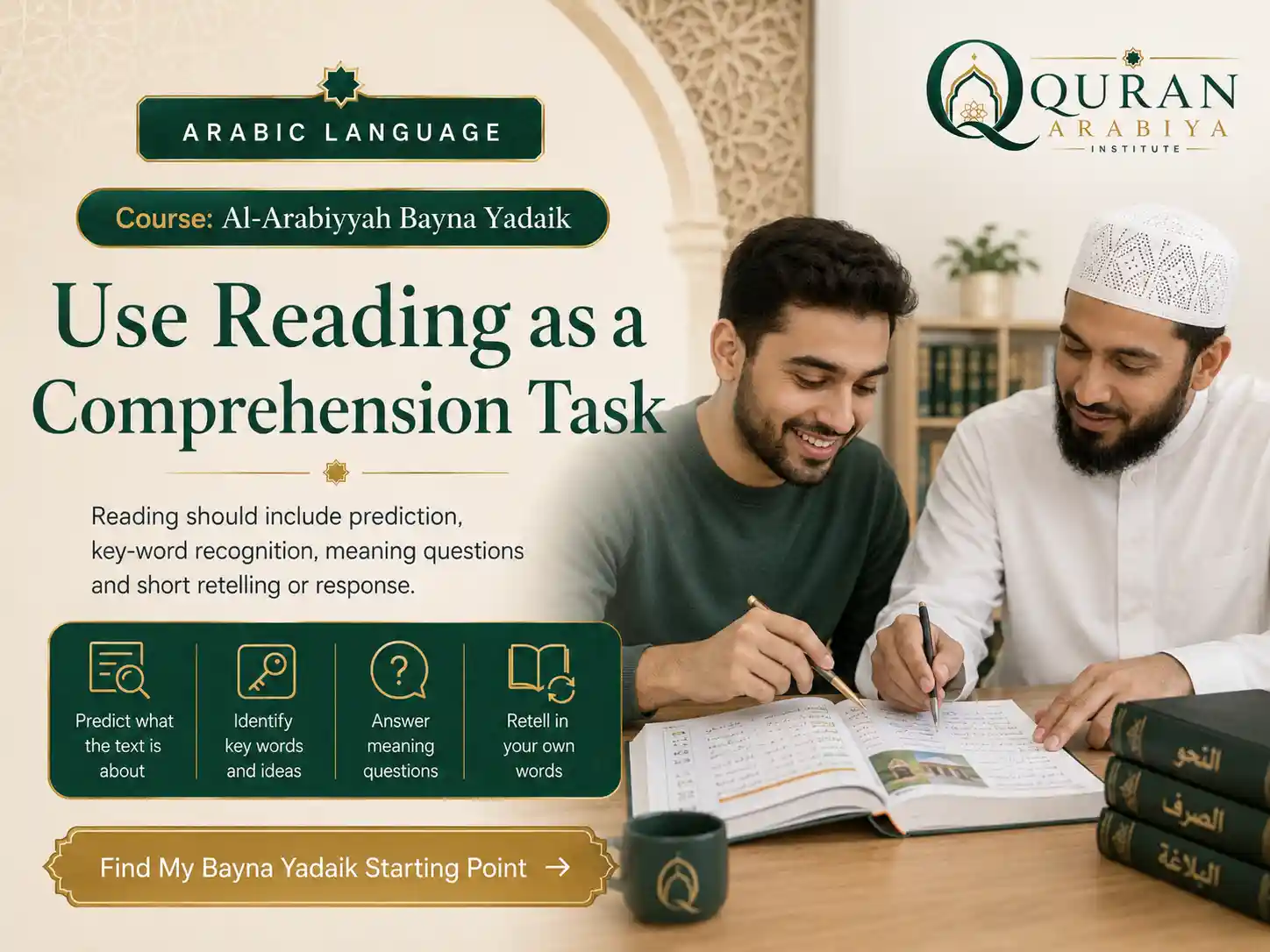
Reading should include prediction, key-word recognition, meaning questions and short retelling or response. The learner is encouraged to understand the text as Arabic rather than using pronunciation as the only success measure.
At higher points in the series, the teacher can ask the learner to identify relationships between sentences, infer vocabulary from context and summarise the central idea.
Written exercises can move from controlled completion to personalised sentences and short paragraphs using the unit’s vocabulary and structures. That forces the learner to retrieve rather than merely recognise.
The teacher can correct the few patterns that matter most, then ask for a revised version so feedback becomes part of the writing process.
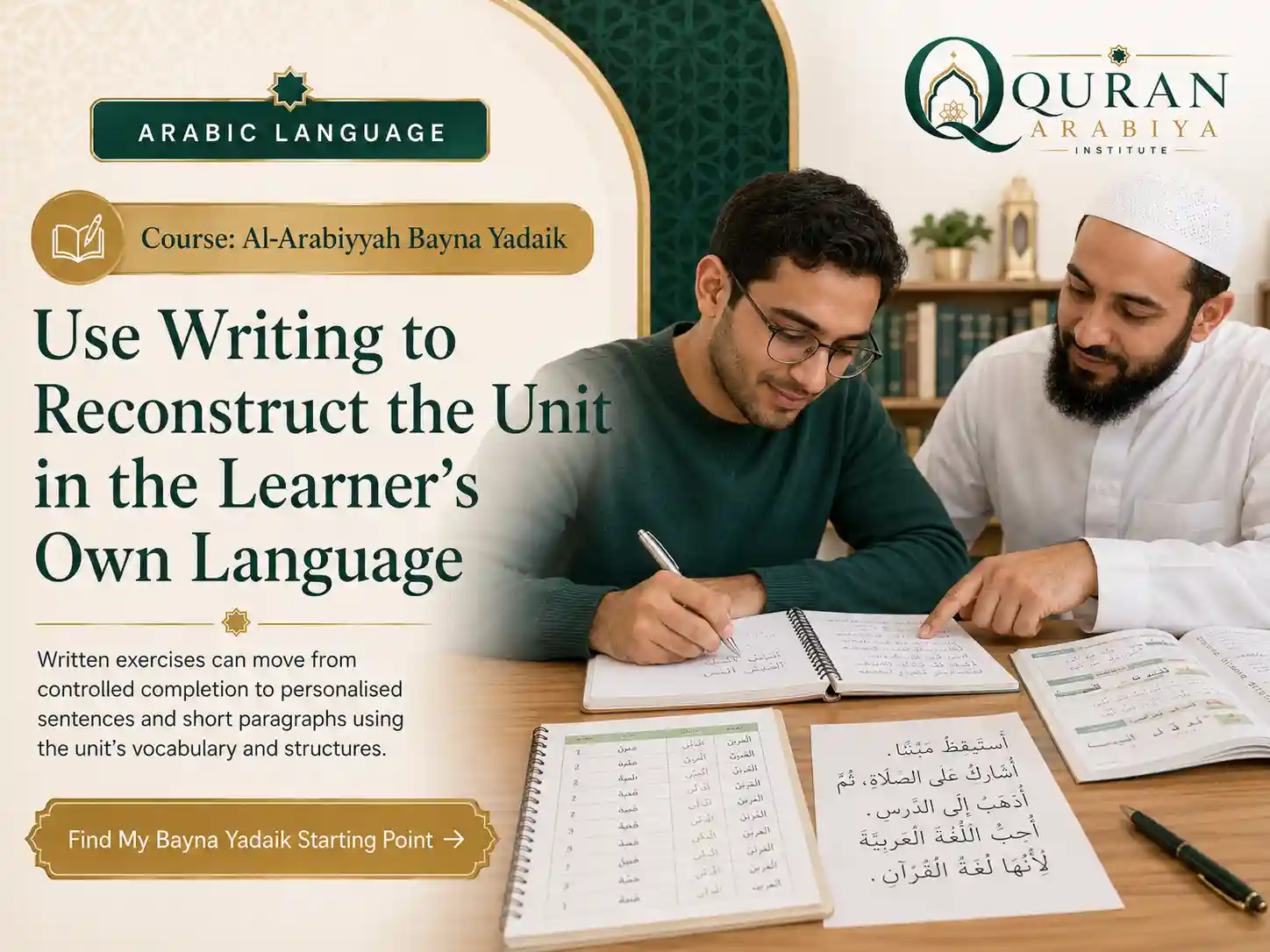
Written exercises can move from controlled completion to personalised sentences and short paragraphs using the unit’s vocabulary and structures. That forces the learner to retrieve rather than merely recognise. The aim is to turn the same language into usable reading, listening, speaking or writing rather than leave it as a completed exercise.
If the book asks a familiar question, the teacher can alter the person, place, time or goal. If a dialogue is about shopping, the learner can role-play a different purchase. If a reading describes one person, the learner can compare it with their own routine.
These small changes show whether the skill can survive outside the exact printed prompt.
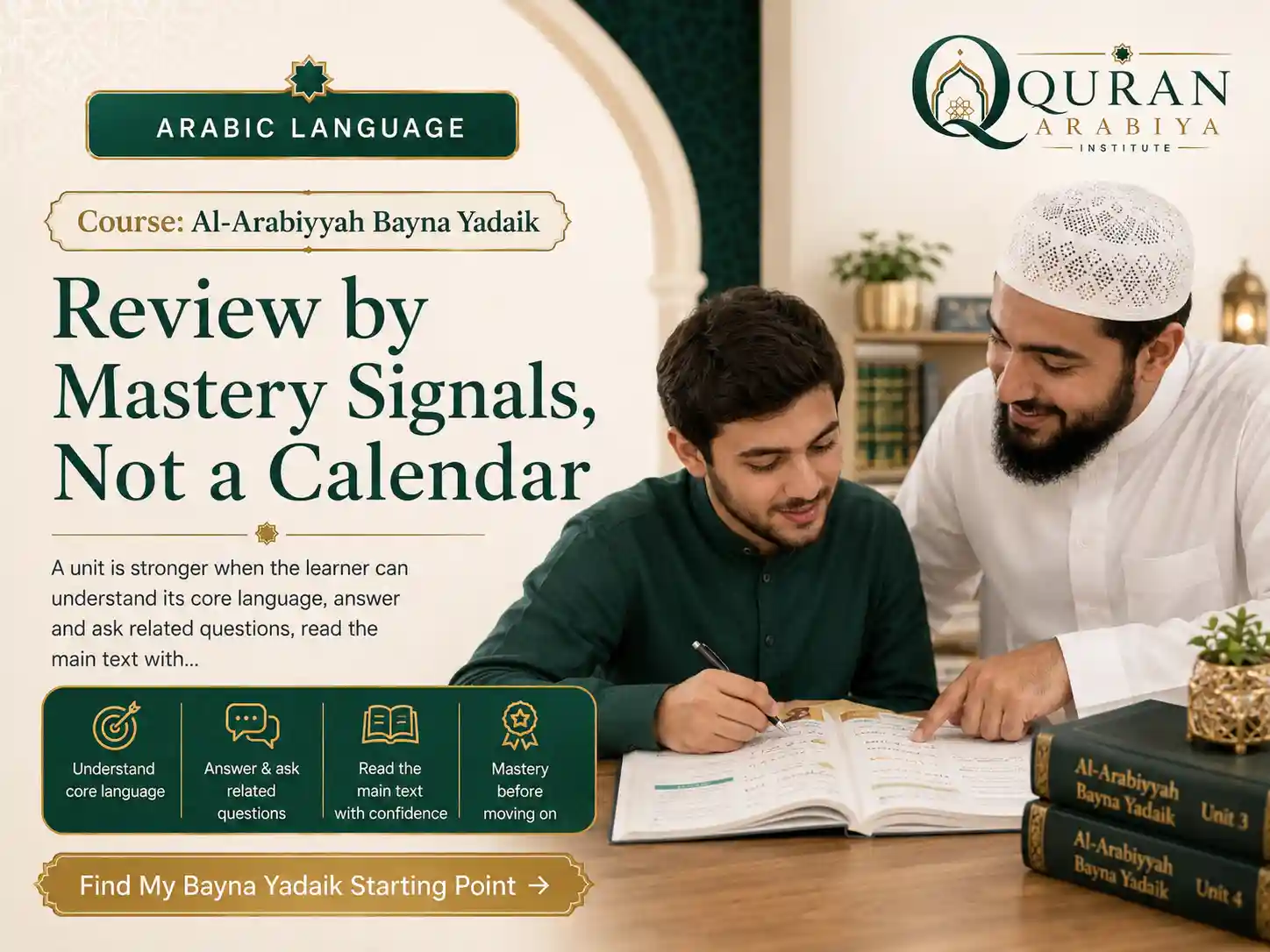
A unit is stronger when the learner can understand its core language, answer and ask related questions, read the main text with comprehension and produce a small written or spoken task using the target patterns.
The exact time required varies by prior Arabic, lesson frequency and practice. That is why Quran Arabiya should not copy another provider’s fixed total duration into this page.
If the book asks a familiar question, the teacher can alter the person, place, time or goal. If a dialogue is about shopping, the learner can role-play a different purchase. The aim is to turn the same language into usable reading, listening, speaking or writing rather than leave it as a completed exercise.
The course suits learners who like a clear textbook path, want balanced Fusha and value communication practice. Learners whose main goal is intensive grammar may prefer the Madinah route; those wanting a different modern communicative series may prefer Al-Takallum.
Complete children may be better served by the kids full track or Al-Arabiyyah Lil-Nashi’in depending on age and learning style.
The trial can establish whether you are ready to work directly with the series and which part of the curriculum best matches your real skills. The teacher can sample reading and a short exchange rather than relying only on previous course names.
You then begin with a clear unit range and a first language goal, not simply “start Book 1” by default.
The course suits learners who like a clear textbook path, want balanced Fusha and.
Use Bayna Yadaik as a living language curriculum, not a page counter. Book a free trial to confirm your entry point and see how the teacher turns the series into active Fusha practice.
It is a structured Arabic curriculum for non-native speakers commonly used to develop Fusha across speaking, listening, reading and writing.
Many providers expect script familiarity. Quran Arabiya should use the trial to confirm whether your reading foundation is strong enough or whether a short literacy bridge is needed first.
No. Communication is a strong feature, but the curriculum also develops reading, writing, vocabulary and grammar.
There is no responsible universal duration. Providers use different lesson lengths, pacing and editions. Your plan should be based on level, frequency and mastery rather than another academy’s timetable.
They emphasise different learning experiences. Bayna Yadaik is strongly communicative and integrated; Madinah is often chosen by learners who want a grammar-heavy classical/Quranic reading route. The trial can help you choose.
The curriculum provides the sequence, but a live teacher can add repetition, explanation, speaking tasks and transfer checks according to your needs.
Yes. A placement sample can identify which language is still active and where a useful restart point should be.
Teens and adults who want a recognised textbook-based Fusha path with strong speaking/listening exposure and balanced reading and writing.
Not automatically. The free assessment can show which skills are already stable and where the first real gap appears, so a returning learner can avoid unnecessary repetition while a beginner receives the foundation that is actually needed.
The balance should follow the course intent and the learner profile rather than force equal time in every lesson. The teacher can reuse the same vocabulary and structures across several skills so one activity strengthens another instead of becoming a disconnected module.
Grammar is used to make Arabic clearer and more accurate at the depth appropriate to this course. If the learner’s main goal becomes advanced Nahw, Sarf, Quranic Grammar or a named classical text, that deeper intent belongs in the Advanced Arabic category.
Yes. A learner may understand much more than they can read or produce, while another may remember the script but little vocabulary. One-to-one placement lets the teacher build from that uneven profile rather than assume that every student labelled “intermediate” has the same strengths.
The trial can sample the skills most relevant to the course, clarify the learner’s goal, previous study and preferred schedule, and identify the first practical target. It is a course-fit step rather than a promise of a fixed completion time or guaranteed fluency level.
Progress should appear in what the learner can do with less prompting, not only in completed units. A useful checkpoint is whether the learner can use the main skill with increasing independence.
If you are considering Al Arabiyyah Bayna Yadaik course online, begin with the language task you actually want Arabic to unlock. The free trial can map the learner’s strongest and weakest skills, then route the plan toward a broad Fusha path, a named curriculum or a specialist skill without forcing every learner through the same sequence.