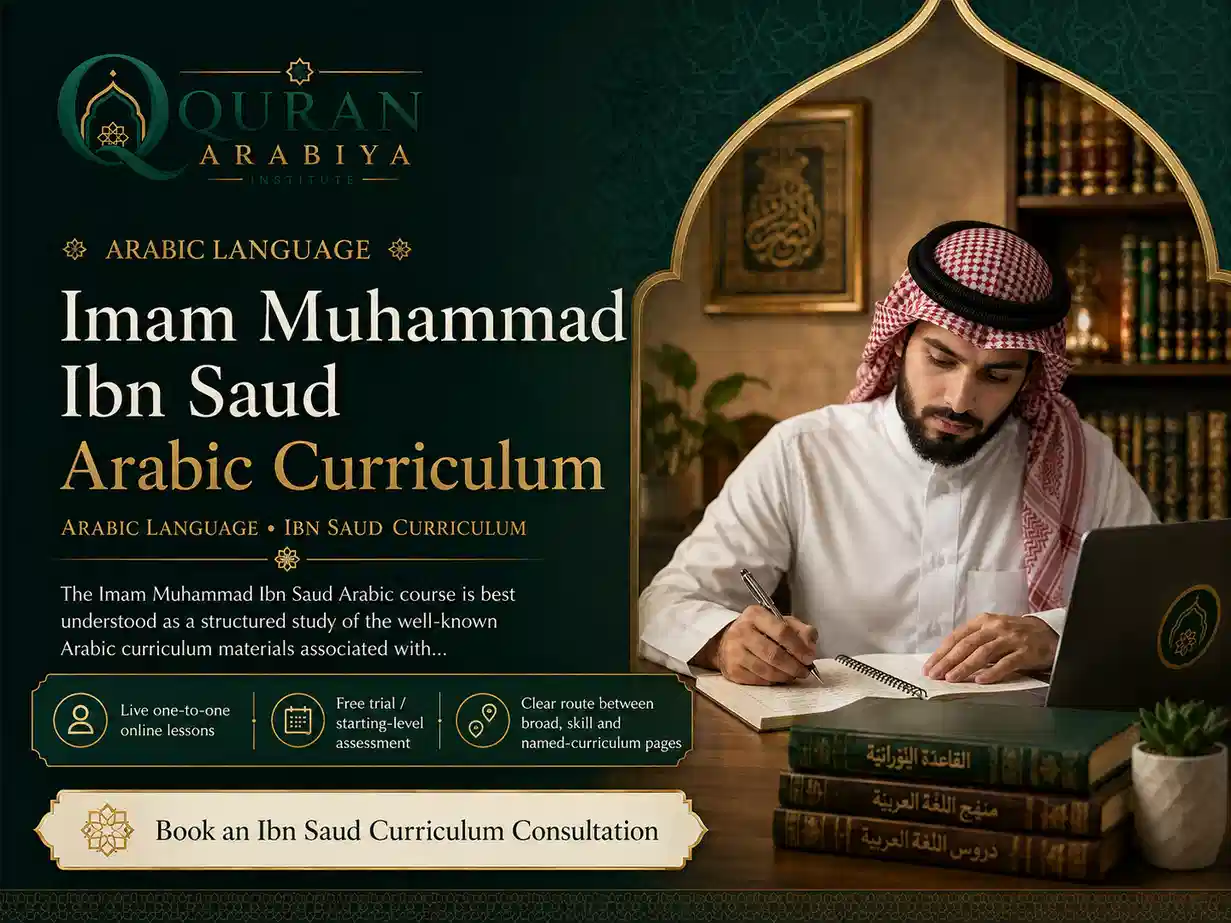
The Imam Muhammad Ibn Saud Arabic course is best understood as a structured study of the well-known Arabic curriculum materials associated with the university, not as a generic “learn Arabic” page. The materials move through reading, vocabulary, expression and language skills and, at later stages, introduce more formal grammar, morphology and text work. Quran Arabiya’s role is to guide the Arabic curriculum with live explanation and correction while keeping language study separate from claims of university affiliation or separate qualifications in Islamic sciences.
You can study the Imam Muhammad Ibn Saud Arabic curriculum with guided one-to-one support from Quran Arabiya. This course is an independent learning route and does not provide an official university degree, diploma or institutional affiliation.
That distinction protects trust and lets the page focus on the real value: a substantial Arabic learning pathway with formal and Islamic-text language contexts.
You can study the Imam Muhammad Ibn Saud Arabic curriculum with guided one-to-one support from Quran Arabiya. This course is an independent learning route and does not provide an official university degree, diploma or institutional affiliation. The aim is to turn the same language into usable reading, listening, speaking or writing rather than leave it as a completed exercise.
Because the materials span several skills and levels, learners should not automatically begin with the same book. A trial can check reading, basic comprehension, vocabulary and prior grammar so the teacher can identify a suitable entry point.
A learner with weak script may need literacy first; a returning learner may be ready for reading/expression or grammar material above the earliest level.
A useful check is whether the learner can reuse the same language with less support in a different task. That transfer matters more than simply recognizing the example that was practised in the lesson.
Early resource indexes include reading and listening components alongside vocabulary and expression. The teacher can use those to strengthen direct comprehension before asking the learner to analyse every sentence grammatically.
Language becomes easier to study when the student can first follow what the sentence is saying.
Because the materials span several skills and levels, learners should not automatically begin with the same book. A trial can check reading, basic comprehension, vocabulary and prior grammar so the teacher can identify a suitable entry. The aim is to turn the same language into usable reading, listening, speaking or writing rather than leave it as a completed exercise.
Early resource indexes include reading and listening components alongside vocabulary and expression. The teacher can use those to strengthen direct comprehension before asking the learner to analyse every sentence grammatically. The aim is to turn the same language into usable reading, listening, speaking or writing rather than leave it as a completed exercise.
Expression material gives the learner a reason to produce Arabic rather than only identify rules. Short answers, descriptions and guided composition can be adapted to the learner’s current vocabulary and gradually become more independent.
The teacher can recycle structures from reading into speaking and writing so “expression” becomes real output, not another written exercise to complete mechanically.
The curriculum includes materials connected to Quranic and Hadith language at different stages. In this course, those texts can build vocabulary, comprehension and formal Arabic sensitivity.
The page should not imply that language exposure replaces Tafsir, Hadith Studies, Aqeedah or Fiqh courses. Those subjects have their own category and teaching objectives.
A useful check is whether the learner can reuse the same language with less support in a different task. That transfer matters more than simply recognizing the example that was practised in the lesson.
Resource indexes show grammar and morphology appearing in later levels. The teacher can connect each rule to material the learner is reading, then use controlled production to confirm understanding.
When a learner’s primary goal becomes deep grammar or morphology rather than progressing through this curriculum, internal links should route to Arabic Grammar, Nahw & Sarf or Advanced Arabic Morphology rather than expanding this page indefinitely.
Later curriculum components include dictation and writing-related work. Dictation can reveal sound-spelling gaps, while short composition shows whether vocabulary and grammar are becoming productive.
Correction should target recurring patterns, followed by rewriting or a new example so feedback is applied rather than simply marked.
Resource indexes show grammar and morphology appearing in later levels. The teacher can connect each rule to material the learner is reading, then use controlled production to confirm understanding. The aim is to turn the same language into usable reading, listening, speaking or writing rather than leave it as a completed exercise.
A broad curriculum can feel like many subjects at once. The teacher can identify one main language objective per stage and choose supporting material that reinforces it, rather than trying to cover every available book equally in every lesson.
This keeps the course coherent and lets the learner see how reading, vocabulary, grammar and expression connect.
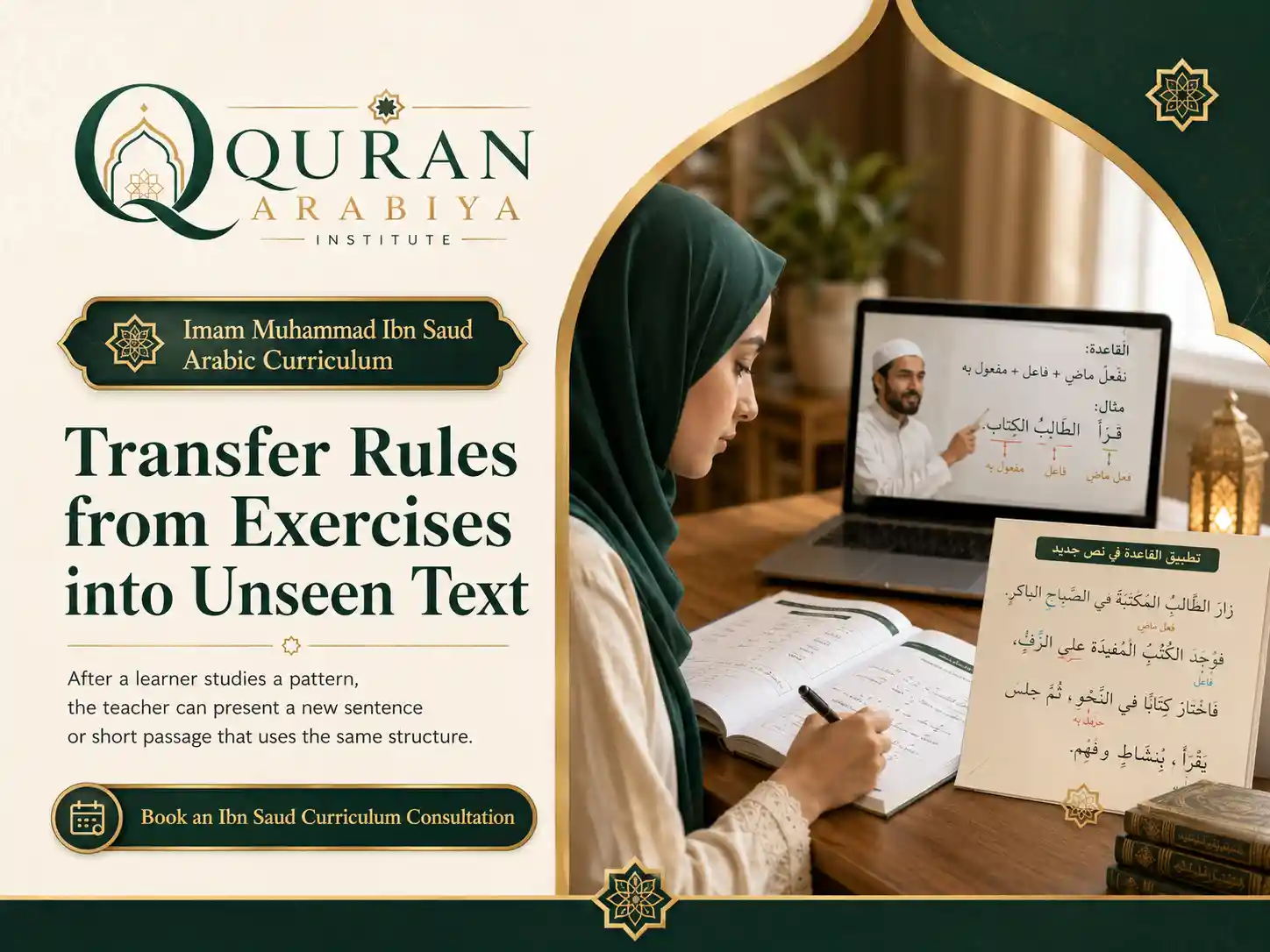
After a learner studies a pattern, the teacher can present a new sentence or short passage that uses the same structure. Recognition in unfamiliar material shows that the rule has become a reading tool rather than a memorised answer key.
Production can then confirm the other direction: can the learner create a correct example without copying?
A broad curriculum can feel like many subjects at once. The teacher can identify one main language objective per stage and choose supporting material that reinforces it, rather than. The aim is to turn the same language into usable reading, listening, speaking or writing rather than leave it as a completed exercise.
After a learner studies a pattern, the teacher can present a new sentence or short passage that uses the same. Recognition in unfamiliar material shows that the rule has become a reading tool rather than a memorised answer key. The aim is to turn the same language into usable reading, listening, speaking or writing rather than leave it as a completed exercise.
The curriculum’s later materials touch areas such as grammar, morphology, literature, rhetoric and Islamic subjects. Quran Arabiya should use those as signposts, not reasons for one URL to absorb every specialist intent.
If the learner wants deep Balagha, classical text reading, Fiqh or Hadith, the corresponding dedicated course can provide the next focused pathway.
It is a strong fit for learners who want a structured, formal Arabic path and value Islamic-text contexts. Learners whose priority is everyday communication may prefer Bayna Yadaik or Al-Takallum; learners who want a lighter general MSA entry may prefer the MSA Beginners course.
Fit should be based on the goal and current level rather than prestige of the curriculum name.
The trial can sample reading and language production, review any books you previously studied and clarify whether your goal is formal Arabic, Quranic vocabulary or later advanced grammar.
The teacher can then recommend a starting component and a first measurable language target without making unsupported claims about university certification.
Study the Ibn Saud curriculum for what it can genuinely give you: structured Arabic language development through a rich set of materials. Book a free trial to identify the right entry point and keep your path language-focused and clear.
Published resource indexes show reading, listening, handwriting, vocabulary/dictionary work, expression, Quran-related lessons and, at later stages, grammar, morphology, dictation and additional formal/Islamic-text material.
No. The materials include early levels, but placement should determine whether your script and comprehension are ready for the chosen entry point.
They appear in later parts of the published curriculum. Deep specialist Nahw or morphology study remains available in separate Advanced Arabic courses.
The wider curriculum materials may include Islamic-text subjects, but this page should remain an Arabic language course. Dedicated Fiqh and Hadith courses are separate.
Both attract serious formal-Arabic learners, but they are different published curricula with different multi-book structures. Placement and learning goals should guide the choice.
Yes. Reviewing the exact materials you studied is useful for deciding where the guided course should begin.
Teens and adults who want a serious, multi-book Arabic curriculum with formal language and increasing exposure to Quran/Hadith-related vocabulary and grammar.
Not automatically. The free assessment can show which skills are already stable and where the first real gap appears, so a returning learner can avoid unnecessary repetition while a beginner receives the foundation that is actually needed.
The balance should follow the course intent and the learner profile rather than force equal time in every lesson. The teacher can reuse the same vocabulary and structures across several skills so one activity strengthens another instead of becoming a disconnected module.
Grammar is used to make Arabic clearer and more accurate at the depth appropriate to this course. If the learner’s main goal becomes advanced Nahw, Sarf, Quranic Grammar or a named classical text, that deeper intent belongs in the Advanced Arabic category.
Yes. A learner may understand much more than they can read or produce, while another may remember the script but little vocabulary. One-to-one placement lets the teacher build from that uneven profile rather than assume that every student labelled “intermediate” has the same strengths.
The trial can sample the skills most relevant to the course, clarify the learner’s goal, previous study and preferred schedule, and identify the first practical target. It is a course-fit step rather than a promise of a fixed completion time or guaranteed fluency level.
Progress should appear in what the learner can do with less prompting, not only in completed units. A useful checkpoint is whether the learner can use the main skill with increasing independence.
If you are considering Imam Muhammad Ibn Saud Arabic course, begin with the language task you actually want Arabic to unlock. The free trial can map the learner’s strongest and weakest skills, then route the plan toward a broad Fusha path, a named curriculum or a specialist skill without forcing every learner through the same sequence.