The Arabic alphabet for Quran reading is more than a list of letters to memorize. A beginner must recognize a letter when it changes position, connect its shape to the right sound, distinguish it from look-alike letters, read it with Harakat, and know whether it joins to the next letter. This focused foundation course isolates those skills so the learner can enter a full reading method without carrying basic script confusion forward.
Many beginners can recite “Alif, Ba, Ta…” yet freeze when one of those letters appears alone on a page in random order. That means the alphabet has been memorized as a sequence, not recognized as a reading system.
The course deliberately mixes the order and presentation. A learner should be able to point to a letter, name or sound it, and distinguish it from close alternatives without using the previous letter as a clue.
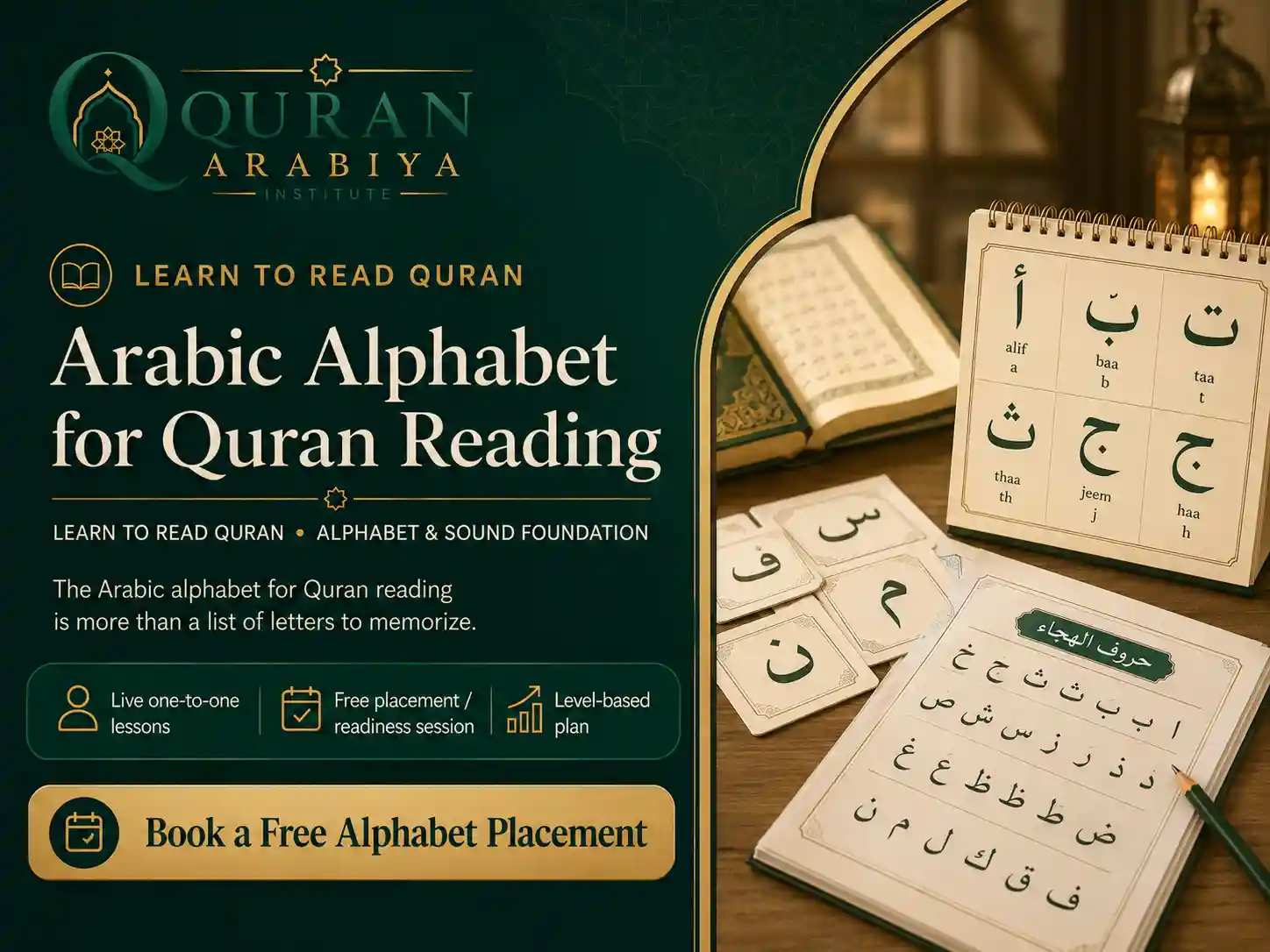
Start by recognizing Arabic letters in mixed order rather than reciting the alphabet sequence. In live one-to-one practice, the teacher changes order, font and neighbouring shapes so the learner must identify the letter itself. This stage is ready when the learner can name or sound the letter without using the previous symbol as a clue.
Letter names are useful labels; Quran letter pronunciation requires producing the sound that actually enters a word. The teacher can model difficult sounds, compare close pairs and correct the mouth or tongue position at a beginner-appropriate level.
This does not replace a specialist Makharij course. The purpose here is practical: build a clean enough sound map that the student is not decoding the correct letter with a completely different sound.
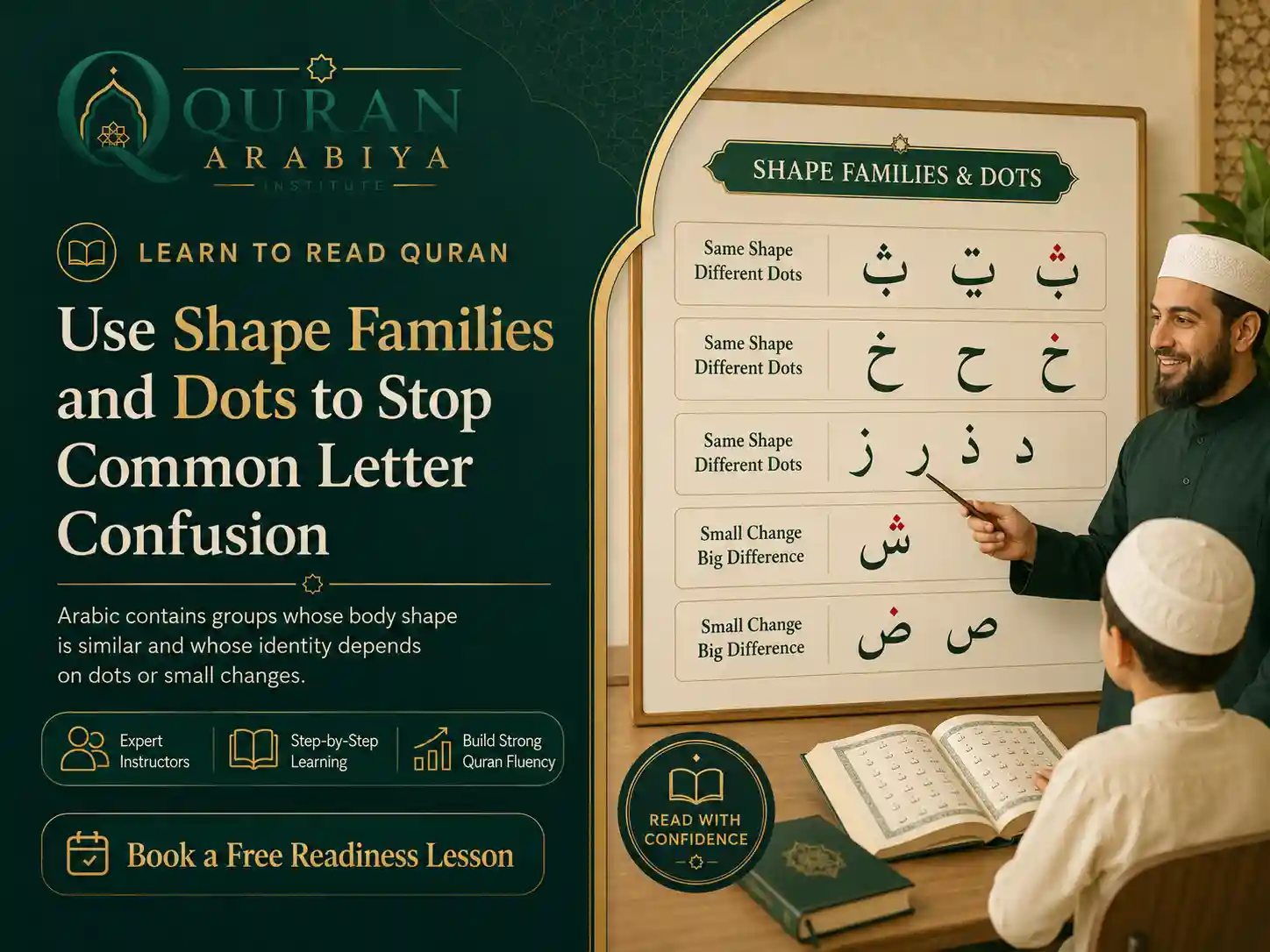
Arabic contains groups whose basic body shape looks similar and whose identity depends on dots or small changes. Studying those families together helps learners notice the feature that matters instead of treating every form as unrelated.
Mixed visual checks are important. The student should identify the letter when fonts, neighboring letters or position change, because that is closer to what happens in real Quranic reading.
Arabic letters change appearance according to position. A learner who knows only isolated forms may believe a familiar letter has “disappeared” inside a connected word. The course therefore builds recognition across the common positional forms before asking for longer reading.
The aim is automatic recognition, not memorizing four disconnected charts. The teacher shows how the core shape is preserved and then checks it inside simple connected examples.
Harakat and Arabic letters work together to create the short sounds the beginner needs for early decoding. Fatha, Kasra and Damma should be read accurately enough that the student no longer supplies a vowel from memory or from what they expect the word to be.
Short contrast drills help: same letter, different Harakah; same Harakah, different letter. That keeps both the symbol and the sound active.
Start by separating letters that share a similar body shape. In live one-to-one practice, the teacher groups the family together and directs attention to dots and small visual differences instead of memorizing unrelated charts. This stage is ready when the learner identifies the correct letter even when neighbouring letters or print style changes.
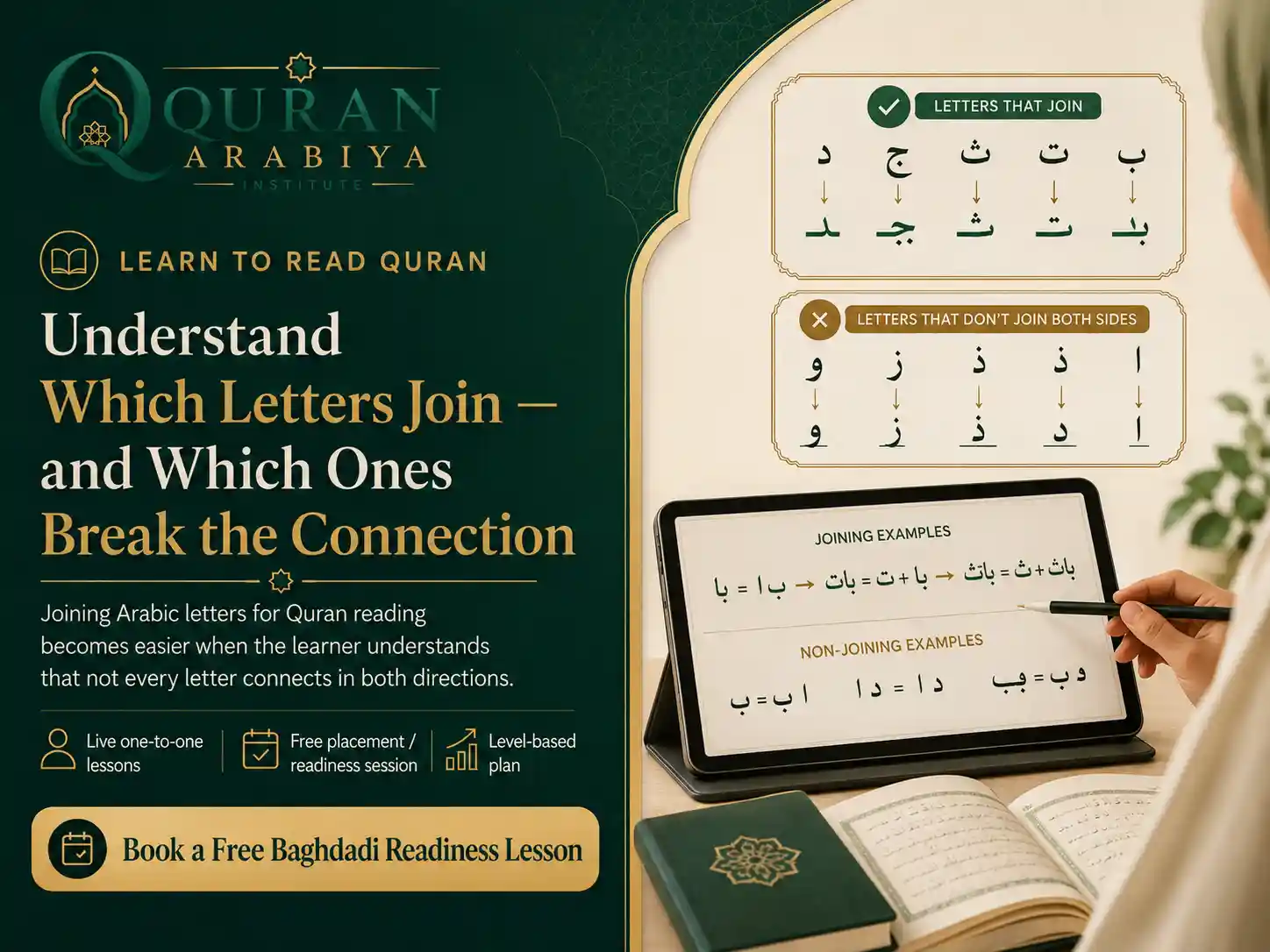
Joining Arabic letters for Quran reading becomes much easier when the student understands that not every letter connects in both directions. This is a visual reading rule, not merely handwriting knowledge.
Learners practise two- and three-letter combinations so they can see where a connection continues, where it stops, and how the next letter begins. That reduces hesitation when they later meet real words.
Once letters, forms and short vowels are stable, the next checkpoint is combining them without spelling everything out indefinitely. The student reads small units, then short combinations, while the teacher watches for guessing or loss of pronunciation.
This is the boundary of the course: enough blending to prove the alphabet foundation is usable, but not a full Qaida or Mushaf curriculum.
Recognize letters without relying on alphabet sequence.
Readiness means more than “I finished the chart.” The learner should recognize letters in mixed order, distinguish common visual confusions, produce the taught sounds reasonably, read short vowels, follow basic joining patterns and blend simple combinations with decreasing help.
If one of those skills is still unstable, the teacher can target that gap instead of restarting the whole alphabet. If the checkpoint is passed, the student can move into the reading method that best fits their goal.
During the free trial, a complete beginner can start with simple recognition and sound tasks. A returning learner can be checked on only the letters, forms or vowels that still create mistakes. That makes the lesson useful even when the student has partial knowledge.
The teacher can then recommend whether the next stage should be a Quran Arabic alphabet course continuation, a named Qaida route, or the broader beginner Quran reading course.
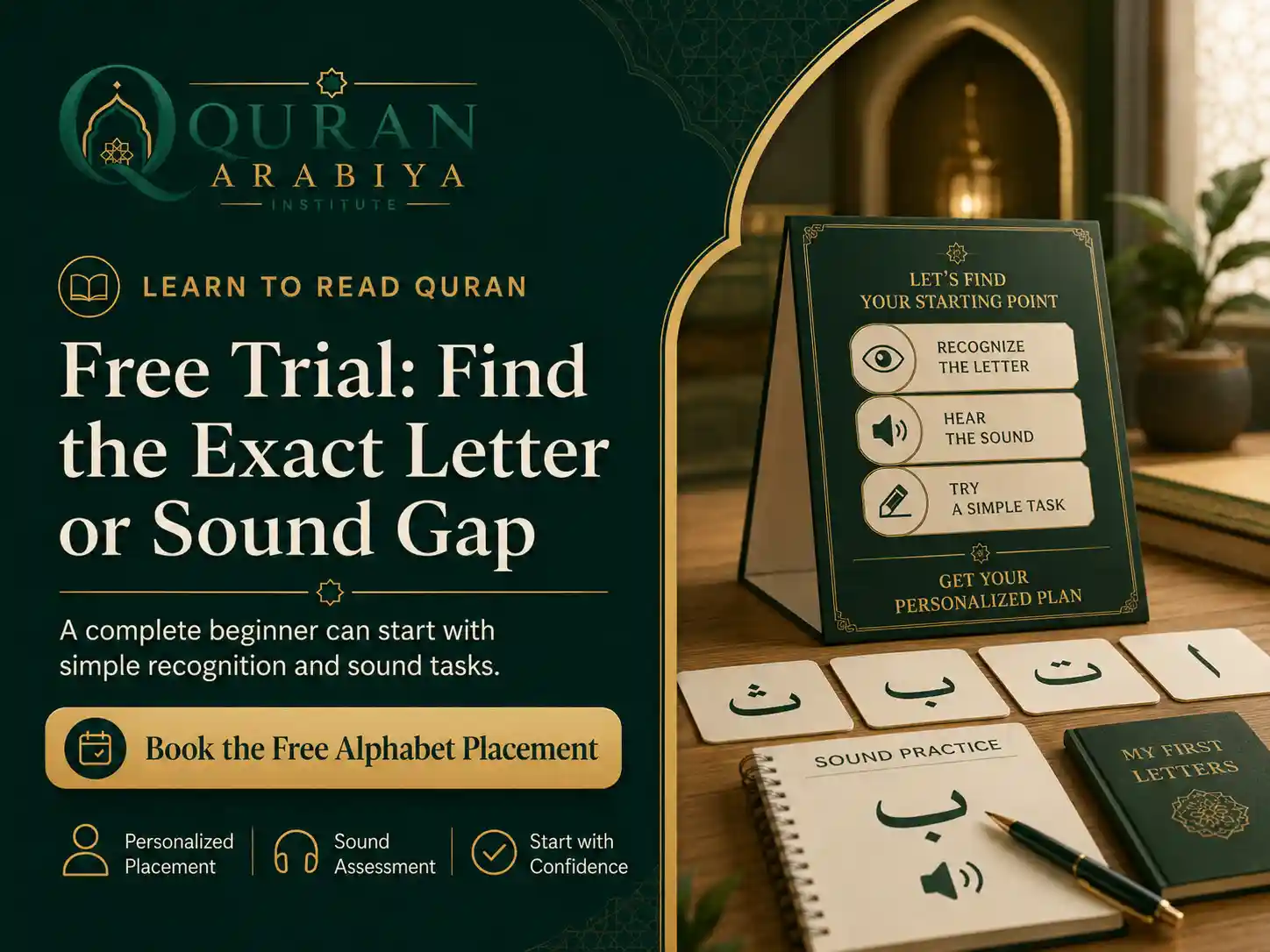
Build the script foundation before asking yourself to read long Quranic words. Book a free trial to identify exactly which letters, forms, vowels or joining patterns need attention.
The focus is letter recognition, basic sounds, connected forms, short vowels, joining patterns and early blending. It stops before a full Quran-reading or Tajweed syllabus.
That varies by first language, but learners often need extra correction for unfamiliar throat and emphatic sounds and extra visual practice for letters that share a similar shape.
The teacher models the sound, listens to the learner, isolates the difficult articulation when needed, then puts the sound back into a simple letter-vowel or word pattern.
Letters are introduced first, then short vowels are layered onto a stable set. The exact pacing can overlap, but the learner should not be overloaded with too many new variables at once.
Because a letter may look different inside a word. Recognizing connected forms is necessary before the learner can decode even simple Quranic words.
No. The alphabet is the foundation. You will still need a structured reading method and guided transition into Quranic text.
Not necessarily. Simple tracing or writing can support visual memory for some learners, but the primary goal of this course is reading recognition and sound production.
The letter name identifies the symbol, while reading requires producing the sound that enters a word. The course makes that distinction explicit so a learner does not recognize the right letter but pronounce it with an unrelated substitute.
Mixed-order recognition shows whether the learner truly identifies the symbol rather than reciting a memorized alphabet sequence. It also prepares the eye for real words, where letters appear without the previous letter acting as a clue.
They can at first, especially when a learner has memorized one printed form. The teacher can gradually vary presentation and connected position so the learner notices the stable identity of the letter instead of one exact shape.
Use the same small set of letters, sounds or Harakat that the teacher assigned rather than introducing many new items. Short recognition games and careful repetition can reinforce the lesson without turning home practice into a second curriculum.
The learner should recognize letters in mixed order, handle common connected forms, read the main short vowels and blend simple combinations with decreasing help. The teacher can then recommend the most suitable reading method.
Yes. The underlying foundation is the same, but explanation, examples and pace can be presented in an adult-appropriate way. One-to-one teaching makes it easier to keep the lesson direct and respectful.
Yes. Share that the learner is at the script-foundation stage during matching. The academy can consider level, age, schedule and teacher preference when discussing the most suitable available teacher.
If you are considering Arabic alphabet for Quran reading, start with a live assessment rather than choosing a level by guesswork. The teacher can confirm the first useful skill, the best-fit route and the next step without making promises that depend on individual progress.