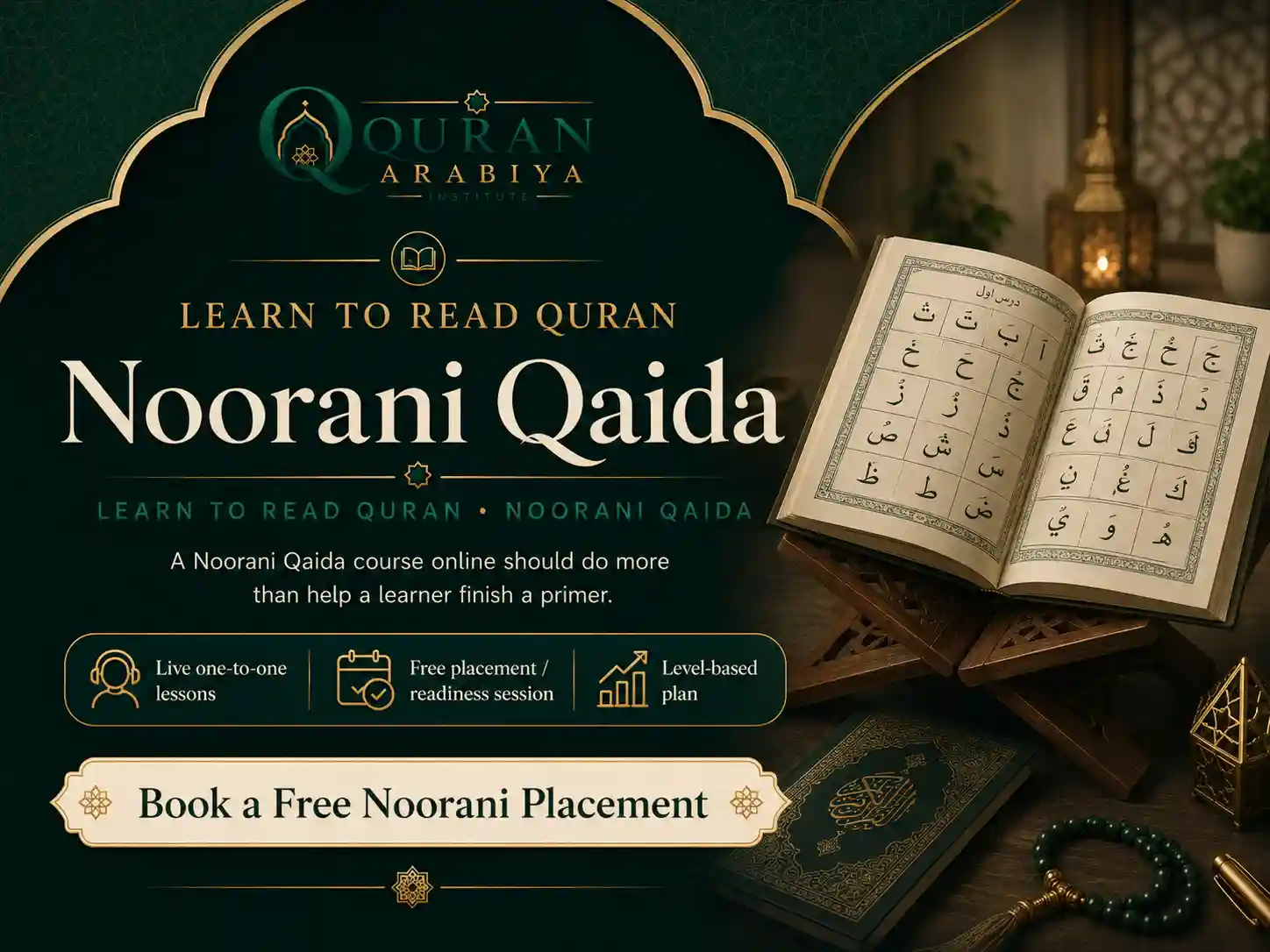
A Noorani Qaida course online should do more than help you finish a primer. Its real job is to connect Arabic symbols to accurate Quran-oriented sounds so that a new pattern can be read even when the learner has never seen that exact word before. Quran Arabiya Institute uses live one-to-one correction and a free placement lesson to identify whether the learner is starting from letters, connected forms, vowel patterns or the transition into Quranic text.
Noorani Qaida for beginners works best when each new reading pattern is built on one that is already usable. Moving ahead because a page has been “covered” can hide weak recognition or pronunciation that becomes harder to correct later.
The teacher therefore checks both recognition and production: can the learner see the pattern, read it, pronounce it, and repeat the same skill in a different example?
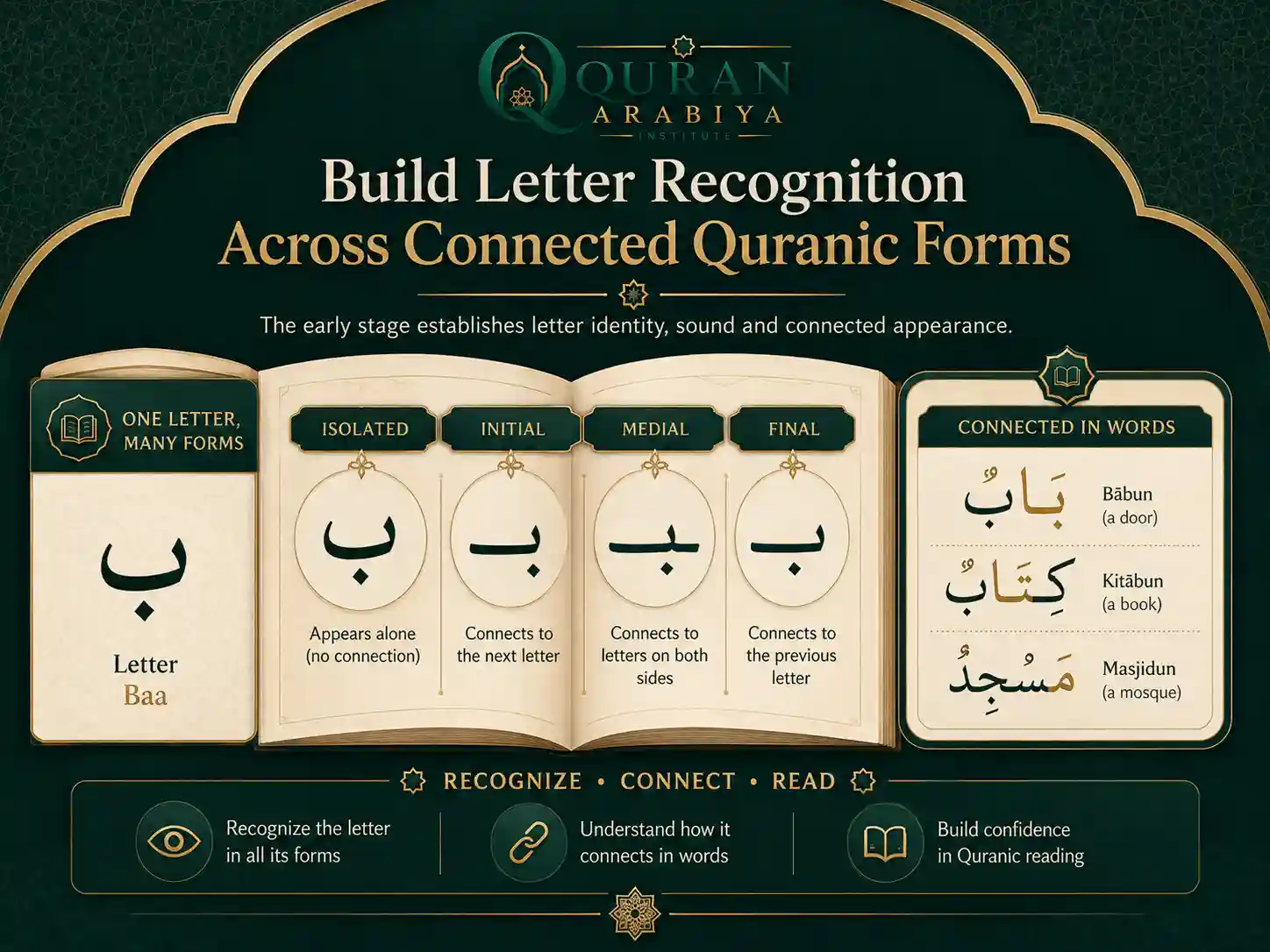
Start by building letter identity, connected forms and accurate Quran-oriented sounds. In live one-to-one practice, the teacher contrasts similar letters and repairs difficult sounds before the learner is asked to decode longer combinations. This stage is ready when the learner recognizes the correct form and produces the target sound in a fresh example.
The early stage establishes letter identity, sound and connected appearance. Similar letters are contrasted, and difficult sounds receive focused correction before the learner is asked to decode longer combinations.
The goal is not alphabet recitation. It is recognizing the correct letter when it appears in the visual forms that Quran reading actually requires.
As the foundation stabilizes, the course adds common reading signs in a controlled order. Short vowels establish basic syllable reading; Tanween, long-vowel patterns, Sukoon and Shaddah add new timing and combination demands.
Each step should reuse earlier material. A learner is not only learning a new sign; they are learning to keep the old skills working while the word becomes more complex.
A Noorani Qaida with Tajweed approach can introduce pronunciation habits and selected recitation patterns at the point they become useful. The teacher corrects the sound inside the actual reading pattern rather than asking a beginner to memorize a large theory list first.
Deeper rule terminology and advanced application remain for the dedicated Tajweed courses. Here, Tajweed supports accurate reading rather than taking over the page’s intent.
Self-study can show the learner what a symbol is supposed to sound like, but it cannot reliably hear whether the learner produced a close substitute. In Noorani Qaida classes online, the teacher can stop at the exact sound, model it, ask for a smaller unit, and then return to the word.
That feedback loop is especially valuable for non-Arabic speakers whose first language does not contain several Arabic sound contrasts.
Start by proving that a studied Noorani pattern is recognized outside the familiar exercise. In live one-to-one practice, the teacher changes the order or presents the same sign with a new letter before giving any model. This stage is ready when the learner reads the pattern correctly without being told what it says first.
Connect each printed form to a stable Quran-oriented sound.
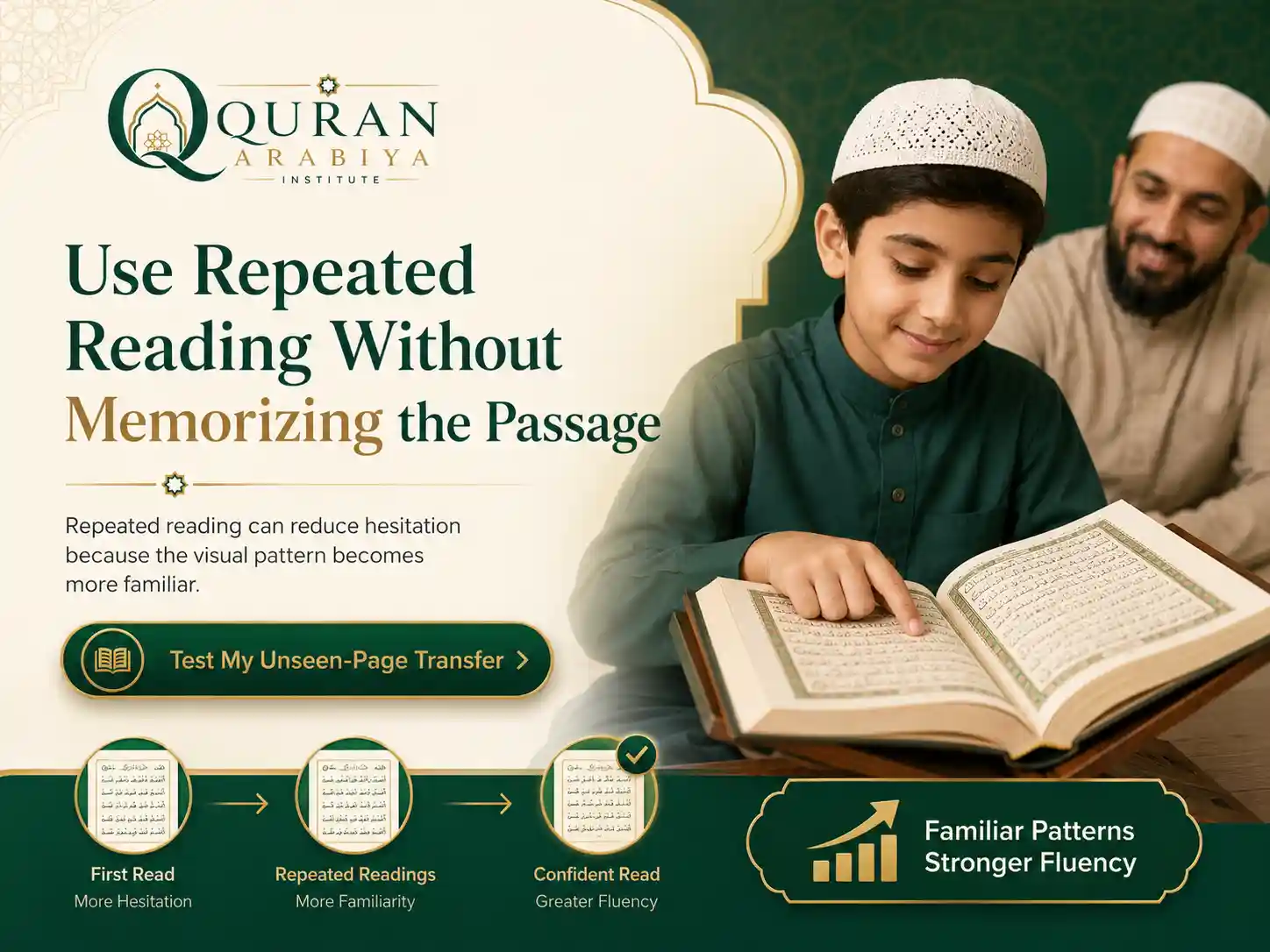
Repetition is necessary, but repeated familiarity can disguise guessing. Before advancing, the teacher can change the order, present a fresh example or combine the same sign with a different letter.
If the learner reads it correctly without being told first, the skill is transferring. If not, the class returns to the smallest unstable part instead of simply assigning more pages.
Learning to read the Qaida and learning to read the Mushaf are connected but not identical. Quranic pages are visually denser and less graded. The course therefore needs a bridge rather than a sudden jump.
Short Quranic passages can be introduced while the teacher controls the amount of difficulty, points out only what is necessary, and gradually reduces support as the learner becomes more independent.
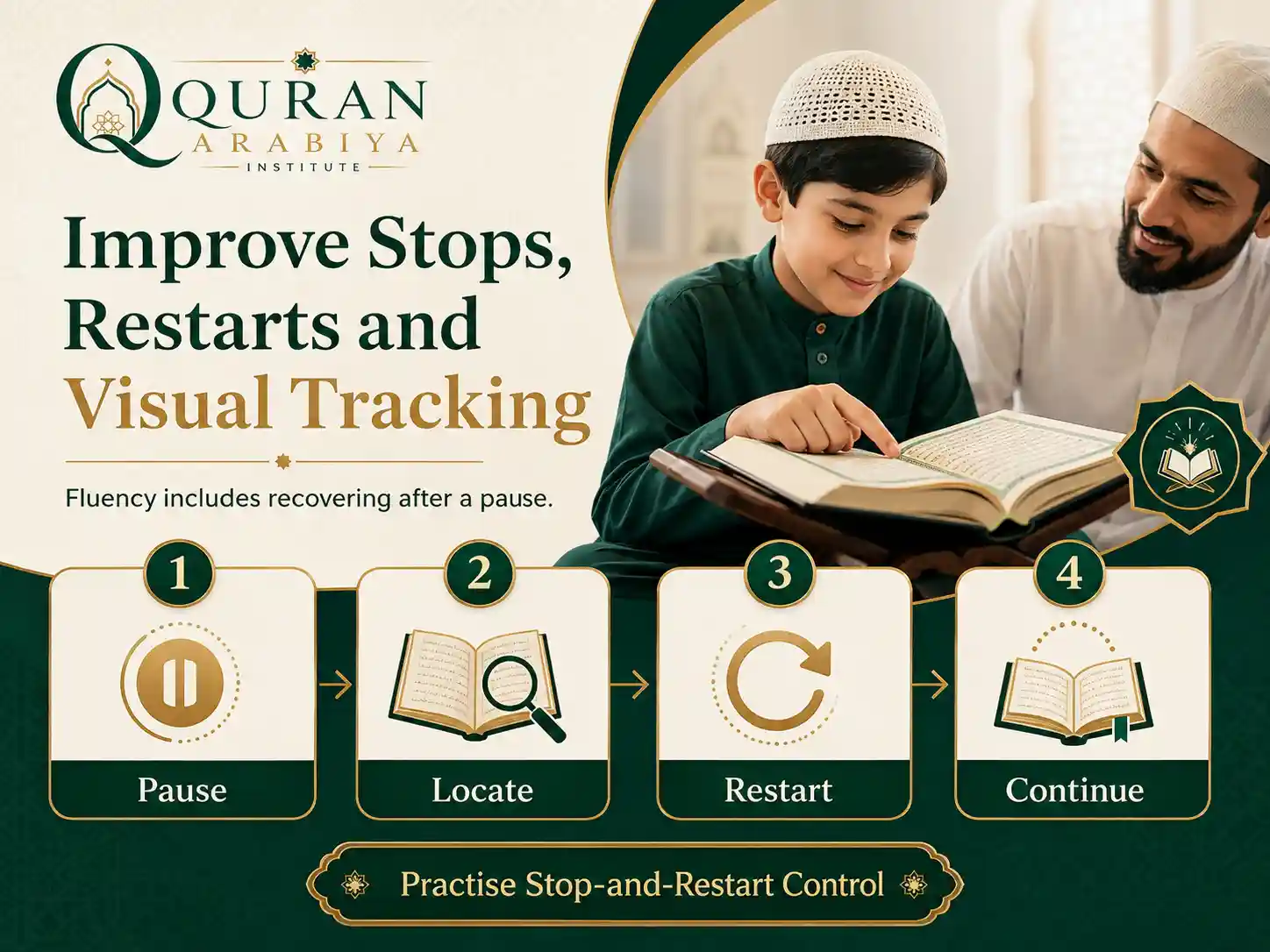
The sequence can serve different ages, but the presentation should change. Children may need shorter tasks and visual variety; adults usually want clear reasons for each pattern; returning learners may need only a few repaired stages rather than a full restart.
A free assessment helps decide which part of the Qaida Noorania course is actually relevant to the learner today.
The Arabic Alphabet page is narrower and ends before a full method. Noorani Qaida is strongly Quran-reading focused. Noor Al Bayan can be used as a broader phonics/literacy route. Baghdadi has its own more analytical oral spelling tradition.
No method needs to “win” universally. The useful question is which method matches the learner’s current gap, goal and response to instruction.
If you want to learn Noorani Qaida online, the free trial can check the exact starting point: letters, connected forms, vowel patterns, complex signs or Mushaf transfer. The learner then receives a more realistic next-step recommendation.
This prevents both unnecessary repetition and premature advancement.
Build a Quran-reading foundation that transfers beyond the workbook. Book a free Noorani Qaida placement lesson and start at the first skill that still needs to become stable.
Yes. The method can be taught to adults with age-appropriate explanation and private correction rather than child-oriented presentation.
The Noorani page follows one named method and its sequence. The general beginner page owns the broader zero-to-Mushaf journey and can recommend different methods after assessment.
Yes, it can begin from the letters. A learner who already knows part of the foundation can start later after placement.
You can review material independently, but live correction is valuable for sound accuracy, guessing, connected forms and confirming that skills transfer to new examples.
No. It can build early recitation habits and introduce selected patterns, while a dedicated Tajweed course goes deeper into rule knowledge and sustained Quran recitation.
There is no responsible universal duration. Age, previous exposure, pronunciation, lesson frequency and practice all affect the pace.
You should be able to decode the studied patterns in unfamiliar examples, maintain basic sound contrasts and read short Quranic passages with a manageable amount of prompting.
The placement lesson can check which patterns are still usable and which have become unstable. You can begin at the first missing skill rather than repeating the entire book simply because some time has passed.
The teacher changes the order, uses unfamiliar combinations and asks the learner to read the same pattern in a new example. Transfer is more important than recognizing a line that has already been repeated many times.
Only the pronunciation habits and selected rules that support accurate beginner reading should be introduced. Detailed Tajweed terminology and sustained rule study belong to the specialist Tajweed courses after reading is stable enough.
Yes. Adults can follow the same sound-to-script progression with concise explanation, private correction and age-appropriate examples. Placement can also prevent unnecessary repetition of stages that are already secure.
Practise the exact pattern that was corrected in class and include one or two fresh examples so you are not only memorizing the page. A small amount of accurate practice is more useful than rushing through new material.
Move when the studied patterns can be decoded in unfamiliar examples and short Quranic passages with manageable prompting. The transition should be guided rather than assuming book completion automatically creates independent Mushaf reading.
Yes. Mention the Noorani method specifically during teacher matching, together with the learner’s age, current stage, time zone and teacher preference, subject to current availability.
If you are considering Noorani Qaida course online, start with a live assessment rather than choosing a level by guesswork. The teacher can confirm the first useful skill, the best-fit route and the next step without making promises that depend on individual progress.