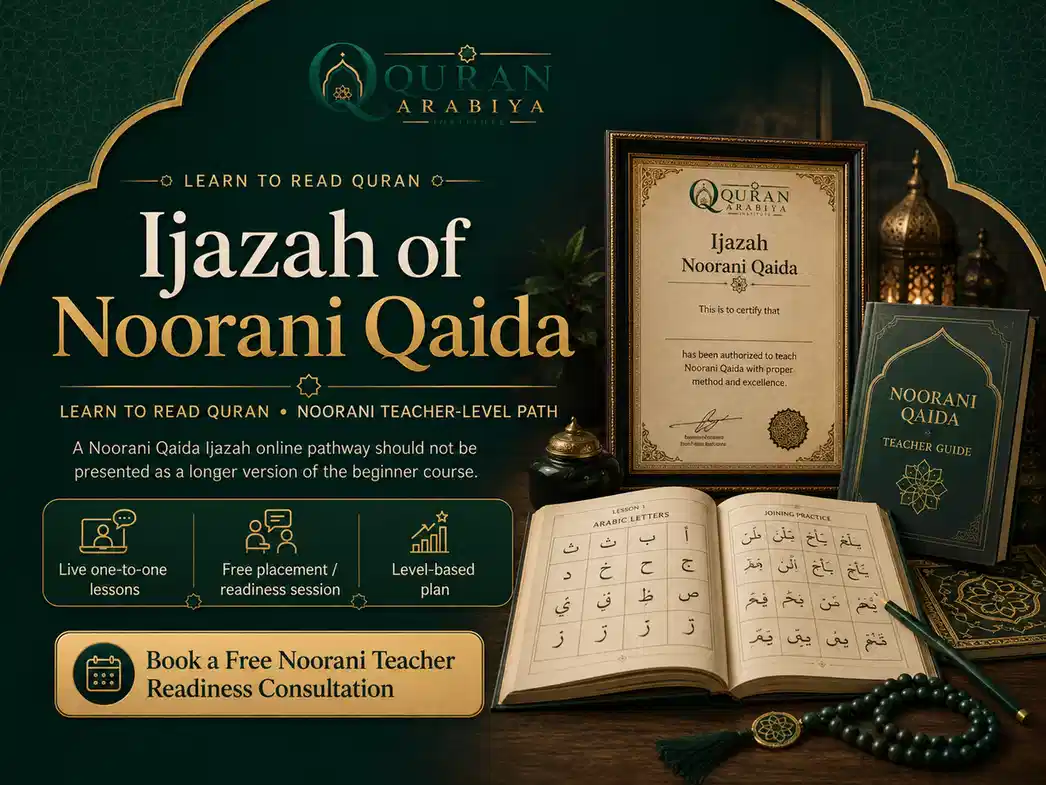
A Noorani Qaida Ijazah online pathway should not be presented as a longer version of the beginner course. A teacher-level candidate needs to know the method as a system: why one stage precedes another, how to hear and diagnose a beginner’s error, how to correct it without creating dependence, and how to decide whether the learner should advance or review. Quran Arabiya Institute can use the free readiness consultation to determine whether the candidate needs foundation repair, method review or true teacher-level assessment.
The beginner Noorani page teaches the learner to read. This page serves a different intent: method mastery for someone preparing to teach, demonstrate or seek formal authorization in the Qaida.
A candidate who still struggles with the underlying reading patterns should strengthen personal recitation first. Teaching methodology cannot compensate for unstable reading.
Start by mastering the Noorani sequence as a teaching system rather than a set of pages. In live one-to-one practice, the teacher asks the candidate to explain why one stage precedes another and what learner skill each exercise is designed to build. This stage is ready when the candidate can choose the correct next step without relying on page order alone.
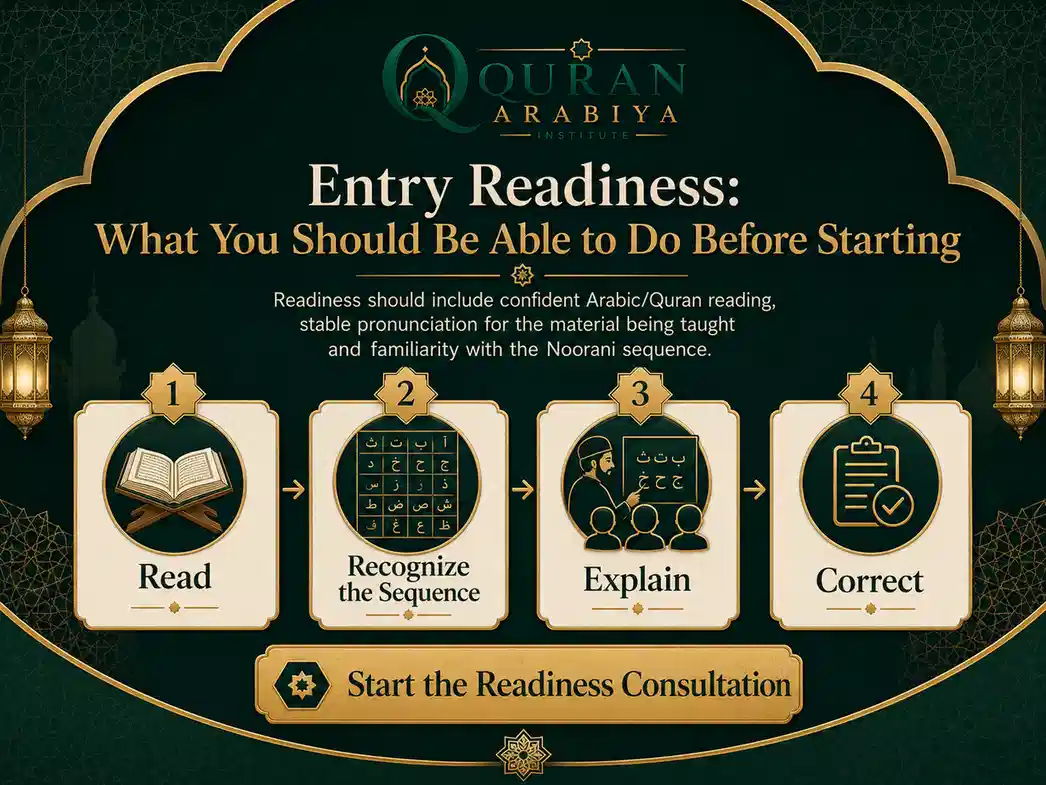
Readiness should include confident Arabic/Quran reading, stable pronunciation for the material being taught and familiarity with the Noorani sequence. The exact threshold belongs to the teacher who will supervise the program.
The free consultation can include a reading sample, selected Qaida patterns and short questions about how the candidate would explain or correct them.
A Noorani Qaida teaching course should not produce a teacher who can only say “repeat this line.” The candidate needs to understand what reading skill each stage is building and what earlier skill it assumes.
That allows the future instructor to teach different learners without becoming trapped by page numbers or one memorized script.
A useful teacher can distinguish a recognition problem from a pronunciation problem, a vowel-reading problem from a joining problem, and genuine decoding from memorized repetition.
The training should include error samples or live learner patterns so the candidate practises naming the likely cause and selecting a correction task that targets it.
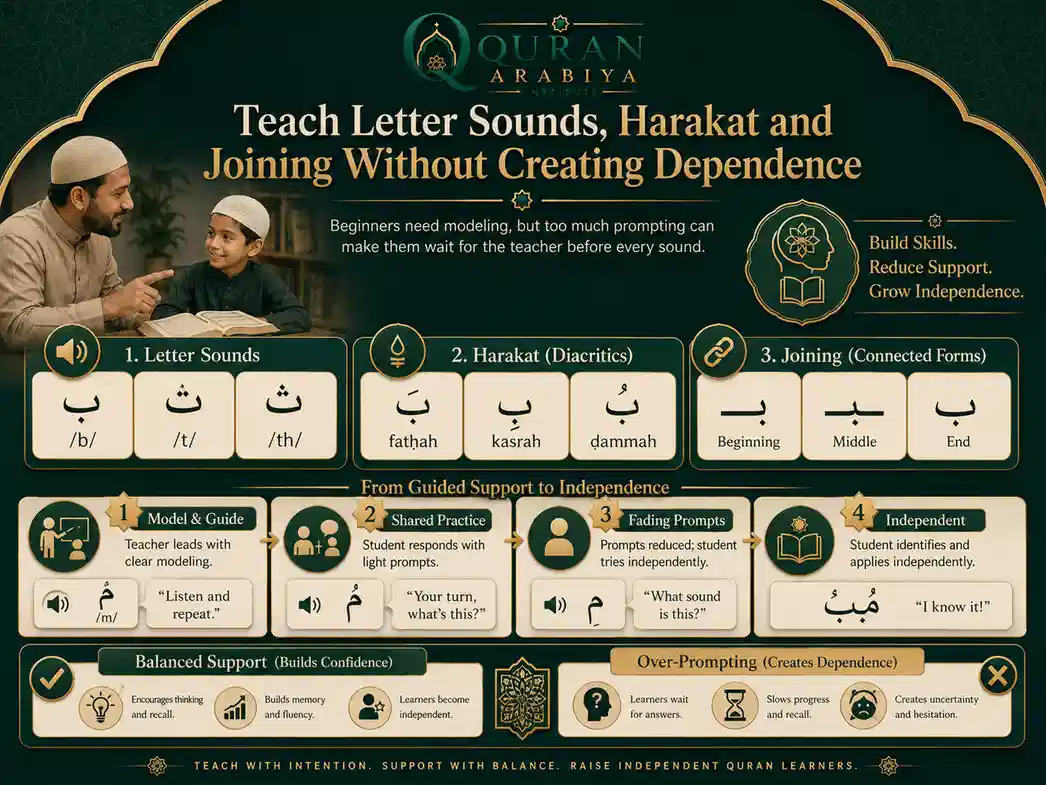
Beginners need modeling, but too much prompting can make them wait for the teacher before every sound. Teacher-level practice therefore includes when to model, when to ask a smaller question, and when to let the learner attempt the pattern unaided.
The goal is independence. A certified Noorani Qaida instructor, where that credential is genuinely awarded, should be able to reduce support as the learner becomes stronger.
Start by confirming that personal recitation and method foundations are strong enough for teacher-level work. In live one-to-one practice, the teacher uses the consultation to separate foundation repair from genuine pedagogy and authorization preparation. This stage is ready when the candidate can focus on teaching decisions instead of using the course to learn basic Noorani patterns.
Know what each Noorani stage is designed to build.
Later Noorani stages combine several reading conditions. The candidate needs to explain them clearly, model them accurately and recognize when a learner is confusing the sign itself with the sound it produces.
The course keeps the focus on the method’s teaching sequence. It is not a substitute for a separate advanced Tajweed qualification if the candidate needs deeper recitation study.
Teaching is a decision process. If the learner succeeds only on the familiar line, the teacher needs a transfer check. If the learner can decode but produces one sound poorly, the correction should be narrower than restarting the chapter.
The candidate learns to use evidence from the learner’s performance rather than a rigid calendar.
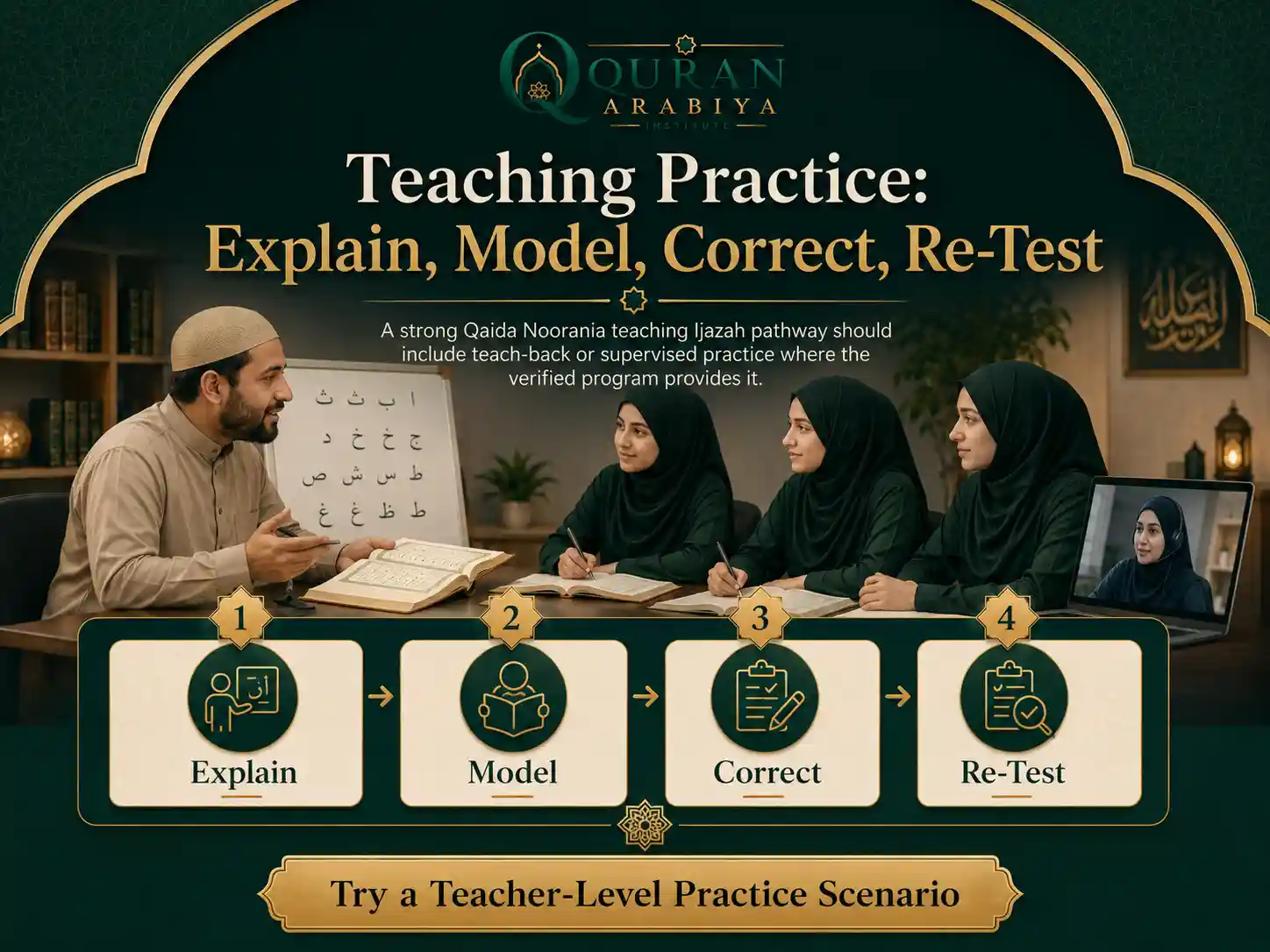
A strong Qaida Noorania teaching Ijazah pathway should include teach-back or supervised practice where possible. The candidate explains a skill, models it, responds to an error, then checks whether the learner can perform the corrected pattern in a new example.
This converts theoretical familiarity into observable instructional competence.
Assessment can include accurate reading of the method material, explanation of sequence and terminology, error diagnosis, teaching demonstration and any additional requirements set by the authorized teacher or institution.
The exact assessment must be published only after the real teacher confirms it. There is no responsible reason to invent a universal exam format.
An Ijazah is an authorization granted by someone qualified to grant it within a defined scope. A course certificate may simply confirm participation or completion. The words should not be used as interchangeable marketing labels.
For any Noorani Qaida teacher certification or Noorani Qaida certification online offered by Quran Arabiya, the page should state who issues it, what it authorizes, whether a sanad is involved, and what standard the candidate must meet.
The free session should be framed as a readiness consultation rather than a beginner lesson. The teacher can test recitation, method familiarity and explanation ability, then recommend preparation or entry into the teacher-level track.
No promise of Ijazah should be made until the authorized teacher confirms both the candidate’s eligibility and the program’s real certification route.
If you already know Noorani Qaida and want to teach it with real method control, start with a readiness consultation. Confirm your recitation, pedagogy gaps and the exact authorization route before committing to the Ijazah track.
The term can mean different things across providers. Quran Arabiya should state the exact issuing teacher/institution, assessment and authorization scope before using the term as a formal promise.
It is a form of authorization related to teaching/transmitting the method, granted only when an authorized issuer is satisfied that the candidate meets the required standard.
No. Enrollment or attendance alone should never be treated as guaranteed authorization. Final award depends on the authorized teacher’s requirements and assessment.
No. Beginners who want to learn Quran reading should use the regular Noorani Qaida course. This page is for teacher-level or advanced candidates.
Potentially, if Quran Arabiya assigns an authorized teacher and the candidate completes that teacher’s verified assessment route. Exact details must be confirmed before enrollment.
Requirements vary by authorized program. Method command is important, but the page should not invent a memorization requirement unless the assigned teacher actually requires it.
That should be a central part of the teacher-level page: diagnosis, explanation, modeling, correction, re-testing and progression decisions.
No. Course attendance, teacher training and formal authorization are not the same thing. The exact issuer, prerequisites, assessment, scope and final authorization decision must be confirmed with the assigned qualified teacher.
It is for candidates who already have strong reading foundations and want method mastery, diagnostic skill and teaching control. A beginner who still needs the Noorani sequence should use the regular Noorani Qaida course first.
Yes. The readiness consultation can identify recitation or method gaps that need repair before practicum or formal assessment. Repair should be treated as preparation, not hidden inside an automatic certification promise.
A teacher-level candidate should be able to explain sequencing, diagnose errors, choose a suitable correction, model accurately and re-test the learner. Method control matters more than page familiarity.
Teaching practice should be included when it is part of the confirmed route. The candidate can explain, model, correct and reassess sample learner problems so pedagogy is observed rather than assumed.
Yes. Authorization arrangements can vary by qualified teacher and route. The exact scope, issuer, sanad if relevant, certificate terms and assessment should be confirmed before they are presented as fixed promises.
Share that requirement during the readiness consultation. The academy should match the candidate with an appropriately qualified available teacher before any specific authorization route is described as confirmed.
If you are considering Noorani Qaida Ijazah online, start with a live assessment rather than choosing a level by guesswork. The teacher can confirm the first useful skill, the best-fit route and the next step without making promises that depend on individual progress.