A Quran reading fluency course is for a learner who can already decode the script but still experiences too much friction on the page. You may know the letters and signs yet pause inside almost every word, lose accuracy when you try to speed up, or read a familiar surah smoothly but struggle on an unfamiliar page. The goal is not “fast recitation.” It is controlled, increasingly smooth Mushaf reading in which accuracy survives as hesitation decreases.
If you are still identifying letters, forgetting basic Harakat or unable to join simple words, a foundation course will be more efficient. Fluency training assumes that the reading code is already available, even if it is slow.
The free trial can separate a foundation gap from a fluency gap. That prevents the learner from practising speed on top of unresolved decoding errors.

Start by finding the real cause of hesitation after basic decoding is already available. In live one-to-one practice, the teacher listens for word recognition delay, visual tracking, weak phrase grouping or accuracy loss instead of calling every pause a speed problem. This stage is ready when practice begins with the mechanism that is actually slowing the reader.
Hesitation can come from several places: slow word recognition, weak connected-form recognition, repeated pronunciation uncertainty, poor visual tracking, fear of mistakes, or difficulty carrying attention across a longer line.
The teacher listens for the pattern. Instead of saying “read more,” the lesson targets the specific bottleneck that interrupts flow.
To improve Quran reading fluency, accuracy remains the first constraint. A faster line with dropped vowels, substituted letters or repeated guessing is not better reading.
The teacher can slow the passage temporarily, correct the recurring error, then increase continuity only when the correct form survives. Pace grows around accuracy rather than competing with it.

Word-by-word decoding often creates choppy reading even when each word is technically correct. Short phrase units help the learner maintain visual attention and reduce unnecessary resets between words.
Phrase practice also gives the teacher a manageable unit for correction. Once a phrase is stable, the learner joins it to the next one without turning the lesson into a speed contest.
Repeated reading can reduce hesitation because the visual pattern becomes more familiar. But the same passage should not be repeated so many times that memory replaces reading.
The solution is paired practice: repeat a short passage for smoothness, then test the same type of skill on an unfamiliar passage. Improvement should travel with the learner.
Start by keeping the eyes on the correct word and line as the passage becomes longer. In live one-to-one practice, the teacher uses guided visual tracking and then removes support so the learner controls the page independently. This stage is ready when skips, line losses and backward eye movements become less frequent.
Preserve letters and signs while hesitation decreases.
A learner may read two lines well and then deteriorate across a full page because attention, breathing or visual tracking becomes less stable. Mushaf reading practice therefore needs gradual increases in passage length.
Longer reading is introduced only when shorter units remain accurate. The objective is sustained control, not simply completing more pages in the lesson.
Fluency includes recovering after a pause. The learner needs to find the correct place, restart without repeating half the line, and keep the eye moving through the Arabic script without losing position.
Targeted stop-and-restart drills and finger/visual tracking strategies can be used when needed, then reduced as the skill becomes automatic.
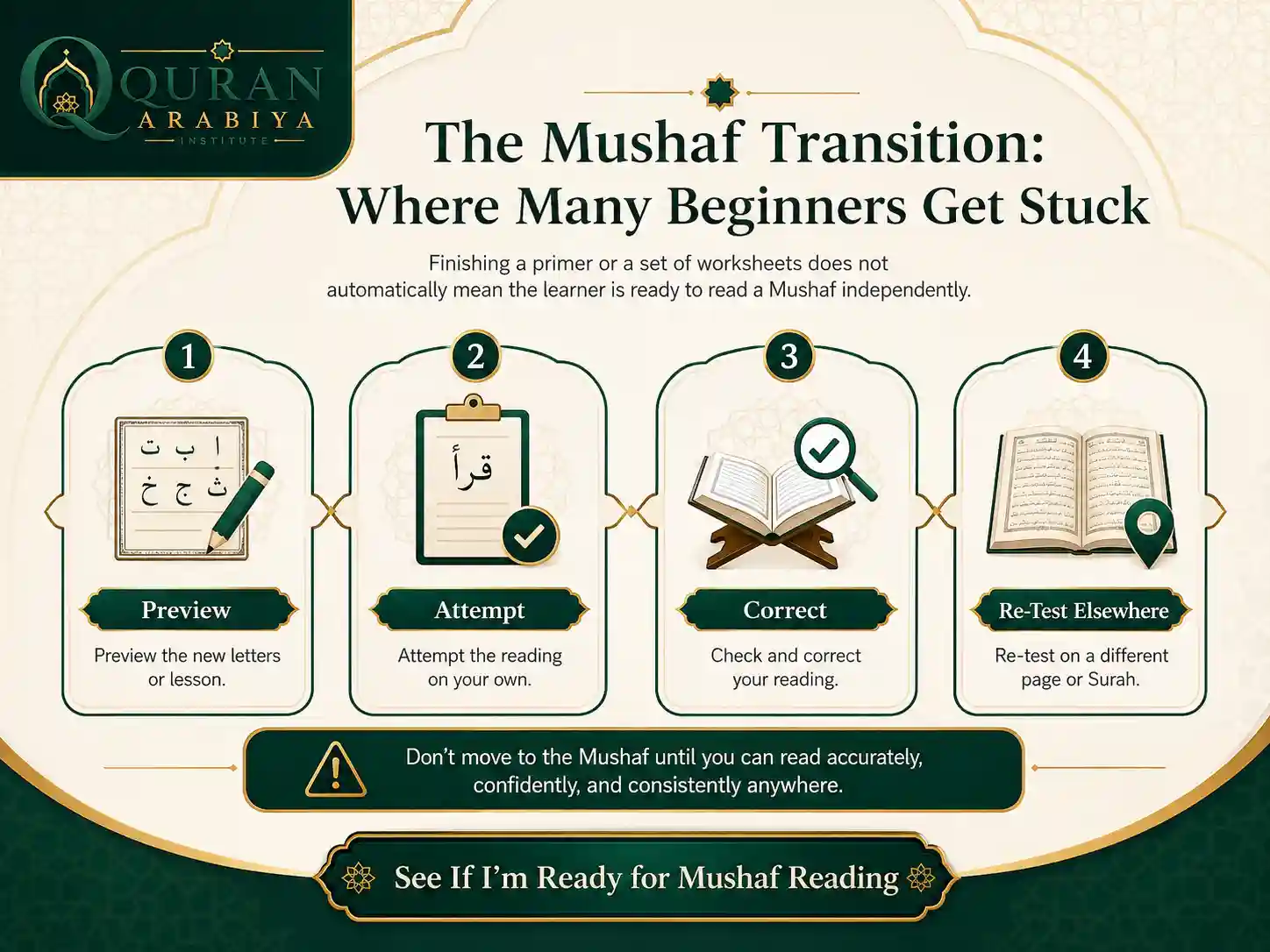
Fluent Quran reading classes should prove progress on material that was not rehearsed in advance. An unfamiliar page reveals whether improved pace comes from better word recognition and control or merely from memory.
The teacher can compare a familiar passage and a fresh passage, then choose the next practice target from the difference.
A stronger reader begins to notice when a word did not sound right, returns to the exact location, and corrects it without waiting for the teacher to supply the answer. That skill turns guided practice into independent reading.
Teachers can encourage a short self-check pause before correcting certain errors, while still intervening immediately when the learner cannot diagnose the problem.
Useful indicators include fewer decoding pauses, fewer repeated starts, more accurate phrase reading, better endurance across longer passages, stronger performance on unfamiliar text and more independent self-correction.
This is a better way to improve Quran reading speed and accuracy than setting an arbitrary speed target. The pace that matters is the fastest pace at which the learner remains controlled.
The teacher can listen to a short familiar passage and a short unfamiliar passage. If the learner cannot decode the underlying signs, a foundation route may be recommended. If decoding is present but slow or fragile, the fluency course is the better fit.
The free trial therefore prevents cannibalization in the real learner journey: each problem is sent to the page and course designed to solve it.

If you can read but every page still feels heavy, work on the coordination that makes reading smoother. Book a free fluency assessment and find out whether your main gap is pace, accuracy, tracking or foundation.
Work on accuracy, word recognition and phrase continuity first. Pace increases only when the correct reading survives.
Learners who can already decode Arabic/Quranic text but read with excessive pauses, weak pacing or low confidence across longer passages.
It can include short supervised passages, targeted correction, repeated reading, phrase practice, unfamiliar-page checks and progressively longer Mushaf reading.
Yes, but accuracy leads. The goal is controlled pace, not maximum speed.
Mushaf practice uses real Quran pages with denser, less graded text. Qaida practice teaches the underlying reading patterns.
You need sufficient decoding. Basic recitation errors can be corrected, but a learner whose main problem is detailed Tajweed should use the dedicated Tajweed course.
Yes if the child already decodes and the main problem is fluency. Placement should determine fit rather than age alone.
Fluency focuses on smoother, increasingly independent Mushaf reading after decoding is already established. Tajweed focuses more deeply on recitation rules and precision, although basic accuracy must still be protected while fluency improves.
No. Faster reading is not useful if accuracy collapses. Progress should also consider hesitation, phrase grouping, tracking, error recovery, self-correction and how well the learner handles unfamiliar Mushaf pages.
It can if the same passage is repeated without transfer checks. The teacher should use repeated reading for coordination, then test the skill on a new passage so familiarity is not mistaken for reading growth.
They reveal whether smoother reading depends on memory or on a more efficient decoding process. Transfer to a new page is one of the clearest signs that fluency is becoming a genuine reading ability.
The teacher may recommend foundation repair before continuing with fluency. Trying to increase pace on unstable letter recognition, vowels or blending can make guessing faster rather than make reading stronger.
Use a short passage with one clear target, such as fewer internal pauses, cleaner phrase reading or better visual tracking. Then include a fresh passage so the same improvement is tested beyond rehearsal.
Yes. Share the fluency goal and current difficulty during matching so the academy can consider teacher experience, level, schedule and preference, subject to availability.
If you are considering Quran reading fluency course, start with a live assessment rather than choosing a level by guesswork. The teacher can confirm the first useful skill, the best-fit route and the next step without making promises that depend on individual progress.