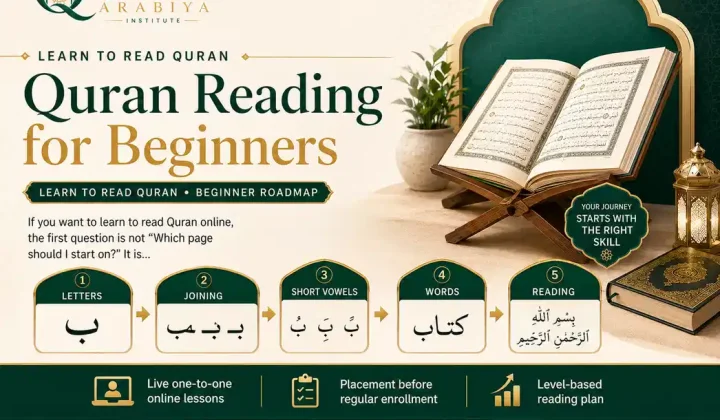
If you want to learn to read Quran online, the first question is not “Which page should I start on?” It is “Which reading skill is missing?” A learner may know the alphabet but fail to recognize connected shapes, read familiar words from memory but struggle with new ones, or decode slowly enough that every line feels exhausting. This course builds the missing skills in sequence so Quran reading becomes a real ability rather than a set of memorized exercises. At Quran Arabiya Institute, the free trial can be used as a placement lesson so the teacher starts from the first skill that genuinely needs work.
A complete beginner needs a different lesson from someone who studied a Qaida years ago and forgot part of it. The teacher can check letter recognition, short vowels, connected forms, simple blending and a short Quranic sample where appropriate. That separates “I have seen this before” from “I can use this independently.”
Placement also protects motivation. An adult should not be made to repeat weeks of alphabet work if only a few sound contrasts are weak, and a child should not be pushed into Quranic pages while still guessing the basic reading signs. The path begins at the first unstable skill and moves forward from there.
Start by recognizing letters and reading signs outside memorized order. In live one-to-one practice, the teacher mixes familiar and unfamiliar symbols so visual recognition does not depend on sequence. This stage is ready when the learner identifies the symbol quickly and correctly without a prompt.
Quran reading becomes much clearer when it is broken into four jobs: recognize the script, attach the right sound to what you see, combine letters and signs into words, then transfer those skills into real Mushaf text. A learner can be strong in one job and weak in another.
This is why a Quran reading course for beginners should not be measured only by pages completed. The teacher needs to see whether the student can recognize, decode, combine and transfer the pattern when the example changes.
One of the most common beginner traps is successful repetition without independent reading. After seeing the same line many times, a learner may know what comes next even if the visual decoding skill is still weak. The solution is not simply more repetition of the same page.
Lessons should include mixed-order practice and unfamiliar examples. When the student can read a new combination without being told what it says first, that is evidence that the reading system is becoming usable.
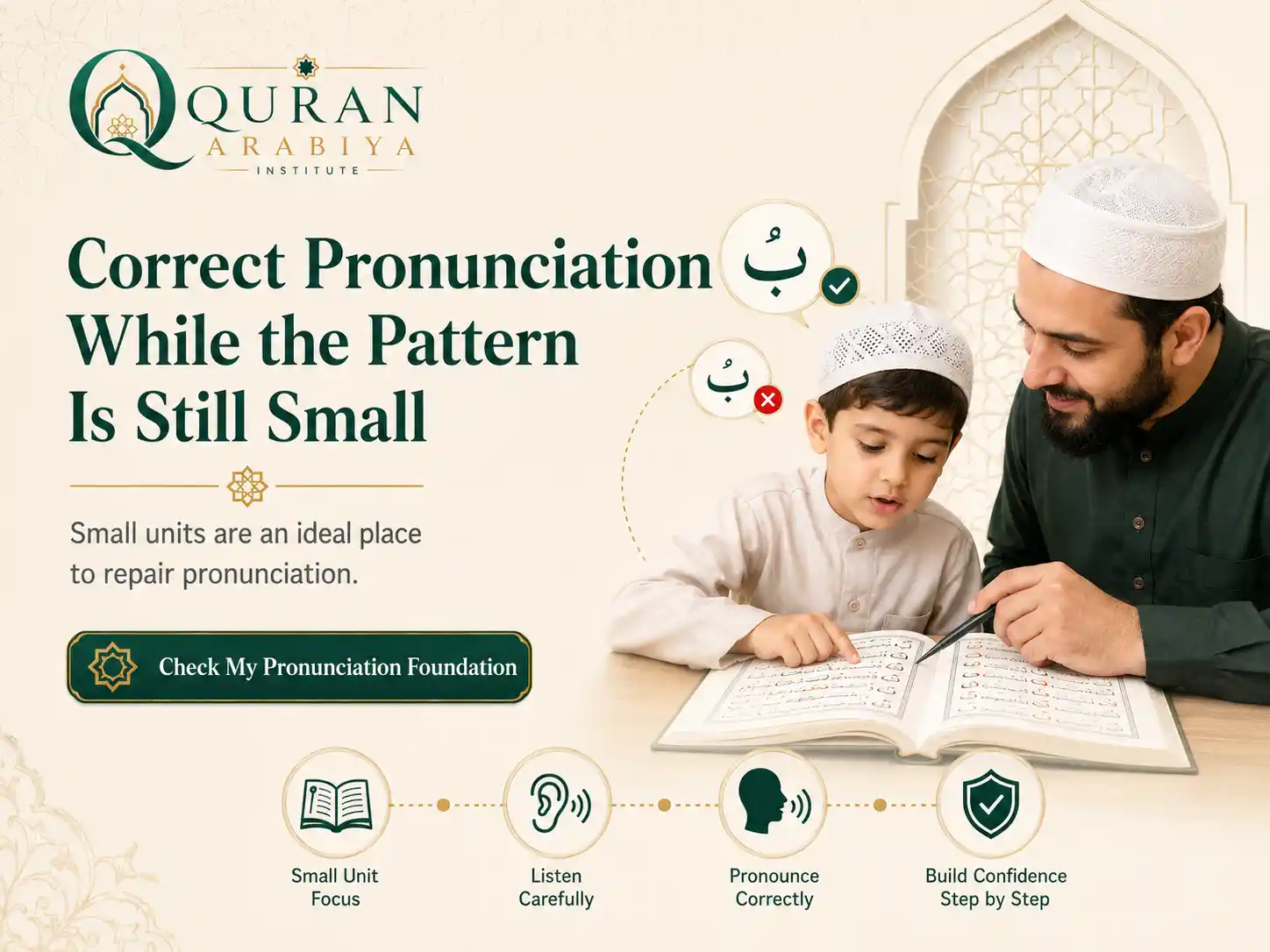
Accuracy comes before pace. Difficult Arabic sounds may need isolated listening, mouth-position guidance and short contrast drills before they are put back into a word. The goal is not to turn the beginner course into an advanced Tajweed class; it is to prevent a wrong sound from becoming the learner’s default.
Once recognition and pronunciation are stable enough, pace usually improves because the reader spends less time stopping to guess. Speed is then a result of stronger decoding, not a target forced on top of weak foundations.
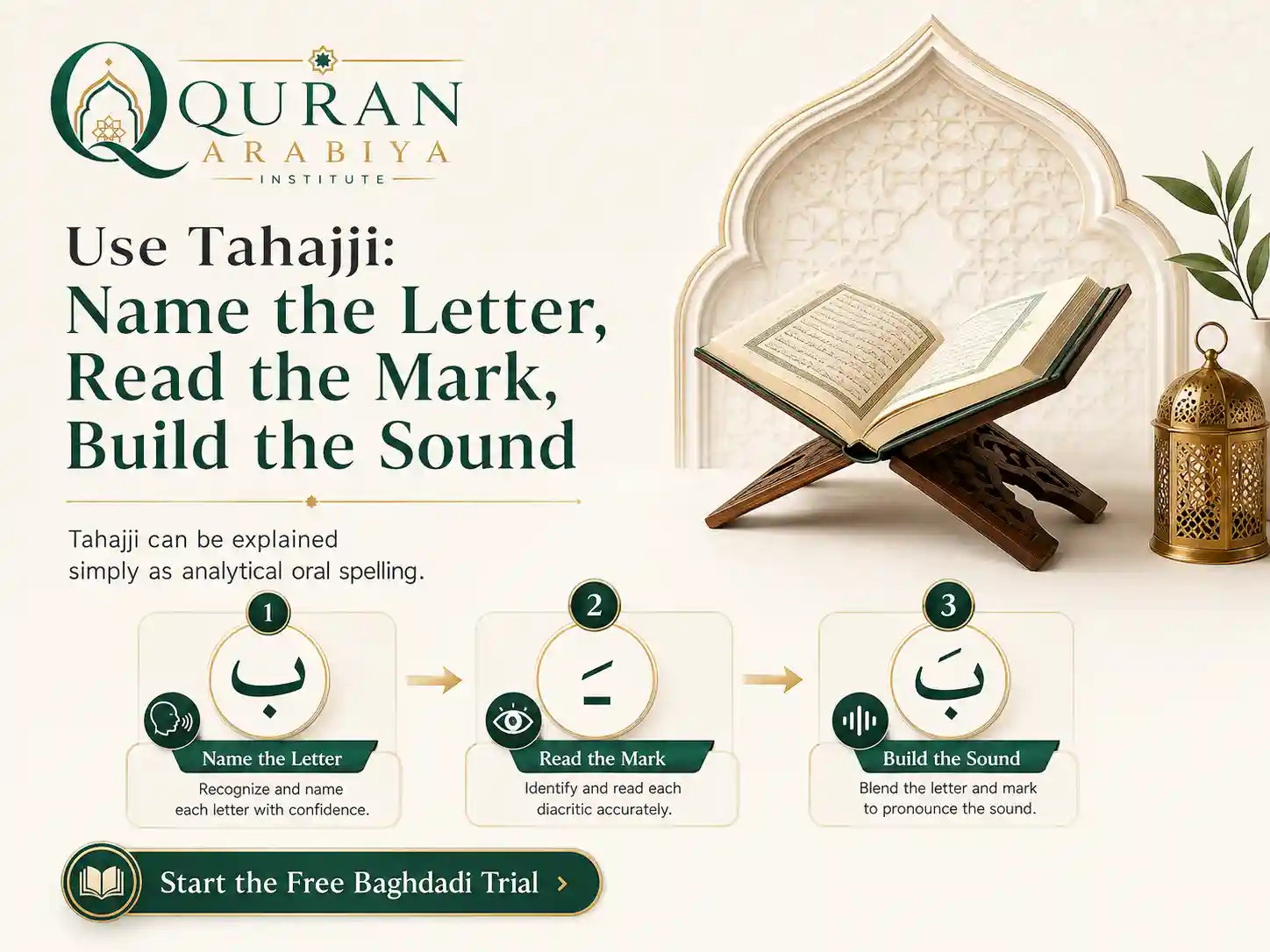
Beginners need control of the reading signs they actually meet: short vowels, joined forms and progressively more complex word patterns. The teacher introduces each new sign only after the earlier pattern is reasonably stable, then combines old and new material so the student cannot rely on a single drill format.
The transition should become progressively more Quran-oriented. Short words and controlled phrases lead into selected Quranic lines, giving the learner a reason to use the skill in the format they ultimately want to read.
Start by matching the learning pace to a child who still needs short turns and visible wins. In live one-to-one practice, the teacher keeps tasks brief, changes the practice mode and protects accuracy before asking for longer reading. This stage is ready when the child stays active and can repeat the same skill with less prompting.
Read the symbol and sound correctly before pace increases.
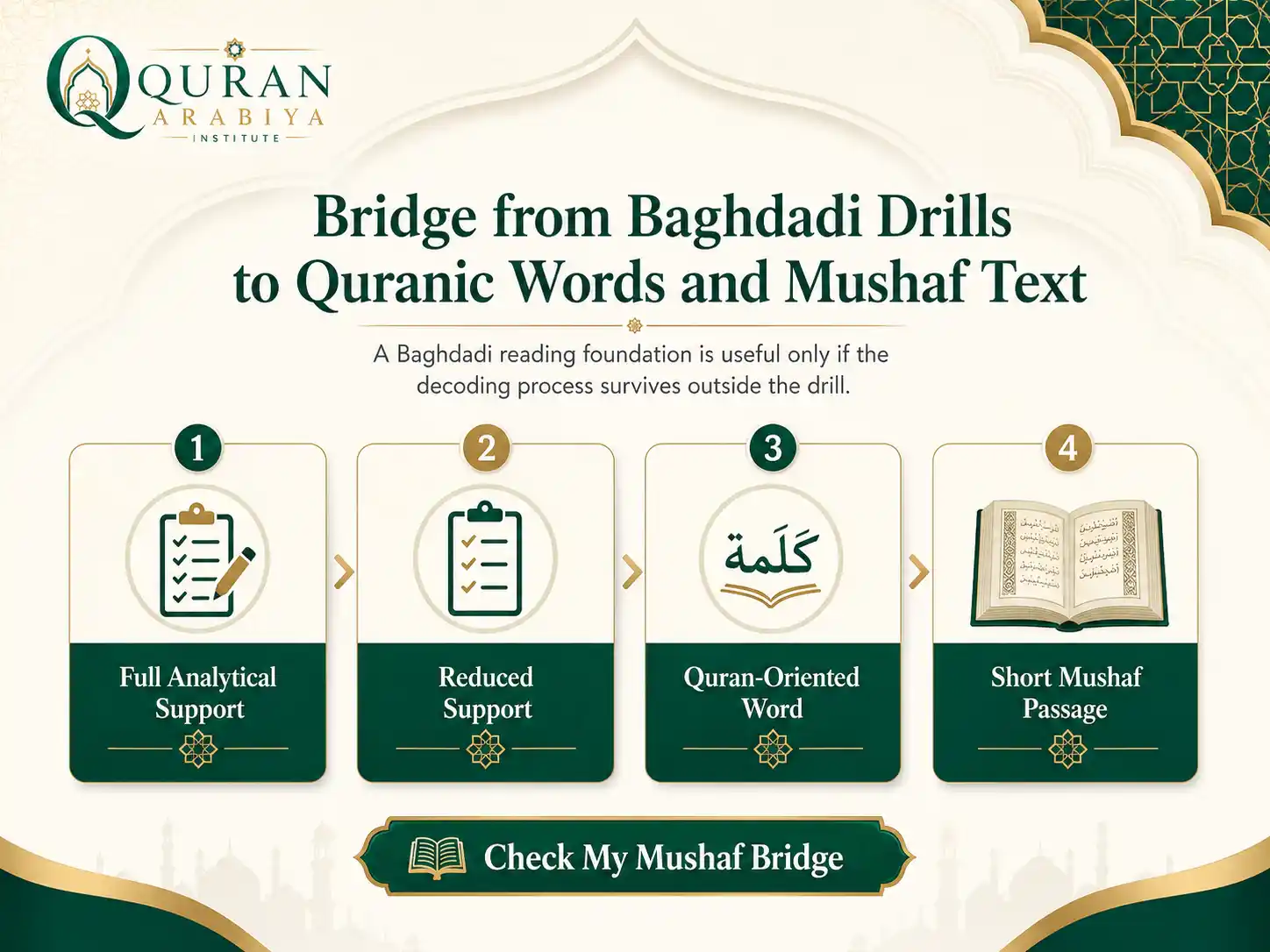
Finishing a primer or a set of worksheets does not automatically mean the learner is ready to read a Mushaf independently. Quranic pages contain denser visual information, longer word forms and less predictable sequencing than a carefully graded beginner exercise.
The teacher can bridge the gap through short guided passages: preview difficult forms, let the learner attempt the line, correct only what is necessary, then re-test a similar pattern elsewhere. The goal is gradually reducing prompts until the student can approach a new passage with a workable reading strategy.
The academic building blocks may be similar, but the way they are taught should change. Children often need shorter turns, visual variety and quick wins. Adults usually benefit from explicit explanation and the privacy of one-to-one correction. New Muslims may also need reassurance that reading Arabic script is a separate skill from understanding Arabic as a language.
Quran reading classes online work best when the teacher adapts the pace, examples and amount of repetition to the learner rather than treating age as the only placement rule.
Useful progress indicators are observable: the learner recognizes letters outside memorized order, distinguishes previously confused shapes, reads a new vowel pattern correctly, blends with fewer pauses, recovers after an error, and needs less prompting on unfamiliar Quranic text.
These measures keep the course honest. They also make it easier to decide whether the next step should be more foundation work, a named Qaida method, a Mushaf-reading stage, or later a specialist fluency or Tajweed course.
The free trial is not a pass-or-fail exam. It is a short diagnostic conversation and reading check. The teacher can listen to what the learner can already do, identify the first bottleneck, and recommend a starting point instead of assuming everyone begins from lesson one.
Because the lessons are live and one-to-one, the teacher can also test whether a particular explanation style, amount of prompting and practice pace fits the learner. The next-step plan can then be discussed before a regular schedule is confirmed.
The next course depends on the student’s real need. A learner who can decode but still hesitates may move into Quran Reading Fluency. Someone whose main issue is recitation accuracy may need a Tajweed-focused course. A student who wants a particular foundation method can follow the relevant Noorani, Noor Al Bayan, Baghdadi, Bashandy or Fath Ar-Rahman page.
This separation is intentional: the beginner page builds the broad reading journey, while each specialist page goes deeper into one method or one next-stage skill.
Start with the reading skill you actually need. Book a free trial and placement lesson so your teacher can identify the first useful step from letters, signs and joining to controlled Mushaf reading.
Yes. The course can start from zero if the learner does not yet recognize Arabic letters. The initial assessment determines whether alphabet work, a Qaida route or direct reading practice is the right first step.
Live one-to-one lessons allow the teacher to hear each attempt, model the sound or pattern, let the learner repeat it, and immediately check whether the correction transfers to a new example.
Yes. Adults can start from the alphabet or from any partial foundation they already have. The course should avoid childish presentation while still teaching the same essential decoding skills.
The main goal is learning to decode and read Quranic Arabic. Basic pronunciation correction is included, but detailed Tajweed rules belong to the dedicated Tajweed courses.
By mastery and current ability, not a fixed number of weeks. Progress depends on previous exposure, lesson frequency, pronunciation needs and practice between lessons.
No. The free placement lesson can help identify whether you need a named method at all and, if so, which type of foundation best matches your gap.
Not necessarily. A guided transition into real Quranic pages is often needed. The goal is independent transfer, not merely finishing a book.
That usually means the gap is no longer simple alphabet recognition. The teacher can check connected forms, short vowels and blending, then begin at the first unstable skill instead of restarting everything from zero.
The reading skills are related, but the teaching experience should differ. Children may need shorter tasks and more visual variety, while adults often benefit from direct explanation, private correction and a pace that respects previous study.
Short, focused practice is usually more useful than repeating a long page without a clear target. The teacher can assign one recognition, blending or Mushaf-reading task that can be checked again in the next lesson.
No. Reading Arabic script and understanding Arabic meaning are separate skills. A learner can build accurate Quran decoding first, then add Arabic-language or meaning study through the appropriate course when that becomes a separate goal.
Move when you can decode unfamiliar Quranic text but hesitation, visual tracking or pacing remains the main barrier. The fluency course begins after the basic reading code is already usable.
A teacher preference can be shared during the free trial and matching process. The final match should also consider age, current level, course goal, schedule and current teacher availability.
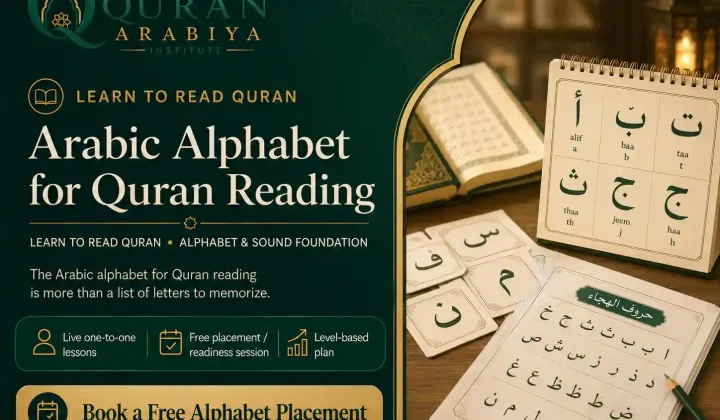
The teacher can route you to the narrower Arabic Alphabet for Quran Reading course instead of using a broad beginner pathway unnecessarily. The goal is to start with the smallest course that genuinely solves the problem.
If you are considering learn to read Quran online, start with a live assessment rather than choosing a level by guesswork. The teacher can confirm the first useful skill, the best-fit route and the next step without making promises that depend on individual progress.