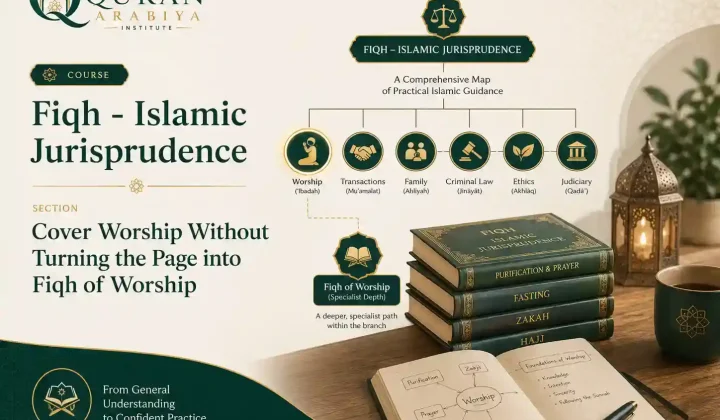
A Fiqh of worship course online focuses on the rulings that shape repeated acts of Ibadah: purification, prayer, fasting, Zakat and Hajj. Instead of treating them as five unrelated topics, the course can show the structure inside each act – what must be present, what changes the ruling, what invalidates the act and what questions require further guidance.
Learners searching for a Fiqh Al Ibadat course, Islamic worship rulings course or Taharah and Salah Fiqh course usually want practical clarity. Quran Arabiya Institute should therefore state the jurisprudential framework clearly and teach the rules through guided examples, not generic motivational copy.
Purification is not merely a preliminary chapter. It teaches the learner how Fiqh works: conditions, types of impurity, acts that affect Wudu/Ghusl and situations where the ruling changes. The exact details should follow the confirmed madhhab or course text.
Once the student understands how to ask “what conditions are present?”, later worship chapters become easier to organize.
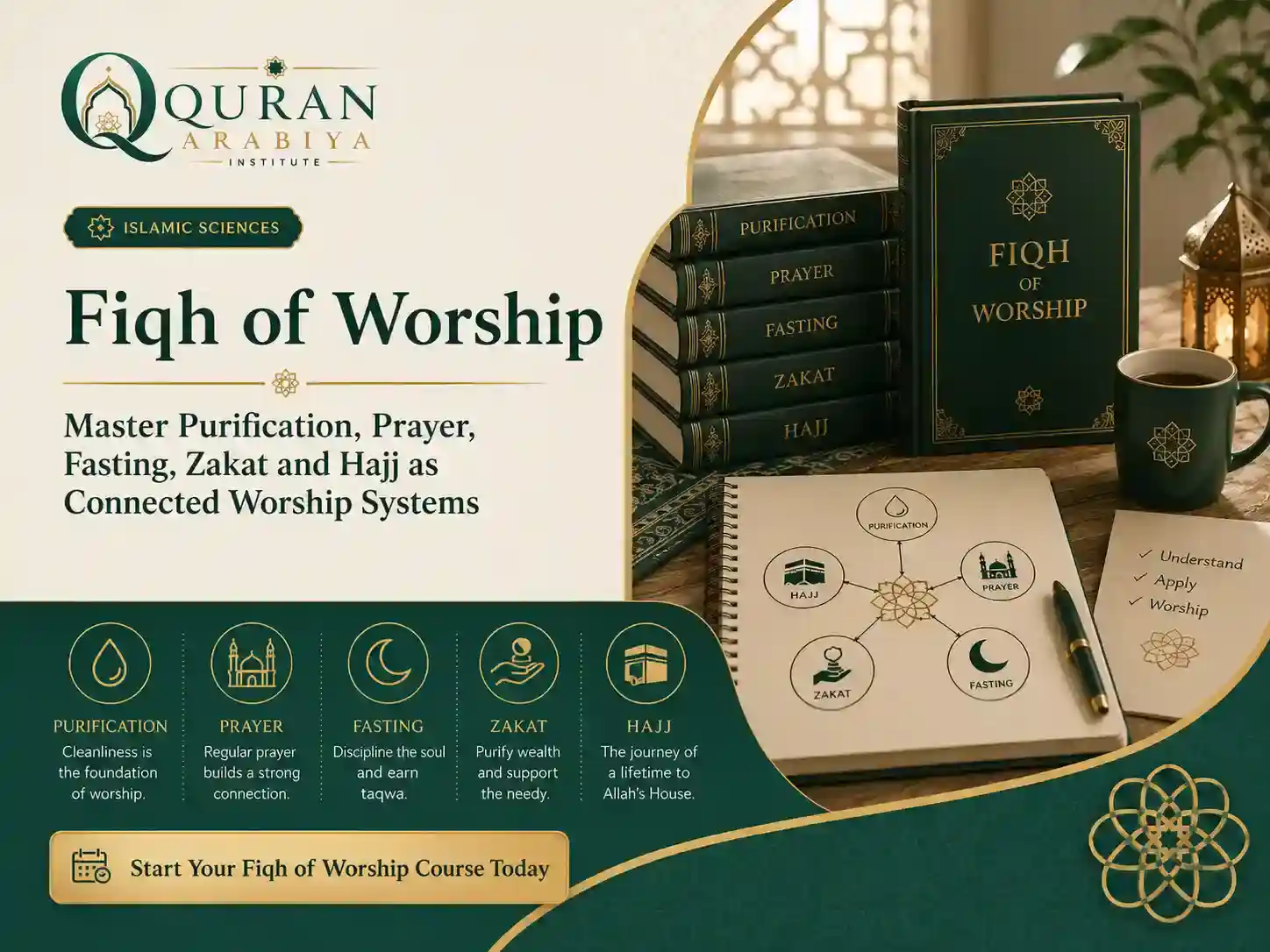
It teaches the learner how Fiqh works: conditions, types of impurity, acts that affect Wudu/Ghusl and situations where the ruling changes. The exact details should follow the confirmed madhhab or course text. The aim is to understand the principle clearly enough to recognize where it applies.
A Fiqh of prayer fasting and zakat course should give prayer the structured attention it deserves. The learner can separate what is required before Salah, what forms part of Salah, what invalidates it and how common mistakes are categorized in the chosen framework.
The goal is not to overwhelm students with every rare edge case. It is to build a reliable map for daily worship and a method for knowing when an unusual question needs specialist guidance. In that sense, acts of worship jurisprudence becomes a structured skill rather than a collection of emergency answers.
A useful checkpoint is to explain the idea in the learner’s own words, identify one example, and know when a deeper specialist course is the better next step.
Fasting Fiqh can cover intention, the fasting day, what invalidates the fast, legitimate exemptions and make-up obligations according to the confirmed syllabus. Practical scenarios help the learner see which facts change a ruling.
This makes Ramadan preparation more informed while preserving deeper medical or complex personal cases for appropriately qualified guidance.
Fasting Fiqh can cover intention, the fasting day, what invalidates the fast, legitimate exemptions and make-up obligations according to the confirmed syllabus. Practical scenarios help the learner see which facts change a ruling. The aim is to understand the principle clearly enough to recognize where it applies.
Zakat involves categories, thresholds, ownership periods and asset-specific questions that vary with the legal framework and circumstances. A foundational course can explain the architecture before asking students to calculate examples.
The page should avoid promising advanced financial or business-Zakat advice unless that exact material and expertise are part of the verified course.
Hajj contains sequence, place, timing and different acts whose legal status matters. A course can first give the learner a visual/chronological map, then add the rulings in manageable groups.
That approach helps the student understand where a detail belongs instead of memorizing an isolated list of rites.
A useful checkpoint is to explain the idea in the learner’s own words, identify one example, and know when a deeper specialist course is the better next step.
Zakat involves categories, thresholds, ownership periods and asset-specific questions that vary with the legal framework.
Simple hypothetical cases are excellent for learning: what if a condition is missing, what fact changes the ruling, or which category should be checked first? These exercises reveal whether the student understands the structure.
Personal cases involving health, travel, finance or unusual circumstances can be flagged for qualified scholarly advice when necessary.
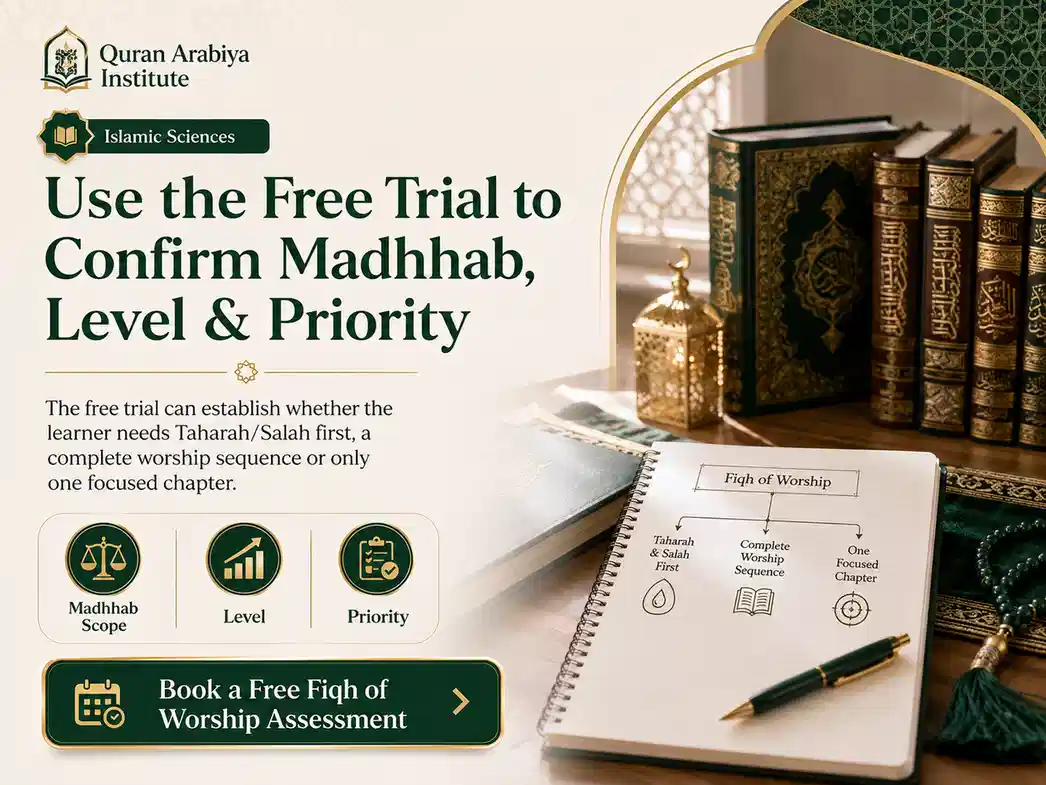
The free trial can establish whether the learner needs Taharah/Salah first, a complete worship sequence or only one focused chapter. It should also confirm which madhhab, text or comparative framework the academy will use.
That fact is essential before publishing detailed worship rulings and helps distinguish this focused course from general Fiqh.
Understands the legal structure of purification and worship chapters.
Can distinguish conditions, core components and invalidators within the chosen framework.
Builds a practical map of Salah, fasting, Zakat and Hajj rulings.
Uses controlled scenarios to test understanding rather than memorize isolated answers.
Knows when a personal worship question needs guidance beyond a general course.
Book a free trial to identify which worship chapter you need first and confirm the madhhab/text framework before building your Fiqh Al-Ibadat study plan.
The target scope is Taharah, Salah, fasting, Zakat and Hajj. Exact subtopics must match the academy’s confirmed syllabus.
Quran Arabiya Institute should confirm this before publication; the page must not mix school-specific rulings without a declared framework.
No. General Fiqh owns broader jurisprudence; this course concentrates on acts of worship.
Yes if the course is taught at a foundational level. The trial can determine whether to begin with Taharah/Salah or another verified starting point.
Foundational calculation examples may be taught if part of the syllabus, but complex personal/business cases should not be promised without verified expertise.
Teens/adults who already want a practical Fiqh Al-Ibadat route rather than broad jurisprudence, inheritance or legal theory.
The learner does not need to repeat every introductory point automatically. The starting conversation can identify what is already stable, what is only familiar by name and which concept needs the first focused explanation or practice.
Private teaching lets the teacher adjust vocabulary, pace, examples and questioning without changing the academic goal. It also creates space to stop on a misunderstood concept, check it from another angle and continue only when the learner can explain it more independently.
The page follows a defined scope and routes deep sibling intent outward. Do not expand into transactions, family law, inheritance or Usul. Confirm madhhab/comparative framework before publishing detailed rulings. Do not promise fatwa services for unusual personal cases. This protects both learning clarity and the SEO role of the dedicated specialist courses.
The course can explain relevant evidence and terminology at the level required by the subject, while avoiding claims beyond the confirmed text, teacher or syllabus. High-trust topics remain guided study rather than independent fatwa, hadith grading or personal interpretation.
No. The course is educational and should keep its scholarly scope clear. Personal rulings, estate cases, legal/tax questions or independent authentication require the appropriately qualified person and the full facts of the real case.
The trial can identify current knowledge, goals, preferred depth and the most suitable route before regular enrollment. It is used as a placement and fit step, not as guaranteed certification, a fatwa session or a promise of fixed completion time.
The next step should follow the skill or science that becomes dominant. Choose this course if you want concentrated study of worship rulings, including purification, prayer, fasting, Zakat and Hajj. If you want a broader introduction to Fiqh across several legal areas, the general Fiqh course is the better route. Once that role has been fulfilled, the teacher can recommend the most relevant specialist route instead of expanding the course beyond its intended scope.
If you are considering Fiqh of worship course online, begin with the concept or study gap that matters most now. The free trial can clarify your current level, intended depth and best-fit route without inventing a certificate, fixed duration or specialist ruling that has not been verified.