A Duas and Adhkar course online should help the learner move from “I have a long list saved on my phone” to “I know a verified set of supplications, understand what they mean and remember when to use them.” For non-Arabic speakers, pronunciation and meaning are part of the learning task, not optional decoration.
Quran Arabiya Institute can structure a daily Dua course online around verified occasions and manageable routines. Morning and evening Adhkar, sleep/waking, meals and other daily moments can be introduced gradually after the exact wording, references, repetition counts and virtues have been checked from reliable sources.
An Islamic supplications course is strongest when the learner connects three things: what to say, what it means and when it is said. Memorizing Arabic without the occasion can produce a list that never enters daily life; memorizing only an English idea loses the established wording of a specific Dua.
The teacher can therefore pair pronunciation practice with a short meaning and a clear daily trigger.

An Islamic supplications course is strongest when the learner connects three things: what to say, what it means and when it is said. Memorizing Arabic without the occasion can produce a list that never enters daily life. The aim is to understand the principle clearly enough to recognize where it applies.
A morning and evening Adhkar course should not overwhelm a beginner with a very long routine on day one. The academy can select a verified progression and add items gradually as earlier ones become stable.
The public page must not invent which specific Adhkar or counts are included until the syllabus has been source-checked.
A practical checkpoint is to explain one idea in simple words and connect it to one realistic situation before adding another concept.
Non-Arabic speakers may need help with sounds, vowel length and common pronunciation errors. The teacher can model short phrases, listen and correct enough for accurate recall.
This remains a Duas/Adhkar page. Learners who need foundational Arabic reading should be routed to the relevant Arabic or Quran-reading course.

Non-Arabic speakers may need help with sounds, vowel length and common pronunciation errors. The teacher can model short phrases, listen and correct enough for accurate recall. The aim is to understand the principle clearly enough to recognize where it applies.
Learn daily Duas online becomes easier when each supplication is attached to a repeated event. The teacher can help the student map a small number of verified Duas to daily triggers so recall happens in context rather than only during a lesson.
The exact set of occasions should follow the academy’s verified curriculum and not a random internet checklist.
A foundational course can explain, in accessible terms, that Dua includes supplication/calling upon Allah, while Dhikr broadly concerns remembrance. Some daily texts function as both remembrance and supplication in practice.
The goal is useful understanding, not an advanced terminological debate.
A useful checkpoint is to explain the idea in the learner’s own words, identify one example, and know when a deeper specialist course is the better next step.
Learn daily Duas online becomes easier when each supplication is attached to a repeated event.
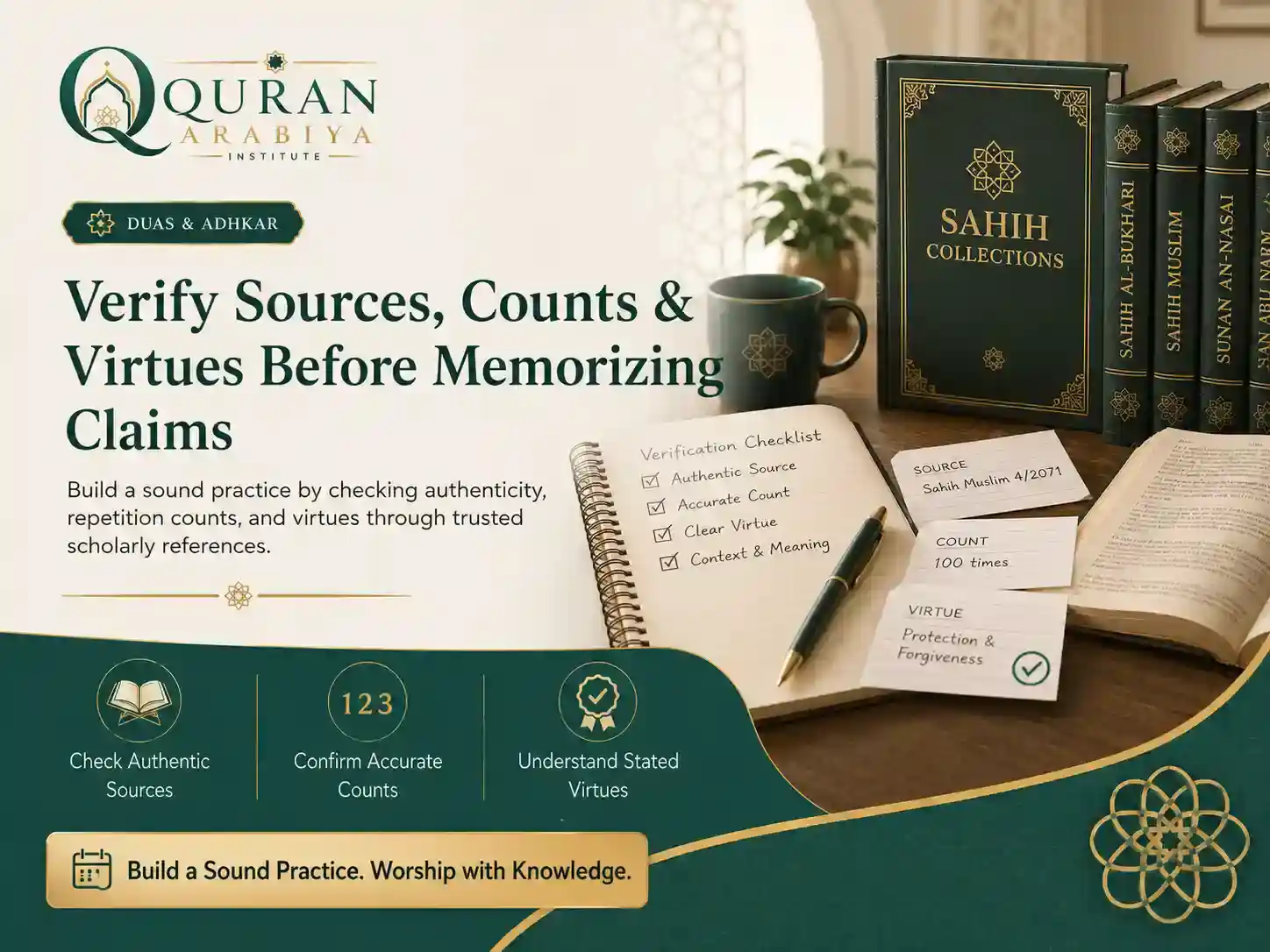
Adhkar classes online carry a special responsibility because online lists often repeat claims about rewards, protection or repetition counts without careful sourcing. Quran Arabiya Institute should source-check the Arabic text, reference and any stated virtue before putting it into the public curriculum.
If there is scholarly nuance in grading or wording, the course should avoid oversimplified certainty.
The trial can check whether the learner already knows some daily Adhkar, can read Arabic, prefers transliteration support and how much memorization is realistic each week. A busy adult and a young child may need very different pacing.
That makes the routine sustainable and lets the teacher recommend a broader Adab or Islamic Studies course if the learner’s goal is actually wider than Duas.

Memorizes a verified, manageable selection of Duas/Adhkar with meaning.
Connects each learned supplication to its correct daily occasion.
Improves pronunciation of the Arabic wording with teacher feedback.
Builds sustainable morning/evening and daily-remembrance habits.
Learns to value source/reference accuracy rather than viral unsourced lists.
Book a free trial to identify what you already know, your Arabic/pronunciation needs and a realistic daily Dua and Adhkar memorization plan.
That is a core target of the course, but the exact list, wording and repetition counts should match the academy’s verified syllabus.
Transliteration can support beginners, but teacher modeling and gradual Arabic recognition are better for pronunciation where possible.
Yes. Meaning and occasion should be taught with the Arabic wording so memorization becomes more useful.
No. The academy should verify the source and grading/wording before teaching a specific virtue or count.
No. Adab owns behavior and etiquette; this page owns supplication, remembrance, meaning and routine.
Kids/teens/adults who want a guided daily Dua/Dhikr repertoire with understanding rather than an unsourced list to memorize.
The learner does not need to repeat every introductory point automatically. The starting conversation can identify what is already stable, what is only familiar by name and which concept needs the first focused explanation or practice.
Private teaching lets the teacher adjust vocabulary, pace, examples and questioning without changing the academic goal. It also creates space to stop on a misunderstood concept, check it from another angle and continue only when the learner can explain it more independently.
The course can explain relevant evidence and terminology at the level required by the subject, while avoiding claims beyond the confirmed text, teacher or syllabus. High-trust topics remain guided study rather than independent fatwa, hadith grading or personal interpretation.
No. The course gives the learner a structured foundation and helps identify the next priority. When one subject becomes the main goal, the specialist Aqeedah, Fiqh, Hadith, Tafsir, Adab or other dedicated route should take over rather than being compressed into one page.
The trial can identify current knowledge, goals, preferred depth and the most suitable route before regular enrollment. It is used as a placement and fit step, not as guaranteed certification, a fatwa session or a promise of fixed completion time.
The next step should follow the skill or science that becomes dominant. Own daily Dua course online, Adhkar classes online, morning and evening Adhkar course and Islamic supplications intent. Adab may link in but should not absorb the route. Once that role has been fulfilled, the teacher can recommend the most relevant specialist route instead of expanding the course beyond its intended scope.
If you are considering Duas and Adhkar course online, begin with the concept or study gap that matters most now. The free trial can clarify your current level, intended depth and best-fit route without inventing a certificate, fixed duration or specialist ruling that has not been verified.