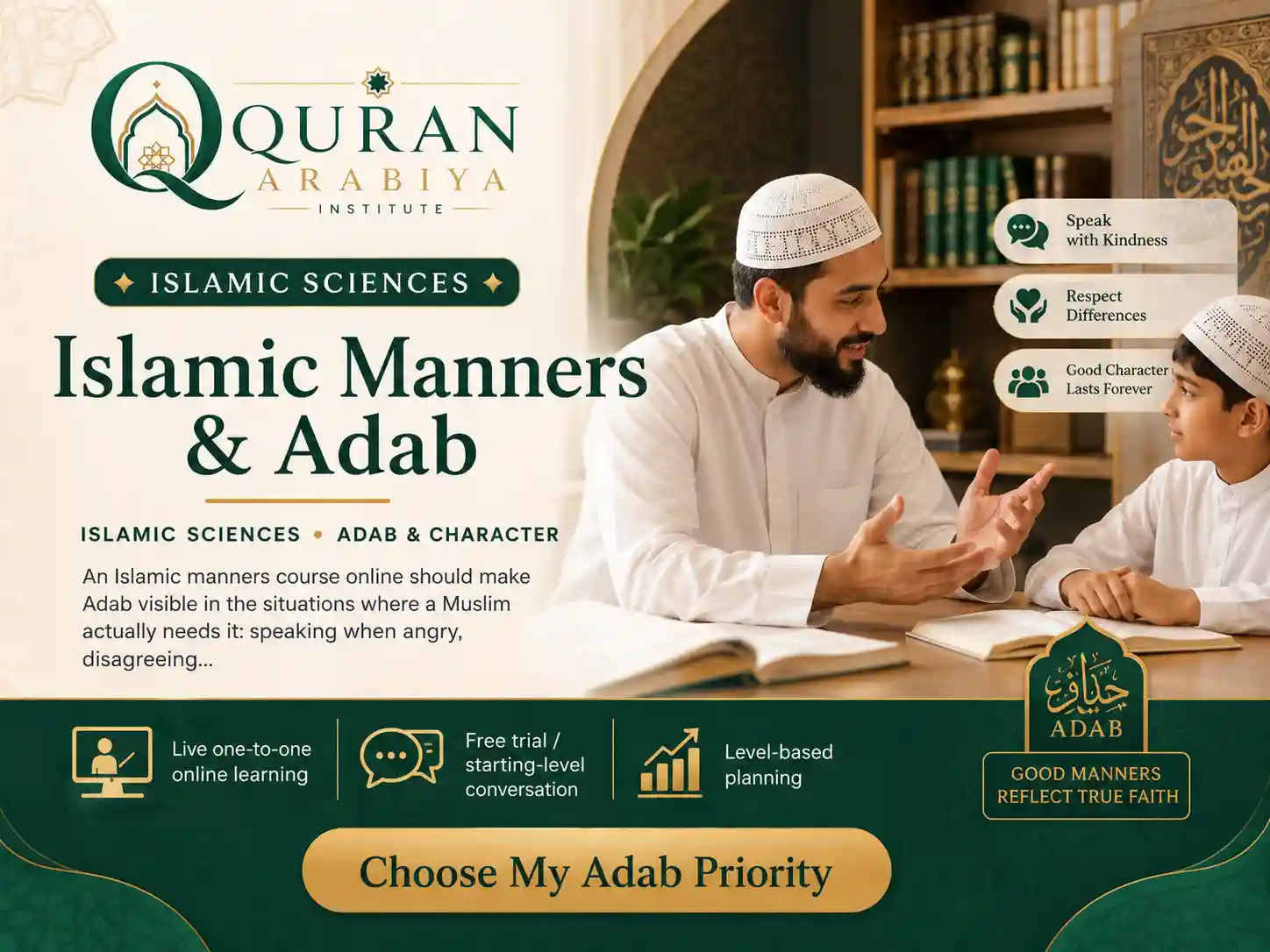
An Islamic manners course online should make Adab visible in the situations where a Muslim actually needs it: speaking when angry, disagreeing without humiliation, treating parents and family with care, entering someone’s space, keeping promises, using social media responsibly and showing respect in ordinary interaction.
Quran Arabiya Institute can teach an Islamic Adab course through clear principles, Prophetic examples and realistic scenarios. For learners searching for Akhlaq classes online or Muslim manners and etiquette, the focus should remain on character and conduct habits; Hadith Studies and Duas & Adhkar remain separate specialist paths.
Adab often refers to refined conduct and appropriate etiquette, while Akhlaq points more broadly to character traits. In practical teaching the two reinforce one another: patience shapes speech, humility shapes disagreement and mercy shapes how power is used.
The course should keep definitions simple enough to be useful, then move quickly into situations where the learner can recognize the principle in action.
Adab often refers to refined conduct and appropriate etiquette, while Akhlaq points more broadly to character traits. In practical teaching the two reinforce one another: patience shapes speech, humility shapes disagreement and mercy shapes how power is used. The aim is to understand the principle clearly enough to recognize where it applies.
Speech is one of the most frequent places where manners are tested. Lessons can explore honesty, avoiding harmful speech, listening, interrupting, joking, correcting another person and disagreeing without contempt.
Scenario-based practice helps learners move from “I know this is wrong” to “I can recognize the moment before I do it.”
A useful checkpoint is to explain the idea in the learner’s own words, identify one example, and know when a deeper specialist course is the better next step.
Islamic character course content should include the relationships people see every day: parents, spouse, siblings, children, guests and neighbors according to the learner’s age. Manners that appear only in public have not yet become a stable habit.
The teacher can help the student choose one realistic home behavior to observe and practise between lessons.

Islamic character course content should include the relationships people see every day. Manners that appear only in public have not yet become a stable habit. The aim is to understand the principle clearly enough to recognize where it applies, with guided discussion checking understanding before the learner moves deeper.
Modern daily life gives you repeated chances to practise Adab: group chats, teasing, privacy, deadlines, teamwork, disagreement and public communication. Guided scenarios help you notice the choice in front of you and practise a more respectful response. A Muslim manners and etiquette course can connect established principles of respect, honesty and responsibility to those settings without inventing new religious rulings.
When a situation becomes a legal/Fiqh question rather than an etiquette question, the course should route it appropriately.
Each lesson can identify a principle, walk through a scenario, then choose one small habit. For example, pause before replying when angry; ask permission before sharing someone’s information; greet before making a request; or review whether a joke embarrasses another person.
This gives the learner an action to practice without promising instant personality change.
A practical checkpoint is to explain one idea in simple words and connect it to one realistic situation before adding another concept.
Modern daily life gives you repeated chances to practise Adab: group chats, teasing, privacy, deadlines, teamwork, disagreement and public communication. Guided scenarios help you notice the choice in front of you and practise a more respectful response.
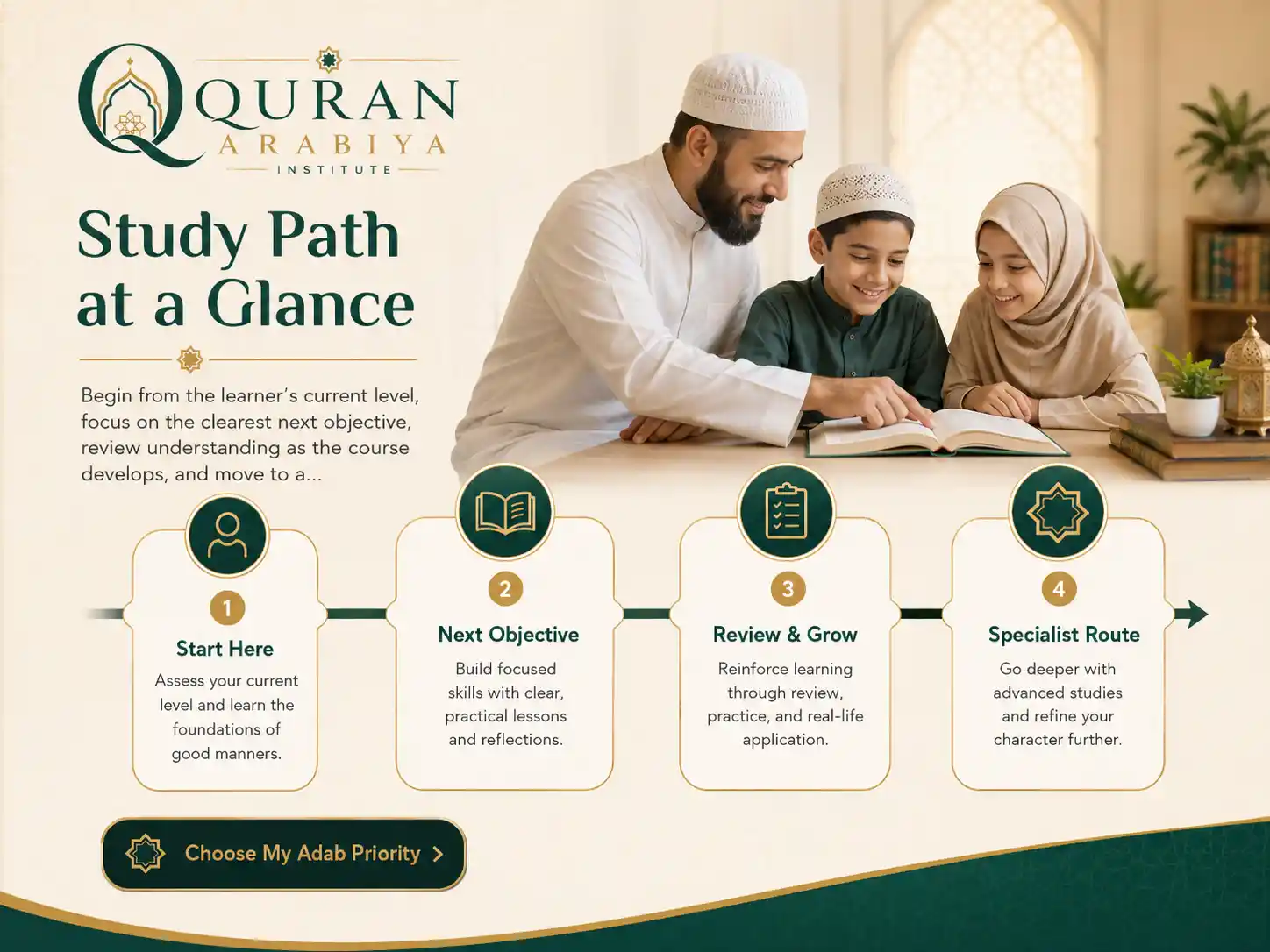
Prophetic teachings and Seerah examples can ground Islamic ethics for Muslims, but the page should use only carefully verified narrations and keep explanation focused on the Adab principle. Technical Hadith terminology and source criticism belong on the Hadith Studies page.
Hadith and Seerah can give you strong examples of Islamic manners, while deeper Hadith study or historical detail remains available in the specialist courses if you want to continue further.
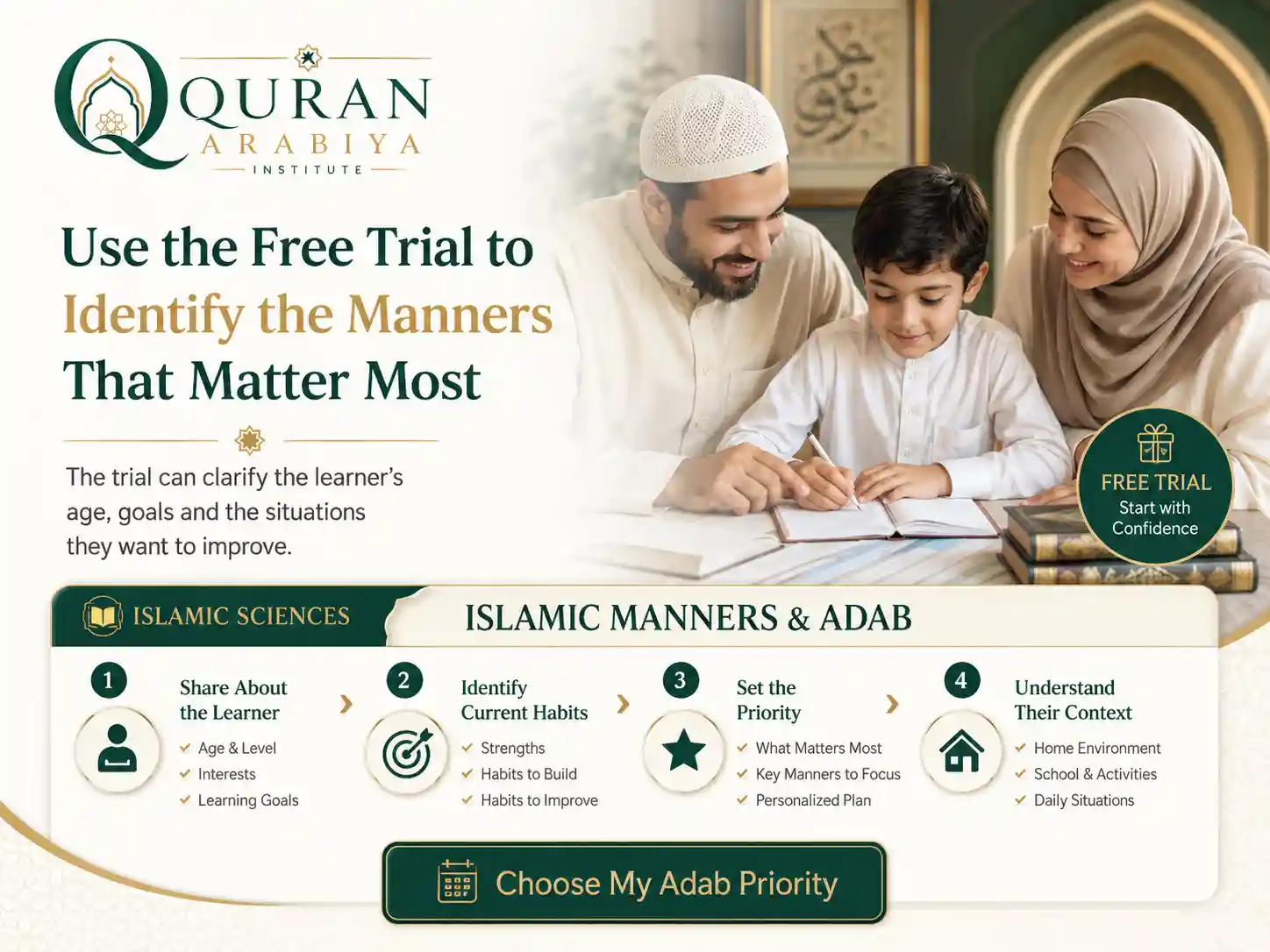
The trial can clarify the learner’s age, goals and the situations they want to improve. A parent may prioritize sibling behavior and respect; an adult may want speech, workplace interaction or family etiquette.
That makes the course practical from the first lesson and helps determine whether Adab is the right specialist route or part of a broader Islamic Studies plan.
Can explain the difference between knowing a rule of manners and applying it in a situation.
Recognizes common speech, family and social situations where Adab matters.
Builds small repeatable conduct habits instead of relying on vague intentions.
Uses Prophetic examples as guidance while keeping Hadith/Fiqh specialist boundaries clear.
Can reflect on behavior progress without expecting guaranteed personality change.
Book a free trial to identify the everyday situations where Adab needs the most attention and build a focused character-and-conduct learning plan.
No. Manners and character can be taught to kids, teens and adults, with scenarios adapted to age and life context.
They overlap. Adab commonly emphasizes appropriate conduct/etiquette, while Akhlaq is often used for underlying character. The course can teach both in practical relationship.
Verified Hadith may be used as evidence and examples, but technical Hadith study belongs to the dedicated Hadith course.
Some relevant supplications may appear, but the dedicated Duas & Adhkar course owns systematic daily supplication/remembrance study.
No. Teaching can build understanding, awareness and practice habits; personal character development depends on sustained effort and many influences.
Kids, teens or adults who want a focused character/etiquette route rather than a broad Islamic Studies or Hadith class.
The learner does not need to repeat every introductory point automatically. The starting conversation can identify what is already stable, what is only familiar by name and which concept needs the first focused explanation or practice.
Private teaching lets the teacher adjust vocabulary, pace, examples and questioning without changing the academic goal. It also creates space to stop on a misunderstood concept, check it from another angle and continue only when the learner can explain it more independently.
The course can explain relevant evidence and terminology at the level required by the subject, while avoiding claims beyond the confirmed text, teacher or syllabus. High-trust topics remain guided study rather than independent fatwa, hadith grading or personal interpretation.
No. The course gives the learner a structured foundation and helps identify the next priority. When one subject becomes the main goal, the specialist Aqeedah, Fiqh, Hadith, Tafsir, Adab or other dedicated route should take over rather than being compressed into one page.
The trial can identify current knowledge, goals, preferred depth and the most suitable route before regular enrollment. It is used as a placement and fit step, not as guaranteed certification, a fatwa session or a promise of fixed completion time.
Progress should be visible in understanding and application rather than chapters finished. A useful checkpoint is whether the learner can can explain the difference between knowing a rule of manners and applying it in a situation. recognizes common speech, family and social situations where adab matters.
The next step should follow the skill or science that becomes dominant. Own Islamic manners course online, Islamic Adab course, Akhlaq classes online and Muslim manners/etiquette intent. Hadith and Duas can support the course but must retain their own dedicated pages. Once that role has been fulfilled, the teacher can recommend the most relevant specialist route instead of expanding the course beyond its intended scope.
If you are considering Islamic manners course online, begin with the concept or study gap that matters most now. The free trial can clarify your current level, intended depth and best-fit route without inventing a certificate, fixed duration or specialist ruling that has not been verified.