A Seerah course online is most useful when it gives you more than a sequence of famous events. This course is designed to help learners follow the life of Prophet Muhammad ﷺ as one connected journey: the Makkan mission, Hijrah, community building in Madinah, major turning points, Prophetic character and the lessons that become clearer when each event is understood in context.
The page is intentionally broader than a single textbook. It is for students who want to learn Seerah online with enough chronology, maps, relationship notes and guided discussion to understand why events mattered – while leaving named-book study to the separate Ar-Raheeq Al-Makhtum course.
A useful Seerah course online should help you see sequence before detail. The learner moves from Arabia before the mission, to the early Makkan call, persecution, migration, community building in Madinah, major encounters and treaties, the opening of Makkah, the Farewell Pilgrimage and the Prophet's ﷺ final days. The point is not to race through dates; it is to understand how one phase prepares the next.
That connected view changes the way students remember Seerah. Names and events stop floating on their own because each one has a place, a cause and a consequence. A simple timeline, map and short recap at the end of each unit can make the life of Prophet Muhammad course easier to retain without turning it into a school-style memorization exercise.
A useful Seerah course online should help you see sequence before detail. The point is not to race through dates; it is to understand how one phase prepares the next. The aim is to connect the detail to its wider chronology and historical context.
Seerah is often reduced to inspirational takeaways too quickly. A better method first asks: What was happening? Who was involved? What options existed? What changed afterward? Only then does the teacher guide reflection on patience, courage, mercy, consultation, worship, leadership or family conduct.
This keeps practical application tied to the actual event. It also helps online Seerah classes avoid a common weakness: using one historical moment as a slogan while leaving the student unable to explain the event itself.
The section should finish with one short recap in the learner’s own words so the new detail stays connected to the wider historical framework.
Many episodes in the Prophetic biography become clearer when students recognize the Qur'anic passages or authentic narrations connected to them. The course can point out these relationships at an appropriate level without turning the Seerah page into a Tafsir or Hadith-specialist course.
For a learner who wants to learn Seerah online seriously, this source connection builds better habits: ask where a report comes from, distinguish a central event from a later storytelling detail, and notice when the Qur'an itself frames the meaning of a historical moment.
Many episodes in the Prophetic biography become clearer when students recognize the Qur'anic passages or authentic narrations connected to them. The course can point out these relationships at an appropriate level without turning the Seerah page into a Tafsir or Hadith-specialist course. The aim is to connect the detail to its wider chronology and historical context.
Prophetic character is more meaningful when studied across changing situations. Mercy in a family setting, patience under persecution, consultation in public affairs, restraint after victory and clarity in teaching all reveal different dimensions of the same character.
A Prophetic biography course should therefore do more than collect virtues. It should ask learners to compare situations and explain how the Prophet ﷺ responded to people with different needs, levels of understanding and relationships to the Muslim community.
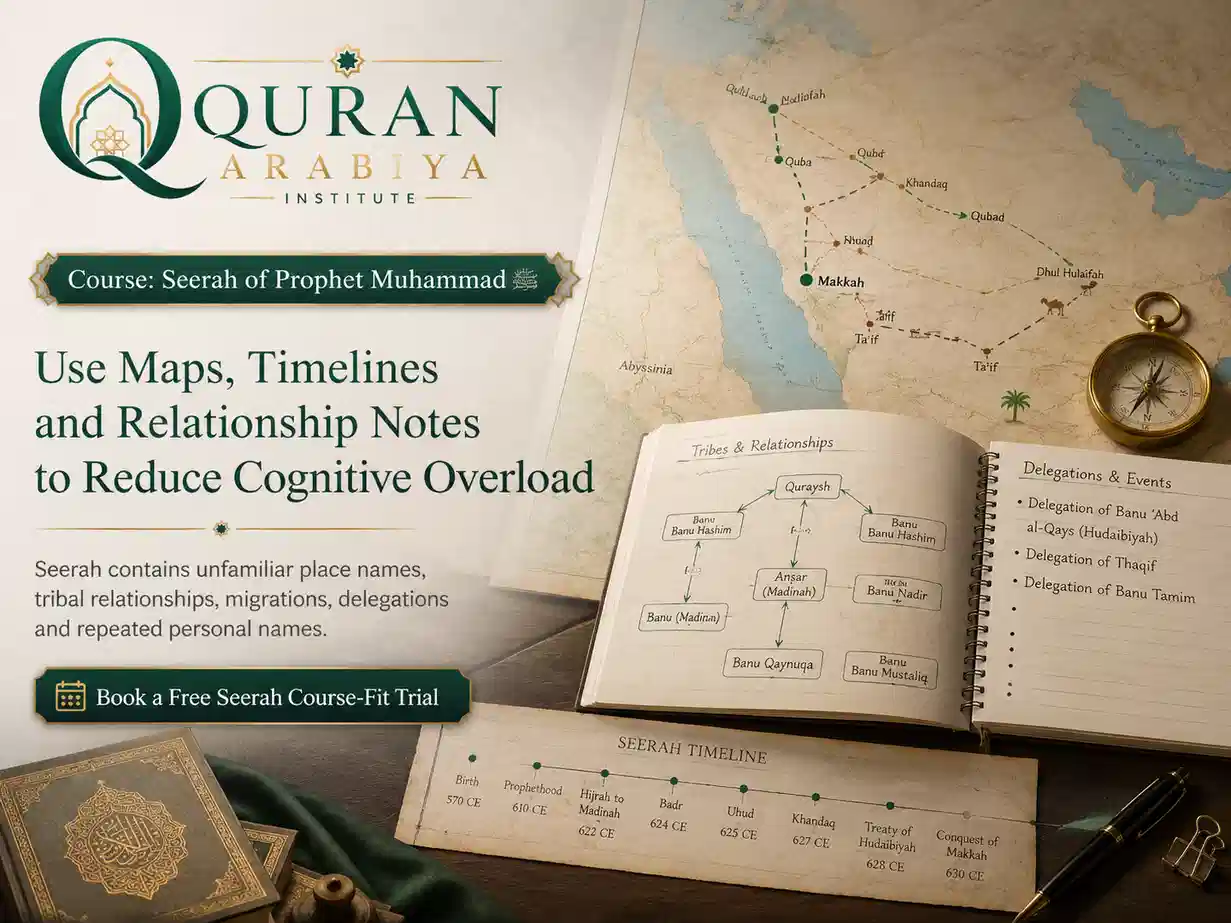
Seerah contains unfamiliar place names, tribal relationships, migrations, delegations and repeated personal names. A learner can lose the story even when every individual fact is explained correctly. Visual or written organizers solve that problem without oversimplifying the subject.
The teacher can keep a running timeline, note key locations and briefly identify recurring people when they reappear. That is especially useful for students taking Seerah of Prophet Muhammad classes in English who may not already know the Arabic naming patterns.
A useful study habit is to keep a short cause → event → consequence note. That makes chronology easier to remember without reducing history to dates.
Prophetic character is more meaningful when studied across changing situations.
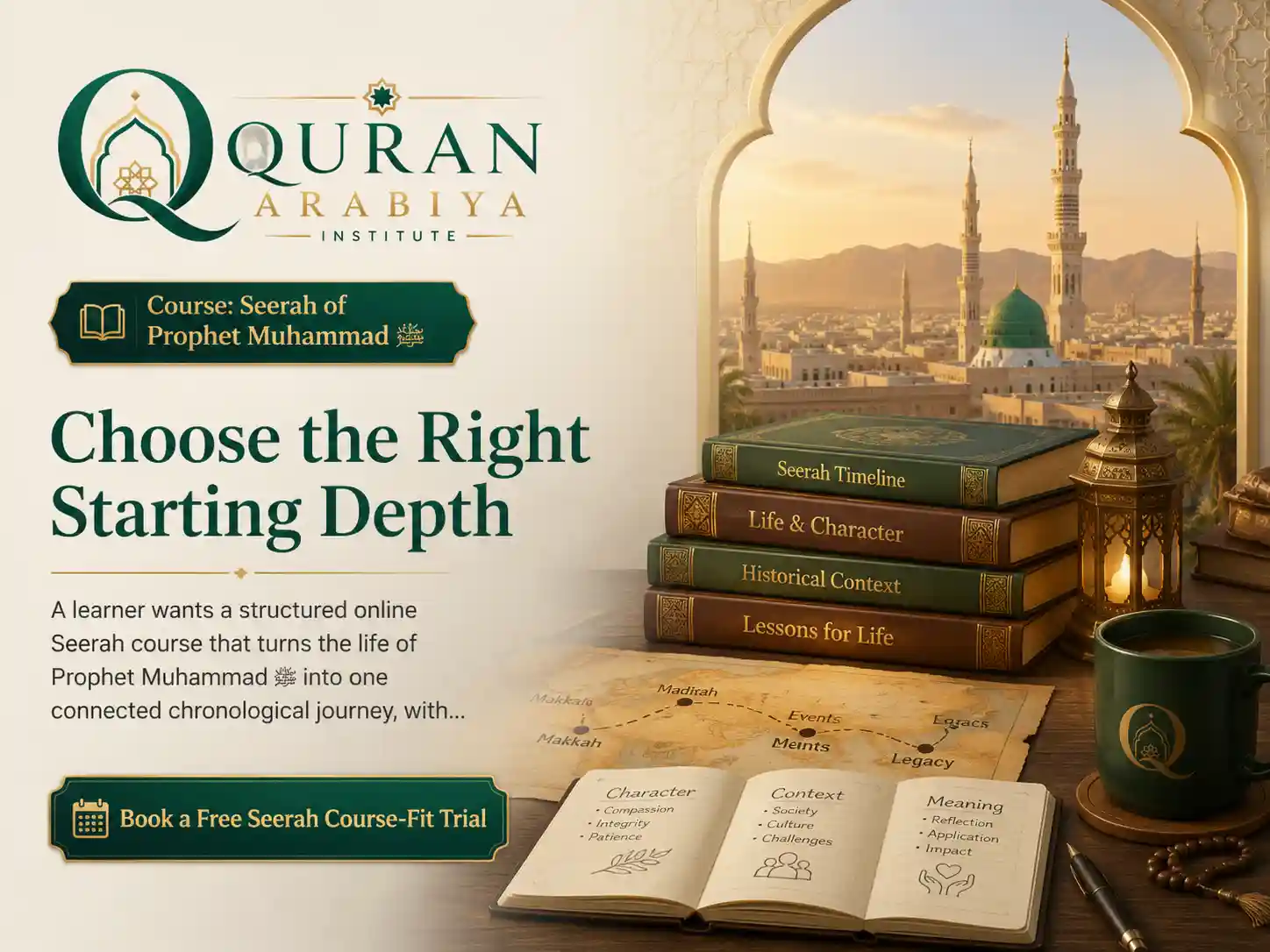
One learner may be completely new; another may have listened to years of lectures but still lacks chronology; a third may want source-aware study and deeper discussion. Private lessons allow the starting point and depth to change without changing the course's central intent.
The free trial can identify whether the student needs a complete beginner route, a chronological consolidation route or a deeper guided study. Students who specifically want to work through The Sealed Nectar should be directed to the Ar-Raheeq Al-Makhtum course rather than forcing that book into every Seerah plan.
The strongest outcome is not remembering every date. It is being able to retell the major phases of the Prophetic mission, locate important events, explain why selected turning points mattered and identify lessons without detaching them from context.
That framework prepares the student for deeper study of Hadith, Tafsir, the Sahabah, the Rightly Guided Caliphs or a broader history of Islam course because the Prophetic period is no longer a collection of isolated stories.
Retell the main phases of the Prophet's ﷺ life in a clear chronological order.
Explain the context and significance of major selected events rather than only naming them.
Recognize where Qur'anic passages or authentic Hadith help illuminate Seerah context at an appropriate level.
Describe dimensions of Prophetic character across different relationships and circumstances.
Know when to continue into Ar-Raheeq, Sahabah, Rashidun or wider Islamic history study.
Book a free trial to explain your current Seerah knowledge and the depth you want. The academy can then recommend a starting point, teacher match and realistic study route without forcing every learner through the same sequence at the same pace.
Yes. A beginner can start with chronology, key names and major turning points. A returning learner can use the same course to repair gaps and go deeper where needed.
No. This page owns the broad Seerah journey. Ar-Raheeq Al-Makhtum is the named-book pathway for students who specifically want guided study through The Sealed Nectar.
Not necessarily. The course can be taught in clear English with Arabic names and terms explained. Arabic can add depth, but it should not be assumed as a prerequisite unless the selected syllabus requires it.
No. A balanced Seerah covers worship, family, teaching, migration, community formation, treaties, conflict, mercy, leadership and the Prophet’s ﷺ final legacy.
Yes, at a supporting level. Relevant connections can be highlighted, while detailed Tafsir and Hadith methodology remain separate specialist subjects.
Teens and adults, returning learners, parents seeking a structured Seerah path for an older child, and students who know famous events but cannot place them in order or explain why they mattered.
The starting point does not have to be lesson one. In a live one-to-one setting, the teacher can identify what is already clear, locate the first real gap and adjust the depth without changing the course’s central historical focus.
Chronology is used as an organizing spine rather than a memorization target. Timelines, cause-and-consequence notes and short recaps help the learner explain how one event prepares the next and why a turning point matters.
The course should distinguish well-established chronology from interpretive or disputed details and avoid turning a debated reading into a marketing promise. Where the source document flags caution, the teacher can explain that difference rather than flatten it into certainty.
Arabic is not assumed as a universal prerequisite for this category. If a selected text, edition or reading route requires a particular language level, that should be confirmed during the course-fit conversation before regular study begins.
The academic focus stays intact while explanation, pacing and depth can change. One-to-one teaching allows the teacher to spend more time on names, relationships, maps, source questions or analytical discussion according to the learner’s age and prior study.
The conversation can clarify age, prior knowledge, preferred depth, learning goal and suitable scheduling before the route is chosen. It is a starting-level discussion, not a promise of a fixed syllabus length or certificate.
If you are considering Seerah course online, begin with the historical question you actually want answered and the depth you can sustain. The free trial can clarify your starting knowledge and route you into this course or a more specific sibling topic without turning disputed interpretation into a fixed promise.