A Stories of the Sahaba course online becomes valuable when the Companions are studied as real people with different strengths, responsibilities, decisions and contributions – not as a collection of disconnected praise stories. Learners follow selected biographies inside the wider Prophetic context and ask what faith, sacrifice, learning, service and character looked like in lived situations.
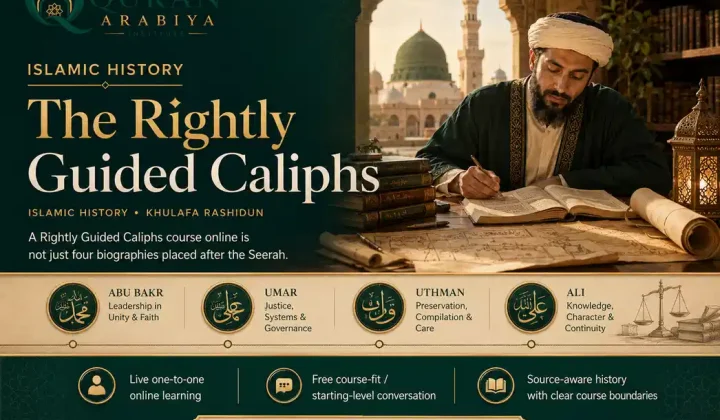
This course focuses on the lives, character and major lessons of the Sahabah. If your interest moves toward governance, succession and the first four caliphates as a connected historical period, the Rightly Guided Caliphs course is the better next step.
Stories of the Sahaba are most powerful when the learner sees more than a list of famous names. The Companions included people with different ages, backgrounds, temperaments, professions, family roles and forms of service. Some became known for knowledge, some for sacrifice, some for leadership, generosity, courage, teaching or preservation of Hadith.
A Stories of the Sahaba course online can use that diversity to show that faith does not produce one personality template. The question becomes: how did this person use their circumstances and strengths in service of Islam?

Stories of the Sahaba are most powerful when the learner sees more than a list of famous names. The Companions included people with different ages, backgrounds, temperaments, professions, family roles and forms of service. The aim is to connect the detail to its wider chronology and historical context.
A companion's life becomes clearer when students know when they accepted Islam, what phase the Muslim community was in, and which events shaped their choices. The course should therefore keep a simple Seerah timeline in the background even though Seerah is not the main keyword owner here.
This prevents biographies of Sahaba classes from becoming detached motivational stories. The learner can understand why migration, persecution, Madinah, major battles or the Prophet's ﷺ passing changed the responsibilities of particular companions.
The visual organizer is there to reduce cognitive load, not to replace explanation. Places become useful when the learner can explain why location changed the story.
It is easy to say that a companion was brave or generous. It is more useful to examine the decision that demonstrated that quality, the risk or sacrifice involved, and what the learner can legitimately conclude from the report.
This makes a Sahabah stories course suitable for older learners. They can discuss intention, loyalty, learning, family, wealth, leadership, disagreement and service without reducing every biography to a one-line virtue.
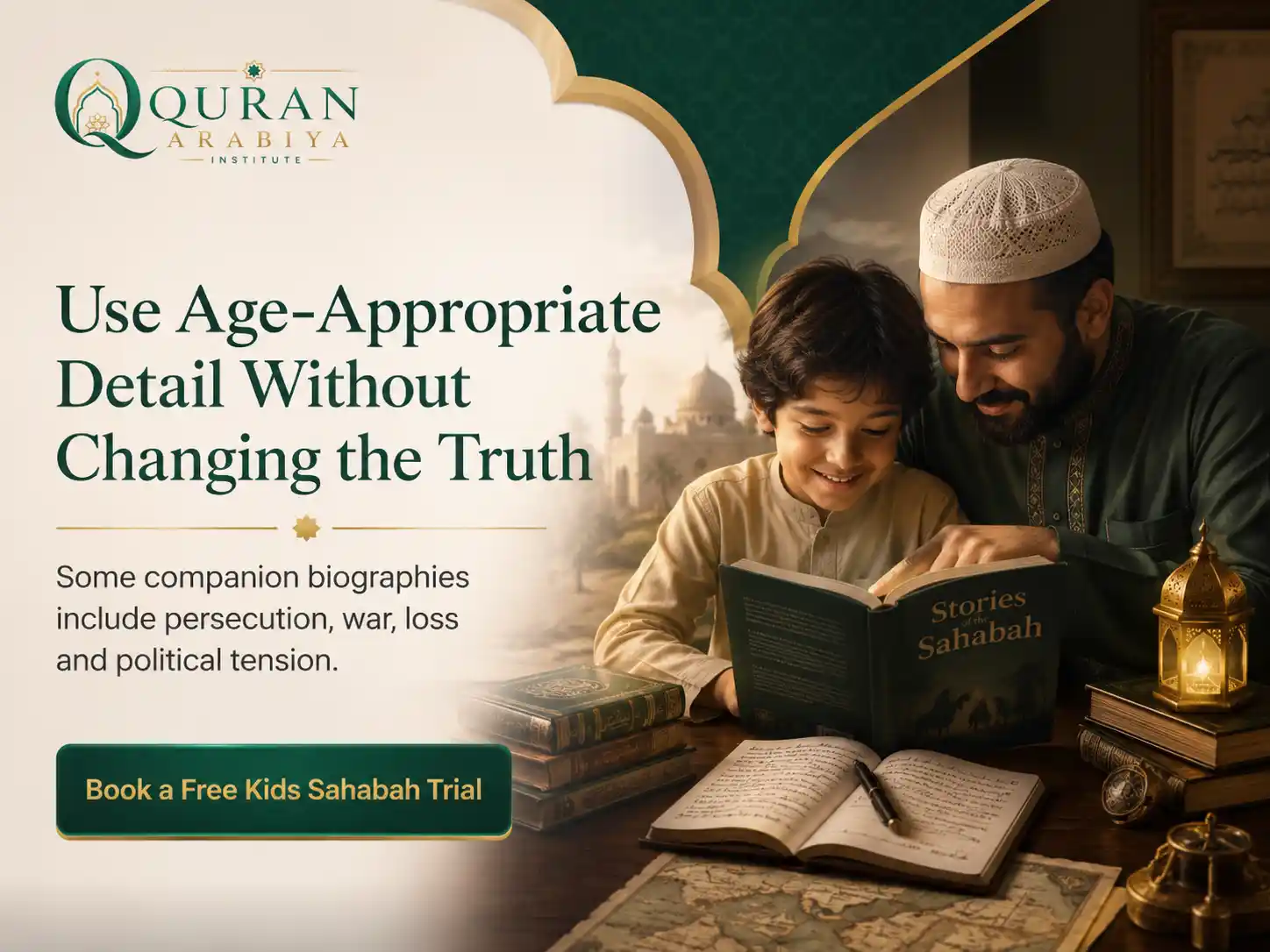
It is easy to say that a companion was brave or generous. It is more useful to examine the decision that demonstrated that quality. The aim is to connect the detail to its wider chronology and historical context, with guided discussion checking understanding before the learner moves deeper.
Many students know the Sahabah mainly through battles. A stronger course also introduces their role in learning the Quran, transmitting Hadith, teaching new Muslims, answering questions, traveling, governing communities and preserving Prophetic practice.
That broader lens helps a companions of Prophet course connect biography with the later development of Islamic scholarship while leaving specialist Hadith methodology to the Hadith course.
Companion stories are widely shared in books, speeches and social media. Some are well established; others are simplified, combined or retold without a clear reference. The teacher should model cautious language and avoid presenting every popular anecdote as a verified historical fact.
Students do not need advanced hadith criticism to learn this habit. They can simply ask: Is this in a recognized source? Is the report central to the biography? Are we treating a later narration as certain?
Source awareness should remain visible: established chronology, debated interpretation and later storytelling are not treated as the same kind of claim.
Many students know the Sahabah mainly through battles.

A useful review method groups biographies around themes such as seeking knowledge, generosity, migration, steadfastness, family service, leadership or courage. The comparison helps memory, but each companion should still be understood in their own context.
This gives learn about Sahabah online content a structure that is easier to revisit than a long chronological name list.
Abu Bakr, Umar, Uthman and Ali رضي الله عنهم are companions and therefore may appear here, but detailed study of their caliphates, governance, expansion and political trials belongs to the Rightly Guided Caliphs page.
This page can focus on their companionship, faith and formative biographies, then link the student to the Rashidun course when the intent becomes leadership history.

Describe the biographies and defining contributions of selected Sahabah with historical context.
Compare different forms of faith, sacrifice, knowledge, service and leadership among the Companions.
Place selected companions inside the broader Seerah timeline.
Use cautious source language rather than repeating every popular anecdote as fact.
Distinguish companion-biography study from specialist Rashidun political history.
Book a free trial and explain whether you want a first introduction to the Sahabah, a thematic biography route or deeper context after studying Seerah. The academy can match the level and choose a realistic starting set of companions.
In standard Sunni usage, a Sahabi is a person who met the Prophet Muhammad ﷺ as a believer and died upon Islam. The course can explain terminology in an age-appropriate way.
No. The lives of the Companions course should include a wider range of Sahabah. Detailed caliphal leadership belongs to the separate Rightly Guided Caliphs course.
A balanced approved syllabus can include women and men among the Sahabah. The exact list should be confirmed by the academy rather than invented on the page.
This general page allows deeper biography, context and discussion. The kids page owns child-friendly storytelling, review and character transfer.
The teacher should prioritize reliable sources and use cautious wording or omit reports that cannot be responsibly presented as established history.
Teens, adults and families with older learners who want stronger knowledge of the Sahabah, their diversity, sacrifices, learning, service and role in transmitting Islam.
The starting point does not have to be lesson one. In a live one-to-one setting, the teacher can identify what is already clear, locate the first real gap and adjust the depth without changing the course’s central historical focus.
Chronology is used as an organizing spine rather than a memorization target. Timelines, cause-and-consequence notes and short recaps help the learner explain how one event prepares the next and why a turning point matters.
The course should distinguish well-established chronology from interpretive or disputed details and avoid turning a debated reading into a marketing promise. Where the source document flags caution, the teacher can explain that difference rather than flatten it into certainty.
Arabic is not assumed as a universal prerequisite for this category. If a selected text, edition or reading route requires a particular language level, that should be confirmed during the course-fit conversation before regular study begins.
The academic focus stays intact while explanation, pacing and depth can change. One-to-one teaching allows the teacher to spend more time on names, relationships, maps, source questions or analytical discussion according to the learner’s age and prior study.
The conversation can clarify age, prior knowledge, preferred depth, learning goal and suitable scheduling before the route is chosen. It is a starting-level discussion, not a promise of a fixed syllabus length or certificate.
Progress should become visible in explanation, sequence and context rather than page count alone. A useful checkpoint is whether the learner can describe the biographies and defining contributions of selected sahabah with historical context. compare different forms of faith, sacrifice, knowledge, service and leadership among the companions.
The next step depends on the intent this page deliberately does not absorb. Do not turn this into a four-caliph political history page. Do not copy the kids page’s activities/hero framing. Do not publish viral anecdotes without source review. The teacher can use the final lessons to identify the most logical sibling course instead of stretching this page beyond its purpose.
If you are considering Stories of the Sahaba course online, begin with the historical question you actually want answered and the depth you can sustain. The free trial can clarify your starting knowledge and route you into this course or a more specific sibling topic without turning disputed interpretation into a fixed promise.