A Rightly Guided Caliphs course online is not just four biographies placed after the Seerah. It studies what happened to leadership, governance, expansion, public responsibility and internal challenge after the Prophet's ﷺ passing, while following the caliphates of Abu Bakr, Umar, Uthman and Ali in sequence.
The course is designed for learners who want Khulafa Rashidun history with enough context to understand decisions and consequences. It approaches civil conflict and succession questions with source awareness and respectful scholarly framing rather than turning difficult history into polemics.
The Rightly Guided Caliphs course begins with a difficult historical transition: the Muslim community had lost the Prophet ﷺ, but still had to preserve worship, unity, leadership, security and public responsibilities. Studying this moment helps learners see why succession was not just a list of names.
The course can explain the standard Sunni understanding of Abu Bakr, Umar, Uthman and Ali رضي الله عنهم as al-Khulafa al-Rashidun while teaching disputed events with careful language rather than pretending every later interpretation is identical.
A Rashidun Caliphate history course should therefore keep chronology and governance visible, while Khulafa Al Rashideen classes can still pause for biography when a personal decision helps explain a larger public event.

The Rightly Guided Caliphs course begins with a difficult historical transition. Studying this moment helps learners see why succession was not just a list of names. The aim is to connect the detail to its wider chronology and historical context.
Abu Bakr's period is not simply a shorter version of Umar's, and Umar's is not the same political problem as Uthman's or Ali's. Each caliph governed a community with different pressures, scale and internal conditions.
A Four Caliphs course online should therefore compare decisions within context: consolidation and Ridda-era challenges, rapid expansion and administration, growing complexity and criticism, then the severe internal conflict faced in Ali's caliphate.
A useful study habit is to keep a short cause → event → consequence note. That makes chronology easier to remember without reducing history to dates.
The Rashidun period saw dramatic territorial expansion, but geography should be taught alongside administration, new populations, military organization, revenue, governors and the challenge of governing a community that was changing quickly.
Maps help learners see scale; they should not replace questions about how expansion affected institutions, communication, social relations and later political tensions.
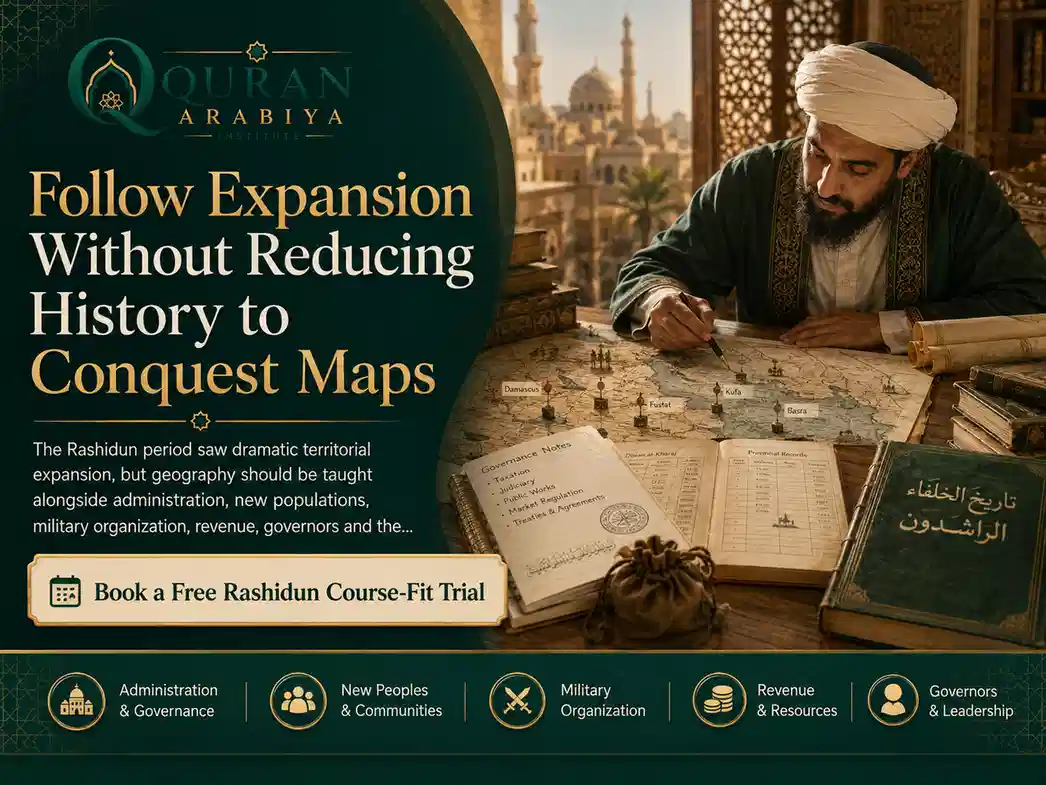
The Rashidun period saw dramatic territorial expansion, but geography should be taught alongside administration, new populations, military organization, revenue, governors and the challenge. Maps help learners see scale; they should not replace questions about how expansion affected institutions, communication, social relations and later political tensions. The aim is to connect the detail to its wider chronology and historical context.
Biographies of Rightly Guided Caliphs are often used for leadership inspiration. The course can make that useful by asking what information the caliph had, which principle or public interest was at stake, what alternatives existed and what consequences followed.
This produces a more serious Khulafa Rashidun course than simply collecting quotations about justice. Historical leadership becomes a set of decisions made under real constraints.
The later Rashidun period includes events that remain emotionally and theologically sensitive. A responsible course should explain the chronology, identify major actors and distinguish well-established events from disputed motives or later partisan interpretations.
The aim is understanding, not sectarian argument. Students should learn to avoid casual judgment of the Sahabah and to recognize when a historical claim needs a stronger source or more careful wording.
Source awareness should remain visible: established chronology, debated interpretation and later storytelling are not treated as the same kind of claim.
Biographies of Rightly Guided Caliphs are often used for leadership inspiration.
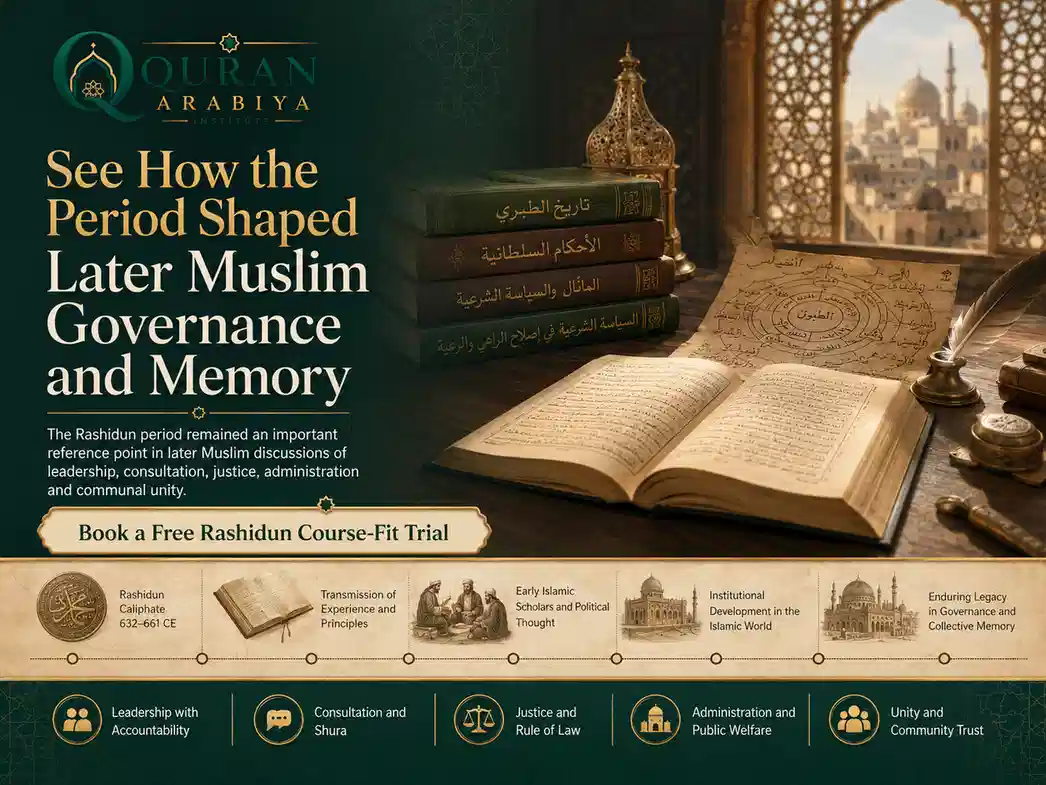
The Rashidun period remained an important reference point in later Muslim discussions of leadership, consultation, justice, administration and communal unity. The course can introduce that legacy without claiming that every later state copied the period directly.
Learners can also see how institutions and political problems developed into the next era, making Umayyad History a natural continuation rather than a completely new story.
Some students arrive wanting the personalities of the four caliphs; others want governance and chronology; others are trying to understand the early civil wars. The trial can identify which emphasis is most useful while keeping the page's primary role clear.
Students who mainly want inspiring companion biographies should be routed to Stories of the Sahabah. Students who need the wider timeline may be better served by Islamic History for Beginners first.

Place the four Rashidun caliphates in chronological order and explain the main transition between them.
Describe key leadership, administrative and expansion challenges faced in each period.
Understand the broad chronology of the First Fitna with respectful, source-aware language.
Distinguish companion biography from caliphal political history.
Explain how the Rashidun period connects the Prophetic era to Umayyad history.
Book a free trial and tell the academy whether your goal is basic chronology, leadership study, early Islamic governance or a careful introduction to the political trials of the period. The teacher can recommend the right depth and prerequisites.
In the standard Sunni framing used by the course title, they are Abu Bakr, Umar ibn al-Khattab, Uthman ibn Affan and Ali ibn Abi Talib رضي الله عنهم.
No. The Sahabah course centers on companion biographies. This course centers on the four caliphates, leadership, governance, major events and the political transition after the Prophet ﷺ.
It can, with an academy-approved scholarly approach that explains chronology and source issues without turning the subject into sectarian polemics.
It helps, especially the Prophet’s ﷺ final years and the community at his passing, but a teacher can provide the necessary bridge for a beginner.
Umayyad History is the direct specialist continuation. A full Islamic history course can place both eras inside a larger chronology.
Teens and adults who know the four names but want to understand the post-Prophetic transition and the Rashidun period as history rather than isolated biographies.
The starting point does not have to be lesson one. In a live one-to-one setting, the teacher can identify what is already clear, locate the first real gap and adjust the depth without changing the course’s central historical focus.
Chronology is used as an organizing spine rather than a memorization target. Timelines, cause-and-consequence notes and short recaps help the learner explain how one event prepares the next and why a turning point matters.
The course should distinguish well-established chronology from interpretive or disputed details and avoid turning a debated reading into a marketing promise. Where the source document flags caution, the teacher can explain that difference rather than flatten it into certainty.
Arabic is not assumed as a universal prerequisite for this category. If a selected text, edition or reading route requires a particular language level, that should be confirmed during the course-fit conversation before regular study begins.
The academic focus stays intact while explanation, pacing and depth can change. One-to-one teaching allows the teacher to spend more time on names, relationships, maps, source questions or analytical discussion according to the learner’s age and prior study.
The conversation can clarify age, prior knowledge, preferred depth, learning goal and suitable scheduling before the route is chosen. It is a starting-level discussion, not a promise of a fixed syllabus length or certificate.
Progress should become visible in explanation, sequence and context rather than page count alone. A useful checkpoint is whether the learner can place the four rashidun caliphates in chronological order and explain the main transition between them. describe key leadership, administrative and expansion challenges faced in each period.
The next step depends on the intent this page deliberately does not absorb. Do not duplicate generic Sahabah virtues. Do not narrate the Umayyad dynasty beyond the transition. Treat succession and civil-war material with approved Sunni framing. The teacher can use the final lessons to identify the most logical sibling course instead of stretching this page beyond its purpose.
Use the final lessons to connect the four caliphates as one historical sequence: leadership after the Prophet ﷺ, expansion, governance, internal trials and the transition toward Umayyad rule. If one part becomes your main interest, your teacher can help you continue into Sahabah biography, Seerah or Umayyad history.