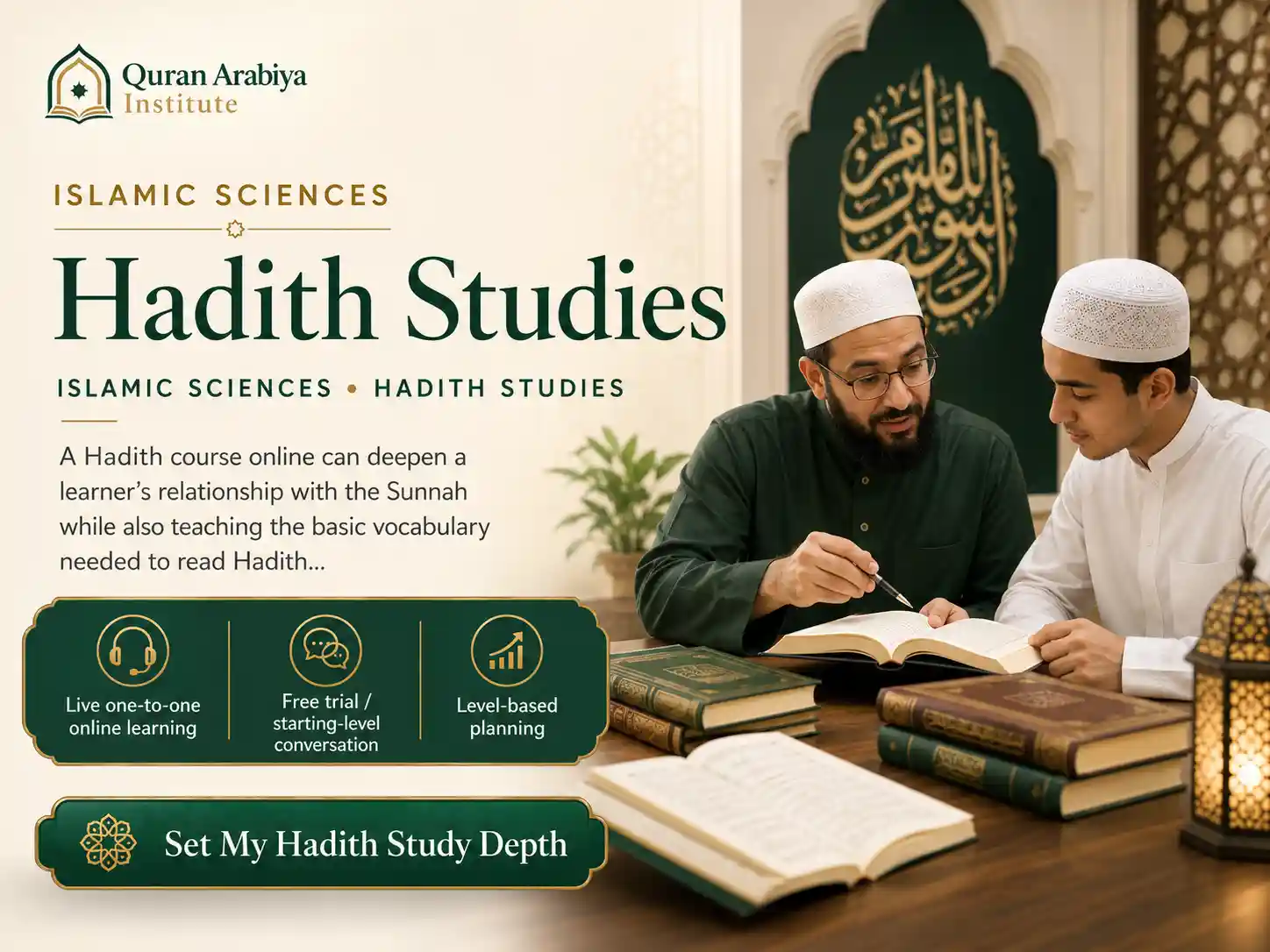
A Hadith course online can deepen a learner’s relationship with the Sunnah while also teaching the basic vocabulary needed to read Hadith responsibly. The course should explain what a Hadith is, how Prophetic teachings function in Islamic learning, and why scholars pay attention to transmission, wording, context and classification.
For students looking for Hadith studies course online or online Hadith classes, Quran Arabiya Institute can combine selected narrations with an introduction to Hadith sciences. The page must stay academically honest: learning what isnad, matn and common grades mean is not the same as becoming qualified to authenticate Hadith independently.
Learn Hadith online should begin by clarifying key terms and the relationship between Prophetic teachings and the broader Islamic tradition. The learner needs a framework before they are given technical classification labels.
This opening also helps separate Hadith Studies from a general Islamic Studies course: here, the text, transmission and understanding of Prophetic reports are the central object of study.
Learn Hadith online should begin by clarifying key terms and the relationship between Prophetic teachings and the broader Islamic tradition. The learner needs a framework before they are given technical classification labels. The aim is to understand the principle clearly enough to recognize where it applies.
An introduction to Hadith sciences can explain isnad as the chain of transmitters and matn as the reported text/content. Students can learn why source identification matters and why scholarly transmission was not treated as anonymous quotation.
The purpose is literacy. A beginner should understand what these terms point to without being told that a few definitions are enough to perform expert authentication.
The learner should distinguish the course explanation from independent source authentication or personal interpretation. Guided study keeps evidence connected to scholarly scope.
Sunnah studies online should not reduce Hadith to inspirational one-liners. A selected narration can be read carefully, difficult words explained, immediate context introduced when relevant and the central lesson distinguished from extra assumptions.
This produces more responsible application and reduces the risk of treating a translation fragment as a complete legal ruling.
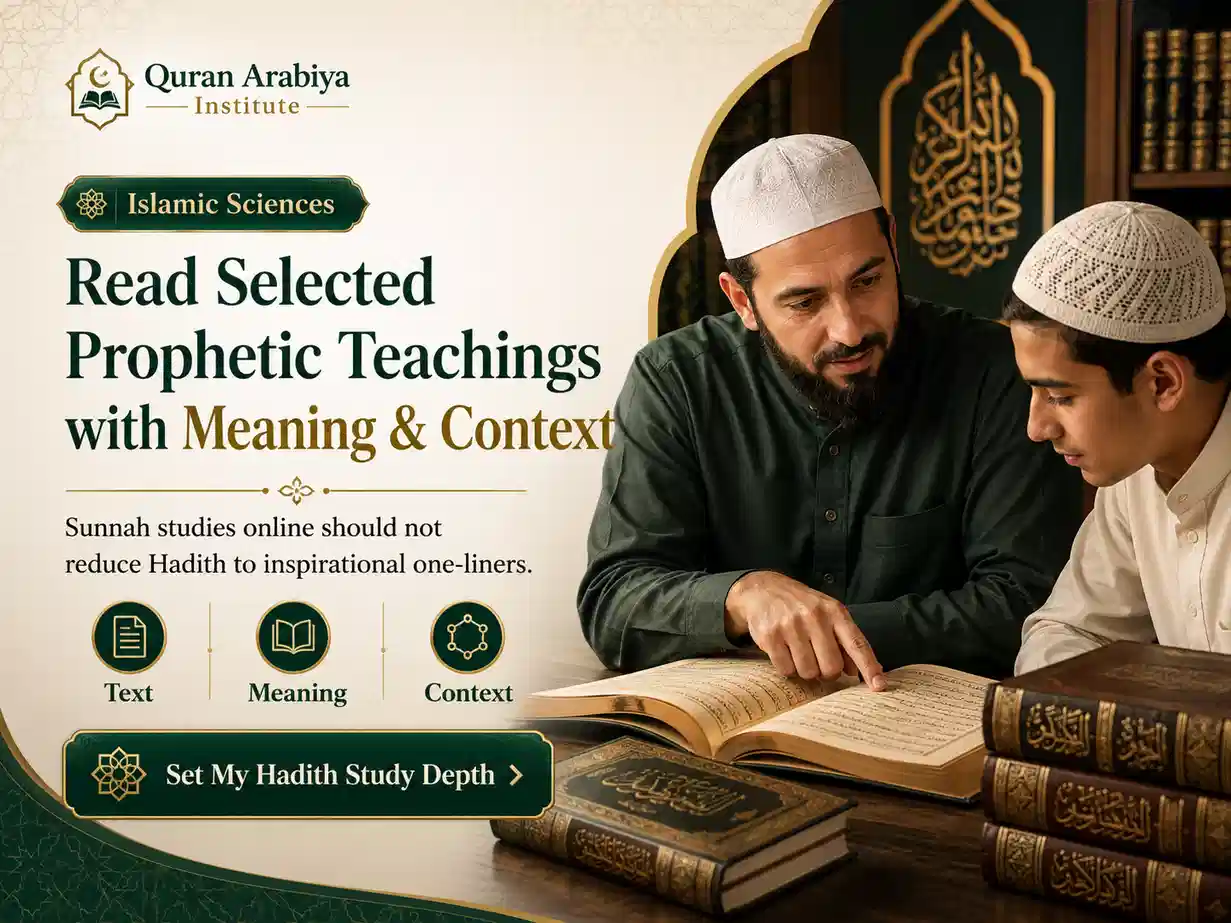
Sunnah studies online should not reduce Hadith to inspirational one-liners. A selected narration can be read carefully, difficult words explained, immediate context introduced when relevant and the central lesson distinguished from extra. The aim is to understand the principle clearly enough to recognize where it applies.
Learners commonly encounter labels such as Sahih, Hasan or Da‘if. A foundational course can explain that these labels belong to scholarly methods involving transmission and evaluation, and that books/scholars may discuss narrations with technical nuance.
The course should avoid teaching a simplistic checklist that implies a student can independently re-grade narrations after a few lessons.
Prophetic teachings can illuminate worship, manners, faith and daily conduct, but application should respect the difference between a moral lesson and a juristic ruling. A teacher can point out when a narration is being studied for guidance and when legal interpretation belongs to Fiqh specialists.
This is one of the most valuable habits in responsible Hadith learning.
The learner should distinguish the course explanation from independent source authentication or personal interpretation. Guided study keeps evidence connected to scholarly scope.
Learners commonly encounter labels such as Sahih, Hasan or Da‘if.
The general course owns Hadith foundations, terminology and a range of selected teachings. The 40 Hadith Nawawi course online is a named-collection route focused on Imam Nawawi’s compilation and its core lessons.
Learners who specifically want Arbaeen Nawawi should be routed there rather than forcing this page to target both intents.
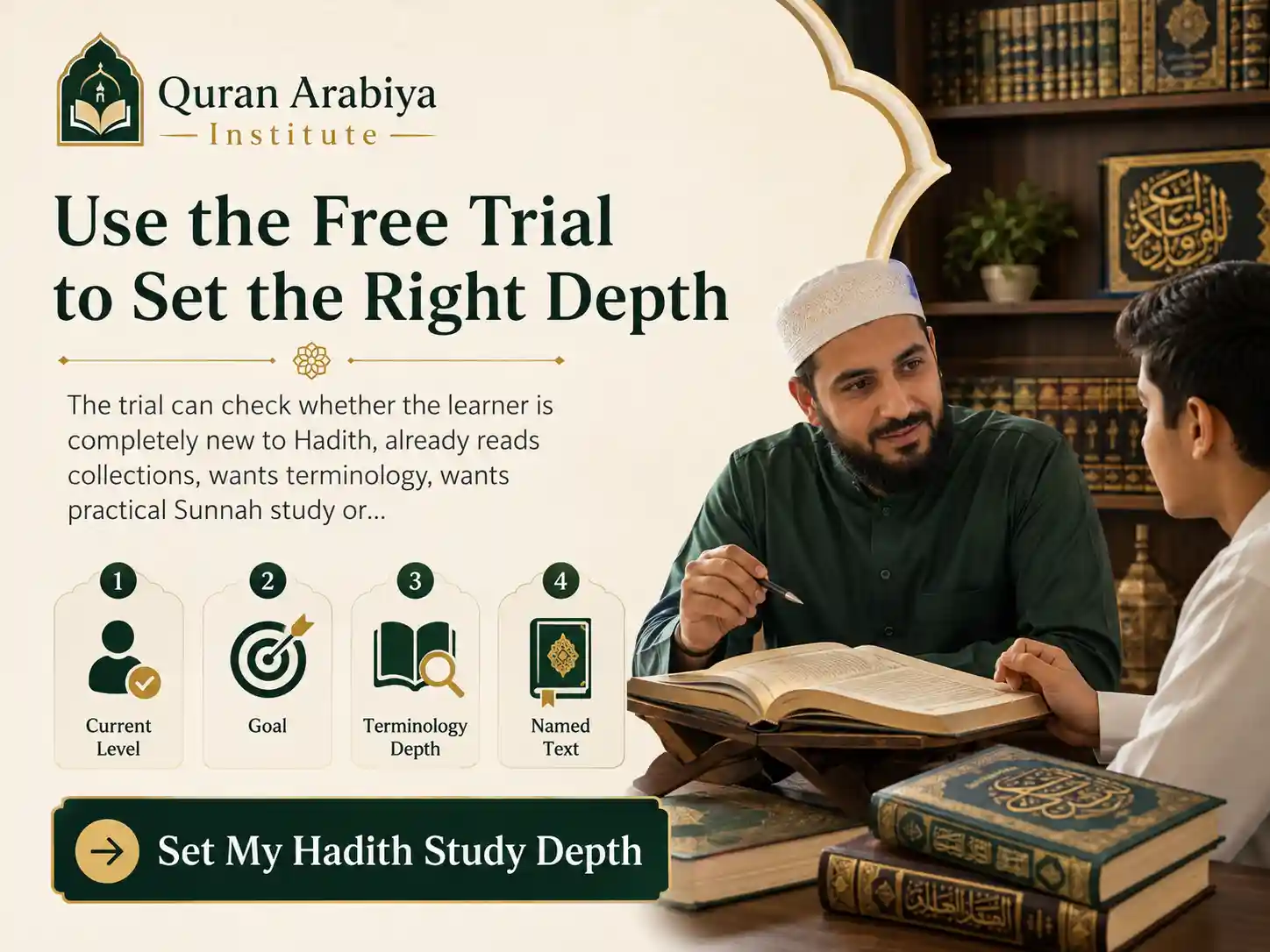
The trial can check whether the learner is completely new to Hadith, already reads collections, wants terminology, wants practical Sunnah study or prefers a named text. The teacher can then recommend general Hadith Studies or a more defined course.
This also helps confirm language needs and whether Arabic terms should be introduced more gradually.
Understands the role of Hadith and Sunnah in Islamic learning.
Recognizes basic terms such as isnad and matn and explains why source structure matters.
Reads selected narrations with greater attention to wording and context.
Understands the purpose of common classification terminology without claiming independent grading authority.
Can choose between general Hadith Studies and a named-collection route such as 40 Hadith Nawawi.
Book a free trial to clarify whether you need general Hadith foundations, selected Sunnah study or a named collection such as Imam Nawawi’s Forty.
Not necessarily for an English-guided introductory course. Key Arabic terms can be introduced gradually; advanced source study may require more Arabic.
The course can introduce common terminology and why classification matters, but it should not promise independent authentication skill.
Memorization may be used as a learning tool if appropriate, but the general page is primarily about understanding Hadith and introductory foundations.
No. Nawawi’s Forty is a dedicated named-collection page; general Hadith Studies has broader source and terminology scope.
Do not assume this. Any Ijazah or transmission authorization requires a specific verified route and teacher and must be separately confirmed.
Teens/adults who want to understand the role of Hadith/Sunnah, read selected narrations responsibly and learn introductory terminology such as isnad and matn.
The learner does not need to repeat every introductory point automatically. The starting conversation can clarify what is already stable, what is only familiar by name and which concept needs the first focused explanation or practice.
Private teaching lets the teacher adjust vocabulary, pace, examples and questioning without changing the academic goal. It also creates space to stop on a misunderstood concept, check it from another angle and continue only when the learner can explain it more independently.
The course can explain relevant evidence and terminology at the level required by the subject, while avoiding claims beyond the confirmed text, teacher or syllabus. High-trust topics remain guided study rather than independent fatwa, hadith grading or personal interpretation.
No. The course is educational and should keep its scholarly scope clear. Personal rulings, estate cases, legal/tax questions or independent authentication require the appropriately qualified person and the full facts of the real case.
The trial can clarify current knowledge, goals, preferred depth and the most suitable route before regular enrollment. It is used as a placement and fit step, not as guaranteed certification, a fatwa session or a promise of fixed completion time.
The next step should follow the skill or science that becomes dominant. Own general Hadith studies course online, online Hadith classes and introduction to Hadith sciences intent. The 40 Hadith Nawawi page owns the named collection; the children’s page owns kids Hadith. Once that role has been fulfilled, the teacher can recommend the most relevant specialist route instead of expanding the course beyond its intended scope.
If you are considering Hadith course online, begin with the concept or study gap that matters most now. The free trial can clarify your current level, intended depth and best-fit route without inventing a certificate, fixed duration or specialist ruling that has not been verified.