A word can be perfectly understood in isolation and still be misunderstood inside a sentence. The opposite is also true: you may recognize the grammatical role but miss what the word's pattern contributes to meaning. This Nahw and Sarf course online brings the two perspectives together. Sarf shows how Arabic words are formed and transformed; Nahw shows how those words function, relate and change inside sentences.
The course is for learners who want more than broad conversational grammar. It develops the analytical toolkit needed for classical Arabic study, while keeping deeper standalone Sarf, Quran-only analysis and specific grammar texts in their own dedicated courses.
The central habit is to ask two sets of questions. At the word level: what is the root, pattern, form and derivation? At the sentence level: what governs this word, what role does it play, and what relationship does it have to what comes before and after?
Nahw Sarf for non Arabic speakers becomes far less abstract when every term answers one of those questions. The teacher can translate traditional terminology into a working analysis process, then gradually expect the learner to use the Arabic labels independently.
The central habit is to ask two sets of questions. At the word level: what is the root, pattern, form and derivation? The aim is to make the analysis repeatable in a fresh Arabic example rather than leave the rule as terminology remembered in isolation.
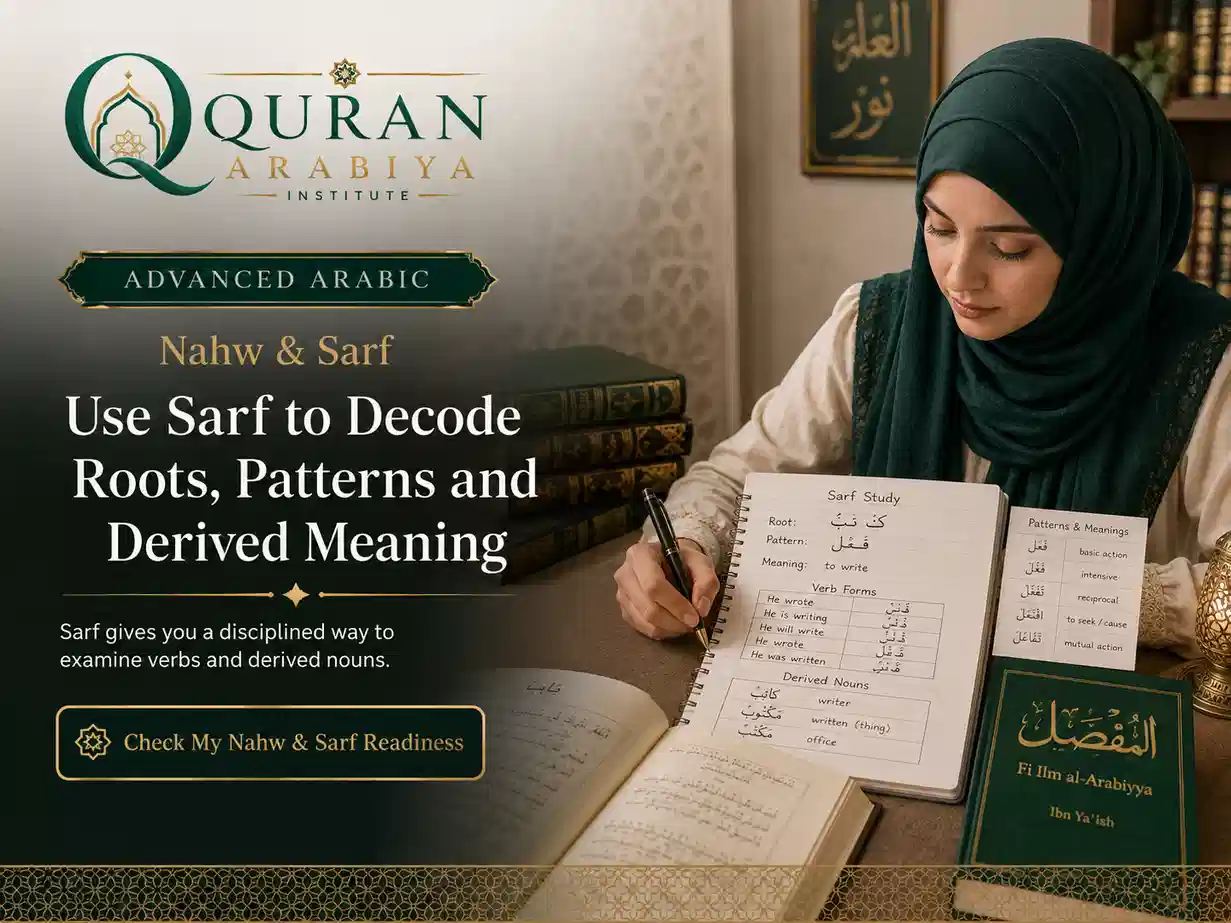
Sarf gives you a disciplined way to examine verbs and derived nouns. You learn to recognize roots, identify common patterns, trace conjugational changes and notice how added letters or pattern changes may signal a new grammatical or semantic function. The goal is not to assume that a root automatically gives you the final meaning, but to narrow the possibilities intelligently.
Students who want to learn Nahw and Sarf often discover that morphology also improves vocabulary retention. Related forms can be organized as a family rather than memorized as unrelated dictionary entries.
A useful check is whether the learner can explain the relationship, test it on a fresh example and correct the reasoning when the first analysis fails. That is stronger evidence than recalling the rule name alone.
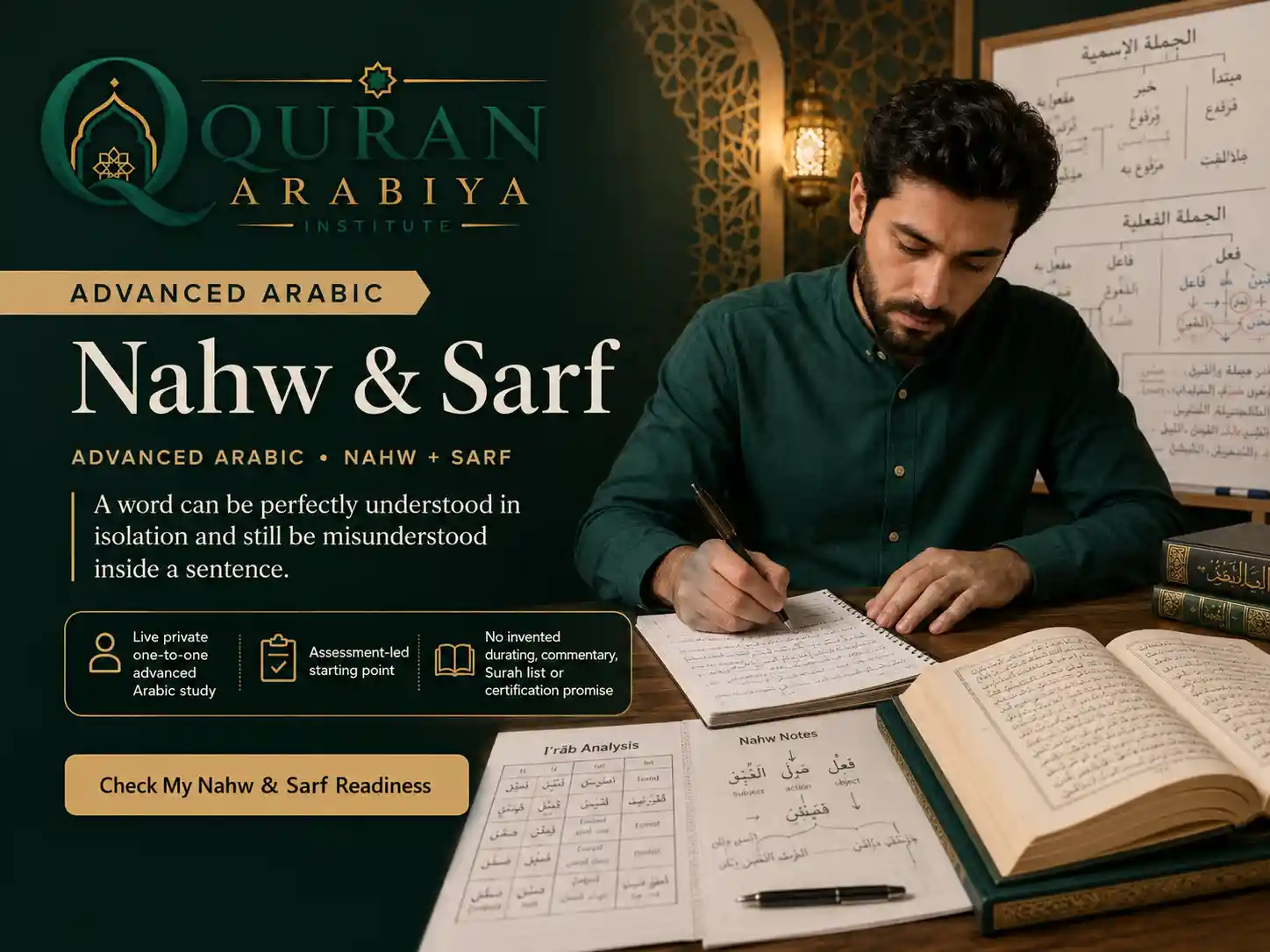
Nahw moves from the internal word to the architecture of the sentence. You work with nominal and verbal structures, subjects and predicates, objects, modifiers, possession, prepositional relationships, particles and the effects they create. I'rab becomes a reasoning process: identify the construction, find the governing relationship and then explain the grammatical state.
This is the core of an Arabic syntax and morphology course: Sarf tells you what form you are looking at, while Nahw tells you why that form is behaving as it does in context.
Nahw moves from the internal word to the architecture of the sentence. You work with nominal and verbal structures, subjects and predicates, objects, modifiers, possession, prepositional relationships, particles and the effects. The aim is to make the analysis repeatable in a fresh Arabic example rather than leave the rule as terminology remembered in isolation.
The value of studying both sciences appears when the sentence is no longer textbook-simple. A learner may need Sarf to identify a derived verb, then Nahw to determine its subject, object and attached pronouns, and then return to morphology to understand a participle or verbal noun elsewhere in the sentence.
Nahw Sarf classes online should therefore include guided passages rather than only separate rule blocks. The teacher can model the order of analysis first, then hand more of the process to the student.
Charts and paradigms are useful reference tools, but mastery requires reconstruction. After parsing a sentence, the learner can be asked to change the tense, replace the subject, turn a derived noun into another related form, or rebuild the phrase with a different grammatical relationship. Those changes force Nahw and Sarf to interact.
A compact analysis worksheet can use four columns – form, root/pattern, syntactic role and evidence – so mistakes become visible. This is a recommended teaching device that can be adapted by the teacher, not a claim that every lesson follows one fixed worksheet.
A useful check is whether the learner can explain the relationship, test it on a fresh example and correct the reasoning when the first analysis fails. That is stronger evidence than recalling the rule name alone.

Charts and paradigms are useful reference tools, but mastery requires reconstruction. After parsing a sentence, the learner can be asked to change the tense, replace the subject, turn a derived. The aim is to make the analysis repeatable in a fresh Arabic example rather than leave the rule as terminology remembered in isolation.
Classical Arabic grammar and morphology matter because advanced texts rarely pause to explain the structures they use. Once the core framework is stable, examples can come from carefully selected classical prose and, where appropriate, Quranic phrases. The purpose here is to train the tools, not to turn the course into Tafsir or a Quranic Grammar syllabus.
If your main objective is detailed analysis of Quranic sentences, the Quranic Grammar course should take ownership of that intent. If your goal is sustained reading of unvowelled heritage texts, the Classical Arabic Text Reading course becomes the natural application route.
The free trial can test whether you read Arabic comfortably enough to benefit from a terminology-rich course, whether you already recognize basic sentence types and how much Sarf exposure you have. Some learners need the broad Arabic Grammar course first; others are ready to enter this combined track immediately.
A one-to-one teacher can then decide how much time to allocate to each science instead of assuming that every learner has equal weaknesses in Nahw and Sarf.

Distinguish morphological questions from syntactic questions.
Identify roots/patterns and common derived forms with increasing independence.
Explain grammatical roles and governing relationships in longer sentences.
Combine Nahw and Sarf in one analysis instead of treating them as separate subjects.
Approach selected classical sentences with a repeatable analytical workflow.
Start With a Free Trial & Placement Lesson
Book a free trial to show the teacher what you can already do, where the current bottleneck is and what you want the course to unlock. The trial can be used as a real placement and learning sample: you participate in a short task, receive correction, and leave with a clearer recommendation for the next step rather than being forced into a fixed starting point.
Book a free trial to show the teacher what you can already do, where the current bottleneck is and what you want the course to unlock. The trial can be used as a real placement and learning sample: you participate in a short task, receive correction, and leave with a clearer recommendation for the next step rather than being forced into a fixed starting point.
Frequently Asked Questions
Sarf studies the internal formation and transformation of words; Nahw studies how words function and relate inside sentences. The course trains both and, most importantly, how to use them together.
Basic reading and some sentence awareness are strongly helpful. The free trial can identify whether you should start here or strengthen broad grammar first.
It can build useful foundations, but those are separate text-based routes. Ajrumiyyah has its own page as a foundational matn, while Alfiyyah is an advanced poem-based study.
In a one-to-one format the balance can be adjusted after assessment, while the course still preserves the combined objective of linking word formation with sentence analysis.
Teens and adults with basic Arabic reading and some grammar awareness who want a more systematic traditional framework for text analysis.
That does not automatically mean you need to restart from the beginning. The free trial can test reading comfort, sentence awareness and the prerequisite skill most relevant to this course, then route you to a foundation course only when the gap would block useful advanced study.
Traditional terminology matters because it gives the learner a precise analytical language, but memorizing labels is not the final test. The stronger outcome is being able to recognize the construction, explain why the term applies and use the same reasoning on a new example.
Examples can be selected where they support the stated language objective, but the page keeps its scope clear. Quranic language analysis is not presented as Tafsir, and a named-text course does not assume an unverified commentary, edition or fixed reading list.
It allows the teacher to see the exact step where analysis breaks down: vocabulary, form recognition, grammatical relation, parsing, rhetorical reasoning or reading stamina. The lesson can then spend time on that bottleneck and test it again in a fresh example before moving on.
The trial can check readiness, prior study, goals and the most useful starting point for this specific subject. It does not guarantee a certificate, fixed syllabus length, particular book edition or teacher qualification that has not been independently confirmed.
Progress should show up in analysis and transfer, not page count alone. A useful checkpoint is whether the learner can distinguish morphological questions from syntactic questions. identify roots/patterns and common derived forms with increasing independence.
If you are considering Nahw and Sarf course online, begin with the analytical skill that is currently breaking down: form, sentence relation, parsing, rhetoric or reading transfer. The free trial can check readiness and route the learner without inventing an edition, commentary, certificate or fixed advanced outcome that has not been verified.