A Quran Tafsir course online should help the learner move beyond translation without moving into unsupported personal interpretation. Translation gives a useful starting meaning; guided Tafsir adds context, connections between verses, important terms, established background and the explanations of recognized scholars.
For learners searching for online Tafsir classes, learn Tafsir online or Quran explanation classes, Quran Arabiya Institute can use a structured verse-study method and choose Surahs/passages appropriate to the learner. Your Surah selection and reference materials are chosen according to your current Tafsir level, study goal and the teaching plan confirmed with your teacher. You will know what material you are studying before regular lessons begin.
A Quran interpretation course can explain why translation is not identical to Tafsir. A translated phrase may not show the relationship to the previous verse, the range of an Arabic term or the background that recognized commentators discuss.
The learner’s goal is guided understanding. You will study recognized Tafsir with teacher guidance, learn how meaning, context and scholarly explanation fit together, and practise responsible reflection without treating personal impressions as independent Tafsir.
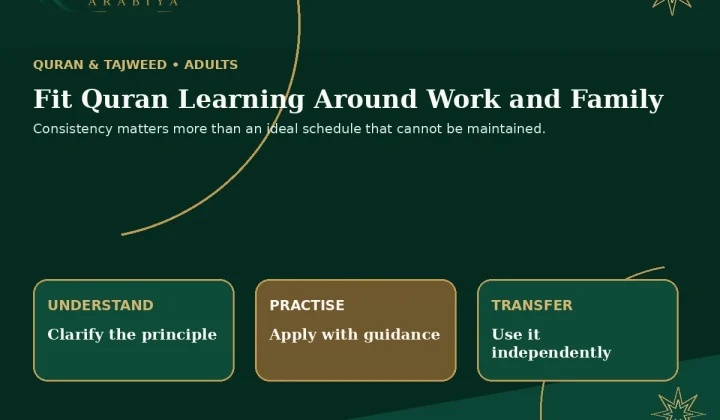
A Quran interpretation course can explain why translation is not identical to Tafsir. A translated phrase may not show the relationship to the previous verse. The aim is to understand the principle clearly enough to recognize where it applies, with guided discussion checking understanding before the learner moves deeper.
A strong lesson can move through five questions: What does the verse say in plain meaning? Which words need clarification? What context is established and relevant? How does the verse connect to the passage? What guidance is responsibly drawn from the recognized explanation?
This framework makes Quran Tafsir in English concrete and helps the student take organized notes.
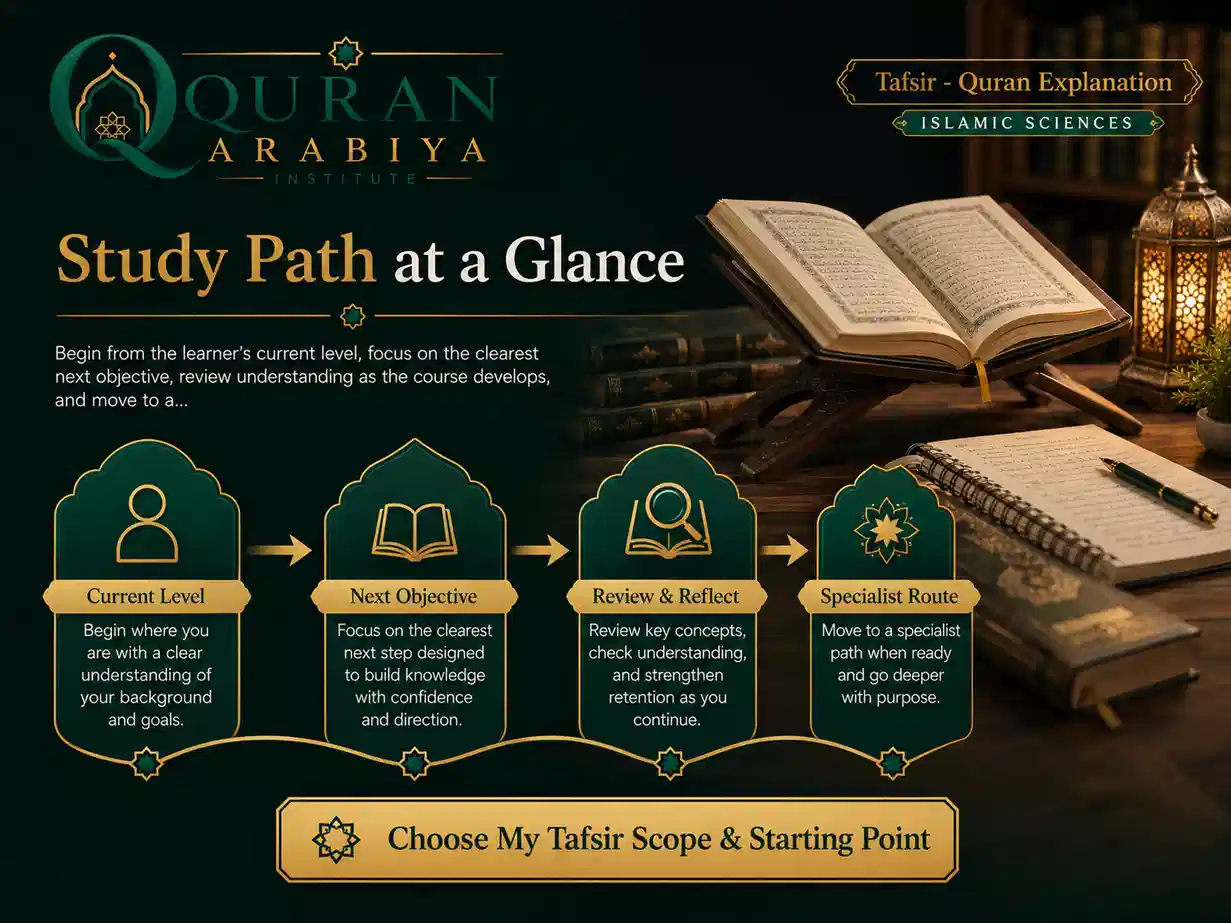
A useful checkpoint is to explain the idea in the learner’s own words, identify one example, and know when a deeper specialist course is the better next step.
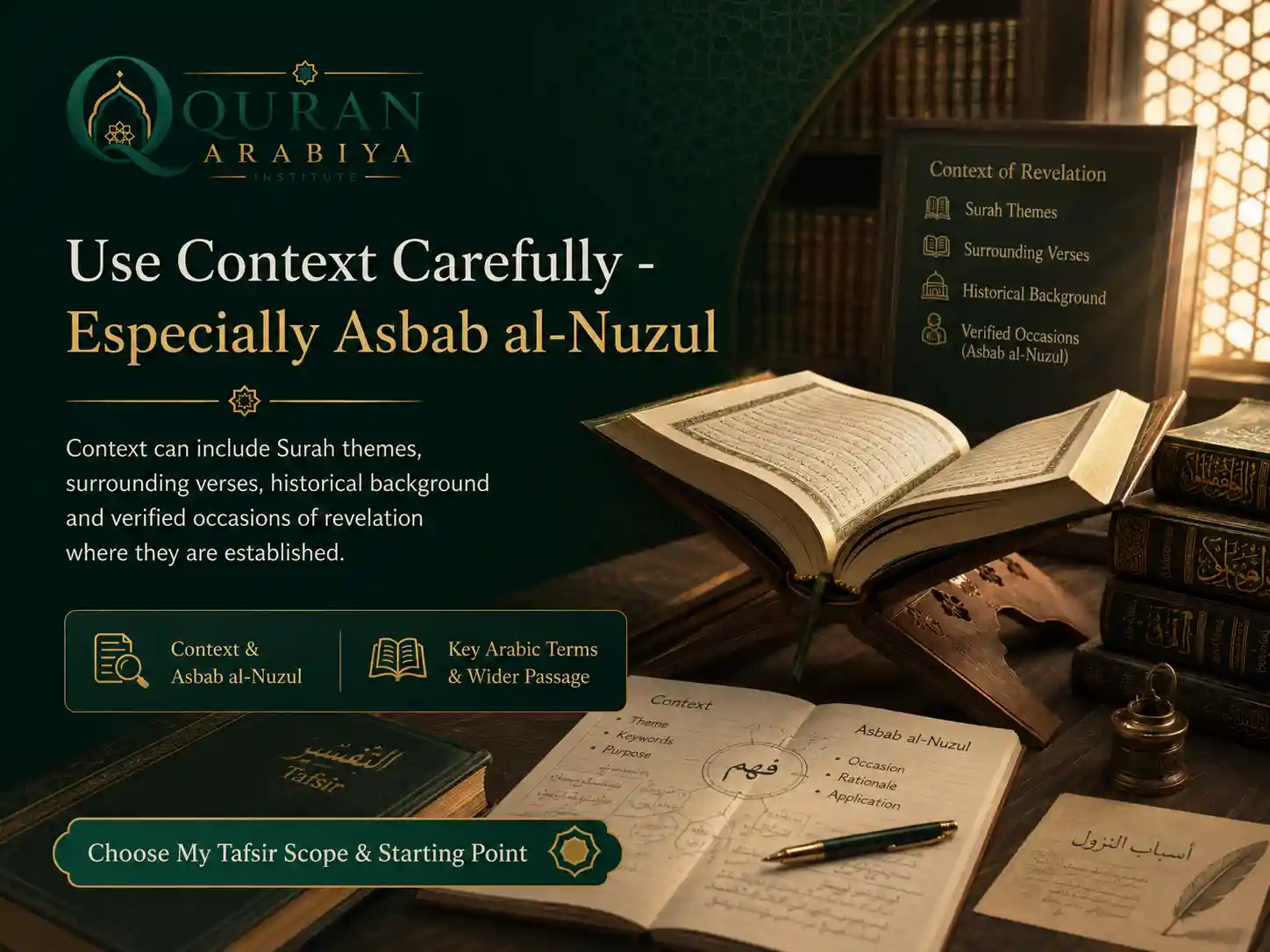
Context can include Surah themes, surrounding verses, historical background and verified occasions of revelation where they are established. The teacher should not invent an “occasion” for every verse or repeat popular stories without checking their scholarly basis.
That careful habit is part of learning Tafsir responsibly, not a limitation of the course.
Context can include Surah themes, surrounding verses, historical background and verified occasions of revelation where they are established. The teacher should not invent an “occasion” for every verse or repeat popular stories without checking their scholarly basis. The aim is to understand the principle clearly enough to recognize where it applies.
Even if you study Tafsir in English, selected Arabic terms can help when they clarify the meaning of a verse, a key concept or the relationship between words in the passage. The teacher can explain one key word without turning the lesson into an Arabic grammar course.
Equally important is the relationship between verses. Tafsir becomes clearer when a student understands why a statement appears where it does and how the passage develops its theme.
Tafsir is not complete when the learner only collects historical details. A lesson can ask what guidance the recognized commentary draws and how that principle should influence worship, character or perspective.
Reflection should remain anchored to the explained meaning rather than forcing every verse into a trendy personal-development message.
A useful checkpoint is to explain the idea in the learner’s own words, identify one example, and know when a deeper specialist course is the better next step.
Even if you study Tafsir in English, selected Arabic terms can help when they clarify the meaning of a verse, a key concept or the relationship between words in the passage.
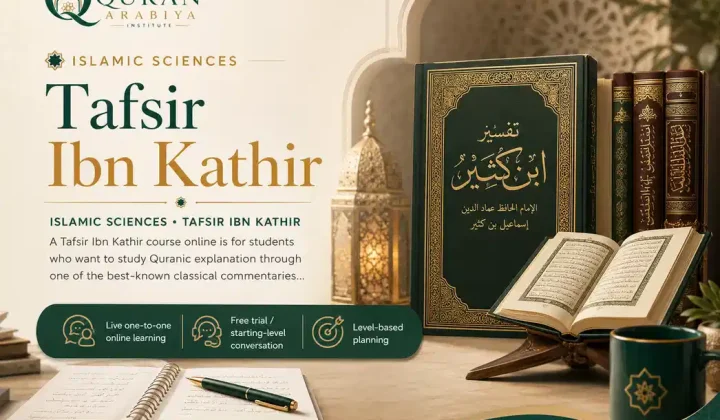
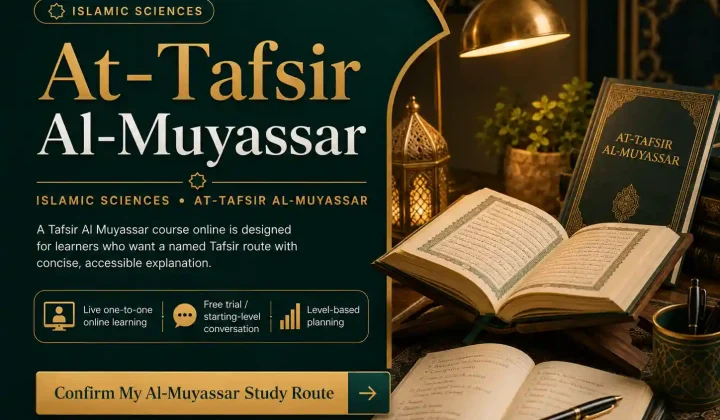
The general page is best for students who want Quran explanation without choosing one book. Tafsir Ibn Kathir course online suits learners who want that classical named commentary; Tafsir Al Sadi course online emphasizes a clear, flowing commentary route; Tafsir Al Muyassar course online serves a concise simplified-text intent.
The free trial can help select the approach based on the learner’s level and goal.
The trial can identify whether the learner is completely new to Tafsir, already reads translations, wants selected short Surahs or is ready for a longer passage-based study. The academy should then state the actual reference material and scope rather than promising a universal fixed syllabus.
This makes the page more truthful and keeps named-text pages distinct.
Understands the difference between translation and guided Tafsir.
Uses a consistent framework for verse meaning, context, connection and guidance.
Recognizes when historical/contextual claims need verification.
Connects selected Arabic terms to meaning without confusing Tafsir with a full language course.
Can choose between a general Tafsir route and a named commentary.
Book a free trial to choose the right Surah scope and decide whether you need a broad Quran Tafsir course or one of the named commentary routes.
No. The course can be taught in English while introducing selected Arabic terms when they clarify meaning.
The exact Surah/passages should be confirmed by the academy based on the course plan and learner level; do not assume a competitor’s list.
No. Translation renders meaning into another language; Tafsir adds explanation, context, relationships and scholarly interpretation.
Established occasions/context can be taught where relevant, but the course should not imply every verse has a known specific occasion of revelation.
No. The purpose is guided study of recognized explanation, not authorization for independent Tafsir.
Teens/adults who want structured Quran explanation in English without committing to one named Tafsir commentary.
The learner does not need to repeat every introductory point automatically. The starting conversation can identify what is already stable, what is only familiar by name and which concept needs the first focused explanation or practice.
Private teaching lets the teacher adjust vocabulary, pace, examples and questioning without changing the academic goal. It also creates space to stop on a misunderstood concept, check it from another angle and continue only when the learner can explain it more independently.
The course can explain relevant evidence and terminology at the level required by the subject, while avoiding claims beyond the confirmed text, teacher or syllabus. High-trust topics remain guided study rather than independent fatwa, hadith grading or personal interpretation.
No. The course is educational and should keep its scholarly scope clear. Personal rulings, estate cases, legal/tax questions or independent authentication require the appropriately qualified person and the full facts of the real case.
The trial can identify current knowledge, goals, preferred depth and the most suitable route before regular enrollment. It is used as a placement and fit step, not as guaranteed certification, a fatwa session or a promise of fixed completion time.
The next step should follow the skill or science that becomes dominant. Own general Quran Tafsir / Quran explanation classes intent. Named Ibn Kathir, As-Sa’di and Al-Muyassar pages should be linked when the learner wants a particular commentary method/text. Once that role has been fulfilled, the teacher can recommend the most relevant specialist route instead of expanding the course beyond its intended scope.
If you are considering Quran Tafsir course online, begin with the concept or study gap that matters most now. The free trial can clarify your current level, intended depth and best-fit route without inventing a certificate, fixed duration or specialist ruling that has not been verified.