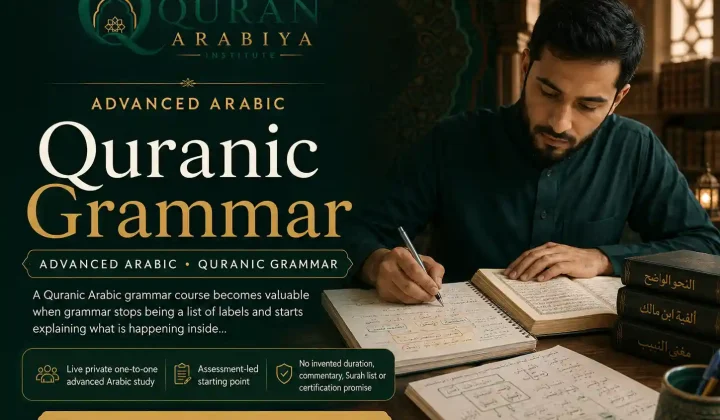
A Quranic Arabic course online should do more than give you a long vocabulary list. The real task is to help you recognize how words, patterns and sentence relationships work together inside the Quran. This course builds that ability gradually: frequent vocabulary, useful roots, recurring expressions and the grammar that explains the passage you are currently studying.
The aim is not to rush you into advanced technical analysis. It is to make each new language tool immediately useful in Quran reading, so that familiar structures begin to stand out and your dependence on word-for-word translation can decrease over time.
For Quranic Arabic for beginners, early progress is easier to feel when lessons begin with language that returns again and again. Instead of memorizing unrelated dictionary entries, the learner can group frequent nouns, verbs, particles and short expressions, then meet them repeatedly in carefully selected ayat.
A well-designed Quran vocabulary course online should make recall active. The student identifies the word in context, notices any attached pronoun or grammatical change, explains the phrase in simple terms and then meets the same item in another passage. Repetition across contexts is what turns a memorized word into usable recognition.

For Quranic Arabic for beginners, early progress is easier to feel when lessons begin with language that returns again and. Instead of memorizing unrelated dictionary entries, the learner can group frequent nouns, verbs, particles and short expressions, then meet. The aim is to make the analysis repeatable in a fresh Arabic example rather than leave the rule as terminology remembered in isolation.
Roots are powerful because they help the learner see relationships between words, but they are not a shortcut that replaces context. Students who learn Quranic Arabic online should be taught to ask two questions together: what root or pattern might help me recognize this form, and what does this particular form mean here?
That protects the learner from a common mistake: assuming that every word from one root carries one fixed English meaning. Root awareness should narrow possibilities and reveal word families; the surrounding sentence still determines how the form is understood.
A useful check is whether the learner can explain the relationship, test it on a fresh example and correct the reasoning when the first analysis fails. That is stronger evidence than recalling the rule name alone.
Arabic for understanding Quran becomes much more manageable when grammar is introduced at the point of need. If an attached pronoun changes who is being discussed, teach that relationship. If a preposition controls the following noun, show it in the passage. If a verb form reveals person, number or voice, connect the rule to the meaning the learner is trying to follow.
This keeps grammar functional. A student does not need to finish an entire general grammar curriculum before beginning Quranic Arabic; essential grammar can grow alongside vocabulary and guided reading.
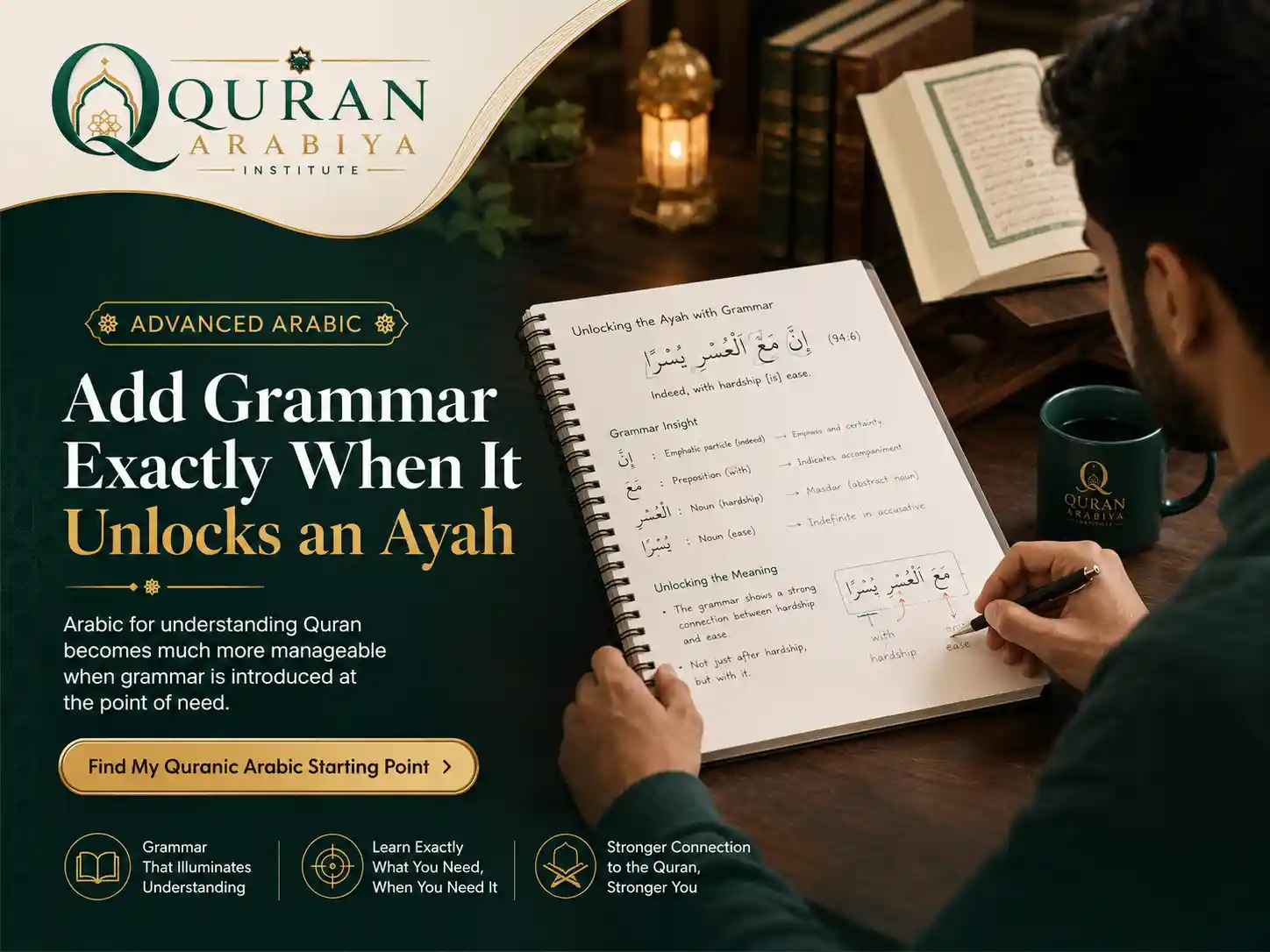
Arabic for understanding Quran becomes much more manageable when grammar is introduced at the point of need. If an attached pronoun changes who is being discussed, teach that relationship. The aim is to make the analysis repeatable in a fresh Arabic example rather than leave the rule as terminology remembered in isolation.
Short elements can carry a surprising amount of meaning. Attached pronouns tell you who possesses or receives something. Conjunctions connect clauses. Prepositions create relationships. Negation, condition and emphasis can change the direction of a sentence even when the main vocabulary is familiar.
Lessons therefore train the eye to notice these small signals instead of skipping over them. This is one of the biggest steps from recognizing isolated words to following an actual Quranic sentence.
The long-term wish to understand Quran Arabic without translation is better approached through meaningful units than through individual glosses. A familiar two- or three-word expression can become instantly recognizable even before the learner can analyze every technical detail inside it.
Students practice segmenting an ayah into manageable phrases, identifying what each phrase contributes and then reconnecting the parts. Translation may still be used as a check or learning aid, but it should not be the only bridge between the Arabic form and the learner's understanding.
A useful check is whether the learner can explain the relationship, test it on a fresh example and correct the reasoning when the first analysis fails. That is stronger evidence than recalling the rule name alone.
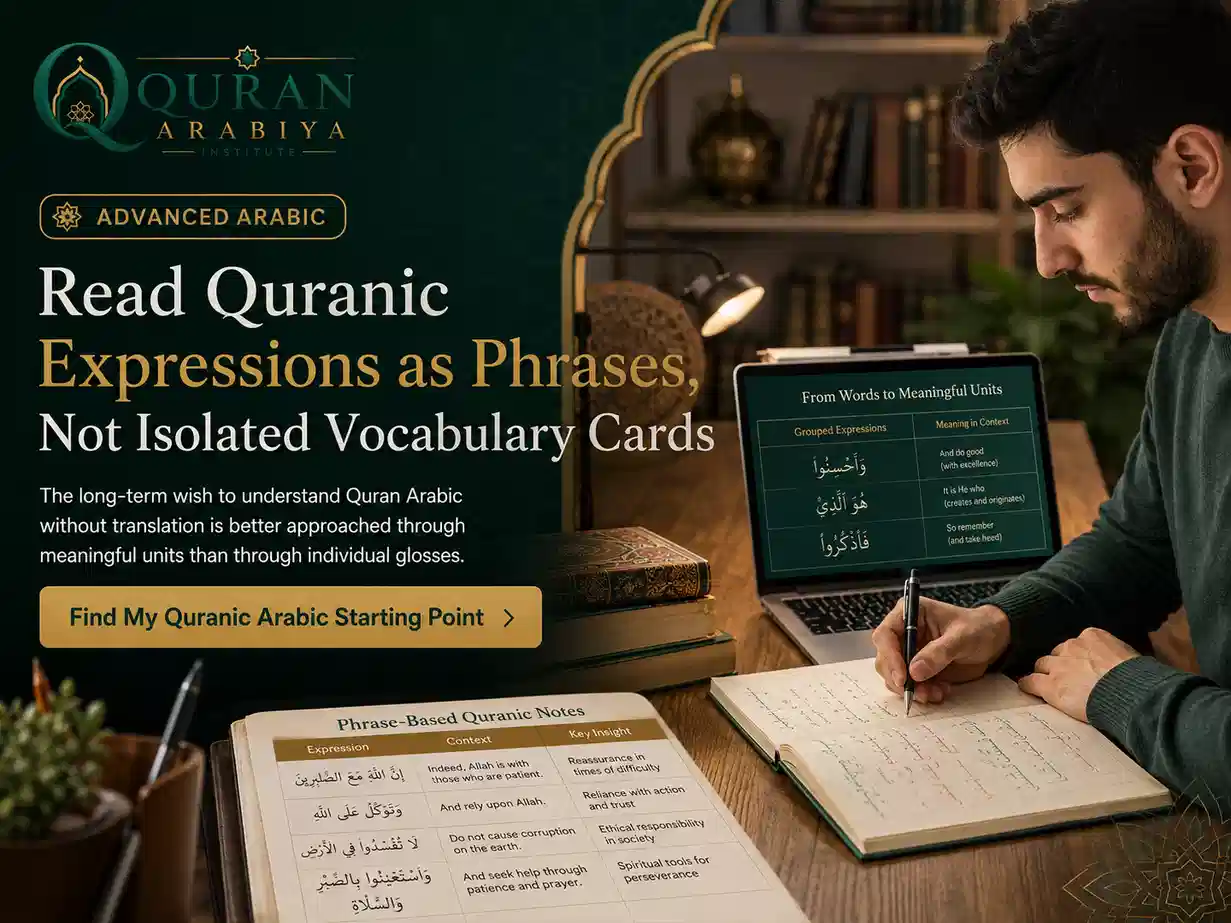
The long-term wish to understand Quran Arabic without translation is better approached through meaningful units than through individual glosses. A familiar two- or three-word expression can become instantly recognizable even before the learner can analyze every technical detail. The aim is to make the analysis repeatable in a fresh Arabic example rather than leave the rule as terminology remembered in isolation.
At first, the teacher can highlight a target structure, ask focused questions and model how to inspect a new phrase. Later, the student should attempt the first pass: circle familiar vocabulary, mark pronouns or particles, identify an obvious verb or noun relationship and explain what can be understood before help is given.
That shift matters. The course is succeeding when the learner becomes less dependent on prompts and can transfer known patterns to passages that were not rehearsed in advance.
Language study can tell you what a word form is doing, how a pronoun connects, what a construction ordinarily signals and how a clause is structured. It does not by itself settle every question of interpretation, context, creed, law or the reasons behind scholarly differences.
The course should therefore distinguish linguistic observation from Tafsir. When a question requires broader exegetical explanation, the responsible next step is to consult reliable Tafsir or study that subject with a qualified teacher rather than making grammar carry more than it can.

A free trial is most useful as a placement lesson, not as a sales presentation. The teacher can check whether you can read the script comfortably, how much recurring Quran vocabulary you already recognize, whether basic pronouns and verb signals are familiar, and how you currently approach an unfamiliar ayah.
Those observations help decide whether your first plan should emphasize vocabulary and expression recognition, essential grammar, guided passage work or a stronger Fusha foundation before moving deeper.
What Progress Should Look Like
Recognize a growing bank of frequent Quranic vocabulary in context rather than only from flashcards.
Use root and pattern clues without forcing one fixed meaning onto every related word.
Track common pronouns, particles and connectors that shape sentence relationships.
Explain selected Quranic phrases with less dependence on word-for-word translation.
Know when a language question has become a Tafsir question and requires a different kind of study.
Start With a Free Trial & Placement Lesson
Book a free trial to show the teacher what you can already do, where the current bottleneck is and what you want the course to unlock. The trial can be used as a real placement and learning sample: you participate in a short task, receive correction, and leave with a clearer recommendation for the next step rather than being forced into a fixed starting point.
Book a free trial to show the teacher what you can already do, where the current bottleneck is and what you want the course to unlock. The trial can be used as a real placement and learning sample: you participate in a short task, receive correction, and leave with a clearer recommendation for the next step rather than being forced into a fixed starting point.
Frequently Asked Questions
No. Essential grammar can be taught alongside Quran vocabulary and passages. A broader grammar foundation becomes increasingly useful as the analysis gets more advanced.
No. This is the broader Quranic-language path: vocabulary, expressions, roots, recurring structures and enough grammar to support comprehension. The Quranic Grammar course concentrates much more deeply on syntax and grammatical relationships.
The course can help reduce dependence on translation as your vocabulary and structural awareness grow. Complete independent understanding is a long-term language and Islamic-study goal, not an instant course guarantee.
No. The course studies the Arabic language of the Quran. Linguistic analysis can support understanding, but Tafsir includes context and interpretive knowledge that goes beyond grammar and vocabulary.
Yes, provided the learner can read the Arabic script sufficiently for the lesson format. The free trial can identify whether Quranic Arabic should start immediately or whether a reading or Fusha foundation would be more productive first.
Teens and adults who can read Quranic script and want direct language access to the Quran, from early Quranic Arabic learners to students who need a more systematic bridge into grammar and text analysis.
That does not automatically mean you need to restart from the beginning. The free trial can test reading comfort, sentence awareness and the prerequisite skill most relevant to this course, then route you to a foundation course only when the gap would block useful advanced study.
Traditional terminology matters because it gives the learner a precise analytical language, but memorizing labels is not the final test. The stronger outcome is being able to recognize the construction, explain why the term applies and use the same reasoning on a new example.
Examples can be selected where they support the stated language objective, but the page keeps its scope clear. Quranic language analysis is not presented as Tafsir, and a named-text course does not assume an unverified commentary, edition or fixed reading list.
It allows the teacher to see the exact step where analysis breaks down: vocabulary, form recognition, grammatical relation, parsing, rhetorical reasoning or reading stamina. The lesson can then spend time on that bottleneck and test it again in a fresh example before moving on.
No. The course owns one defined intent and should route adjacent goals outward. Own the broad Quranic-language route. Do not turn the page into a full Nahw syllabus, a detailed Quranic Grammar page, an I’rab workshop, or Tafsir. Link those intents to their dedicated courses.
The trial can check readiness, prior study, goals and the most useful starting point for this specific subject. It does not guarantee a certificate, fixed syllabus length, particular book edition or teacher qualification that has not been independently confirmed.
Progress should show up in analysis and transfer, not page count alone. A useful checkpoint is whether the learner can use the main skill with increasing independence.
The next route should follow the skill this page intentionally does not absorb. Own the broad Quranic-language route. Do not turn the page into a full Nahw syllabus, a detailed Quranic Grammar page, an I’rab workshop, or Tafsir. Link those intents to their dedicated courses. The teacher can recommend the most logical sibling course once the present objective is stable.
If you are considering Quranic Arabic course online, begin with the analytical skill that is currently breaking down: form, sentence relation, parsing, rhetoric or reading transfer. The free trial can check readiness and route the learner without inventing an edition, commentary, certificate or fixed advanced outcome that has not been verified.