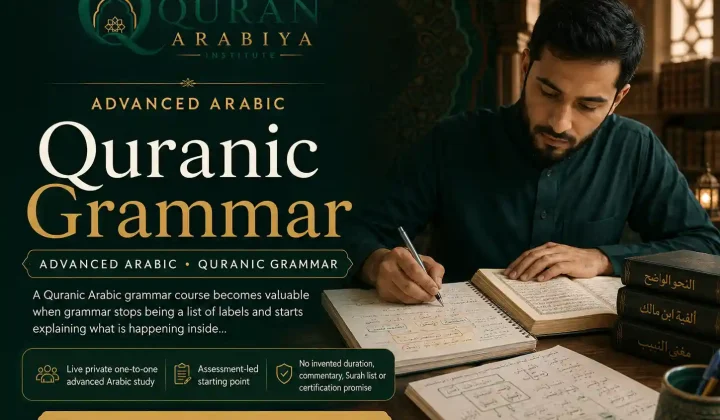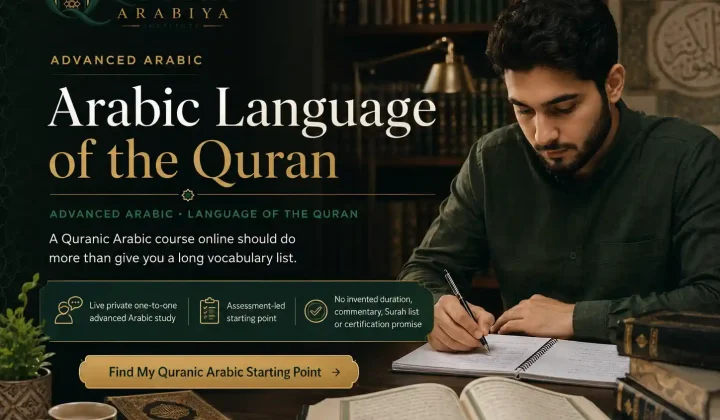
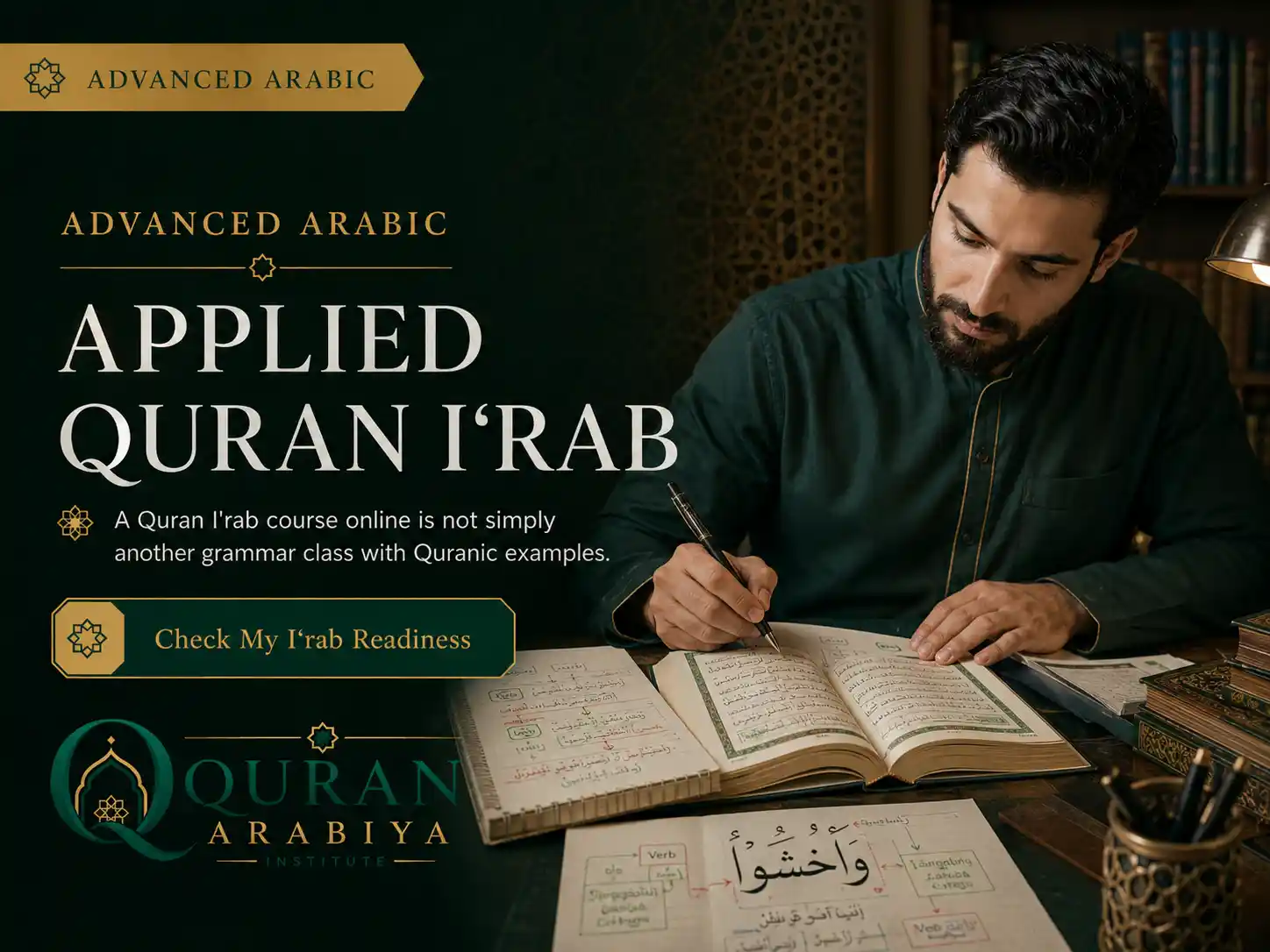
A Quran I'rab course online is not simply another grammar class with Quranic examples. Its purpose is sustained application. You take rules you already know and use them to explain why words and clauses in the Quran occupy particular grammatical roles, how they connect and what evidence supports the analysis.
This program is organized around 20 selected Surahs. The exact Surah list should be confirmed by the academy before the page is published; the SEO promise is the number and the applied parsing method, not an invented list. The learning focus is consistent: move from guided parsing toward a defensible independent first analysis.
I'rab of selected Surahs works best when the learner already recognizes basic word classes, common sentence types, subjects and objects, adjective and idafah relationships, common particles and the main case concepts. The course can review a rule when a passage exposes a weakness, but it should not spend most of its time rebuilding elementary grammar.
That boundary protects the course's real value. Students who still need the foundation can first study Arabic Grammar, Nahw & Sarf or Quranic Grammar and return when they can use those concepts under pressure.
I'rab of selected Surahs works best when the learner already recognizes basic word classes, common sentence types, subjects and objects. The course can review a rule when a passage exposes a weakness, but it should not spend most of. The aim is to make the analysis repeatable in a fresh Arabic example rather than leave the rule as terminology remembered in isolation.
A Quran grammatical parsing course becomes much easier to manage when the learner follows the same sequence instead of improvising every time. Begin by reading the whole phrase, segmenting it into meaningful units, identifying the main sentence structure, then moving word by word only where the syntax requires it.
For each important element, ask: what type of word or construction is this, what is its role, what governs or connects to it, what grammatical state or ending follows, and what evidence supports that decision? A stable workflow turns I'rab from a memory test into a method.
A useful check is whether the learner can explain the relationship, test it on a fresh example and correct the reasoning when the first analysis fails. That is stronger evidence than recalling the rule name alone.
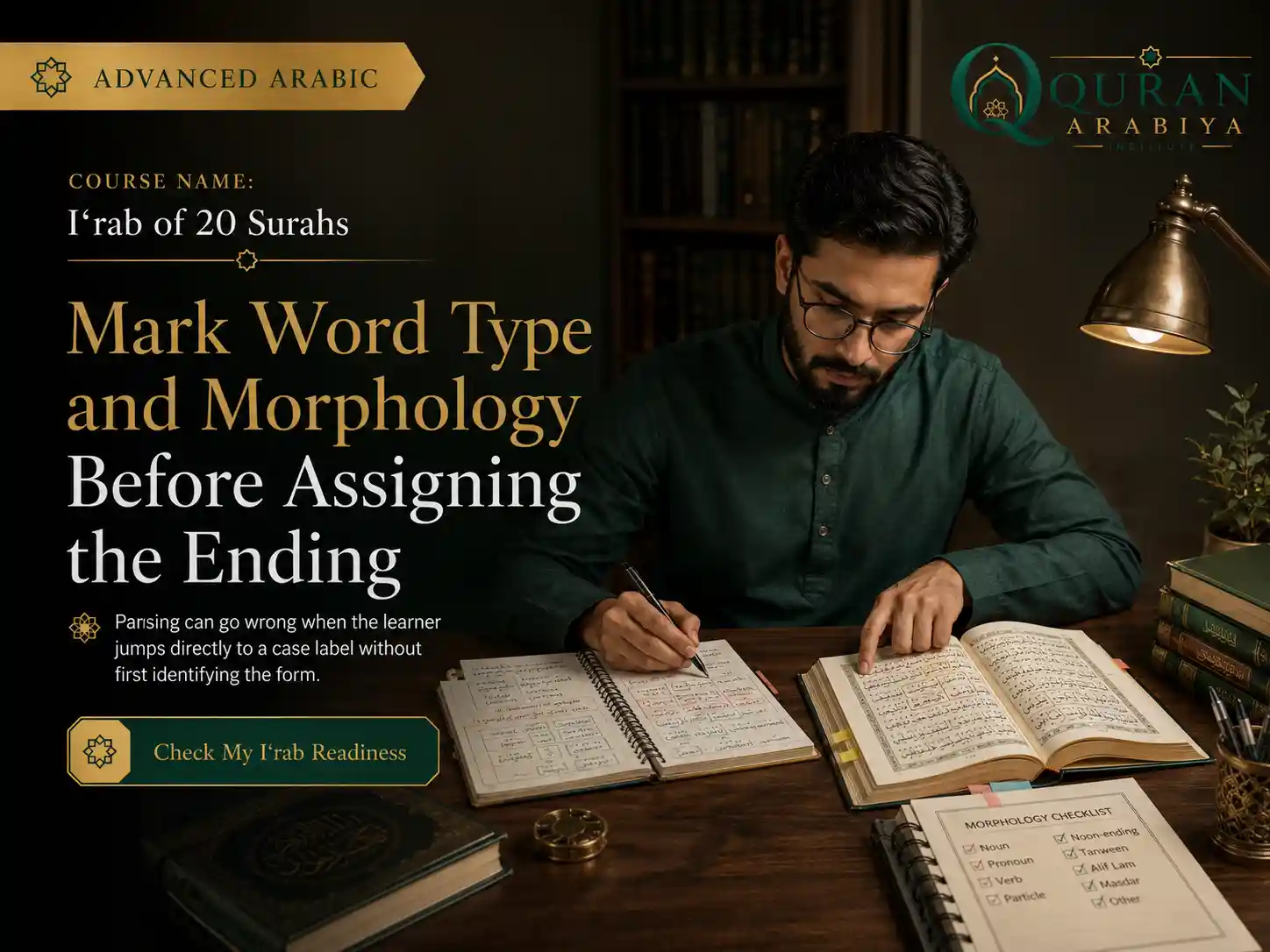
Parsing can go wrong when the learner jumps directly to a case label without first identifying the form. Is the item a noun, verb or particle? If it is a verb, what form and tense or mood are relevant? Is a pronoun attached? Is a noun indeclinable, dual, plural or otherwise behaving in a way that affects the visible marker?
This is where morphology supports syntax without taking over the course. A quick form check prevents many downstream I'rab mistakes.
A Quran grammatical parsing course becomes much easier to manage when the learner follows the same sequence instead of improvising. Begin by reading the whole phrase, segmenting it into meaningful units, identifying the main sentence structure, then moving word. The aim is to make the analysis repeatable in a fresh Arabic example rather than leave the rule as terminology remembered in isolation.
Good I'rab of Quran verses explains the reason, not only the label. Saying that a noun is mansub is incomplete unless the learner can identify what grammatical role placed it there and what construction governs that role.
Teachers should repeatedly ask 'because of what?' and 'connected to what?' This builds causal grammar knowledge and makes the student's analysis easier to transfer to unfamiliar passages.
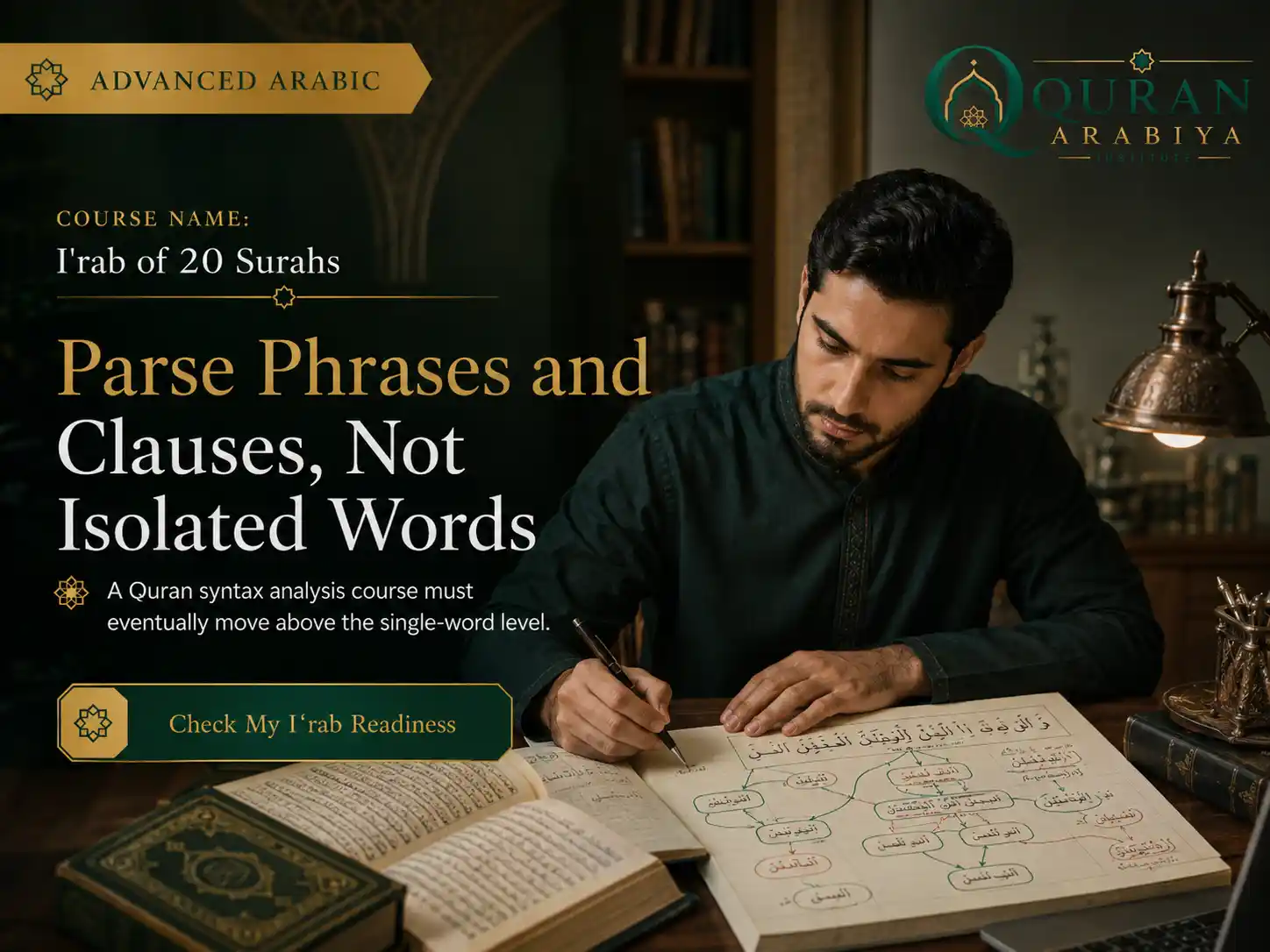
A Quran syntax analysis course must eventually move above the single-word level. Idafah units, prepositional phrases, relative constructions, subordinate clauses and coordinated elements work as groups. If the learner labels each token but cannot see the phrase, the overall sentence can remain unclear.
Lessons therefore combine micro-analysis with sentence mapping: identify the core clause first, attach its dependents and then show where embedded phrases or clauses begin and end.
A useful check is whether the learner can explain the relationship, test it on a fresh example and correct the reasoning when the first analysis fails. That is stronger evidence than recalling the rule name alone.
Good I'rab of Quran verses explains the reason, not only the label. Saying that a noun is mansub is incomplete unless the learner can identify what grammatical role placed it there. The aim is to make the analysis repeatable in a fresh Arabic example rather than leave the rule as terminology remembered in isolation.
The grammatical analysis of Quran becomes much more productive when mistakes are classified. One learner may repeatedly confuse adjective and idafah relationships; another may miss hidden subjects, attached pronouns or the effect of a particle. Record the pattern, not just the corrected answer.
As the 20-Surah study progresses, the teacher can deliberately select review moments where the same weakness appears again. Improvement then becomes visible in the types of errors that disappear, not simply in the number of pages completed.
Early lessons may require the teacher to model the order of analysis and ask leading questions. That support should gradually decrease. The student first marks the sentence independently, proposes roles and endings, and then defends the choices before seeing the teacher's analysis.
This is the transfer test. A learner who can follow an explanation is not yet the same as a learner who can generate a plausible parse and revise it after evidence-based feedback.
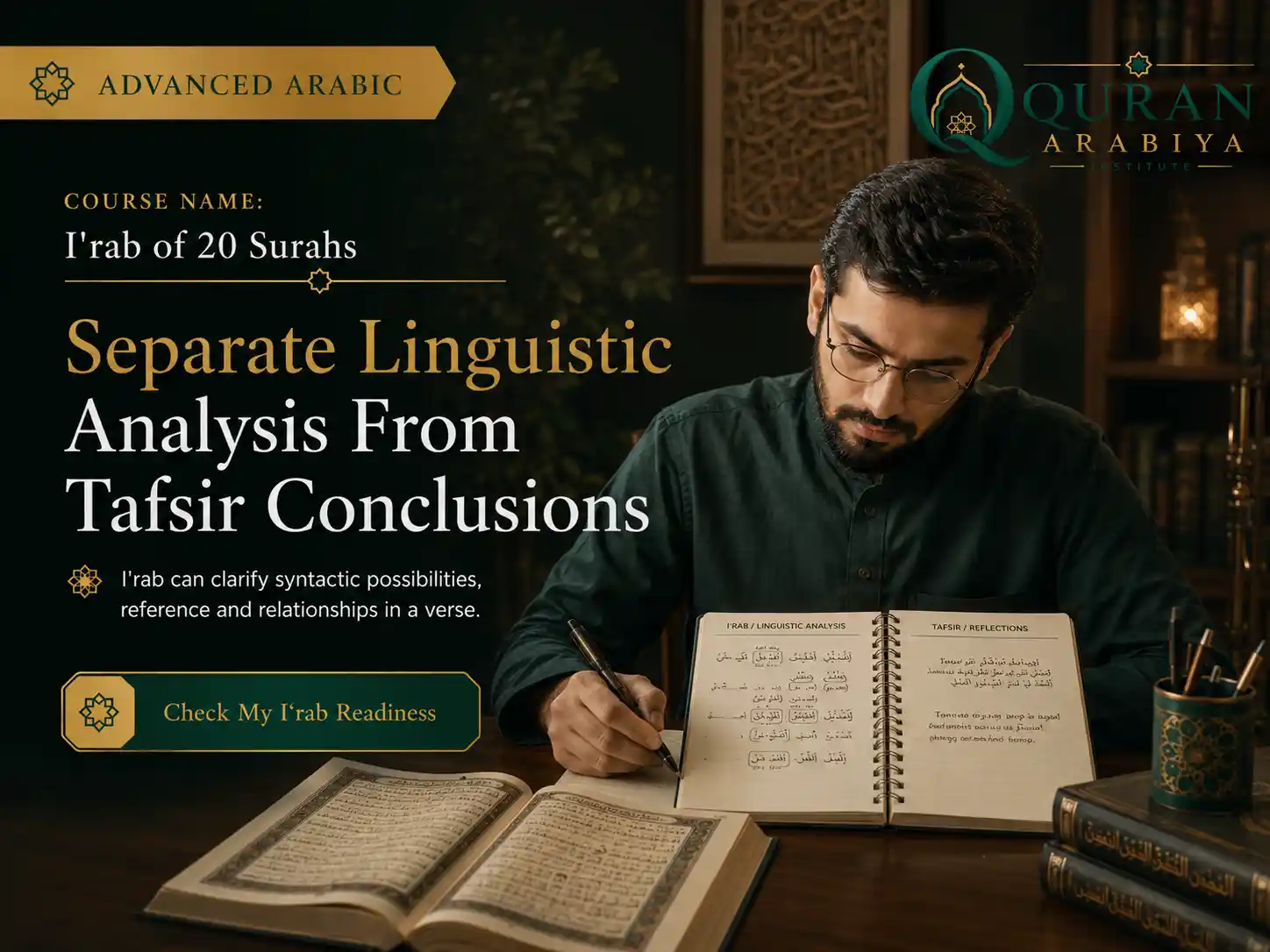
I'rab can clarify syntactic possibilities, reference and relationships in a verse. It does not automatically settle every interpretive question. Historical context, qira'at, hadith evidence, legal principles and the wider Tafsir tradition may be relevant beyond the grammar itself.
The course should therefore phrase conclusions carefully: 'the grammatical structure shows…' rather than treating a parsing exercise as a complete Tafsir.
The free trial can include a short parsing task. You may be asked to identify a nominal or verbal sentence, assign a few obvious roles, explain the effect of a particle or show why a word takes a particular state.
If the process is mostly unfamiliar, the teacher can recommend a prerequisite course. If the foundations are stable, the trial helps choose an appropriate starting point and level of teacher support within the 20-Surah program.
What Progress Should Look Like
Follow a consistent parsing workflow instead of guessing word by word.
Justify major grammatical roles and endings through the governing relationship.
Map phrases and clauses as units before focusing on fine detail.
Recognize recurring personal I'rab errors and correct them more independently.
Attempt a first parse of new Quranic material before receiving teacher guidance.
Start With a Free Trial & Placement Lesson
Book a free trial to show the teacher what you can already do, where the current bottleneck is and what you want the course to unlock. The trial can be used as a real placement and learning sample: you participate in a short task, receive correction, and leave with a clearer recommendation for the next step rather than being forced into a fixed starting point.
I'rab can clarify syntactic possibilities, reference and relationships in a verse. It does not automatically settle every interpretive question. The aim is to make the analysis repeatable in a fresh Arabic example rather than leave the rule as terminology remembered in isolation.
Book a free trial to show the teacher what you can already do, where the current bottleneck is and what you want the course to unlock. The trial can be used as a real placement and learning sample: you participate in a short task, receive correction, and leave with a clearer recommendation for the next step rather than being forced into a fixed starting point.
Frequently Asked Questions
The academy should publish the exact list only after confirming the teaching plan. This content intentionally does not invent a Surah list.
Yes, this is an applied course. Core Nahw and basic Quranic-language awareness should already be reasonably stable. The free trial can check readiness.
No. Quranic Grammar teaches and practices the concepts. This course concentrates on sustained I’rab and sentence analysis through 20 selected Surahs.
The depth can vary with level and teaching goals. The important promise is disciplined grammatical parsing and progression, not an unrealistic claim that every possible linguistic issue will be exhausted.
No. I’rab is grammatical analysis. It can support understanding but does not replace Tafsir or the other Islamic sciences needed for full interpretation.
Adults and advanced teens who already know core Nahw concepts and can read Quranic Arabic comfortably enough to spend lesson time on analysis rather than basic decoding.
That does not automatically mean you need to restart from the beginning. The free trial can test reading comfort, sentence awareness and the prerequisite skill most relevant to this course, then route you to a foundation course only when the gap would block useful advanced study.
Traditional terminology matters because it gives the learner a precise analytical language, but memorizing labels is not the final test. The stronger outcome is being able to recognize the construction, explain why the term applies and use the same reasoning on a new example.
Examples can be selected where they support the stated language objective, but the page keeps its scope clear. Quranic language analysis is not presented as Tafsir, and a named-text course does not assume an unverified commentary, edition or fixed reading list.
It allows the teacher to see the exact step where analysis breaks down: vocabulary, form recognition, grammatical relation, parsing, rhetorical reasoning or reading stamina. The lesson can then spend time on that bottleneck and test it again in a fresh example before moving on.
The trial can check readiness, prior study, goals and the most useful starting point for this specific subject. It does not guarantee a certificate, fixed syllabus length, particular book edition or teacher qualification that has not been independently confirmed.
Progress should show up in analysis and transfer, not page count alone. A useful checkpoint is whether the learner can use the main skill with increasing independence.
If you are considering Quran I’rab course online, begin with the analytical skill that is currently breaking down: form, sentence relation, parsing, rhetoric or reading transfer. The free trial can check readiness and route the learner without inventing an edition, commentary, certificate or fixed advanced outcome that has not been verified.