Arabic grammar becomes useful when it helps you explain a sentence, repair an error and produce a better sentence of your own. This Arabic grammar course online is built around that practical goal. Instead of collecting rules in isolation, you work with the structures that control real formal Arabic: word classes, nominal and verbal sentences, agreement, verb relationships, case awareness, modifiers, possession, pronouns and the connectors that hold longer ideas together.
The course is designed for learners who want accuracy without turning every lesson into a terminology test. In live one-to-one study, the teacher can slow down around the pattern that is blocking you, skip what you already control and bring the same rule back in new reading and writing contexts until it becomes usable knowledge.
The fastest route is not always to begin at chapter one of a grammar book. A learner may already know the names of many rules but still confuse adjective agreement, lose the subject inside a longer verbal sentence or guess the ending of a noun without understanding its role. The first lessons should identify those high-impact gaps.
For someone searching for Arabic grammar for beginners, that may mean starting with a simple question: what kind of word is this, what job is it doing, and what other word controls it? For a stronger learner, the same diagnostic approach can reveal less obvious weaknesses in relative clauses, attached pronouns, negation, conditionals or case relationships.

The fastest route is not always to begin at chapter one of a grammar book. A learner may already know the names of many rules but still confuse adjective agreement, lose the subject inside. The aim is to make the analysis repeatable in a fresh Arabic example rather than leave the rule as terminology remembered in isolation.
A clear grammar map reduces cognitive load. You first learn to distinguish nouns, verbs and particles, then recognize how nominal and verbal sentences are built. From there, the teacher can attach new topics to something you already understand: adjective phrases to noun agreement, idafah to noun relationships, subject/object roles to verbal sentences, and prepositions to the nouns they govern.
This is where Arabic grammar classes online should become visual and analytical rather than purely verbal. Color-coding roles, bracketing phrases and asking you to rebuild a sentence in more than one way can make the structure visible before you are asked to remember a formal definition.
A useful check is whether the learner can explain the relationship, test it on a fresh example and correct the reasoning when the first analysis fails. That is stronger evidence than recalling the rule name alone.
Agreement is one of the places where learners often know the rule but fail to notice it while reading. We can repeatedly compare gender, number, definiteness and grammatical role inside short sentences, then move into more complex examples. I'rab is introduced to the level needed for the learner's goal: not as decorative vowel marks, but as signals of how words are related.
A Modern Standard Arabic grammar course should also explain where full case endings matter most in formal and carefully read Arabic, without pretending that everyday spoken varieties behave exactly the same way. The aim is accurate Fusha awareness, not confusion between registers.
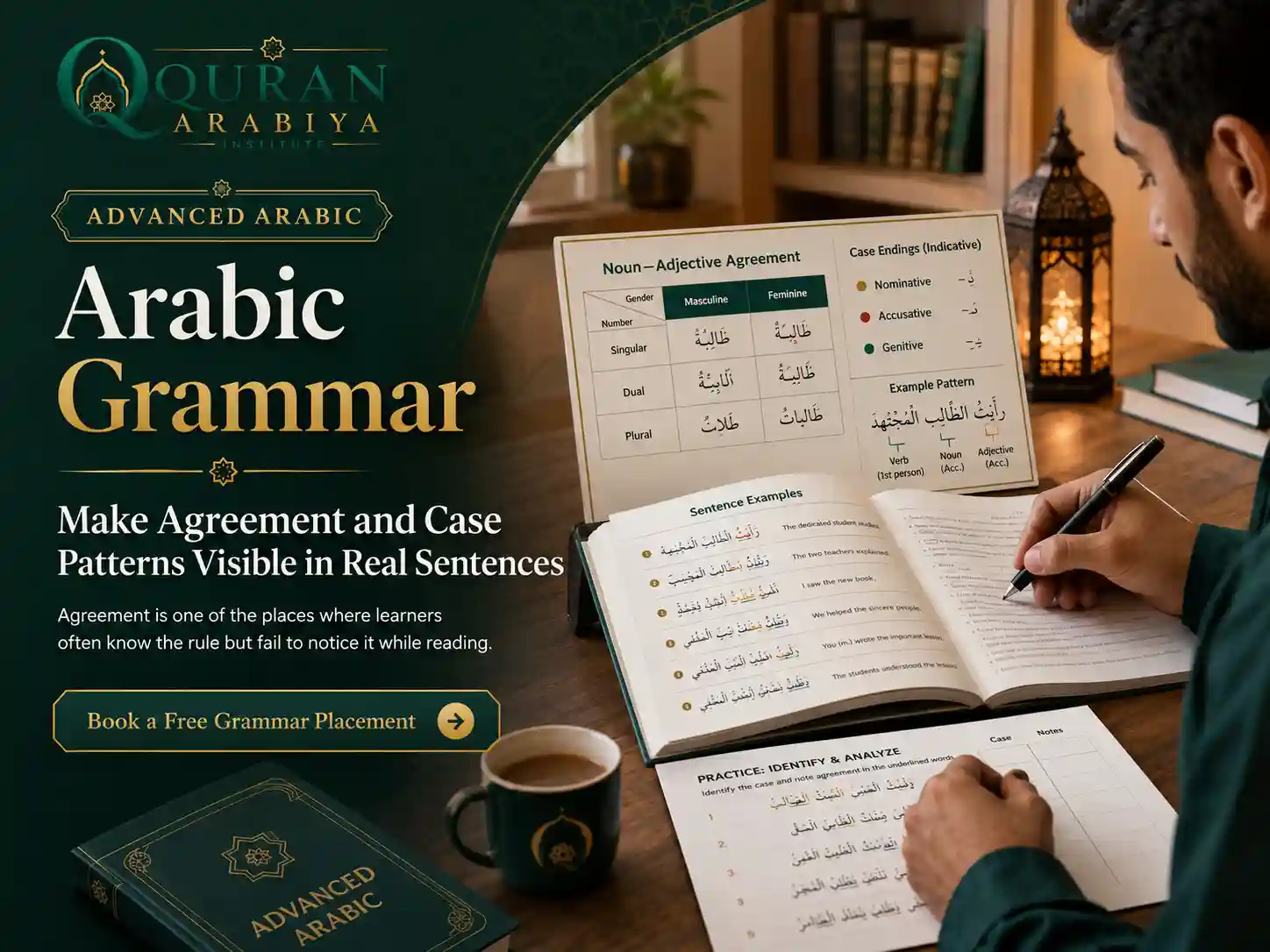
Agreement is one of the places where learners often know the rule but fail to notice it while reading. We can repeatedly compare gender, number, definiteness and grammatical role inside short sentences, then move into more complex examples. The aim is to make the analysis repeatable in a fresh Arabic example rather than leave the rule as terminology remembered in isolation.
After a rule is understood, you should have to use it. A lesson can move from recognition to controlled transformation: change singular to dual or plural, replace a noun with a pronoun, switch a nominal sentence into a verbal one where appropriate, add a modifier, negate the idea or connect two clauses. Then you explain what changed and why.
That makes the page's promise closer to an Arabic sentence structure course than a list of grammar lectures. Short production tasks expose weak understanding immediately, which allows the teacher to correct the exact point before the error becomes habitual.
Grammar is easier to retain when it unlocks material you actually want to read or helps you write something clearer. Selected sentences can come from level-appropriate Fusha texts, short informational passages and formal writing tasks. The teacher can ask you to identify the grammatical skeleton first, then read for meaning instead of translating word by word.
Learners who want to learn Arabic grammar online for academic, professional or Islamic-study goals can then receive examples closer to their real purpose. Quran-focused students should still be routed to the dedicated Quranic Arabic or Quranic Grammar course when the sacred text becomes the main corpus, so this page keeps its broad formal-Arabic intent.
A useful check is whether the learner can explain the relationship, test it on a fresh example and correct the reasoning when the first analysis fails. That is stronger evidence than recalling the rule name alone.

Grammar is easier to retain when it unlocks material you actually want to read or helps you write something clearer. Selected sentences can come from level-appropriate Fusha texts, short informational passages and formal writing tasks. The aim is to make the analysis repeatable in a fresh Arabic example rather than leave the rule as terminology remembered in isolation.
One corrected sentence is not evidence that a rule is secure. A useful one-to-one system records recurring errors and brings them back in spaced ways: a quick oral check, a reading example, a sentence-building task and a short review in a later lesson. The target is fewer prompts, faster recognition and successful use in a new context.
A simple personal grammar log can note the error, the reason, one corrected example and a later test sentence. This is a recommended learning tool rather than a promise of a fixed platform feature, and it gives both teacher and learner a concrete way to see whether the same problem is actually disappearing.
The free trial should work as a placement session, not a sales script. The teacher can check reading comfort, sentence awareness, vocabulary, prior grammar terminology and the learner’s real goal. A student who mainly wants broad Fusha accuracy may stay here; a student whose problem is roots and derivation may be better placed in Advanced Arabic Morphology; a learner ready for classical combined study may need Nahw & Sarf.
With Quran Arabiya’s live one-to-one lessons, your teacher can adjust the pace, explanation and practice around your actual grammar gaps instead of forcing you through identical lessons.

Identify the role of common sentence elements with less prompting.
Build and transform nominal and verbal sentences more accurately.
Apply agreement and core case relationships in unfamiliar examples.
Explain the reason for corrections instead of memorizing the corrected form.
Transfer grammar into clearer Fusha reading and writing.
Start With a Free Trial & Placement Lesson
Book a free trial to show the teacher what you can already do, where the current bottleneck is and what you want the course to unlock. The trial can be used as a real placement and learning sample: you participate in a short task, receive correction, and leave with a clearer recommendation for the next step rather than being forced into a fixed starting point.
During the free trial, you may be asked to identify sentence parts, correct a recurring agreement error or explain why a word has a particular role. That gives the teacher a practical picture of your grammar level and the best place to begin.
Frequently Asked Questions
No. Placement should determine the starting point. A beginner can build the grammar map from the ground up, while an intermediate learner can focus on recurring structural errors and more complex sentence relationships.
It introduces the grammar and morphology needed for broad formal Arabic, but the dedicated Nahw & Sarf course is the better route for students seeking a combined classical study of the two sciences.
A teacher may use an occasional suitable example, but Quran-specific grammar is intentionally kept for the Quranic Grammar course so the two pages do not duplicate each other.
Useful terminology is taught, but the main test is whether you can recognize and apply the structure. Definitions support analysis; they are not the final outcome.
Yes. The free trial can be used to assess your current level, clarify your goal and recommend the most suitable grammar route and teacher fit.
Teens and adults who can already read Arabic at a basic level and want grammar that improves real reading, writing and formal expression.
That does not automatically mean you need to restart from the beginning. The free trial can test reading comfort, sentence awareness and the prerequisite skill most relevant to this course, then route you to a foundation course only when the gap would block useful advanced study.
Traditional terminology matters because it gives the learner a precise analytical language, but memorizing labels is not the final test. The stronger outcome is being able to recognize the construction, explain why the term applies and use the same reasoning on a new example.
Examples can be selected where they support the stated language objective, but the page keeps its scope clear. Quranic language analysis is not presented as Tafsir, and a named-text course does not assume an unverified commentary, edition or fixed reading list.
It allows the teacher to see the exact step where analysis breaks down: vocabulary, form recognition, grammatical relation, parsing, rhetorical reasoning or reading stamina. The lesson can then spend time on that bottleneck and test it again in a fresh example before moving on.
The trial can check readiness, prior study, goals and the most useful starting point for this specific subject. It does not guarantee a certificate, fixed syllabus length, particular book edition or teacher qualification that has not been independently confirmed.
Progress should show up in analysis and transfer, not page count alone. A useful checkpoint is whether the learner can identify the role of common sentence elements with less prompting. build and transform nominal and verbal sentences more accurately.
After you build practical grammar, your next step depends on the skill you want to deepen: Nahw and Sarf for a more classical framework, Arabic Morphology for word formation, or Quranic Grammar if your main goal is Quranic syntax. Own broad practical grammar. Mention Nahw/Sarf as underlying sciences, but route combined classical study to Nahw & Sarf, deep word formation to Advanced Arabic Morphology, Quran-specific analysis to Quranic Grammar, and named-text study to their dedicated pages. The teacher can recommend the most logical sibling course once the present objective is stable.
If you are considering Arabic grammar course online, begin with the analytical skill that is currently breaking down: form, sentence relation, parsing, rhetoric or reading transfer. The free trial can check readiness and route the learner without inventing an edition, commentary, certificate or fixed advanced outcome that has not been verified.