An Al Kitab Al Asasi course online is for learners who want a substantial textbook-based Modern Standard Arabic path rather than disconnected grammar lessons. The published curriculum develops Arabic through themed material that brings vocabulary, listening, speaking and grammar together across a three-part course. With a live teacher, the challenge is to turn that rich content into language you can actually understand and produce rather than simply reading explanations and completing exercises.
The series contains enough language and thematic range that learners can easily move through it passively: read the text, look up words, answer the exercise and forget the unit. A teacher can instead identify the core language target and make the student retrieve and reuse it.
This is the main value of studying a published curriculum live: the book supplies structure while the teacher supplies pacing, clarification, correction and transfer.

The series contains enough language and thematic range that learners can easily move through it passively: read the text, look. A teacher can instead identify the core language target and make the student retrieve and reuse it. The aim is to turn the same language into usable reading, listening, speaking or writing rather than leave it as a completed exercise.
Because the course is built for serious Arabic study, basic script reading should be stable enough that decoding does not consume the entire lesson. The free trial can check whether you can follow simple Arabic text and identify where reading support is still needed.
Learners whose main difficulty is script or spelling can first use the Arabic Reading & Writing course rather than forcing literacy remediation into every Al-Kitab lesson.
A useful check is whether the learner can reuse the same language with less support in a different task. That transfer matters more than simply recognizing the example that was practised in the lesson.
Al-Kitab Al-Asasi approaches MSA through broad topics rather than isolated word lists. The learner can build vocabulary networks around daily life and wider cultural, social and intellectual themes as the course advances.
The teacher reinforces those networks through categorisation, paraphrase, questions and short speaking/writing tasks so words become connected to meaning and use.
Because the course is built for serious Arabic study, basic script reading should be stable enough that decoding does not. The free trial can check whether you can follow simple Arabic text and identify where reading support is still. The aim is to turn the same language into usable reading, listening, speaking or writing rather than leave it as a completed exercise.
Al-Kitab Al-Asasi approaches MSA through broad topics rather than isolated word lists.
Where audio or teacher-led listening is available, the first task should often be global comprehension: who is speaking, what is the topic, what information matters? A second pass can focus on target expressions or structures.
This builds the ability to follow formal Arabic as language rather than treating every sentence as a translation exercise.
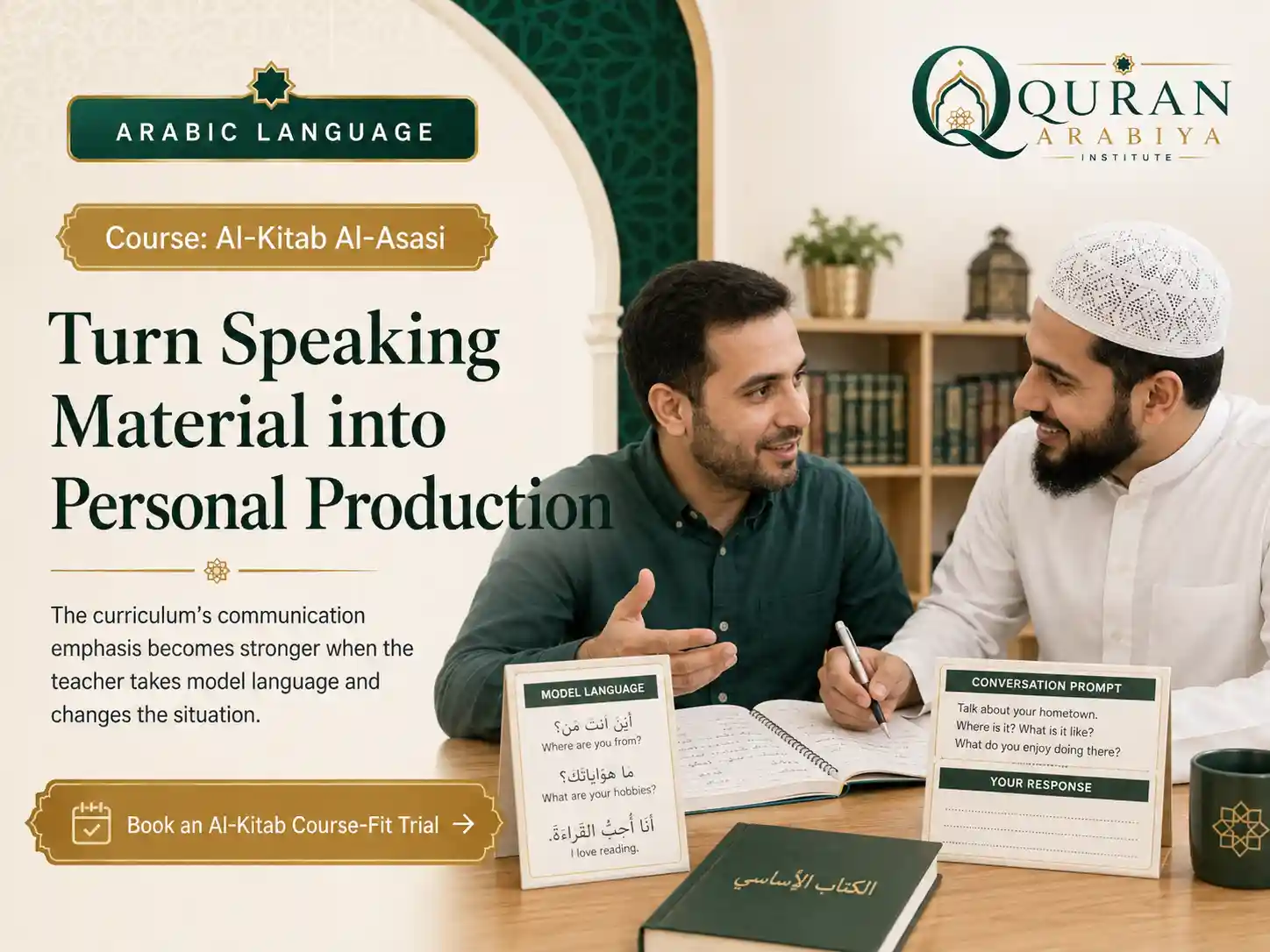
The curriculum’s communication emphasis becomes stronger when the teacher takes model language and changes the situation. The learner may answer a similar question about their own life, compare two ideas or explain an opinion using the unit’s vocabulary.
Production exposes gaps that a recognition exercise cannot show and gives the teacher a reason to revisit specific words or grammar.
A useful check is whether the learner can reuse the same language with less support in a different task. That transfer matters more than simply recognizing the example that was practised in the lesson.
Grammar is introduced more effectively when the learner already understands the sentences that contain it. The teacher can highlight the pattern, explain the rule and immediately ask for new examples using familiar vocabulary.
Deep theoretical grammar remains on the Advanced Arabic pages. Here, the rule is valuable because it unlocks the current text and improves the learner’s own language.
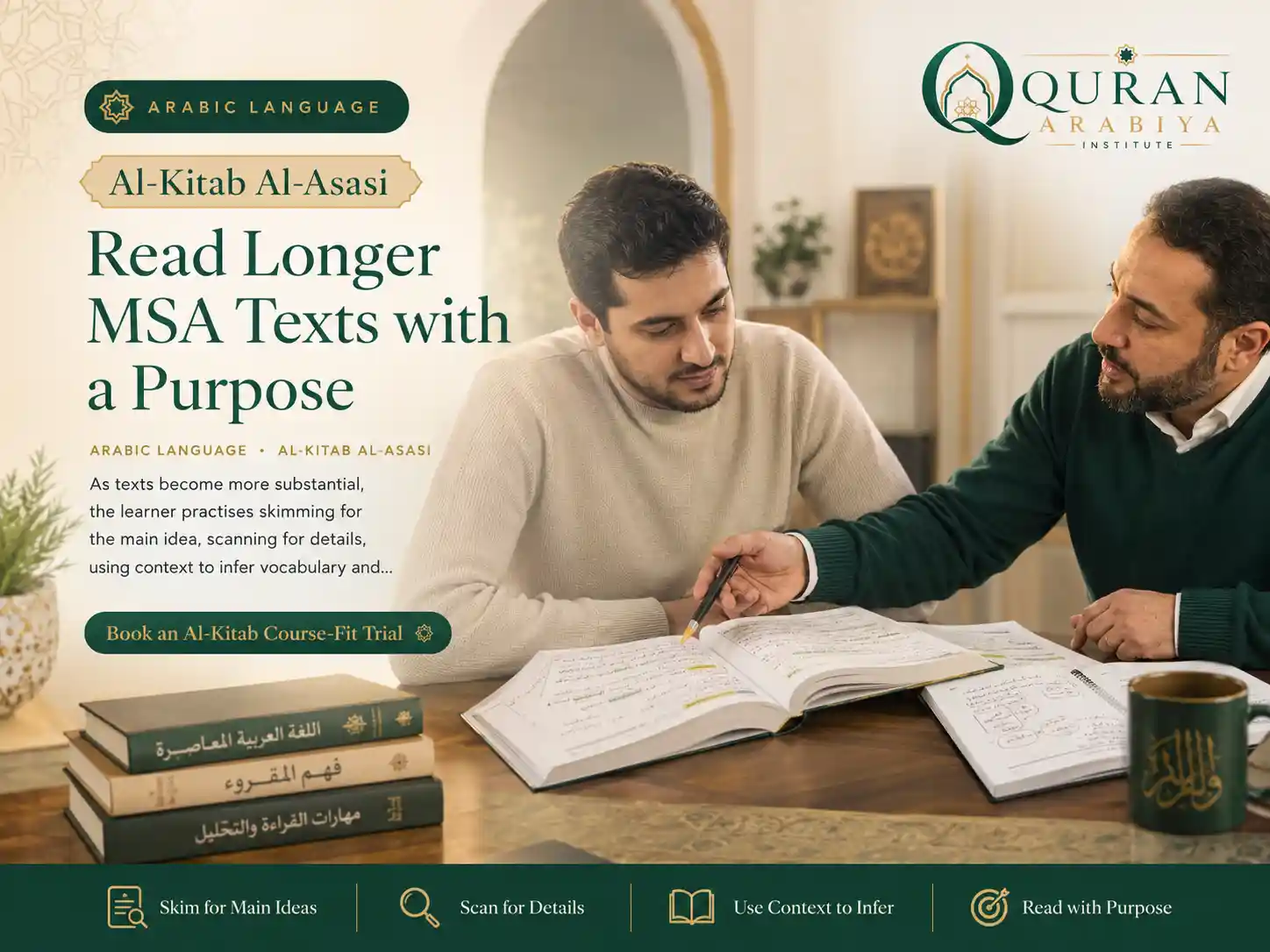
As texts become more substantial, the learner practises skimming for the main idea, scanning for details, using context to infer vocabulary and identifying how sentences connect. Not every unknown word needs to stop the reading process.
After reading, a short oral or written response proves comprehension more effectively than pronunciation alone.
Grammar is introduced more effectively when the learner already understands the sentences that contain it. The teacher can highlight the pattern, explain the rule and immediately ask for new examples using familiar vocabulary. The aim is to turn the same language into usable reading, listening, speaking or writing rather than leave it as a completed exercise.
Writing can begin with controlled sentence tasks and grow into summaries, comparisons, descriptions or opinions related to the theme. The teacher can require a small set of target words or structures to be reused naturally.
Revision focuses on the most important recurring errors, then the learner rewrites part of the task so correction becomes active learning.
A large curriculum creates forgetting unless earlier language is deliberately recycled. Review can pull vocabulary and grammar from previous units into new speaking prompts, short quizzes, reading questions and writing tasks.
Cumulative retrieval is what turns a long textbook sequence into an expanding language system rather than a series of finished chapters.
Writing can begin with controlled sentence tasks and grow into summaries, comparisons, descriptions or opinions related to the theme. The teacher can require a small set of target words or structures to be reused naturally. The aim is to turn the same language into usable reading, listening, speaking or writing rather than leave it as a completed exercise.
A large curriculum creates forgetting unless earlier language is deliberately recycled.
A learner is ready to move forward when core vocabulary can be recalled, the main text is understood, target structures can be recognised in new examples and the learner can produce a small spoken or written task without copying the model.
This avoids importing another academy’s fixed hours and lets one-to-one pacing reflect actual mastery.
This course suits learners who want a detailed, broad MSA textbook and are comfortable engaging with substantial reading and vocabulary. A complete beginner may prefer MSA Beginners first; a learner wanting a more overtly conversational series may prefer Al-Takallum or Bayna Yadaik.
A learner who wants intensive classical grammar may prefer Madinah or a specialist Advanced Arabic route.

The teacher can sample reading, comprehension and a simple production task, then discuss previous textbook study. If you already worked through part of Al-Kitab, placement should test retained language rather than book ownership.
The result is a practical entry point and a first study objective for the curriculum.
If you want the depth of Al-Kitab Al-Asasi without getting lost in a dense textbook, start with a free placement lesson. Confirm your reading level, previous study and the point in the curriculum where guided work will add the most value.
It is a three-part Modern Standard Arabic course for non-native speakers published by the American University in Cairo Press, organised through themed topics and integrated language study.
Basic reading ability is strongly helpful and is listed as a prerequisite by some providers. The free trial can confirm whether your literacy is ready for the material.
Yes. Publisher descriptions emphasise listening and speaking, while the curriculum also builds vocabulary, grammar and other language skills.
It can begin at foundational levels, but If you are completely new to Arabic, you may need a short reading or language-foundation phase before starting the full Al-Kitab Al-Asasi text. Placement helps us choose the right entry point for you. Placement is important.
MSA Beginners is a broad entry-level program not tied to one textbook. This page is specifically for learners choosing the Al-Kitab Al-Asasi curriculum.
Not universally. Al-Kitab Al-Asasi offers a rich themed MSA curriculum; Bayna Yadaik and Al-Takallum have different communicative designs. Fit depends on the learner’s goals and preferred study style.
The curriculum itself is three-part. Your starting point, lesson frequency and study plan are confirmed after placement, so your completion time reflects your actual level and pace rather than a fixed promise.
Teens and adults who can generally read Arabic and want a substantial textbook-based MSA program with broad topics and integrated language study.
Not automatically. The free assessment can show which skills are already stable and where the first real gap appears, so a returning learner can avoid unnecessary repetition while a beginner receives the foundation that is actually needed.
The balance should follow the course intent and the learner profile rather than force equal time in every lesson. The teacher can reuse the same vocabulary and structures across several skills so one activity strengthens another instead of becoming a disconnected module.
Grammar is used to make Arabic clearer and more accurate at the depth appropriate to this course. If the learner’s main goal becomes advanced Nahw, Sarf, Quranic Grammar or a named classical text, that deeper intent belongs in the Advanced Arabic category.
Yes. A learner may understand much more than they can read or produce, while another may remember the script but little vocabulary. One-to-one placement lets the teacher build from that uneven profile rather than assume that every student labelled “intermediate” has the same strengths.
The trial can sample the skills most relevant to the course, clarify the learner’s goal, previous study and preferred schedule, and identify the first practical target. It is a course-fit step rather than a promise of a fixed completion time or guaranteed fluency level.
Progress should appear in what the learner can do with less prompting, not only in completed units. A useful checkpoint is whether the learner can use the main skill with increasing independence.
If you are considering Al Kitab Al Asasi course online, begin with the language task you actually want Arabic to unlock. The free trial can map the learner’s strongest and weakest skills, then route the plan toward a broad Fusha path, a named curriculum or a specialist skill without forcing every learner through the same sequence.