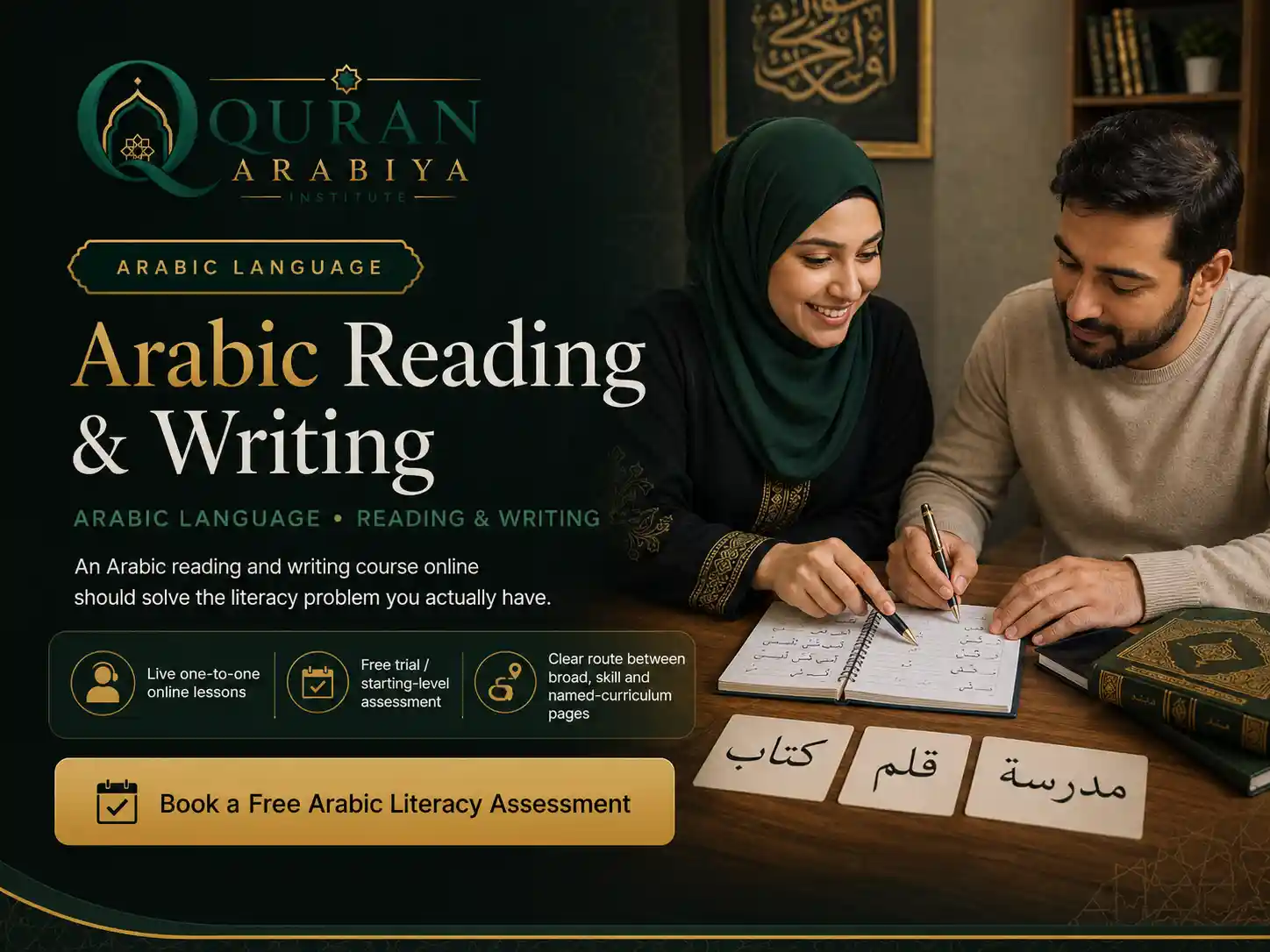
An Arabic reading and writing course online should solve the literacy problem you actually have. Some learners still confuse connected letter forms; others read aloud but do not understand; others speak Arabic comfortably yet hesitate over spelling and written sentences. This course separates those skills, strengthens the weak link and then reconnects reading and writing so Arabic becomes a usable written language rather than a collection of letter drills.
The teacher can check letter recognition, connected forms, vowel reading, word decoding, reading comprehension, spelling from dictation and a short writing sample where appropriate. Two learners who both say “I cannot write Arabic” may need completely different work.
This diagnostic approach also prevents unnecessary overlap with the Learn to Read Quran category. If the learner’s goal is specifically Quran decoding, the Quran-reading path is the better destination.
The teacher can check letter recognition, connected forms, vowel reading, word decoding, reading comprehension, spelling from dictation and a short. Two learners who both say “I cannot write Arabic” may need completely different work. The aim is to turn the same language into usable reading, listening, speaking or writing rather than leave it as a completed exercise.
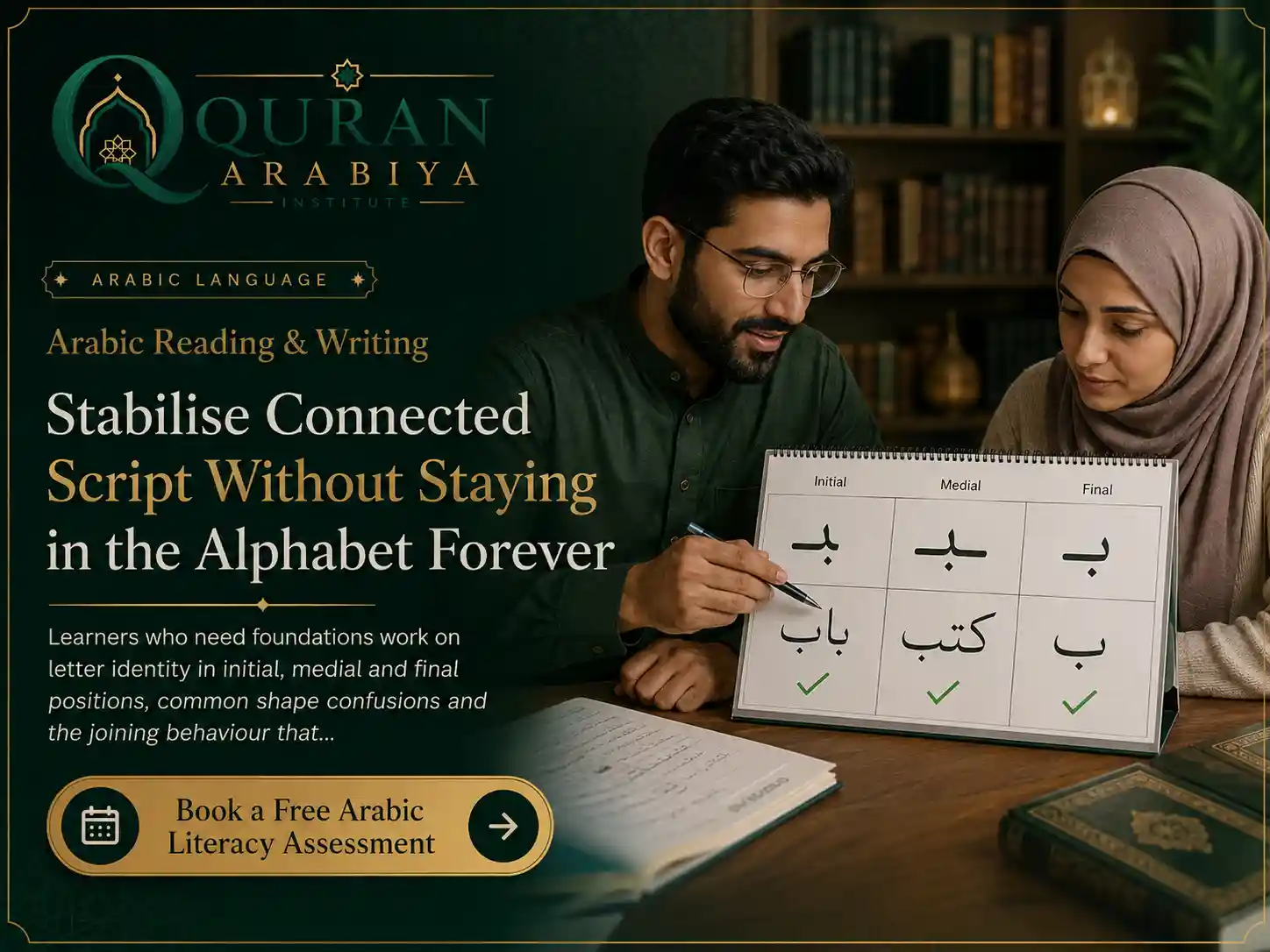
Learners who need foundations work on letter identity in initial, medial and final positions, common shape confusions and the joining behaviour that affects how words appear. The aim is rapid recognition inside real words rather than endless alphabet recitation.
Once recognition is stable, the course should move into meaningful reading rather than keeping advanced learners trapped in beginner worksheets.
A useful check is whether the learner can reuse the same language with less support in a different task. That transfer matters more than simply recognizing the example that was practised in the lesson.
Early reading may use fully or partly vowelled text so the learner can connect visual forms to sound. As confidence grows, the teacher can gradually reduce support and teach the learner to use word patterns, vocabulary and sentence context.
The goal is not simply faster sounding-out. It is to recognise increasingly familiar word forms and preserve meaning while reading.
Learners who need foundations work on letter identity in initial, medial and final positions, common shape confusions and the joining. The aim is rapid recognition inside real words rather than endless alphabet recitation. The aim is to turn the same language into usable reading, listening, speaking or writing rather than leave it as a completed exercise.
Early reading may use fully or partly vowelled text so the learner can connect visual forms to sound. As confidence grows, the teacher can gradually reduce support and teach the learner to use word patterns, vocabulary and. The aim is to turn the same language into usable reading, listening, speaking or writing rather than leave it as a completed exercise.
Arabic writing includes recurring orthographic decisions that deserve explicit practice when the learner is ready. Depending on level, this can include distinctions involving hamza, taa marbuta, alif maqsurah, long vowels, shaddah and common endings.
The teacher should choose only the spelling patterns that explain the learner’s actual errors rather than front-loading an encyclopedic orthography syllabus.
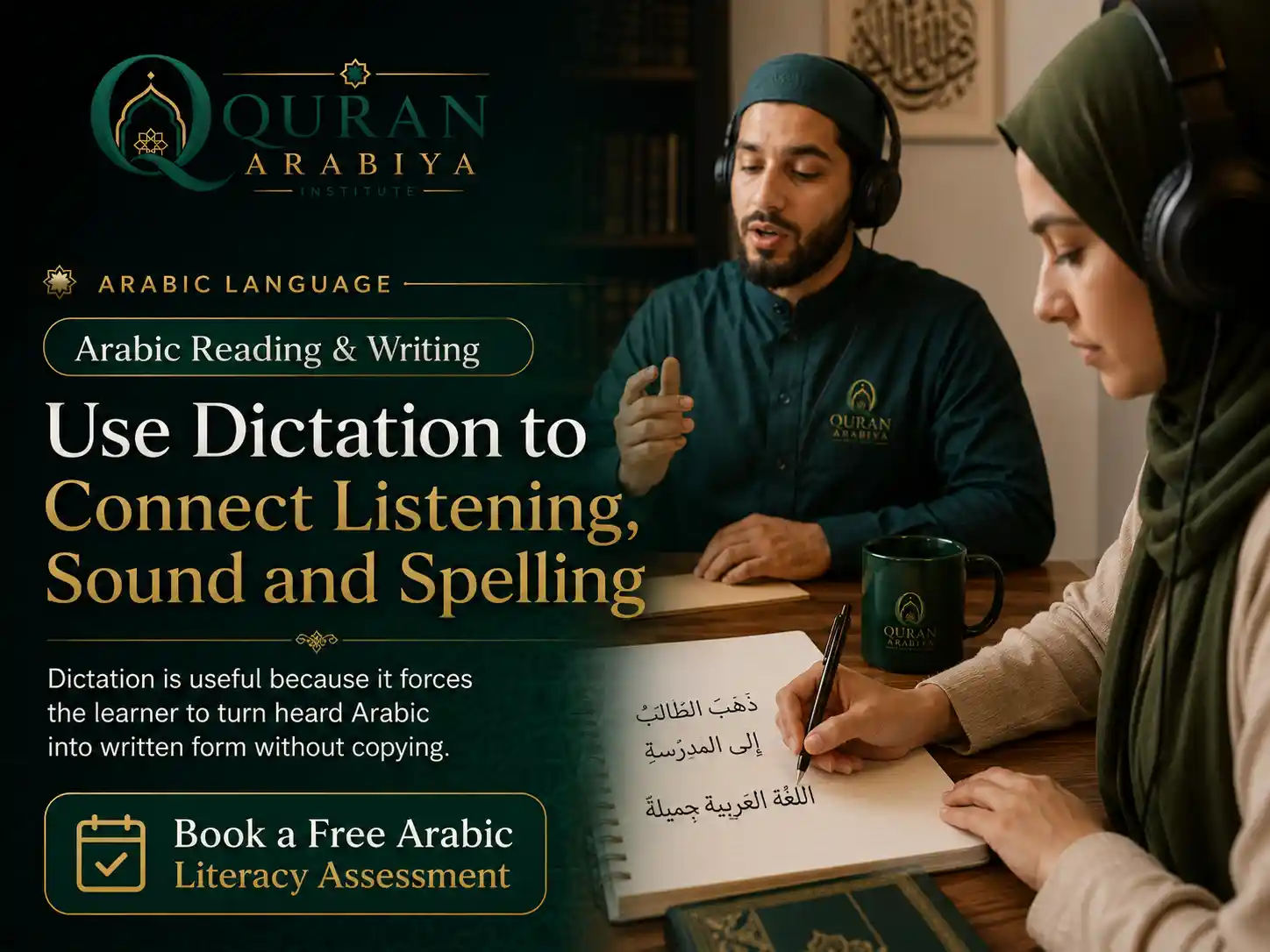
Dictation is useful because it forces the learner to turn heard Arabic into written form without copying. Short items can reveal whether the problem is sound discrimination, letter choice, vowel length, word segmentation or memory.
After correction, the learner rewrites the item and then uses the same pattern in a new word or sentence so the feedback transfers.
A useful check is whether the learner can reuse the same language with less support in a different task. That transfer matters more than simply recognizing the example that was practised in the lesson.
Reading comprehension grows when the learner identifies the subject, action, description and key relationships in a sentence rather than translating word by word. Short questions, matching tasks and retelling help check whether meaning survived the reading process.
Longer graded texts can then be introduced with a purpose: find information, summarise, infer from context or notice a target structure.
Copying may support beginners, but independent writing requires retrieval. The course progresses through completion tasks, sentence building, answers, picture descriptions and short connected paragraphs based on vocabulary already learned.
The teacher can gradually reduce prompts so the learner must decide on words, order and connectors rather than reproduce a model.
Reading comprehension grows when the learner identifies the subject, action, description and key relationships in a sentence rather than translating. Short questions, matching tasks and retelling help check whether meaning survived the reading process. The aim is to turn the same language into usable reading, listening, speaking or writing rather than leave it as a completed exercise.
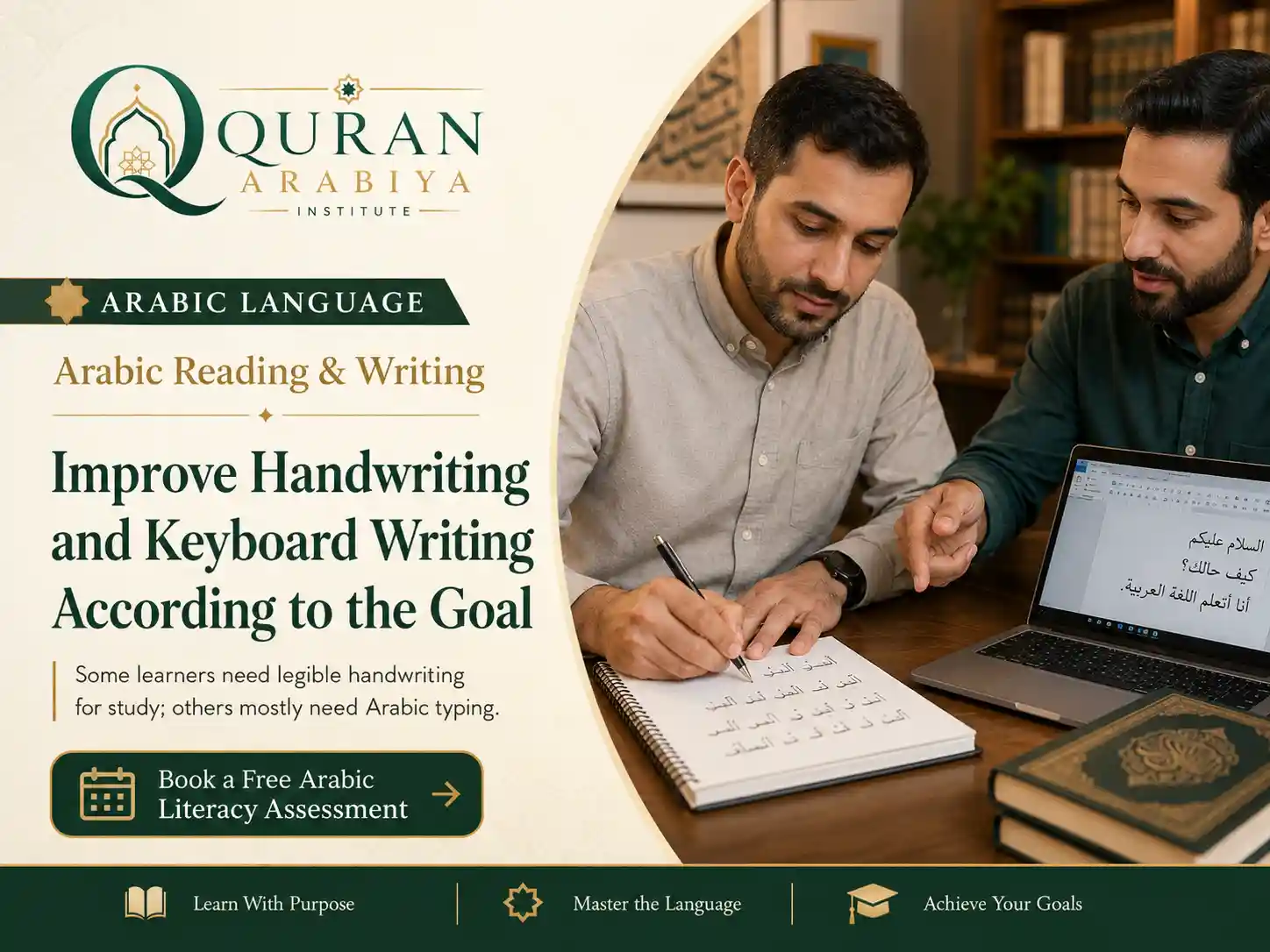
Some learners need legible handwriting for study; others mostly need Arabic typing. Both can be practised without turning the whole course into calligraphy. Handwriting work focuses on readable letter forms and spacing, while typing work focuses on finding letters and producing accurate Arabic text efficiently.
The proportion depends on the learner’s use case, age and current skill.
Repeated mistakes are valuable data. If a learner consistently drops long vowels, confuses visually similar letters or writes speech-like forms that do not match standard spelling, the teacher can build a small correction cycle around that pattern.
Retesting the same skill in new vocabulary shows whether the correction became transferable rather than temporary.
Some learners need legible handwriting for study; others mostly need Arabic typing. Both can be practised without turning the whole course into calligraphy. The aim is to turn the same language into usable reading, listening, speaking or writing rather than leave it as a completed exercise.
If a learner consistently drops long vowels, confuses visually similar letters or writes speech-like forms that do not match standard. Retesting the same skill in new vocabulary shows whether the correction became transferable rather than temporary. The aim is to turn the same language into usable reading, listening, speaking or writing rather than leave it as a completed exercise.
Literacy improves faster when the text is understandable. Useful vocabulary reduces guessing, while basic sentence structure helps the learner predict how words relate. Grammar is therefore used to support comprehension and written accuracy, not to turn this page into the Arabic Grammar course.
Learners who need deeper formal language study can move into MSA or Advanced Arabic after the literacy bottleneck is reduced.
You are ready to shift emphasis when script recognition is automatic enough, unfamiliar words can be decoded with reasonable control, common spelling patterns are more stable and you can understand and write short connected text at your level.
At that point, the next need may be broader MSA, Fusha conversation, a named curriculum or advanced grammar rather than more alphabet practice.
A short sample can quickly reveal whether you need foundational script work, fluency practice, spelling repair or composition support. The teacher can then recommend a narrower starting focus instead of putting every learner through the same sequence.
This makes the trial useful even for heritage speakers and returning learners who are not traditional beginners.
Do not restart the Arabic alphabet if your real problem is spelling or composition. Book a free literacy assessment to identify the exact reading or writing bottleneck and build the course around it.
No. It can support beginners, but it is also useful for learners who speak or understand Arabic and need stronger reading, spelling or writing.
No. This page owns general Arabic literacy. Quran reading methods and Mushaf decoding are covered in the Learn to Read Quran category.
Handwriting can be included when it supports your goal, but the course focuses on functional, legible writing rather than decorative calligraphy.
Yes, at the level appropriate to the learner. The teacher can focus on recurring patterns that explain real errors rather than teaching every orthographic rule at once.
Yes. Learners who mainly use digital Arabic can include keyboard writing and typed assignments as part of the literacy plan.
Yes. The goal is to move beyond pronouncing text into understanding sentences and short passages at the learner’s level.
Pronunciation owns sound production, articulation, stress and intonation. Reading & Writing owns script, spelling, comprehension and written production.
Kids, teens and adults who may understand or speak some Arabic but need stronger script, spelling, handwriting/typing, reading comprehension or written production.
Not automatically. The free assessment can show which skills are already stable and where the first real gap appears, so a returning learner can avoid unnecessary repetition while a beginner receives the foundation that is actually needed.
The balance should follow the course intent and the learner profile rather than force equal time in every lesson. The teacher can reuse the same vocabulary and structures across several skills so one activity strengthens another instead of becoming a disconnected module.
Grammar is used to make Arabic clearer and more accurate at the depth appropriate to this course. If the learner’s main goal becomes advanced Nahw, Sarf, Quranic Grammar or a named classical text, that deeper intent belongs in the Advanced Arabic category.
Yes. A learner may understand much more than they can read or produce, while another may remember the script but little vocabulary. One-to-one placement lets the teacher build from that uneven profile rather than assume that every student labelled “intermediate” has the same strengths.
The trial can sample the skills most relevant to the course, clarify the learner’s goal, previous study and preferred schedule, and identify the first practical target. It is a course-fit step rather than a promise of a fixed completion time or guaranteed fluency level.
Progress should appear in what the learner can do with less prompting, not only in completed units. A useful checkpoint is whether the learner can use the main skill with increasing independence.
If you are considering Arabic reading and writing course online, begin with the language task you actually want Arabic to unlock. The free trial can map the learner’s strongest and weakest skills, then route the plan toward a broad Fusha path, a named curriculum or a specialist skill without forcing every learner through the same sequence.