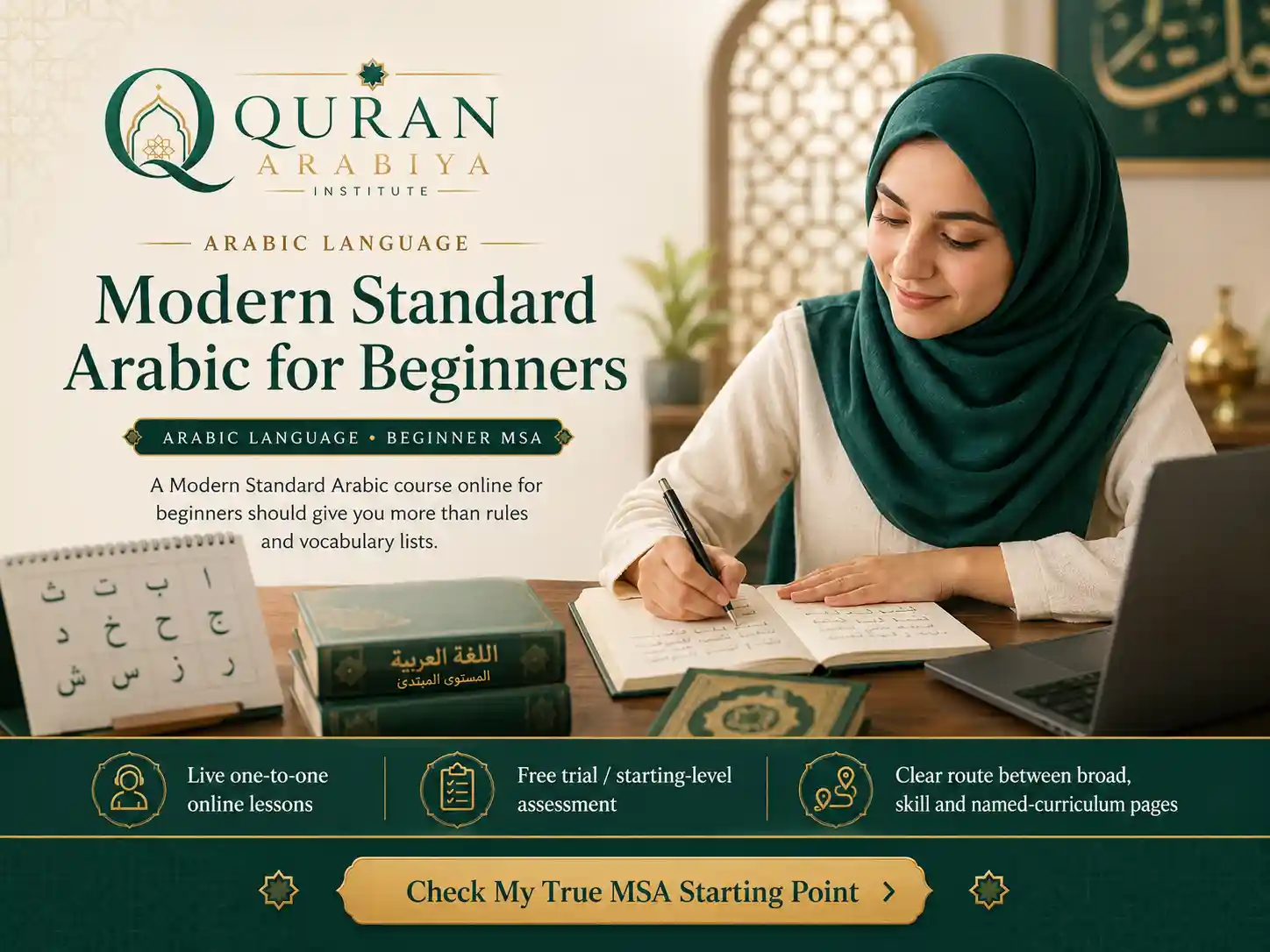
A Modern Standard Arabic course online for beginners should give you more than rules and vocabulary lists. It should help you understand and produce formal Arabic in small, usable steps: hear a pattern, say it, recognise it in writing, read it in context and use it in a short written response. This beginner program builds that foundation systematically, while the free trial helps determine whether you are starting from zero script, basic reading ability or some previous MSA knowledge.
The first stage of MSA is about control of simple formal Arabic, not advanced grammar. You should gradually become able to exchange basic information, understand common classroom-style instructions, read short texts, form clear sentences and write short responses using vocabulary you have actually practised.
The course therefore prioritises a small number of reusable language functions before expanding into heavier structures.
The first stage of MSA is about control of simple formal Arabic, not advanced grammar. You should gradually become able to exchange basic information, understand common classroom-style instructions, read short texts, form clear sentences.
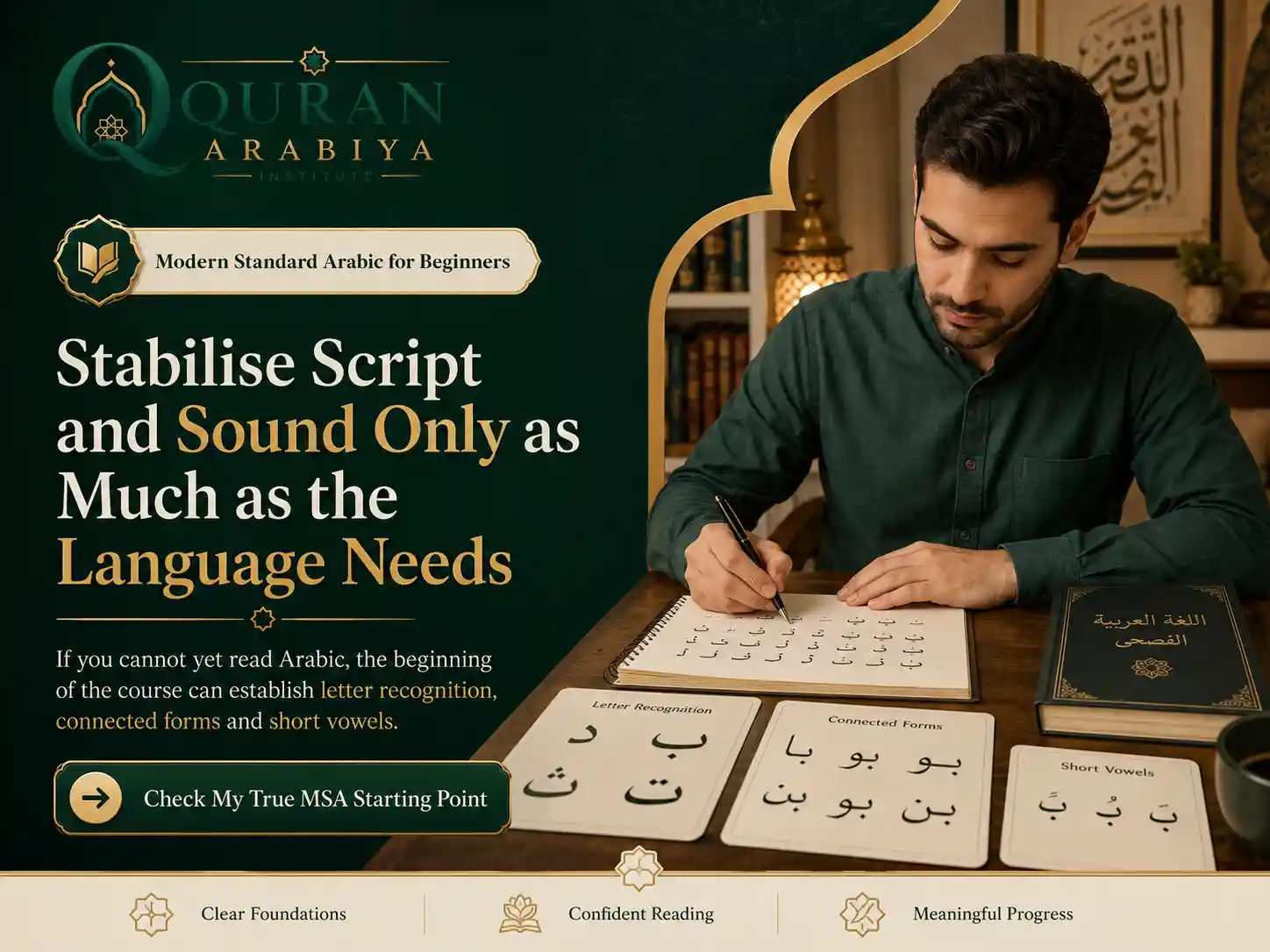
If you cannot yet read Arabic, the beginning of the course can establish letter recognition, connected forms and short vowels. If you already read, the teacher does not need to keep you in alphabet work simply because you are a beginner in MSA.
If reading and writing become your main goal, the dedicated Arabic Reading & Writing course gives you deeper practice in literacy, spelling and written fluency.
A useful check is whether the learner can reuse the same language with less support in a different task. That transfer matters more than simply recognizing the example that was practised in the lesson.
Beginner language becomes useful when it helps you do things: greet, introduce yourself, identify people and objects, ask and answer basic questions, describe a routine, express possession, talk about location, give simple preferences and discuss familiar topics.
Vocabulary is selected to serve those functions, so each new word has a reason to be used rather than merely memorised.
If you cannot yet read Arabic, the beginning of the course can establish letter recognition, connected forms and short vowels. If you already read, the teacher does not need to keep you in alphabet work simply because you are.
Vocabulary is selected to serve those functions, so each new word has a reason to be used rather than merely. Vocabulary is selected to serve those functions, so each new word has a reason to be used rather than.
Arabic can feel complex when every sentence is treated as a new rule. Beginners benefit from noticing recurring frames: noun-based statements, simple descriptions, question patterns, prepositional phrases, basic verb use and common connectors.
The teacher can model a pattern, vary one element at a time, then ask the learner to create a new sentence. That moves the skill from recognition to production.
Listening practice begins with controlled, clearly pronounced MSA and familiar vocabulary. The learner first identifies key words and meaning, then follows short questions and statements without relying on written support.
As the course advances, audio and teacher speech become longer and less predictable so comprehension is not tied to one memorised dialogue.
The goal is to follow familiar MSA at a natural beginner pace without depending on a transcript.
A useful check is whether the learner can reuse the same language with less support in a different task. That transfer matters more than simply recognizing the example that was practised in the lesson.
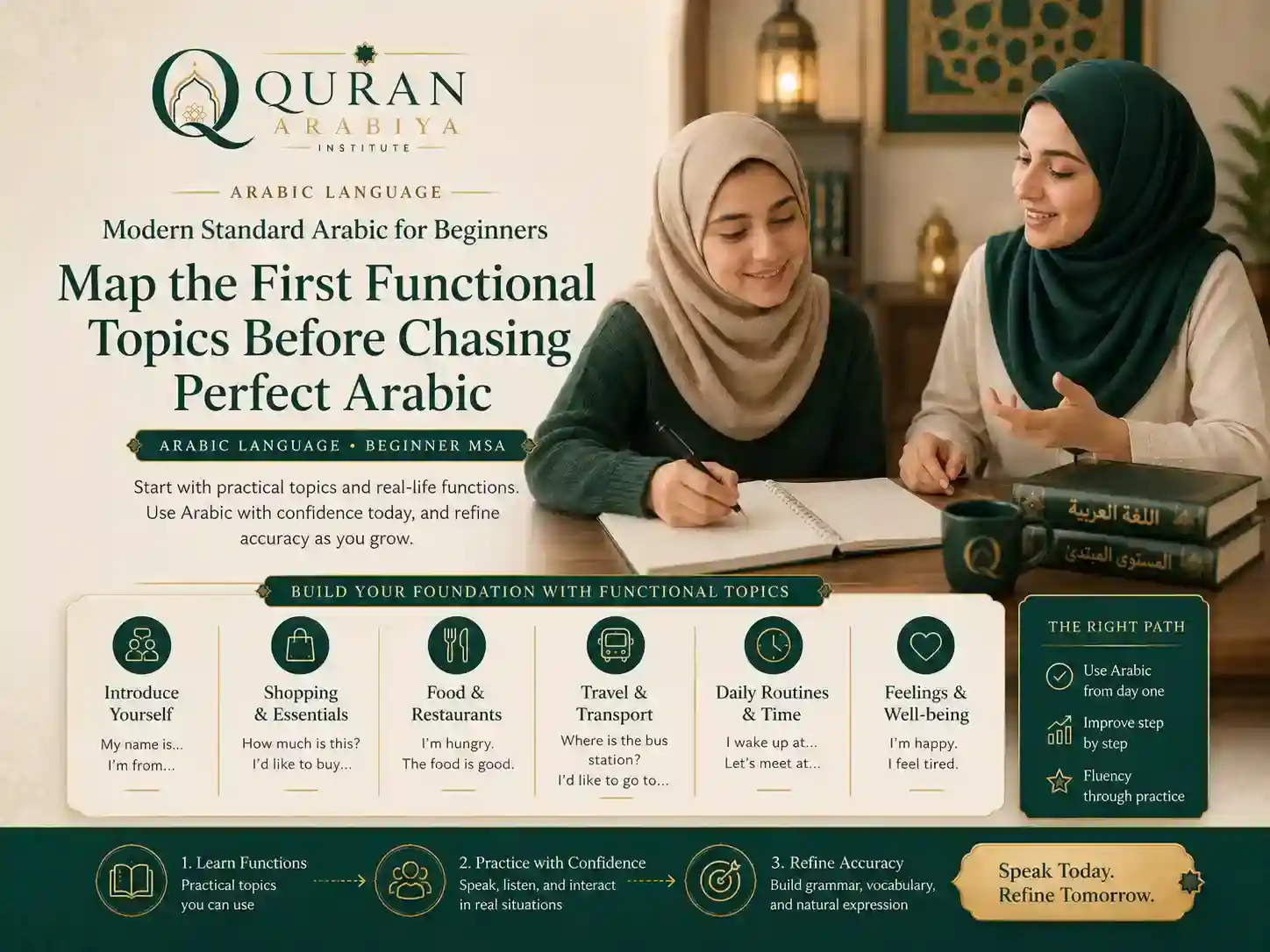
Beginners do not need to wait for a large vocabulary before speaking. Short answers, substitutions, guided questions and picture descriptions create safe production. The teacher corrects the most important errors, then asks for the idea again so the correction is immediately reused.
Over time, one-sentence responses become short connected turns. The separate Arabic Conversation page is available for learners whose main goal later becomes speaking fluency rather than balanced beginner MSA.
The goal is to produce short, accurate MSA responses with less hesitation and less teacher prompting.
Reading should move quickly from isolated words to short meaningful sentences and graded passages. The learner practises identifying known vocabulary, using sentence structure to predict relationships and answering comprehension questions in simple Arabic where possible.
This prevents a common problem: being able to pronounce a paragraph accurately while understanding almost nothing.
The goal is to understand short formal Arabic texts by recognizing familiar vocabulary and sentence patterns in context.
Beginners do not need to wait for a large vocabulary before speaking. Short answers, substitutions, guided questions and picture descriptions create safe production.
Reading should move quickly from isolated words to short meaningful sentences and graded passages. The learner practises identifying known vocabulary, using sentence structure to predict relationships and answering comprehension questions in simple Arabic.
Beginner writing can start with copying only when needed, then move to completing patterns, answering questions, rearranging words, dictation of familiar items and short guided sentences.
The goal is not perfect composition. It is to make spelling, vocabulary and structure active enough that the learner can create something without seeing the model directly in front of them.
The goal is to turn practised vocabulary and structures into clear short sentences and connected responses.
Grammar becomes useful when it clarifies why examples behave the way they do. Beginners can study core concepts in manageable pieces, immediately apply them and revisit them as vocabulary grows.
Deep Nahw, Sarf and classical text analysis belong to the Advanced Arabic category. You learn enough grammar to support beginner MSA communication and comprehension without letting technical rules overwhelm the four language skills.
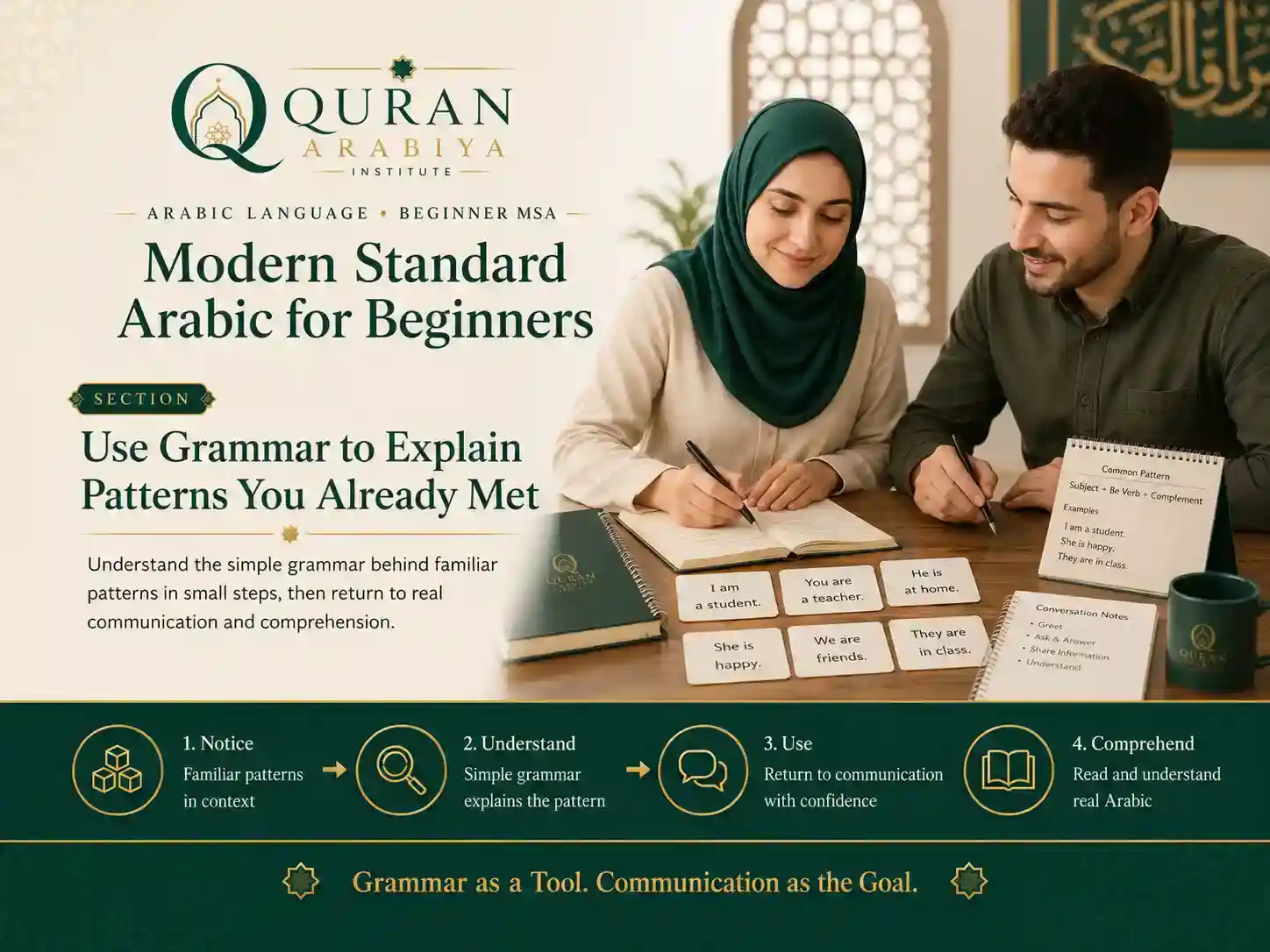
Grammar becomes useful when it clarifies why examples behave the way they do. Beginners can study core concepts in manageable pieces, immediately apply them and revisit them as vocabulary grows.
New words need repeated contact after the lesson. Review can mix recognition and production: listen and choose, see and say, complete a sentence, use the word in a personal answer, then meet it again in a later text.
This creates a working vocabulary rather than a list that disappears after a quiz.
Useful early milestones include reading familiar sentence patterns with less effort, understanding common teacher questions, answering without translating every word, writing several accurate sentences and reusing vocabulary across new topics.
These are more meaningful than promising a particular CEFR label or fluency date without a formal assessment system.
After the foundation becomes stable, the learner can continue into broader Fusha, a communication-focused curriculum such as Al-Takallum or Bayna Yadaik, a grammar-heavy path such as Madinah, or a specialist skill page depending on the goal.
Egyptian Arabic is a separate choice for everyday spoken communication, not a ‘next level’ of Modern Standard Arabic.
The free trial can check script, simple reading, basic listening and any Arabic you can already produce. A learner who studied before may enter above the very first material, while a complete beginner receives the minimum literacy support needed to start productively.
After the assessment, the teacher can recommend the first language functions and skill balance to prioritise.
Egyptian Arabic is a separate choice for everyday spoken communication, not a ‘next level’ of Modern Standard Arabic.
Start MSA with a sequence that turns new language into something you can hear, say, read and write. Book a free trial to identify your current foundation and the most useful first stage.
Modern Standard Arabic, often called MSA or Fusha in learning contexts, is the formal Arabic used broadly in education, writing, formal media and cross-regional communication. Everyday dialects such as Egyptian Arabic are different spoken varieties.
Yes. Early script support can be included. If reading and writing are the dominant problem, the dedicated literacy course may be a more efficient first route.
Yes. Speaking is one of the four skills, with guided production from early lessons. The goal is clear formal communication, not Egyptian or another colloquial dialect.
Yes, but grammar is introduced in manageable pieces that support the language being used. Advanced grammar has separate specialist courses.
They are closely related formal varieties and share much vocabulary and structure, but a beginner MSA course is not the same as a specialist Quranic Arabic or Quranic grammar course.
This page owns a structured beginner MSA program. The Adult Full Track is a broader all-level service that can be personalised around many goals and may not follow one beginner sequence.
Choose based on use. MSA is better for formal reading, writing, education and cross-regional formal communication; Egyptian Arabic is the separate route for everyday Egyptian conversation and listening.
Teen and adult beginners, including learners with little or no MSA who want formal Arabic for reading, education, media, Islamic study or later advanced Arabic.
Not automatically. The free assessment can show which skills are already stable and where the first real gap appears, so a returning learner can avoid unnecessary repetition while a beginner receives the foundation that is actually needed.
The balance should follow the course intent and the learner profile rather than force equal time in every lesson. The teacher can reuse the same vocabulary and structures across several skills so one activity strengthens another instead of becoming a disconnected module.
Grammar is used to make Arabic clearer and more accurate at the depth appropriate to this course. If the learner’s main goal becomes advanced Nahw, Sarf, Quranic Grammar or a named classical text, that deeper intent belongs in the Advanced Arabic category.
Yes. A learner may understand much more than they can read or produce, while another may remember the script but little vocabulary. One-to-one placement lets the teacher build from that uneven profile rather than assume that every student labelled “intermediate” has the same strengths.
The trial can sample the skills most relevant to the course, clarify the learner’s goal, previous study and preferred schedule, and identify the first practical target. It is a course-fit step rather than a promise of a fixed completion time or guaranteed fluency level.
Progress should appear in what the learner can do with less prompting, not only in completed units. A useful checkpoint is whether the learner can use the main skill with increasing independence.
If you are considering Modern Standard Arabic course online, begin with the language task you actually want Arabic to unlock. The free trial can map the learner’s strongest and weakest skills, then route the plan toward a broad Fusha path, a named curriculum or a specialist skill without forcing every learner through the same sequence.