An Ajrumiyyah course online should preserve the precision of the classical matn without leaving the learner trapped inside compressed definitions. Al-Muqaddimah Al-Ajrumiyyah gives students a compact map of foundational Nahw, but that map becomes useful only when each term is unpacked, demonstrated and applied.
This course therefore combines close reading of the matn with teacher explanation, short examples and guided I'rab. It is a text-based grammar route, not a promise to cover every branch of Arabic grammar and morphology in one course.
A useful Matn Ajrumiyyah explanation starts by showing what the author is trying to organize. Each definition points to a larger grammar system: kinds of words, signs of I'rab, grammatical states and the categories that take those states. If the student memorizes wording without seeing that structure, later chapters feel like disconnected lists.
The teacher can first give a simple map of the section, then return to the exact Arabic wording and explain why each technical term is there. This makes the matn a reference the learner can revisit rather than a sequence to recite and forget.
A useful Matn Ajrumiyyah explanation starts by showing what the author is trying to organize. Each definition points to a larger grammar system: kinds of words, signs of I'rab, grammatical states and the categories. The aim is to make the analysis repeatable in a fresh Arabic example rather than leave the rule as terminology remembered in isolation.
Early Ajrumiyyah lessons online should make the opening terminology operational. The learner distinguishes ism, fi'l and harf in actual examples, notices the signs that help identify them and understands what is meant by meaningful composed speech in the grammatical definition.
The point is not to rush. These categories support almost every later decision in Nahw, so the student should be able to classify unfamiliar examples and explain the evidence rather than simply repeat the three labels.
A useful check is whether the learner can explain the relationship, test it on a fresh example and correct the reasoning when the first analysis fails. That is stronger evidence than recalling the rule name alone.
An Ibn Ajurrum grammar course becomes much clearer once the learner understands why endings can change and which signs indicate grammatical state. The teacher should separate the idea of grammatical role from the visible marker, since the marker is not always the same simple vowel the beginner expects.
At this stage, short contrastive examples are powerful: change the governing relationship, observe what changes on the noun or verb and explain why. That turns abstract terminology into a system the student can test.
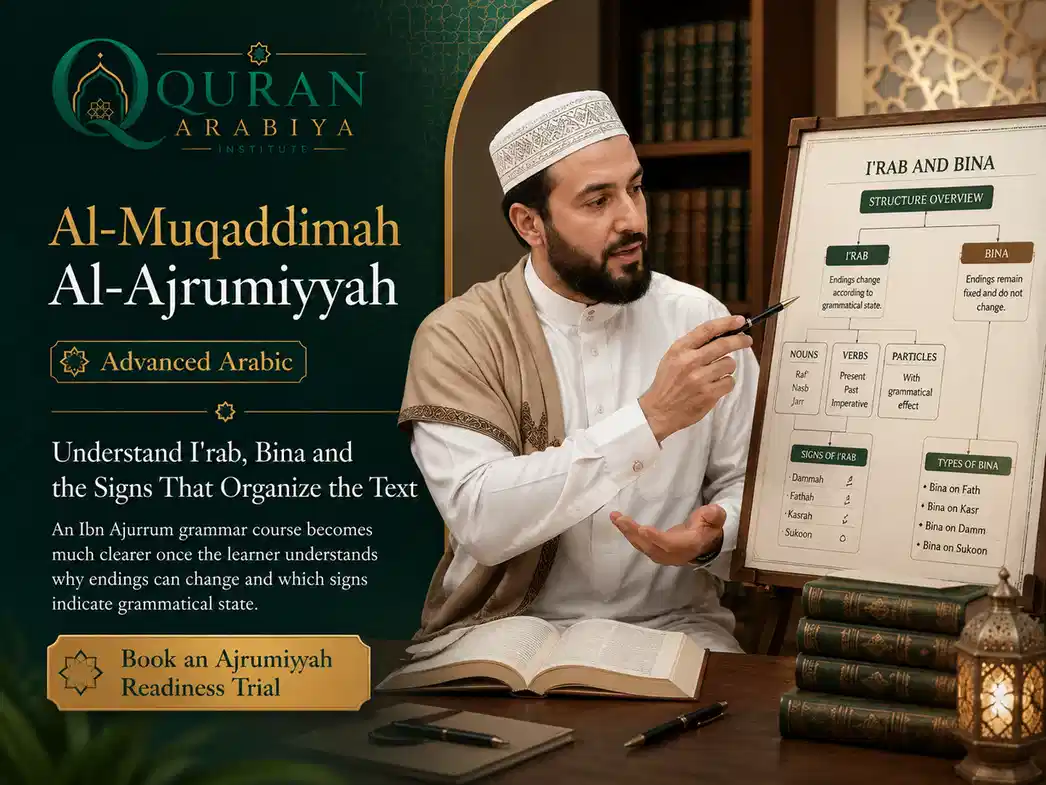
An Ibn Ajurrum grammar course becomes much clearer once the learner understands why endings can change and which signs indicate. The teacher should separate the idea of grammatical role from the visible marker, since the marker is not always. The aim is to make the analysis repeatable in a fresh Arabic example rather than leave the rule as terminology remembered in isolation.
The matn groups many syntactic roles by grammatical state. Instead of presenting every category at once, lessons can add one family at a time and constantly compare new roles with familiar ones. The learner asks both 'what is this role?' and 'why does it belong in this grammatical state?'
A running reference sheet can help: category, identifying question, common marker and one clear example. The sheet should support recall, not replace reading the matn.
A Sharh Al Ajrumiyyah course is most valuable when explanation immediately produces work. After a definition, the student classifies examples, changes a sentence to create a new role, or performs a short I'rab of the exact feature under study.
Teacher correction should focus on the reasoning chain. If the answer is wrong, identify whether the learner misread the word type, misunderstood the construction or remembered the category but applied the wrong sign.
A useful check is whether the learner can explain the relationship, test it on a fresh example and correct the reasoning when the first analysis fails. That is stronger evidence than recalling the rule name alone.
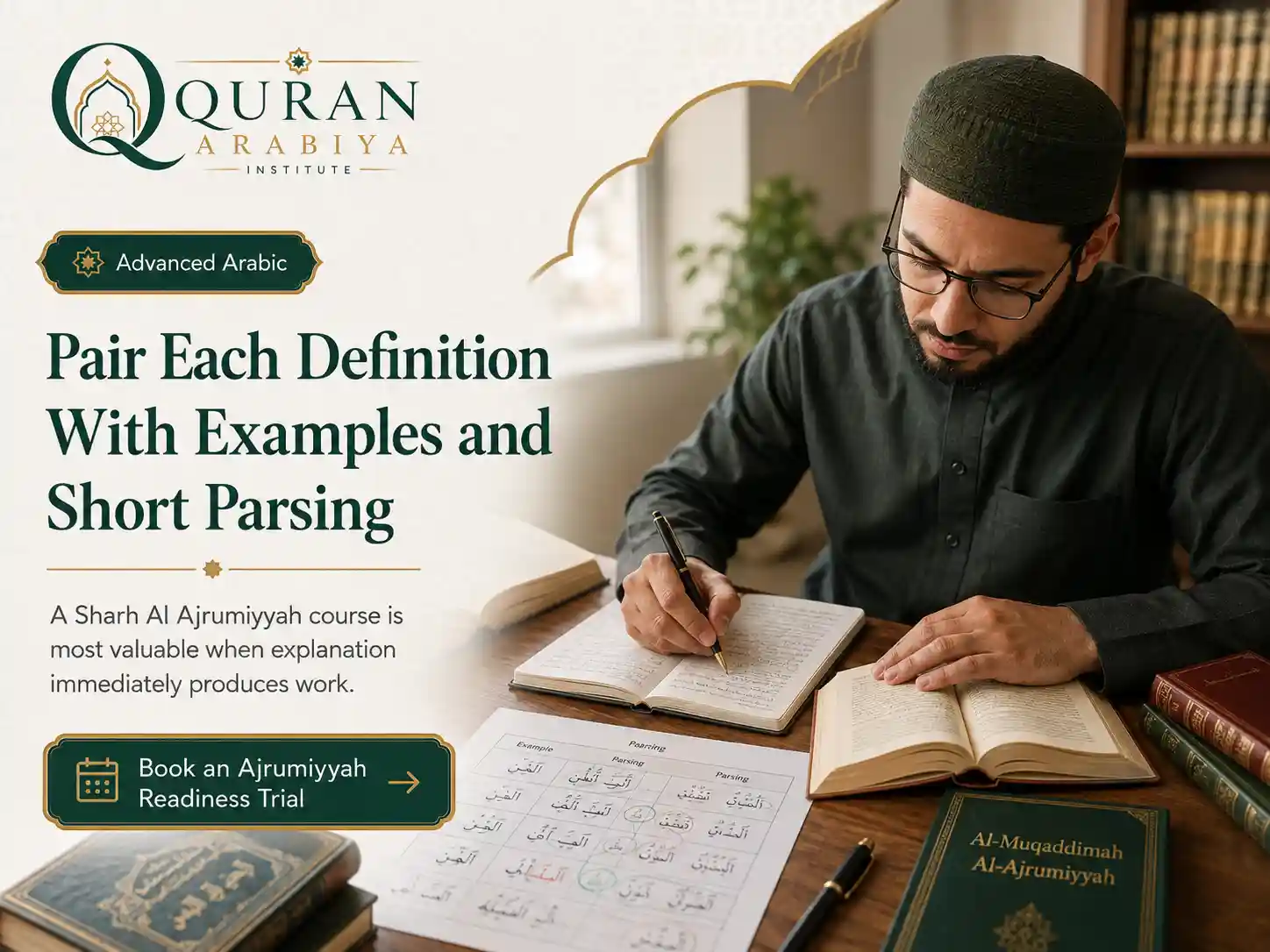
A Sharh Al Ajrumiyyah course is most valuable when explanation immediately produces work. After a definition, the student classifies examples, changes a sentence to create a new role, or performs a short. The aim is to make the analysis repeatable in a fresh Arabic example rather than leave the rule as terminology remembered in isolation.
Memorizing some or all of the matn can be useful for students pursuing traditional study, but the page should not make memorization a universal requirement unless the academy decides that operationally. A learner whose main goal is accurate reading may benefit more from frequent retrieval of definitions and repeated application.
The teacher can recommend a memorization level according to the student's goal, Arabic ability and study time. Understanding and use remain essential even for a student who chooses full memorization.
The end goal is not to know Ajrumiyyah only inside Ajrumiyyah. Once a rule is stable, the teacher can show it in short classical or Quranic examples and ask the learner to recognize the same relationship without the chapter heading telling them what to look for.
Different teachers may use different supporting explanations or commentaries. Unless the academy chooses and publishes a specific sharh, the course page should promise clear explanation and application rather than naming a commentary that may not actually be used.
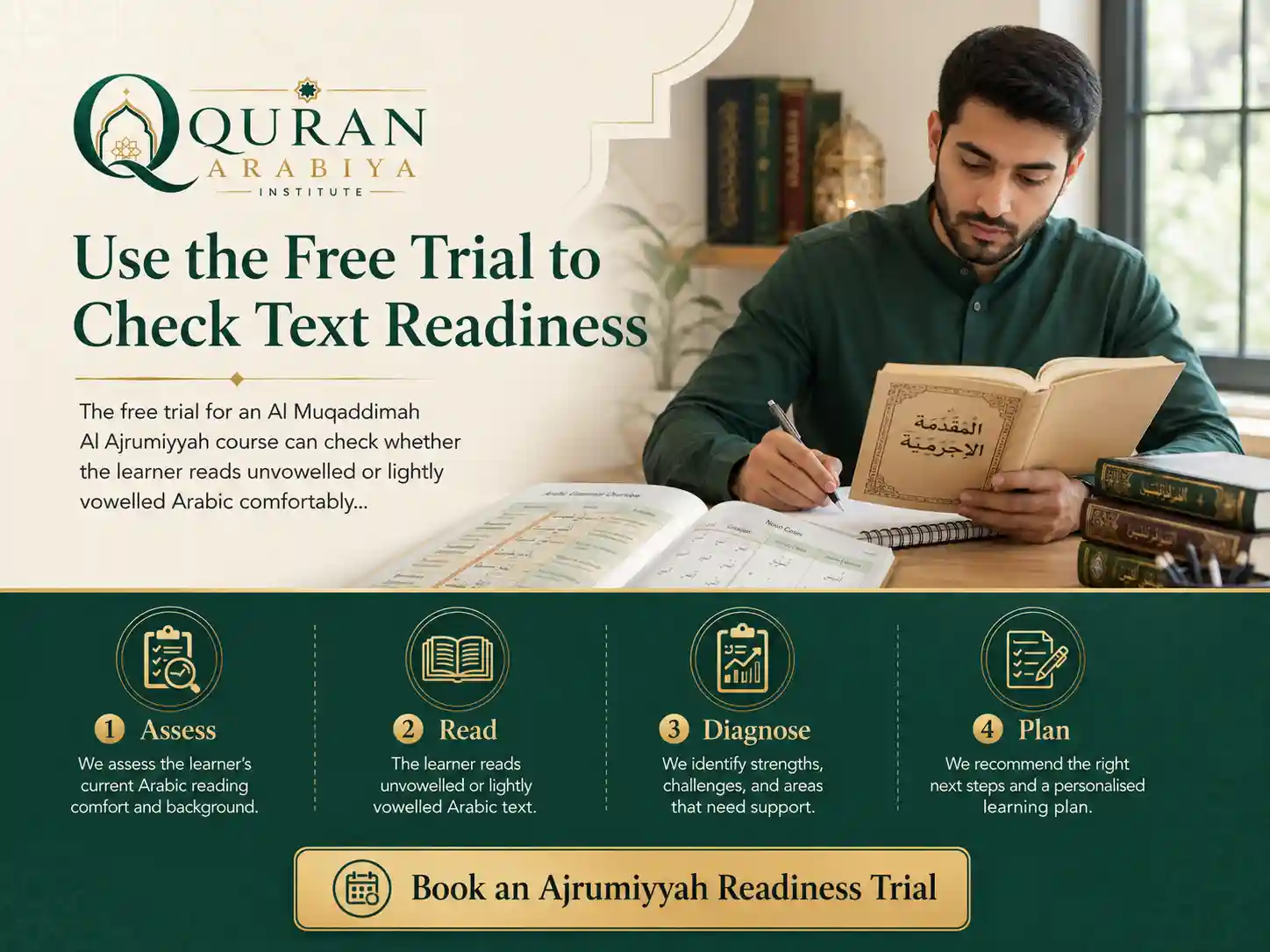
The free trial for an Al Muqaddimah Al Ajrumiyyah course can check whether the learner reads unvowelled or lightly vowelled Arabic comfortably enough, recognizes basic sentence elements and can follow Arabic grammatical terminology at the planned teaching level.
If the text would create too much decoding load, the teacher may recommend a broader Arabic Grammar or reading foundation first. If the learner is ready, the trial helps decide how much explanation, memorization and application the study plan should include.
What Progress Should Look Like
Explain the main purpose of core Ajrumiyyah terminology in your own words.
Classify common words and constructions instead of relying on memorized chapter order.
Connect major I'rab states with the grammatical roles that produce them.
Apply definitions to short new examples and justify the analysis.
Use the matn as a foundation for later commentary, I'rab and advanced Nahw study.
Start With a Free Trial & Placement Lesson
Book a free trial to show the teacher what you can already do, where the current bottleneck is and what you want the course to unlock. The trial can be used as a real placement and learning sample: you participate in a short task, receive correction, and leave with a clearer recommendation for the next step rather than being forced into a fixed starting point.
Book a free trial to show the teacher what you can already do, where the current bottleneck is and what you want the course to unlock. The trial can be used as a real placement and learning sample: you participate in a short task, receive correction, and leave with a clearer recommendation for the next step rather than being forced into a fixed starting point.
Frequently Asked Questions
It is primarily a concise foundational text in Nahw and I’rab. Morphological information may appear where needed for grammar, but this course should not be presented as a complete Sarf syllabus.
Not necessarily unless the academy sets that as a course requirement. Memorization can support traditional study, but understanding and application are essential.
That should be confirmed by the academy or teacher. The commentary may vary according to the teacher, your Arabic level and the study plan. We can confirm the exact Sharh or supporting material before regular lessons begin.
Usually the learner should already be able to read Arabic and benefit from grammatical explanation. The free trial can determine whether a more general foundation is needed first.
Arabic Grammar is the broad practical grammar route. Ajrumiyyah is a named classical-text course built around the structure and terminology of Al-Muqaddimah Al-Ajrumiyyah.
Teens and adults with enough Arabic reading ability to study a concise classical grammar text; suitable for learners beginning formal traditional Nahw or rebuilding a scattered foundation.
That does not automatically mean you need to restart from the beginning. The free trial can test reading comfort, sentence awareness and the prerequisite skill most relevant to this course, then route you to a foundation course only when the gap would block useful advanced study.
Traditional terminology matters because it gives the learner a precise analytical language, but memorizing labels is not the final test. The stronger outcome is being able to recognize the construction, explain why the term applies and use the same reasoning on a new example.
Yes. Your teacher may use Quranic or classical Arabic examples when they help you understand the grammar in Ajrumiyyah, while Tafsir and other specialist subjects remain outside the course focus. Quranic language analysis is not presented as Tafsir, and a named-text course does not assume an unverified commentary, edition or fixed reading list.
It allows the teacher to see the exact step where analysis breaks down: vocabulary, form recognition, grammatical relation, parsing, rhetorical reasoning or reading stamina. The lesson can then spend time on that bottleneck and test it again in a fresh example before moving on.
No. Choose Ajrumiyyah if you want a focused foundation in classical Nahw through Al-Muqaddimah Al-Ajrumiyyah. If you need broader practical grammar first, or deeper standalone Sarf, another course may be a better starting point. Own study of the Ajrumiyyah matn. Do not present it as a complete Sarf course, a generic Arabic Grammar page, the example-led Nahw Al-Wadih route, or advanced Alfiyyah study.
The trial can check readiness, prior study, goals and the most useful starting point for this specific subject. It does not guarantee a certificate, fixed syllabus length, particular book edition or teacher qualification that has not been independently confirmed.
Progress should show up in analysis and transfer, not page count alone. A useful checkpoint is whether the learner can use the main skill with increasing independence.
The next route should follow the skill this page intentionally does not absorb. Own study of the Ajrumiyyah matn. Do not present it as a complete Sarf course, a generic Arabic Grammar page, the example-led Nahw Al-Wadih route, or advanced Alfiyyah study. The teacher can recommend the most logical sibling course once the present objective is stable.
If you are considering Ajrumiyyah course online, begin with the analytical skill that is currently breaking down: form, sentence relation, parsing, rhetoric or reading transfer. The free trial can check readiness and route the learner without inventing an edition, commentary, certificate or fixed advanced outcome that has not been verified.