An Al Balagha Al Wadiha course online should help students experience rhetoric before drowning them in terminology. The textbook is widely used because rhetorical ideas are approached through examples and exercises, giving the learner something concrete to notice, compare and explain.
This course keeps that practical spirit. Students study the relevant section of the book, identify what makes the expression effective, learn the technical concept and then test it through guided analysis and production. Exact edition, number of levels and duration should be confirmed by the academy before publication.
Effective Balagha Al Wadiha lessons begin by asking what the learner notices in two expressions. Is one more vivid? Does one make a comparison explicit while another leaves it implied? What image or emphasis is created? Only after the learner has observed the effect does the teacher formalize the rhetorical term.
That sequence makes Balagha intelligible. The term becomes a name for something the learner has already seen rather than another definition to memorize.

Effective Balagha Al Wadiha lessons begin by asking what the learner notices in two expressions. Does one make a comparison explicit while another leaves it implied? The aim is to make the analysis repeatable in a fresh Arabic example rather than leave the rule as terminology remembered in isolation.
A good Al Balaghah Al Wadihah explanation should train recognition and interpretation together. The learner identifies the structure of a simile, notices when an image becomes metaphorical and learns why kinayah cannot be reduced to a simple word substitution.
For each example, the teacher can ask: what is being compared or implied, which element creates the effect, and how would the sentence change if expressed more directly? These questions move the learner from classification to appreciation.
A useful check is whether the learner can explain the relationship, test it on a fresh example and correct the reasoning when the first analysis fails. That is stronger evidence than recalling the rule name alone.
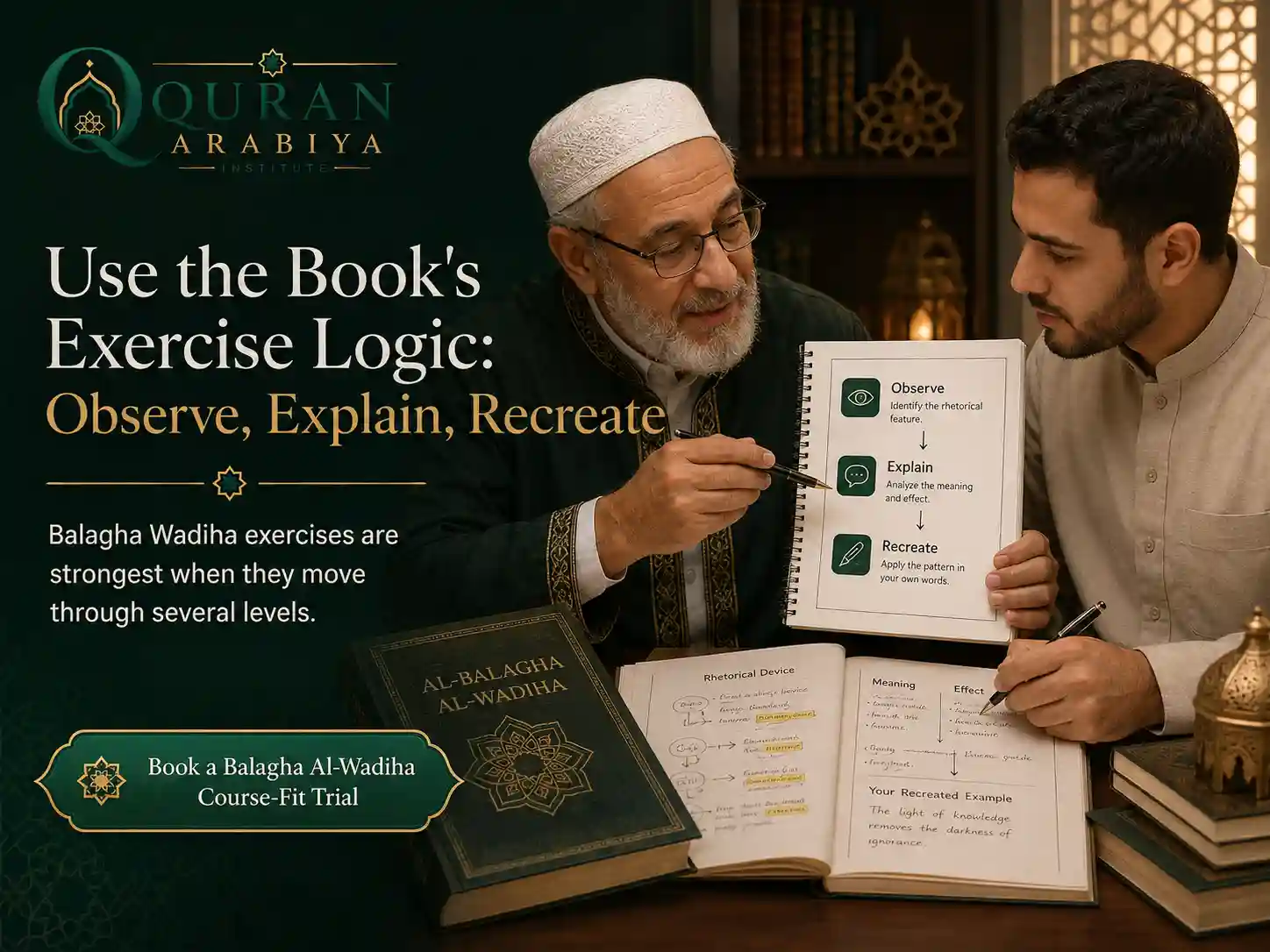
Balagha Wadiha exercises are strongest when they move through several levels. First, locate the rhetorical feature. Next, explain how it works. Then compare it with a nearby alternative. Finally, create or transform a sentence using the same principle.
Production reveals whether the learner understands the relationship or only recognizes a familiar example. Teacher feedback should correct both the Arabic and the rhetorical reasoning.
A good Al Balaghah Al Wadihah explanation should train recognition and interpretation together. The learner identifies the structure of a simile, notices when an image becomes metaphorical and learns why kinayah cannot. The aim is to make the analysis repeatable in a fresh Arabic example rather than leave the rule as terminology remembered in isolation.
An Al Balagha Al Wadiha textbook course should not make rhetoric look like a catalog of figures. Ilm al-Ma'ani asks how wording is shaped by context, audience and communicative purpose. Sentence form, emphasis, order, brevity and expansion can all matter depending on the passage.
The learner therefore compares expressions that may both be grammatically correct but do different rhetorical work. This creates a bridge from grammar to stylistic judgment.
Students often collect labels from different branches of Balagha without understanding what each branch is asking. Lessons should maintain a simple map: Ma'ani examines expression in relation to context, Bayan examines ways meaning is presented through devices such as simile and metaphorical expression, and Badi' studies additional forms of verbal or semantic embellishment.
The map can become more precise as the course progresses, but keeping the categories distinct prevents early confusion.
A useful check is whether the learner can explain the relationship, test it on a fresh example and correct the reasoning when the first analysis fails. That is stronger evidence than recalling the rule name alone.
An Al Balagha Al Wadiha textbook course should not make rhetoric look like a catalog of figures. Ilm al-Ma'ani asks how wording is shaped by context, audience and communicative purpose. The aim is to make the analysis repeatable in a fresh Arabic example rather than leave the rule as terminology remembered in isolation.

Al Balagha Al Wadiha classes may draw on Quranic, poetic and prose examples where appropriate. The purpose of those examples is linguistic and rhetorical analysis. A rhetorical observation about a Quranic expression should not be turned into an independent Tafsir claim without the wider interpretive sources that Tafsir requires.
This boundary allows students to appreciate form while remaining careful about what language analysis can and cannot establish.
One of the best tests of rhetoric is contrast. Give two ways to express a similar idea and ask what changes in vividness, emphasis, implication or tone. Ask the learner to make a direct sentence more figurative, or to turn an image back into literal wording and explain what was lost.
Comparison makes rhetorical choice visible. It also gives advanced students a practical route from passive appreciation toward more precise formal Arabic expression.

This page is for students who specifically want the Al-Balagha Al-Wadiha route. The separate Arabic Rhetoric & Eloquence course owns the broader subject of Ma'ani, Bayan and Badi' without being tied to one textbook.
A student may study one before the other or use the book as part of a broader plan, but the two pages should remain distinct in both search intent and curriculum promise.
Balagha becomes frustrating if ordinary sentence structure and vocabulary still consume all the learner's attention. In the free trial, the teacher can ask the student to read a short formal passage, explain its literal meaning and compare two expressions.
That gives a practical readiness signal. If basic comprehension is unstable, Classical Arabic Reading, Arabic Grammar or Nahw may be the better immediate step. If the text is accessible, the teacher can place the learner into the appropriate book-based study level.
What Progress Should Look Like
Recognize core rhetorical relationships in examples without depending on memorized chapter headings.
Explain the effect of selected Tashbih, Isti'ara and Kinayah examples in clear language.
Distinguish the broad roles of Ma'ani, Bayan and Badi' more reliably.
Complete analytical and productive rhetoric exercises with decreasing support.
Compare two valid expressions and articulate the rhetorical difference between them.
Start With a Free Trial & Placement Lesson
Book a free trial to show the teacher what you can already do, where the current bottleneck is and what you want the course to unlock. The trial can be used as a real placement and learning sample: you participate in a short task, receive correction, and leave with a clearer recommendation for the next step rather than being forced into a fixed starting point.
This page is for students who specifically want the Al-Balagha Al-Wadiha route. The separate Arabic Rhetoric & Eloquence course owns the broader subject of Ma'ani, Bayan and Badi' without being tied. The aim is to make the analysis repeatable in a fresh Arabic example rather than leave the rule as terminology remembered in isolation.
Book a free trial to show the teacher what you can already do, where the current bottleneck is and what you want the course to unlock. The trial can be used as a real placement and learning sample: you participate in a short task, receive correction, and leave with a clearer recommendation for the next step rather than being forced into a fixed starting point.
Frequently Asked Questions
No. This is the textbook-specific route. The Arabic Rhetoric & Eloquence course covers the broader discipline without tying the learner to one book.
A solid reading and grammar foundation is recommended because rhetoric assumes you can already understand the basic sentence before analyzing why it was expressed in a particular way.
The academy should confirm the exact edition and materials before publication. This content intentionally avoids inventing edition or volume details.
Quranic examples may be used for linguistic and rhetorical study where appropriate, but rhetoric lessons do not replace Tafsir.
The core value is understanding and application. Any memorization requirement should be stated only if the academy formally includes it in the teaching plan.
Adults and advanced teens with a solid Arabic reading and grammar foundation who want a structured textbook introduction to Balagha before or alongside broader rhetoric study.
That does not automatically mean you need to restart from the beginning. The free trial can test reading comfort, sentence awareness and the prerequisite skill most relevant to this course, then route you to a foundation course only when the gap would block useful advanced study.
Traditional terminology matters because it gives the learner a precise analytical language, but memorizing labels is not the final test. The stronger outcome is being able to recognize the construction, explain why the term applies and use the same reasoning on a new example.
Examples can be selected where they support the stated language objective, but the page keeps its scope clear. Quranic language analysis is not presented as Tafsir, and a named-text course does not assume an unverified commentary, edition or fixed reading list.
It allows the teacher to see the exact step where analysis breaks down: vocabulary, form recognition, grammatical relation, parsing, rhetorical reasoning or reading stamina. The lesson can then spend time on that bottleneck and test it again in a fresh example before moving on.
No. The course owns one defined intent and should route adjacent goals outward. Own the specific Al-Balagha Al-Wadiha textbook route. Do not absorb the broad Arabic Rhetoric & Eloquence page, and do not promise a fixed edition, level count or course duration unless the academy confirms them.
The trial can check readiness, prior study, goals and the most useful starting point for this specific subject. It does not guarantee a certificate, fixed syllabus length, particular book edition or teacher qualification that has not been independently confirmed.
Progress should show up in analysis and transfer, not page count alone. A useful checkpoint is whether the learner can use the main skill with increasing independence.
The next route should follow the skill this page intentionally does not absorb. Own the specific Al-Balagha Al-Wadiha textbook route. Do not absorb the broad Arabic Rhetoric & Eloquence page, and do not promise a fixed edition, level count or course duration unless the academy confirms them. The teacher can recommend the most logical sibling course once the present objective is stable.
If you are considering Al Balagha Al Wadiha course online, begin with the analytical skill that is currently breaking down: form, sentence relation, parsing, rhetoric or reading transfer. The free trial can check readiness and route the learner without inventing an edition, commentary, certificate or fixed advanced outcome that has not been verified.