A Classical Arabic reading course online is for the learner who knows more Arabic than their reading speed suggests. You may recognize grammar rules, know many roots and understand a sentence once someone vowels it for you, yet still hesitate when faced with a dense unvowelled page. The missing skill is often transfer.
This course turns grammar, morphology and vocabulary into a reading routine. Instead of stopping at every unknown word, you learn to locate sentence anchors, predict structure, test endings, use the dictionary selectively and keep enough of the passage in working memory to understand the whole.
Students who want to read classical Arabic texts can spend years collecting rules while postponing sustained reading. That creates a paradox: grammar knowledge grows, but real reading never becomes automatic because the learner rarely has to coordinate all the tools at once.
This course uses reading itself as training. When a passage exposes a grammar or morphology gap, the teacher repairs that gap in context and returns immediately to the text.
Students who want to read classical Arabic texts can spend years collecting rules while postponing sustained reading. That creates a paradox: grammar knowledge grows, but real reading never becomes automatic because the learner rarely has to. The aim is to make the analysis repeatable in a fresh Arabic example rather than leave the rule as terminology remembered in isolation.
Effective classical Arabic reading classes teach what to do before reaching for a translation. Scan the sentence for obvious verbs, subjects, particles, prepositional phrases, relative markers and punctuation or editorial clues. Segment the line into likely meaning units and identify the main clause before examining every detail.
This first pass creates a hypothesis. The rest of the reading process tests and refines it.
A useful check is whether the learner can explain the relationship, test it on a fresh example and correct the reasoning when the first analysis fails. That is stronger evidence than recalling the rule name alone.
Unvowelled Arabic reading practice is not about magically knowing every harakah. It is about using grammatical evidence to narrow the possibilities. If a noun follows a preposition, enters an idafah, functions as a subject or is governed by a known particle, the structure gives clues about the expected ending.
The teacher can ask the learner to predict, justify and then correct. Over time, the student begins to hear syntactic possibilities before receiving the fully vowelled form.
Effective classical Arabic reading classes teach what to do before reaching for a translation. Scan the sentence for obvious verbs, subjects, particles, prepositional phrases, relative markers and punctuation or editorial clues. The aim is to make the analysis repeatable in a fresh Arabic example rather than leave the rule as terminology remembered in isolation.
A long unfamiliar word often becomes manageable after identifying prefixes, suffixes, attached pronouns and the likely root-pattern relationship. Before opening a dictionary, the learner asks: is this a verb or noun form, what attachments can I remove mentally, and what root is plausible?
That quick morphological analysis reduces bad dictionary searches and helps the learner recognize families of words across texts.
Dictionary use is a skill, not a sign of failure. The problem is stopping for every unknown word or choosing the first English gloss without checking context. Students learn to decide which word actually blocks the sentence, locate the likely root, inspect the relevant range of meanings and return to the passage to test the result.
Repeated useful words are recorded with a phrase or sentence, not as isolated translations. This creates a lexicon tied to the kinds of texts the learner actually reads.
A useful check is whether the learner can explain the relationship, test it on a fresh example and correct the reasoning when the first analysis fails. That is stronger evidence than recalling the rule name alone.
A long unfamiliar word often becomes manageable after identifying prefixes, suffixes, attached pronouns and the likely root-pattern relationship. Before opening a dictionary, the learner asks: is this a verb or noun form, what attachments can I remove. The aim is to make the analysis repeatable in a fresh Arabic example rather than leave the rule as terminology remembered in isolation.
Advanced Arabic text comprehension often breaks down because the learner understands each short phrase but loses the relationship across a long sentence. Classical prose may contain embedded descriptions, quoted material, conditions and chains of pronoun reference.
The teacher trains the student to mark connectors, resolve pronouns, bracket subordinate units and keep the main clause visible. Reading then becomes hierarchical rather than a word-by-word march.
Classical Islamic text reading should not jump from short teaching sentences directly into pages of dense specialist prose. Passages can increase gradually in length, syntactic density, vocabulary load and dependence on unstated background knowledge.
The exact books do not need to be hard-coded on this page. The teacher can select appropriate authentic or adapted material according to the student's level and goals while preserving a clear progression in difficulty.

Classical Islamic text reading should not jump from short teaching sentences directly into pages of dense specialist prose. Passages can increase gradually in length, syntactic density, vocabulary load and dependence on unstated background knowledge. The aim is to make the analysis repeatable in a fresh Arabic example rather than leave the rule as terminology remembered in isolation.
At the beginning, teacher modeling can reveal how an experienced reader segments and predicts. But support should fade. The learner first reads and marks the passage independently, proposes vowels or structure where relevant, identifies uncertainties and only then receives correction.
This preserves the most important learning moment: the student's own first attempt. Listening to a perfect teacher reading before trying can hide the exact skill that needs development.
A student preparing for Islamic studies may need different vocabulary and conventions from someone focused on classical literature or language scholarship. The course can therefore vary texts by goal while keeping the same transferable reading method.
Genre choice should be deliberate, but the page should not promise a fixed list of books until the academy confirms the curriculum and the student's placement.
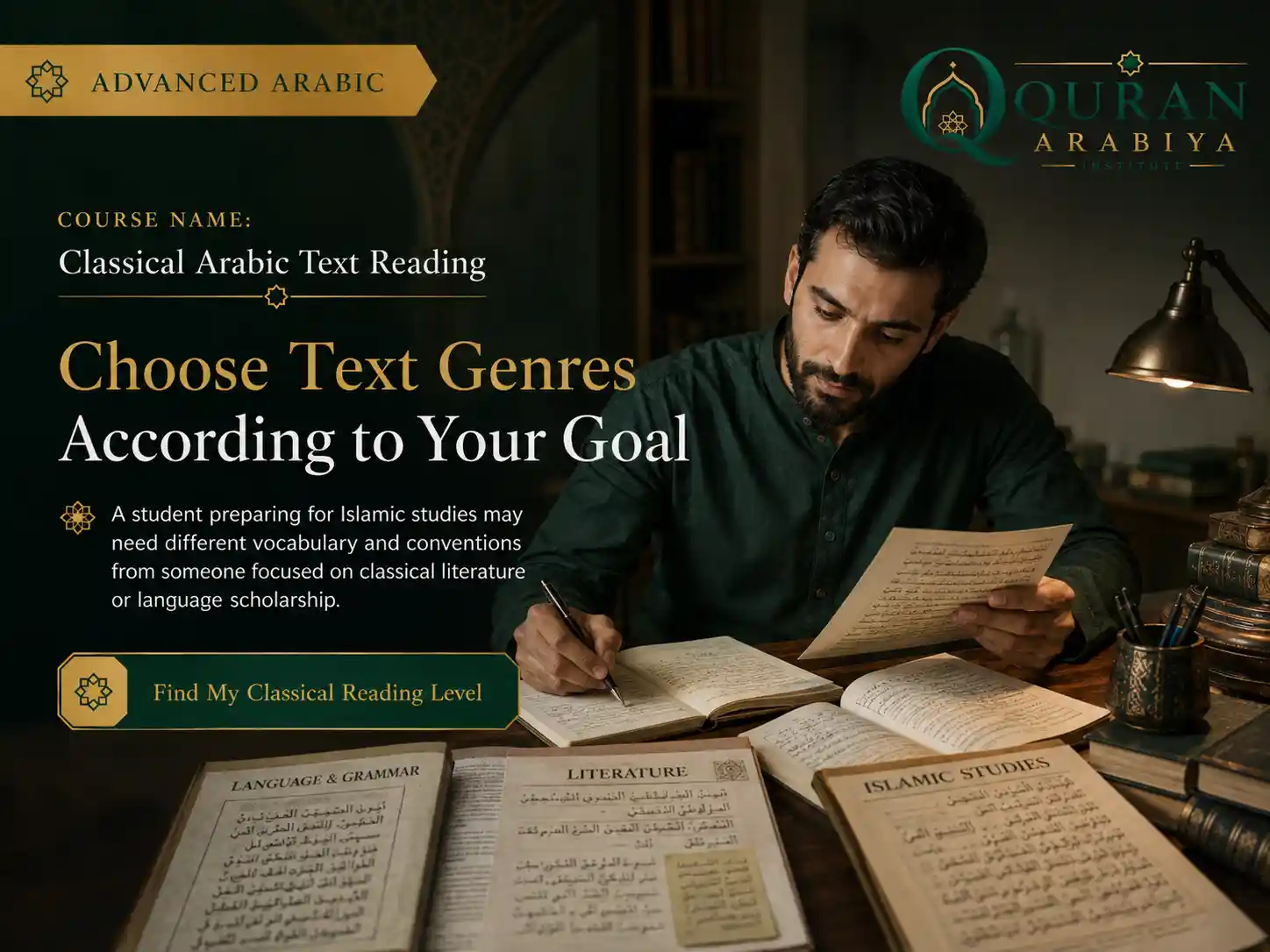
A student preparing for Islamic studies may need different vocabulary and conventions from someone focused on classical literature or language. The course can therefore vary texts by goal while keeping the same transferable reading method. The aim is to make the analysis repeatable in a fresh Arabic example rather than leave the rule as terminology remembered in isolation.
The free trial can use a short unvowelled or lightly vowelled passage. The teacher can observe reading speed, segmentation, grammar use, morphology, dictionary habits and whether the learner retains the meaning of the whole sentence after solving individual words.
That assessment helps choose passage difficulty and identify the main bottleneck. One student may need syntax reinforcement; another may need vocabulary, morphology or simply more sustained reading practice.
What Progress Should Look Like
Approach an unvowelled passage with a repeatable first-pass routine.
Use syntax and morphology to generate plausible readings before checking external help.
Consult dictionaries selectively and choose meanings in context.
Track long sentences, connectors and pronoun references with less loss of comprehension.
Complete an independent first reading before relying on teacher vocalization or translation.
Start With a Free Trial & Placement Lesson
Book a free trial to show the teacher what you can already do, where the current bottleneck is and what you want the course to unlock. The trial can be used as a real placement and learning sample: you participate in a short task, receive correction, and leave with a clearer recommendation for the next step rather than being forced into a fixed starting point.
Book a free trial to show the teacher what you can already do, where the current bottleneck is and what you want the course to unlock. The trial can be used as a real placement and learning sample: you participate in a short task, receive correction, and leave with a clearer recommendation for the next step rather than being forced into a fixed starting point.
Frequently Asked Questions
You need a meaningful foundation, but you do not need to know every rule. Reading itself can expose and strengthen the rules that matter most.
Text selection should depend on level, goals and the academy’s confirmed curriculum. This page intentionally avoids inventing a fixed book list.
Unvowelled and lightly vowelled reading is a central skill, but the course also trains sentence segmentation, morphology, dictionary use, vocabulary and whole-passage comprehension.
No. Classical Islamic texts can be one important genre, but text selection may also include broader classical prose or literature according to the learner’s goal.
Grammar teaches the system. This course trains you to deploy grammar, morphology and vocabulary together while reading sustained classical text.
Adults and advanced teens who already possess meaningful grammar and vocabulary knowledge but still read classical texts slowly, guess endings, overuse dictionaries or lose the sentence across long passages.
That does not automatically mean you need to restart from the beginning. The free trial can test reading comfort, sentence awareness and the prerequisite skill most relevant to this course, then route you to a foundation course only when the gap would block useful advanced study.
Traditional terminology matters because it gives the learner a precise analytical language, but memorizing labels is not the final test. The stronger outcome is being able to recognize the construction, explain why the term applies and use the same reasoning on a new example.
Examples can be selected where they support the stated language objective, but the page keeps its scope clear. Quranic language analysis is not presented as Tafsir, and a named-text course does not assume an unverified commentary, edition or fixed reading list.
It allows the teacher to see the exact step where analysis breaks down: vocabulary, form recognition, grammatical relation, parsing, rhetorical reasoning or reading stamina. The lesson can then spend time on that bottleneck and test it again in a fresh example before moving on.
No. The course owns one defined intent and should route adjacent goals outward. Own reading-transfer skills. Do not recreate a full grammar, Sarf, Balagha or Quranic-Arabic syllabus; use those tools only when they solve a reading problem. Text genres can be selected to match goals without promising a fixed book list.
The trial can check readiness, prior study, goals and the most useful starting point for this specific subject. It does not guarantee a certificate, fixed syllabus length, particular book edition or teacher qualification that has not been independently confirmed.
Progress should show up in analysis and transfer, not page count alone. A useful checkpoint is whether the learner can use the main skill with increasing independence.
The next route should follow the skill this page intentionally does not absorb. Own reading-transfer skills. Do not recreate a full grammar, Sarf, Balagha or Quranic-Arabic syllabus; use those tools only when they solve a reading problem. Text genres can be selected to match goals without promising a fixed book list. The teacher can recommend the most logical sibling course once the present objective is stable.
If you are considering Classical Arabic reading course online, begin with the analytical skill that is currently breaking down: form, sentence relation, parsing, rhetoric or reading transfer. The free trial can check readiness and route the learner without inventing an edition, commentary, certificate or fixed advanced outcome that has not been verified.