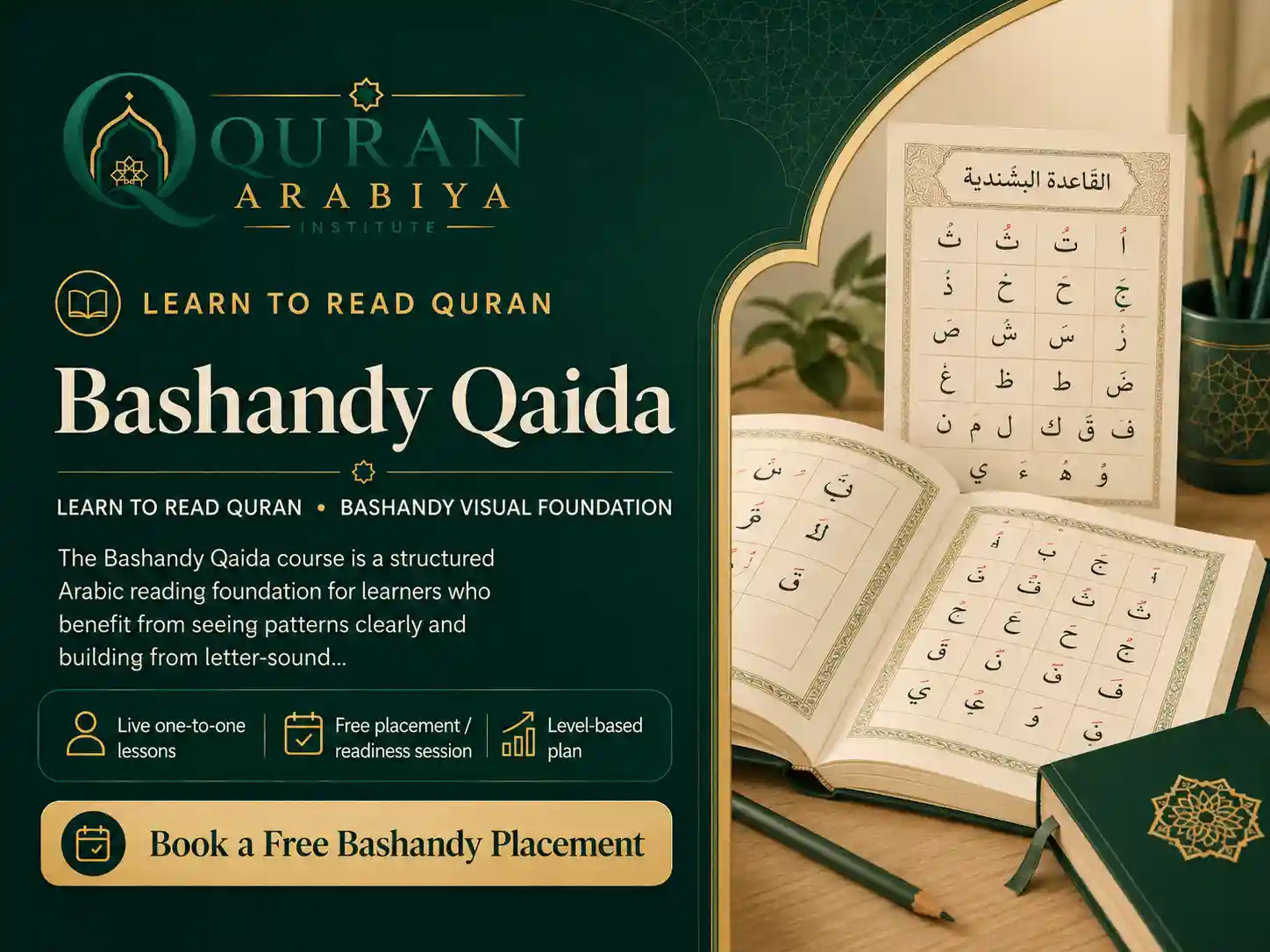
The Bashandy Qaida course is a structured Arabic reading foundation for learners who benefit from seeing patterns clearly and building from letter-sound recognition into words before moving toward more demanding text. Because Bashandy is less widely described in English than Noorani or Noor Al Bayan, Quran Arabiya Institute should keep the public promise precise: teach the confirmed Bashandy reading sequence well, use visual support where it genuinely helps, and test whether the learner can read without depending on the prompt.
The Bashandy reading method can be presented as a structured route for learners who benefit from visual clarity and graded examples. Visual support can reduce the initial load of an unfamiliar script and help the learner notice the feature that distinguishes one letter or pattern from another.
The support is a means, not the goal. The learner should gradually recognize the Arabic form directly without needing an external picture or cue every time.
Start by using visual structure to make the page easier to interpret. In live one-to-one practice, the teacher highlights the relevant shape or pattern without adding unsupported claims about the method beyond the confirmed reading foundation. This stage is ready when the learner notices the reading feature quickly enough to use it in the next step.
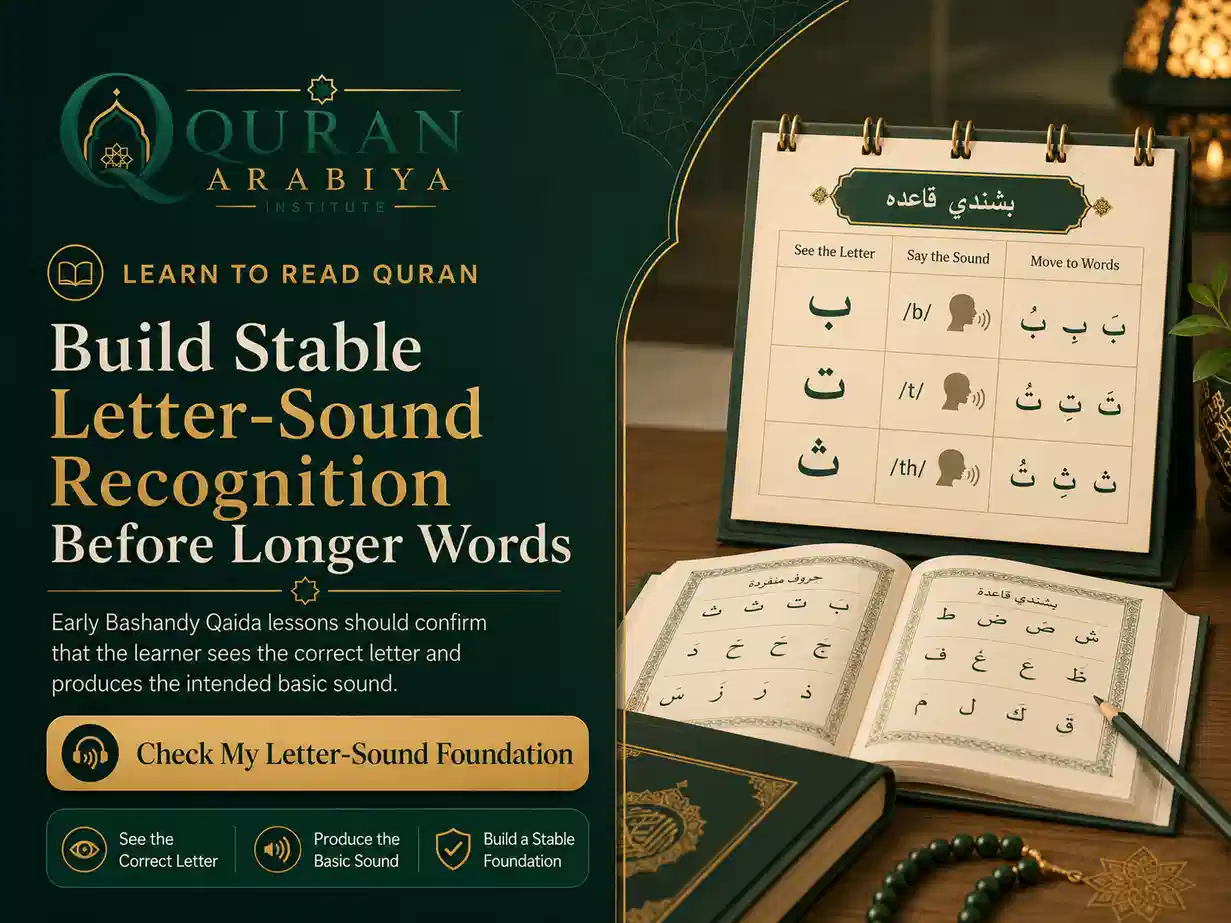
Early Bashandy Qaida lessons should confirm that the learner sees the correct letter and produces the intended basic sound. Similar shapes and unfamiliar sounds can be isolated and contrasted before they are placed in longer combinations.
This prevents longer-word practice from becoming a chain of guesses built on an unstable alphabet.
Visual scaffolding is most useful when it draws attention to the part of the script the learner is missing: dot pattern, orientation, positional form or vowel sign. The teacher can then remove that scaffolding in stages.
Mixed-order checks are important. If the student succeeds only when the same pictures or page layout are present, the visual support has become a crutch rather than a bridge.
As the learner moves from isolated forms into words, attention shifts from “What letter is this?” to “Can I keep the correct sound while the shape changes and the word becomes longer?”
The Bashandy Arabic foundation course can use short graded word-building tasks that keep pronunciation and visual recognition active at the same time.
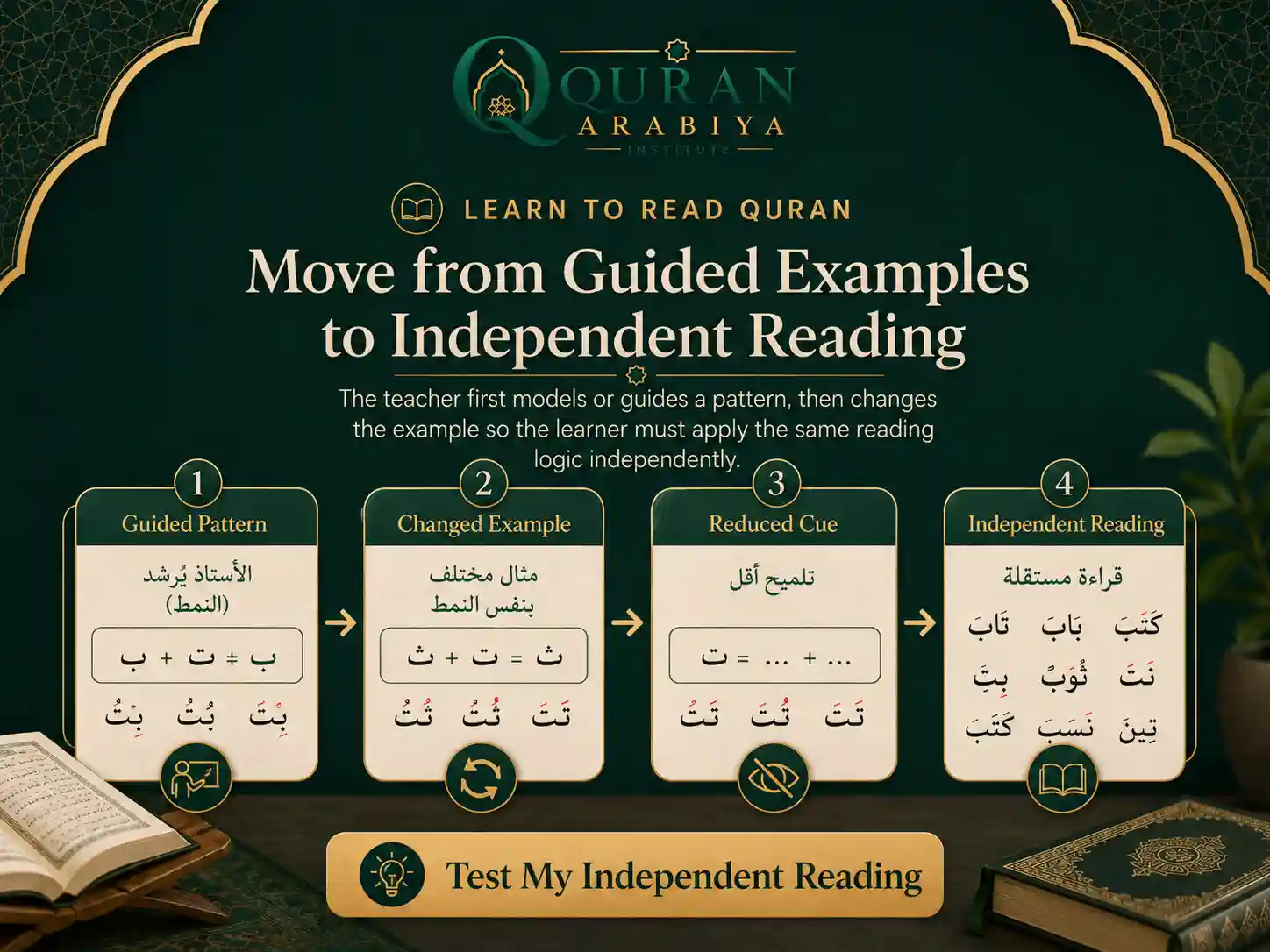
The teacher first models or guides a pattern, then changes the example so the learner must apply the same rule independently. The amount of help is reduced deliberately rather than disappearing all at once.
That creates a meaningful exit condition: the student can approach new Arabic material with a usable decoding process instead of remembering only the training page.
Start by checking whether the learner genuinely benefits from a structured visual route. In live one-to-one practice, the teacher compares performance with and without the prompt during placement instead of choosing a method name at random. This stage is ready when the learner becomes more accurate and less hesitant when the visual structure is used.
Use support to reveal the pattern, not to replace decoding.
Method references describe Bashandy as useful for broader Arabic reading as well as Quran preparation. Using both Quranic and general Arabic examples can help test whether the learner understands the script system across contexts.
When the learner’s main goal is the Quran, the later stages should increasingly include Quran-oriented words and selected passages so the transition is not left to chance.
It can be a good fit for a beginner who learns well from visual structure, a child who needs clear pattern recognition, or a learner who wants an Arabic-reading base that is not limited to one narrow set of Quranic exercises.
The free trial should still compare the learner’s response with other routes. A method is useful only if it solves the actual reading bottleneck.
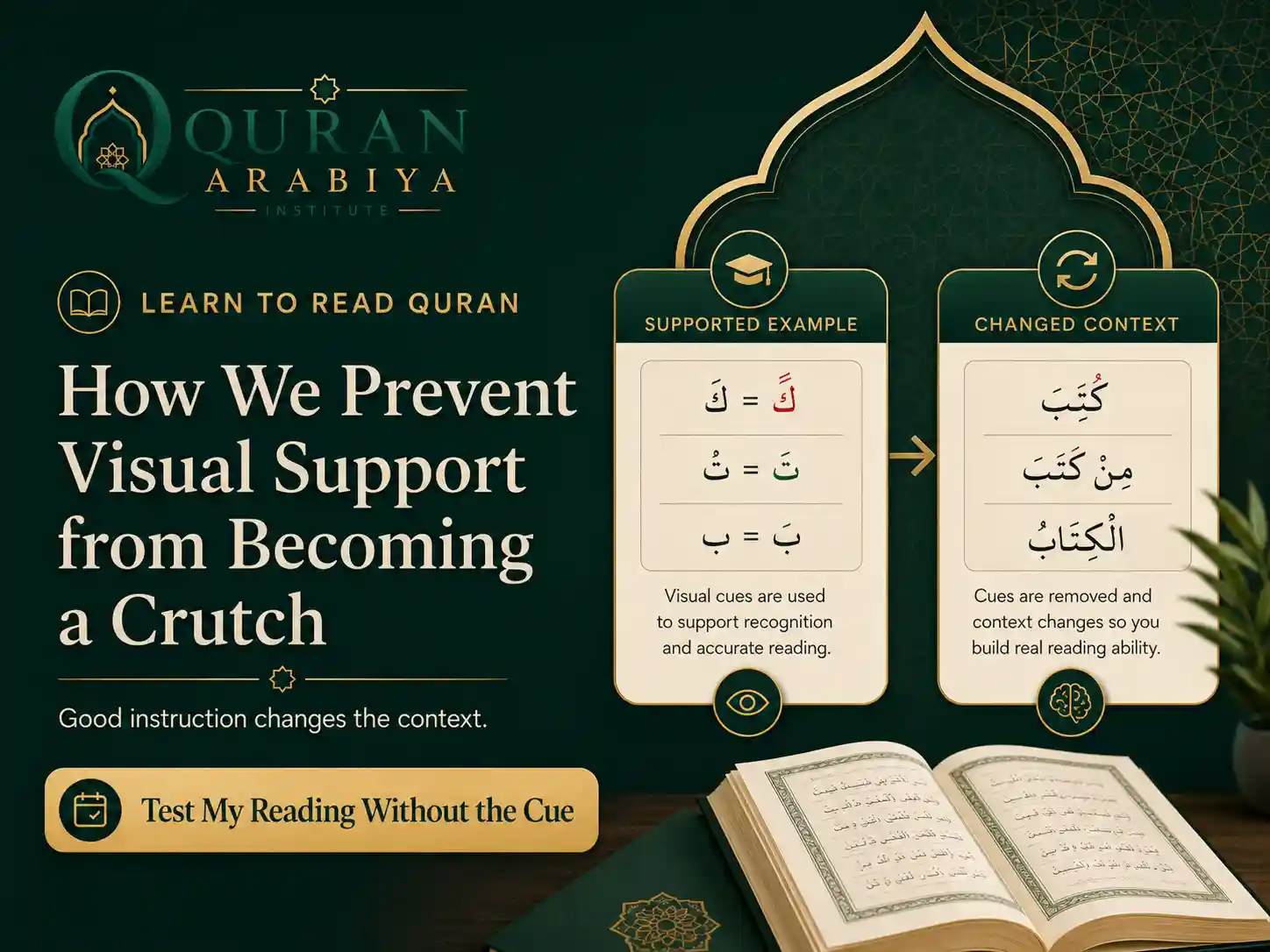
Good instruction changes the context. The teacher can remove color cues, rearrange examples, switch to a cleaner text presentation and ask the learner to read an unfamiliar word.
If accuracy drops sharply without the original visual cue, the class returns to recognition work before claiming mastery.
Bashandy and Noor Al Bayan can both lean toward broader Arabic reading foundations, while Noorani is commonly positioned more directly around Quran-oriented sound-to-script progression. The methods also differ in how they organize practice and visual support.
The page should not claim universal superiority. Quran Arabiya can use placement to recommend the route that gives the learner the clearest path from their current weakness to their reading goal.
If you want to learn Bashandy Qaida online, the free trial can test letter recognition, sound production, response to visual prompts and ability to transfer the pattern when the prompt changes.
Because Bashandy course implementations can vary, the exact book/materials used by Quran Arabiya should be confirmed in the course plan before enrollment.
Choose Bashandy because the method fits the learner, not because it is simply another Qaida option. Book a free placement lesson to test whether a structured visual reading route gives you the clearest foundation.
They focus on foundational Arabic reading: letter-sound recognition, decoding, word building, pronunciation and a gradual move toward more independent reading.
English-language course references commonly position it as a visual, structured Arabic-reading foundation that can support both Quran preparation and wider Arabic literacy.
It can prepare learners for Quran reading, but references also describe examples beyond Quran-only material. The exact edition and implementation should be confirmed by the academy.
Yes. One-to-one teaching can adapt the presentation and pace for adults while preserving the method’s reading sequence.
The public page should promise only the confirmed method sequence, live correction, graded reading practice and appropriate Quran-preparation work. Exact materials should be stated only after the academy confirms them.
Not universally. Learner fit, reading goal and response to the teaching style matter more than the method name.
The learner should read the same pattern in a new example and with fewer visual cues. Transfer is the test, not familiarity with the original page.
It can suit learners who respond well to a structured visual foundation and need the page to make letter-sound patterns clearer. Placement should still test whether visual support actually improves decoding for the individual learner.
No. A useful prompt should help the learner notice a pattern and then be reduced. The teacher should test the same reading skill without the visual cue so support does not become a new form of dependence.
Yes, as a reading foundation when the method fits the learner. The public promise should remain careful: build usable Arabic decoding and then transfer the confirmed skills toward Quranic text without inventing unsupported method claims.
Yes. The method can be taught privately with adult-appropriate explanation and pace. The deciding factor should be whether its structured visual logic solves the learner’s current reading bottleneck.
The teacher varies the example, changes order and removes support before asking the learner to decode again. Successful transfer to an unfamiliar form shows that the reading system is becoming independent.
Yes. State the method during matching so the academy can consider relevant experience, learner level, schedule and current availability before confirming the teacher.
The learner can move toward more independent Arabic and Quranic text once letter-sound recognition, word building and transfer are stable. The exact next course depends on whether the remaining gap is decoding, Mushaf transition or fluency.
If you are considering Bashandy Qaida course, start with a live assessment rather than choosing a level by guesswork. The teacher can confirm the first useful skill, the best-fit route and the next step without making promises that depend on individual progress.