A Fath Ar Rahman course online offers a direct foundation for learners who need to turn basic letter knowledge into usable Arabic and Quran-oriented reading. The method is commonly described as progressive and straightforward: recognize the script, add the main reading signs, combine the patterns into words, then prepare for Quranic text. Quran Arabiya Institute keeps that simplicity but adds an important safeguard: every stage is checked for transfer before the learner is pushed forward.
The Fath Ar Rahman reading method is useful when a learner wants a clear progression without a broad language curriculum surrounding it. The course focuses on the reading code that unlocks Arabic words and prepares the student for Quranic text.
Direct does not mean rushed. A short sequence can still be taught slowly when pronunciation or recognition needs more time.
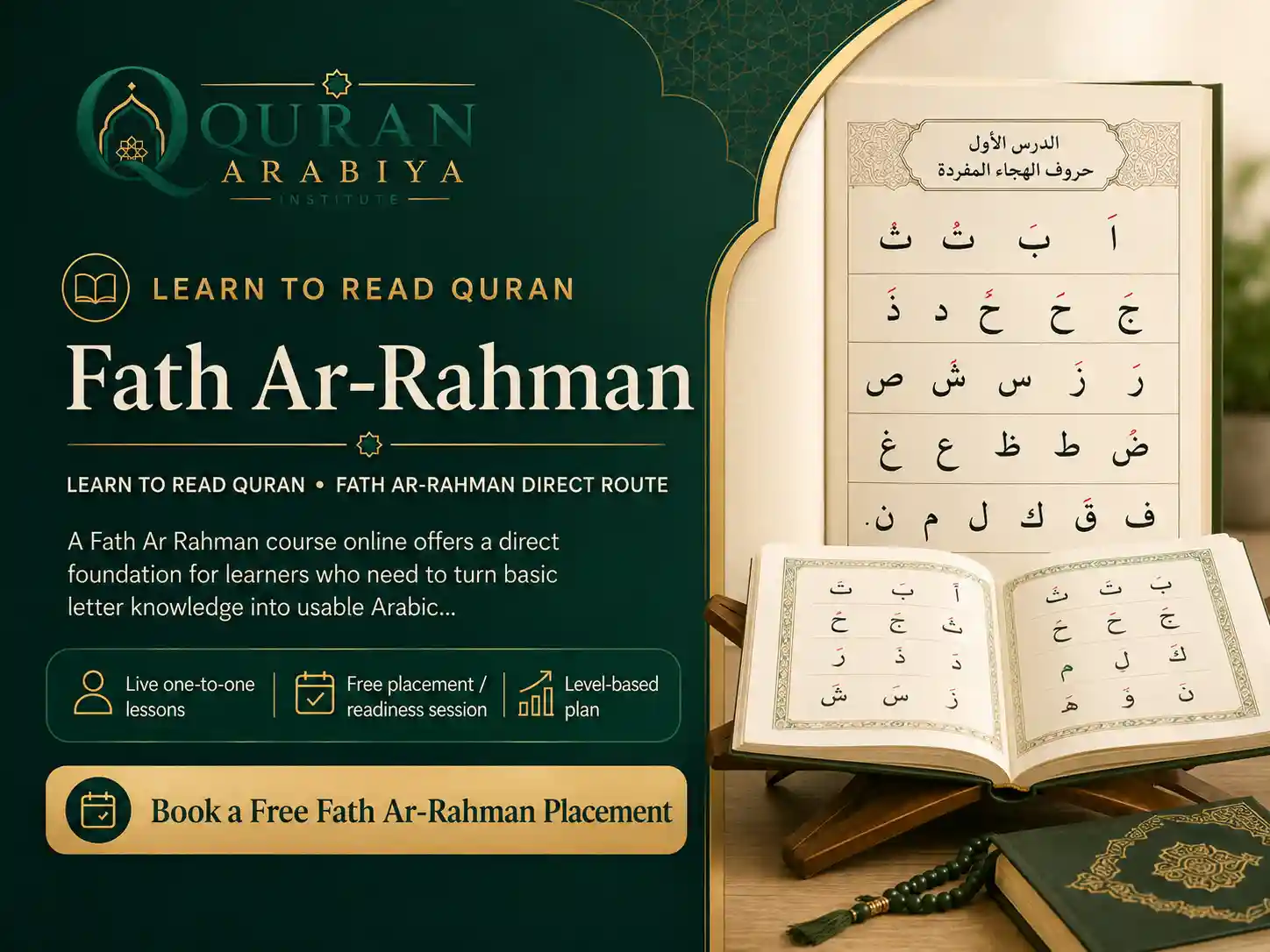
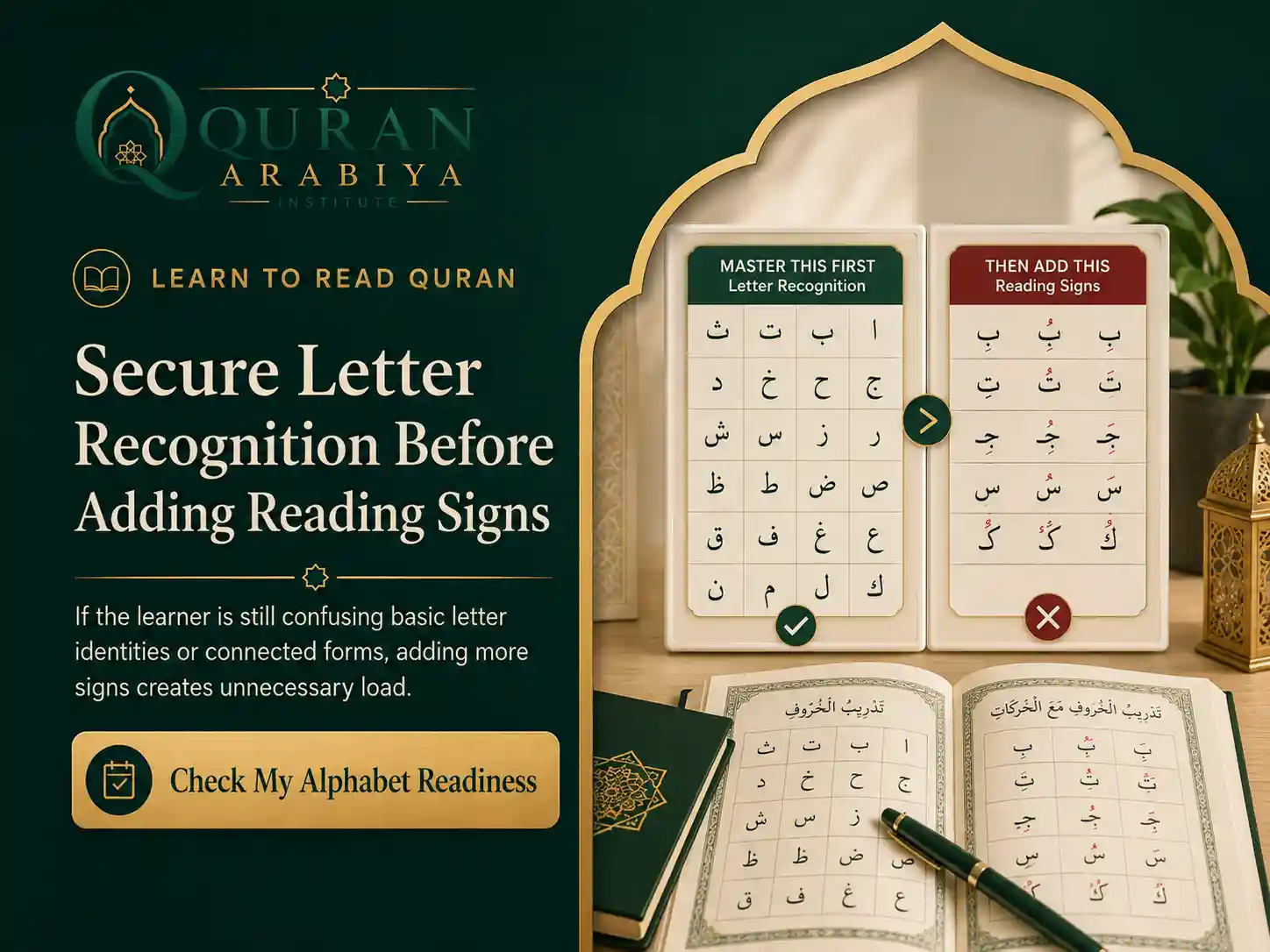
Start by securing letter recognition before adding several reading signs at once. In live one-to-one practice, the teacher checks mixed-order identity and connected forms so the learner is not carrying basic script confusion forward. This stage is ready when the learner recognizes the symbol quickly enough for the next sign to be meaningful.
If the learner is still confusing basic letter identities or connected forms, adding more signs creates unnecessary load. The teacher first stabilizes the minimum alphabet foundation needed for the method.
A student who already has that skill does not need to repeat it for weeks. Placement allows the course to begin where the real gap starts.
Short vowels establish the first reliable syllable patterns; long-vowel patterns add timing and visual complexity. The learner practises the contrast until the difference is visible and audible rather than guessed from memory.
The teacher can isolate a weak pattern, model it, then immediately re-test it in a fresh combination.
As signs accumulate, the challenge becomes keeping earlier skills active inside a longer word. Tanween, Sukoon and Shaddah are introduced in a sequence that allows the learner to decode rather than simply imitate.
Mastery is checked by changing the letter combination and asking the student to reconstruct the reading independently.
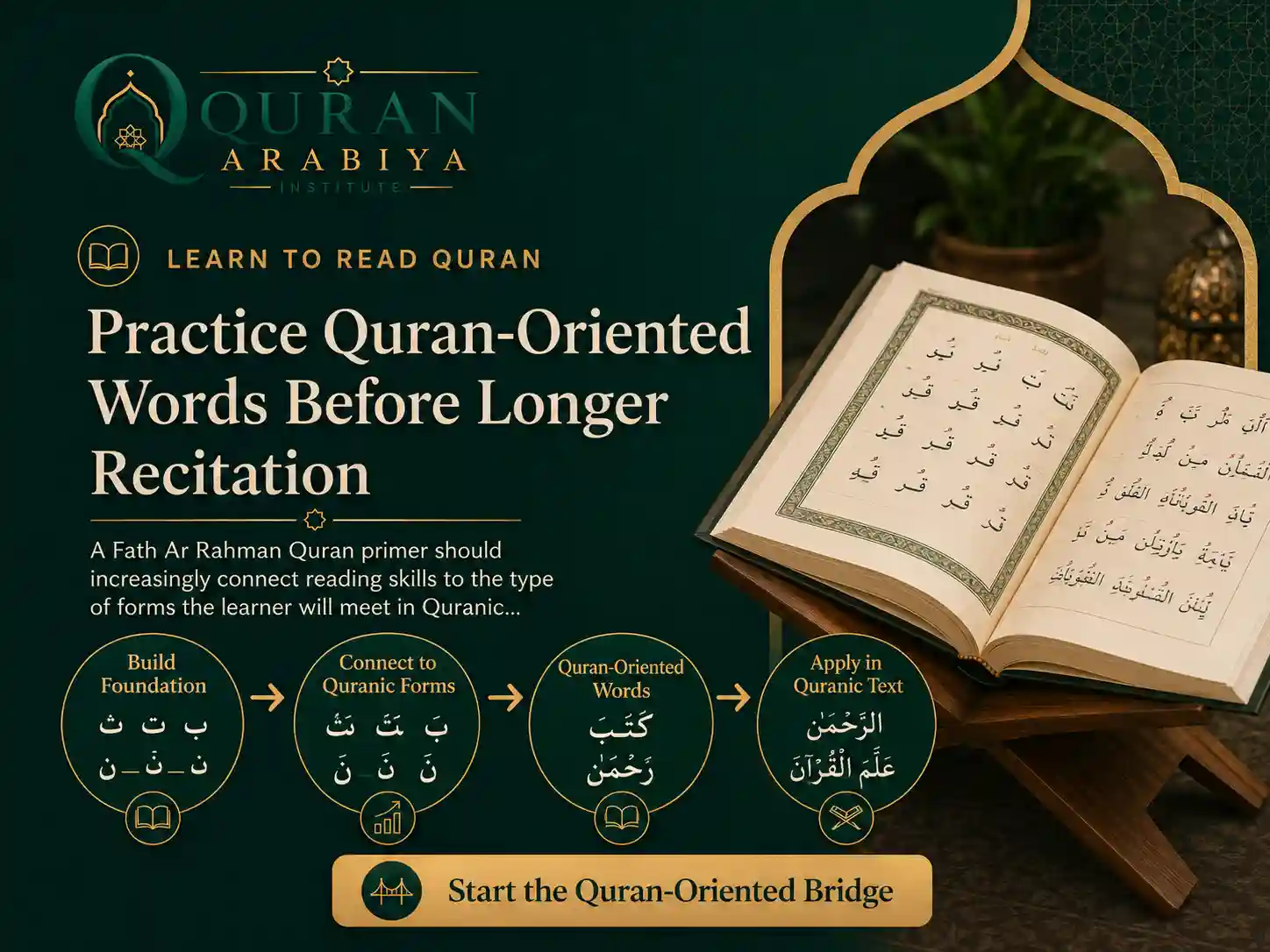
A Fath Ar Rahman Quran primer should increasingly connect the reading skill to the type of forms the learner will meet in Quranic text. Short Quran-oriented examples create that bridge without overwhelming a beginner with a full dense page too soon.
The teacher can preview one new difficulty at a time, then let the learner apply the pattern in context.
Start by using a compact sequence when the learner benefits from clear, uncomplicated steps. In live one-to-one practice, the teacher keeps each stage focused and verifies mastery before adding the next reading demand. This stage is ready when the route feels direct because unnecessary repetition is removed, not because weak skills are rushed.
Keep the written pattern and produced sound aligned.
Early “fluency” in a foundation course means fewer stops inside known reading patterns and less need to spell out each symbol. It is not the same as sustained fluency across unfamiliar Mushaf pages.
This distinction protects the intent of the separate Quran Reading Fluency course, which begins after the learner can already decode.
It can suit complete beginners, returning learners with a partial alphabet base, and students who prefer a direct reading sequence. The free assessment should confirm whether the learner benefits from this method or needs a narrower alphabet repair first.
Learners seeking broader reading/writing literacy may be better served by a route such as Noor Al Bayan or Bashandy, depending on the academy’s confirmed implementation.
Fath Ar-Rahman and Noorani are both foundation routes with Quran-reading relevance, but their material and sequencing differ. Noor Al Bayan can be positioned more broadly around phonics/literacy. The Fluency course is not a primer at all; it assumes the student can already decode.
Internal links between these pages should help the visitor choose, not make the pages repeat one another.
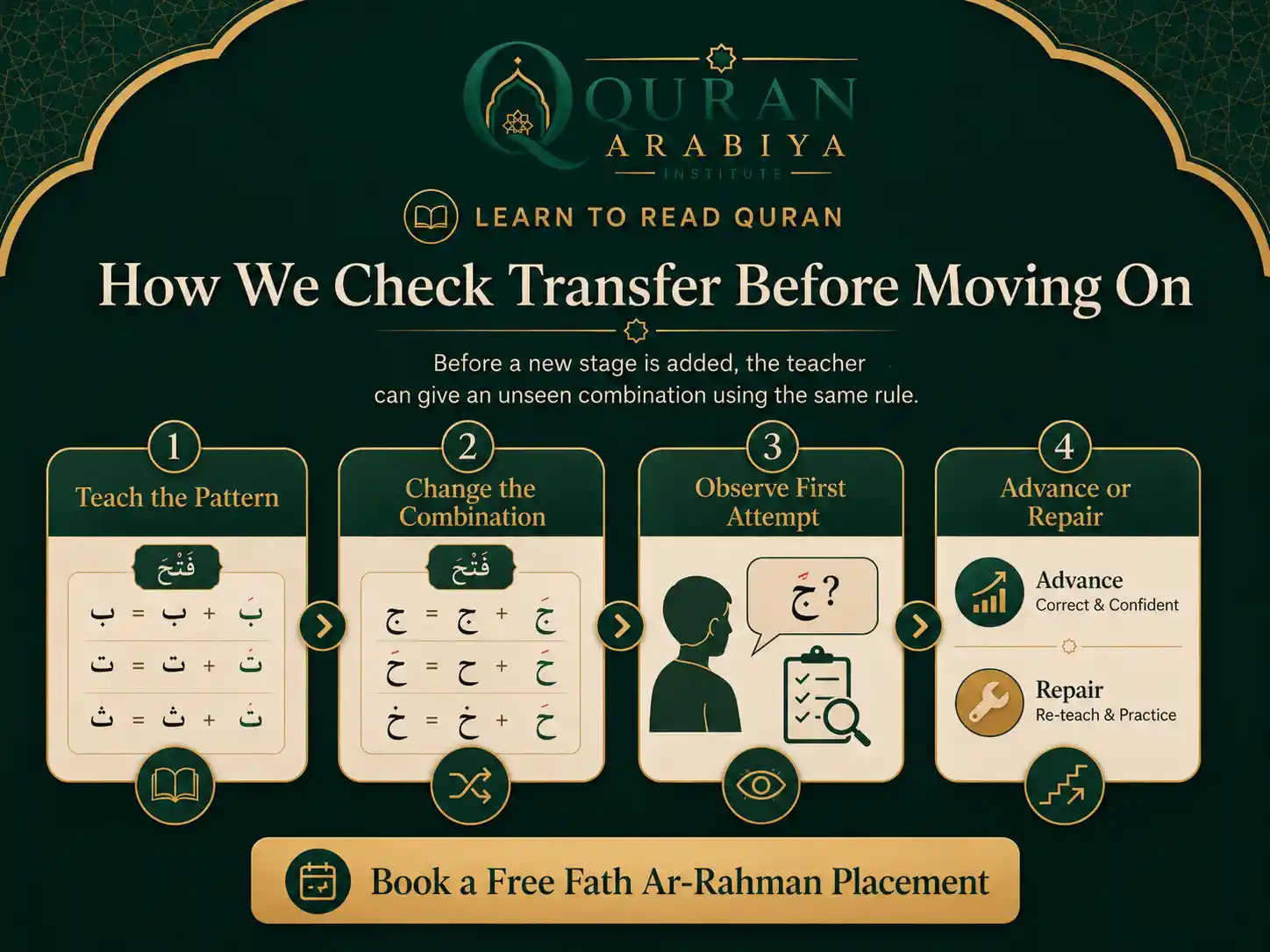
Before a new stage is added, the teacher can give an unseen combination that uses the same rule. If the learner reads it correctly without a full model first, that is stronger evidence than perfect repetition of the exercise they just practised.
This simple check keeps Fath Ar Rahman lessons online mastery-based instead of page-count based.
If you want to learn Fath Ar Rahman method online, the free trial can check letter recognition, vowel reading, connected patterns and a short reading sample. The teacher then decides whether to begin at the start of the method or skip already-mastered foundations.
That keeps the Fath Ar Rahman Arabic reading course efficient without making unrealistic promises about how quickly every learner will finish.
Use a direct reading method without turning “direct” into “rushed.” Book a free Fath Ar-Rahman placement lesson and start at the first pattern that still needs to become reliable.
It is a structured beginner reading approach that moves from Arabic letters and reading signs toward connected words and preparation for Quranic reading.
Yes, it can be used as a foundation. Learners who already know part of the material should be placed at the first weak skill rather than automatically restarting.
The teacher introduces a pattern, listens to the learner apply it, corrects pronunciation or decoding, then checks the same skill in a new example.
Potentially. They are different foundation routes. The best choice depends on the learner’s current gap, goal and response to the method.
It prepares you to decode increasingly complex Arabic/Quran-oriented words and to enter guided Quranic reading with a stronger foundation.
No fixed duration should be promised before assessment. Previous exposure, pronunciation, lesson frequency and practice affect the pace.
No. Fath Ar-Rahman is a foundation method. The Fluency course is for learners who already decode and need smoother, more accurate Mushaf reading.
Not necessarily. Direct means the sequence is compact and clearly staged, not that mastery can be guaranteed in a fixed time. The learner should move only when the current pattern transfers to a fresh example.
Mixing their length can change how a learner reads even when the correct letters are recognized. The teacher can compare the patterns directly and keep timing controlled before adding more complex combinations.
Placement can start at the first unstable pattern instead of repeating the entire sequence. The teacher should verify that the known signs are usable in connected words, not only familiar in isolation.
They can appear progressively once the learner controls the relevant pattern in smaller examples. The transition should strengthen the same reading mechanism rather than create a sudden jump into dense Mushaf text.
Yes. The method can be delivered with different pacing, explanation and practice length. One-to-one teaching allows the same reading target to be adapted without changing the sequence unnecessarily.
Yes. Mention the method during matching so teacher experience, schedule, current level and preference can be considered together, subject to availability.
A learner who can decode reliably may move into guided Mushaf reading or Quran Reading Fluency if hesitation and pacing become the main issue. The assessment should decide the next stage from actual reading performance.
If you are considering Fath Ar Rahman course online, start with a live assessment rather than choosing a level by guesswork. The teacher can confirm the first useful skill, the best-fit route and the next step without making promises that depend on individual progress.