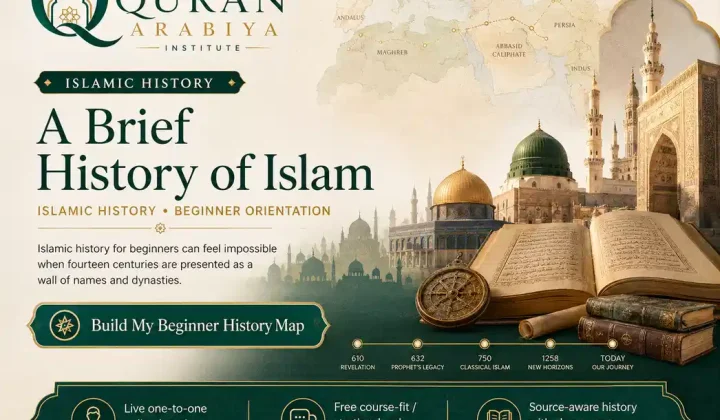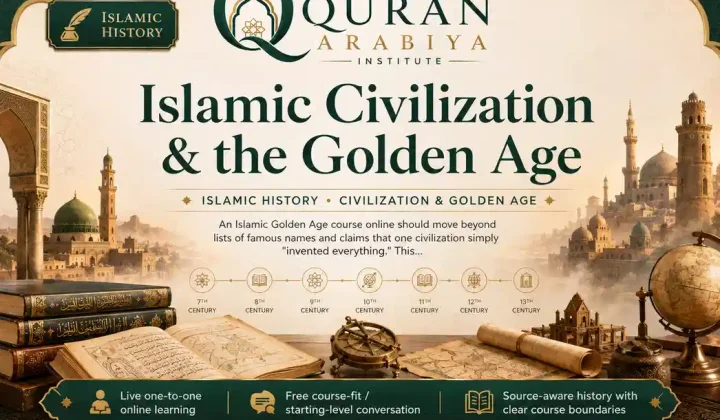
An Islamic history course online should connect more than rulers and dates. This full course builds a chronological spine across major eras and then studies why transitions happened, how political authority shifted, how societies and institutions developed, and how intellectual and civilizational life interacted with changing states.
The page is intentionally more comprehensive than the beginner overview. It gives students a structured history of Islam course while sending specialist intent – such as detailed Umayyad, Abbasid or Golden Age study – to the dedicated pages where those subjects can receive the depth they need.
An Islamic history course online becomes manageable when every lesson attaches to one visible timeline. The student should know which era they are in, which political center matters, what came before and what transition comes next.
The comprehensive route can begin from the Prophetic foundation and move through major caliphates and later Muslim historical developments according to the academy's approved syllabus. The public page should not invent an endpoint; the important promise is a connected long-form journey rather than scattered lectures.
That is what separates a comprehensive history of Islam course from a sequence of isolated dynasty summaries: each era is connected to what came before, what changed inside it and what conditions shaped the transition that followed.
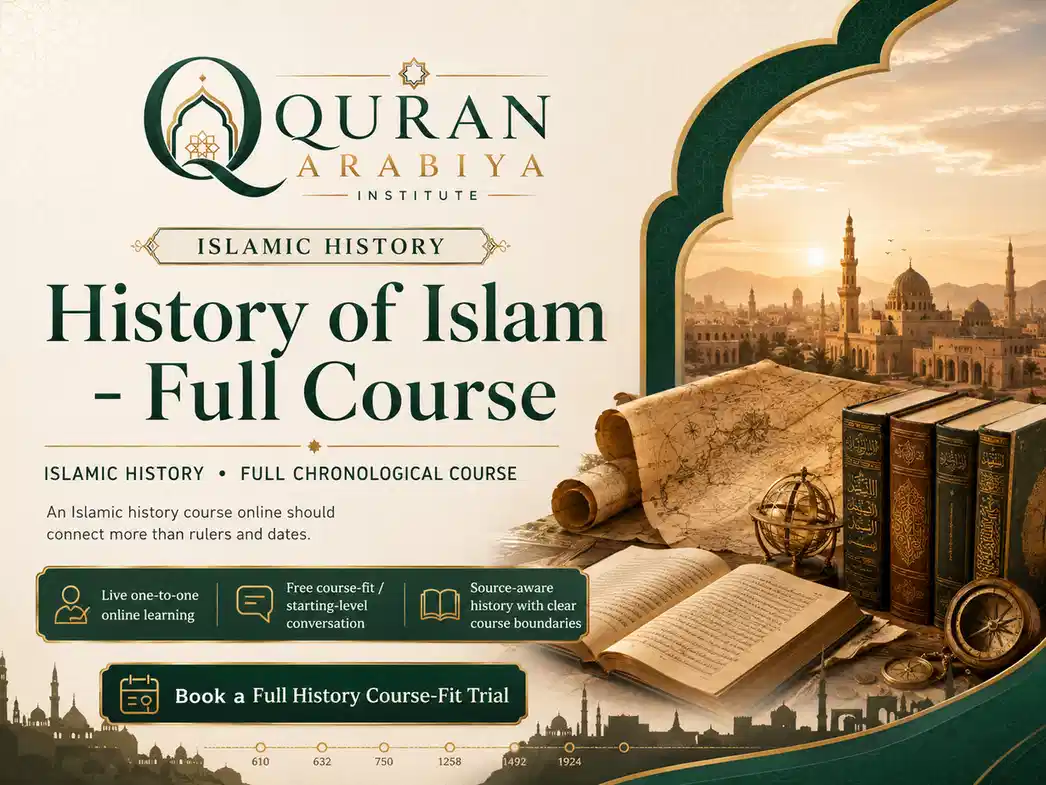
An Islamic history course online becomes manageable when every lesson attaches to one visible timeline. The student should know which era they are in, which political center matters, what came before and what transition comes next. The aim is to connect the detail to its wider chronology and historical context.
A date tells you that a dynasty ended; history asks why the transition became possible. The full course can examine leadership, succession, regional power, taxation, military structure, social tensions, religious movements, trade and intellectual change at a level suitable for the learner.
This cause-and-consequence focus is what separates a comprehensive Islamic history program from the beginner overview. The student learns to explain change, not merely recite it.
A useful study habit is to keep a short cause → event → consequence note. That makes chronology easier to remember without reducing history to dates.
Geography matters. Political centers shift, provincial elites grow, new cities become important and Muslim societies develop across very different regions. Maps should therefore be a regular tool, not decorative images.
A Muslim history course online can use maps to show expansion, trade routes, capitals, regional dynasties and the fragmentation of political authority while reminding students that shared religious and scholarly networks can continue across political boundaries.
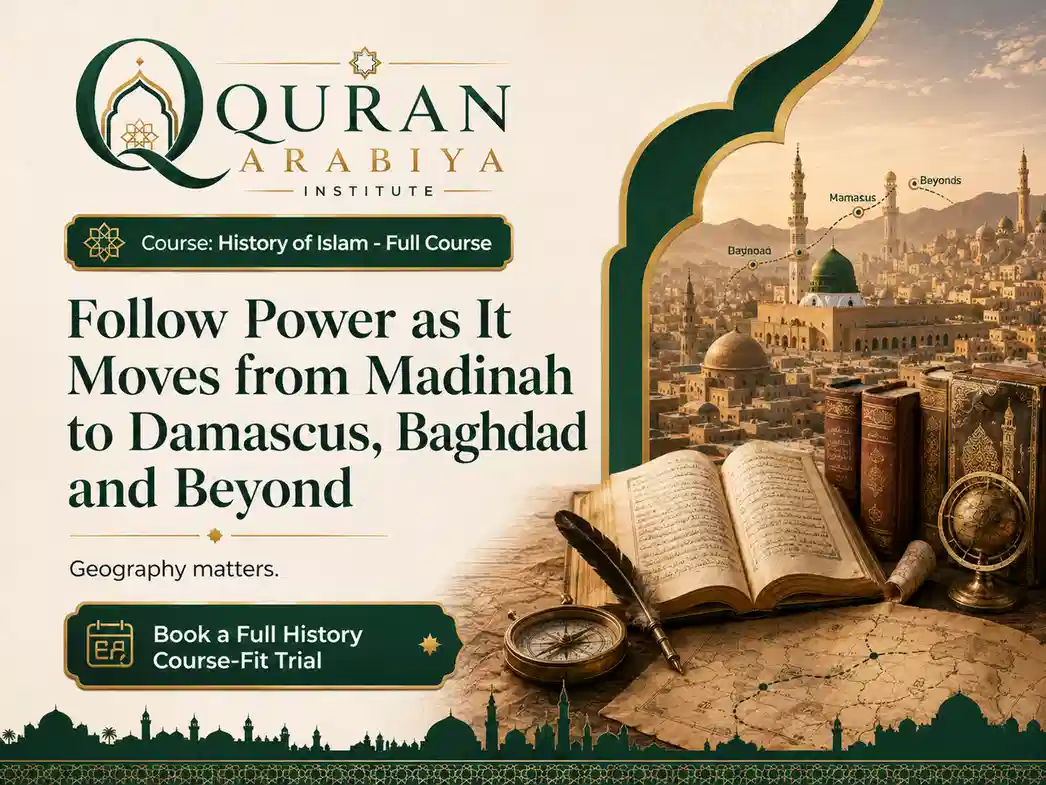
Political centers shift, provincial elites grow, new cities become important and Muslim societies develop across very different regions. Maps should therefore be a regular tool, not decorative images. The aim is to connect the detail to its wider chronology and historical context.
A complete history is not only a sequence of caliphs. Each period can be studied through three lenses: political events and institutions; social and economic life; and scholarship, culture and intellectual development.
This prevents the course from implying that civilization rises or falls on one ruler. It also creates a disciplined place for Islamic civilization history course material without allowing the Golden Age section to swallow the whole political narrative.
Serious students benefit from a basic introduction to source types: chronicles, biographies, Hadith material, documents, inscriptions, coins, art and later historical writing. The teacher can explain that sources have different purposes and that later historians may interpret the same event differently.
This is not an academic research degree, but it gives students a safer way to approach controversial events and grand claims. They learn to ask whether a statement is an event, an interpretation or a later judgment.
The section should finish with one short recap in the learner’s own words so the new detail stays connected to the wider historical framework.
A complete history is not only a sequence of caliphs.
The history of Islam is often taught as a straight climb to a Golden Age followed by decline. Real history is more complex: political fragmentation can coexist with scholarship; one region can weaken while another flourishes; institutions can change rather than disappear.
A comprehensive course should help students compare periods with specific evidence instead of repeating a single civilizational slogan.
The full course should give enough Umayyad, Abbasid and Golden Age context to keep the chronology coherent, but it does not need to reproduce every specialist page. If a learner wants detailed Umayyad governance, Baghdad-centered Abbasid history or focused science/culture, the dedicated course can take over.
This protects the comprehensive page from becoming unfocused and gives the student a modular path for deeper study.
The full course should give enough Umayyad, Abbasid and Golden Age context to keep the chronology coherent, but it does not need to. If a learner wants detailed Umayyad governance, Baghdad-centered Abbasid history or focused science/culture, the dedicated course can take over. The aim is to connect the detail to its wider chronology and historical context.
A long history course needs more than attendance. Learners can build a personal timeline, write short period summaries, compare two dynasties, label a map or explain a transition in their own words.
These outputs show whether the student has a working historical framework and reveal which era needs review before moving forward.
Construct a coherent chronological framework across the major periods studied in the approved syllabus.
Explain causes and consequences of selected major political transitions.
Use maps and period comparisons to understand shifts in power and regional development.
Discuss political, social and intellectual history as connected but distinct layers.
Recognize basic source types and distinguish historical event from interpretation.
Identify when a specialist Umayyad, Abbasid, Golden Age, Seerah or Rashidun course is appropriate.
Book a free trial and explain how much history you have studied, which eras interest you and whether you want an overview or a long-form program. The academy can then recommend the correct entry point, depth and teacher match.
It is designed as a long-form chronological program, but the exact starting and ending periods should follow the academy’s approved syllabus and the learner’s level. The website should not invent a fixed 14-century promise.
A beginner can join if the teacher builds foundations carefully, but students who want a lighter orientation may prefer Islamic History for Beginners first.
They are natural parts of a comprehensive chronology. The dedicated Umayyad and Abbasid pages remain the place for deeper specialist study.
A full course can include intellectual and cultural developments in context. The Golden Age course is the focused route for science, scholarship, culture and institutions.
Yes when relevant, with source-aware and respectful framing. The teacher should distinguish secure chronology from debated motives or interpretations.
Teens and adults who already know the basics or are willing to follow a longer structured route, including serious learners who want causes, transitions and context rather than only a timeline overview.
The starting point does not have to be lesson one. In a live one-to-one setting, the teacher can identify what is already clear, locate the first real gap and adjust the depth without changing the course’s central historical focus.
Chronology is used as an organizing spine rather than a memorization target. Timelines, cause-and-consequence notes and short recaps help the learner explain how one event prepares the next and why a turning point matters.
The course should distinguish well-established chronology from interpretive or disputed details and avoid turning a debated reading into a marketing promise. Where the source document flags caution, the teacher can explain that difference rather than flatten it into certainty.
Arabic is not assumed as a universal prerequisite for this category. If a selected text, edition or reading route requires a particular language level, that should be confirmed during the course-fit conversation before regular study begins.
The academic focus stays intact while explanation, pacing and depth can change. One-to-one teaching allows the teacher to spend more time on names, relationships, maps, source questions or analytical discussion according to the learner’s age and prior study.
The conversation can clarify age, prior knowledge, preferred depth, learning goal and suitable scheduling before the route is chosen. It is a starting-level discussion, not a promise of a fixed syllabus length or certificate.
Progress should become visible in explanation, sequence and context rather than page count alone. A useful checkpoint is whether the learner can construct a coherent chronological framework across the major periods studied in the approved syllabus. explain causes and consequences of selected major political transitions.
The next step depends on the intent this page deliberately does not absorb. Do not claim a fixed 14-century syllabus or modern endpoint unless approved. Do not absorb the most detailed Umayyad, Abbasid or Golden Age keyword targets; give them enough context and link to specialist courses. The teacher can use the final lessons to identify the most logical sibling course instead of stretching this page beyond its purpose.
If you are considering Islamic history course online, begin with the historical question you actually want answered and the depth you can sustain. The free trial can clarify your starting knowledge and route you into this course or a more specific sibling topic without turning disputed interpretation into a fixed promise.