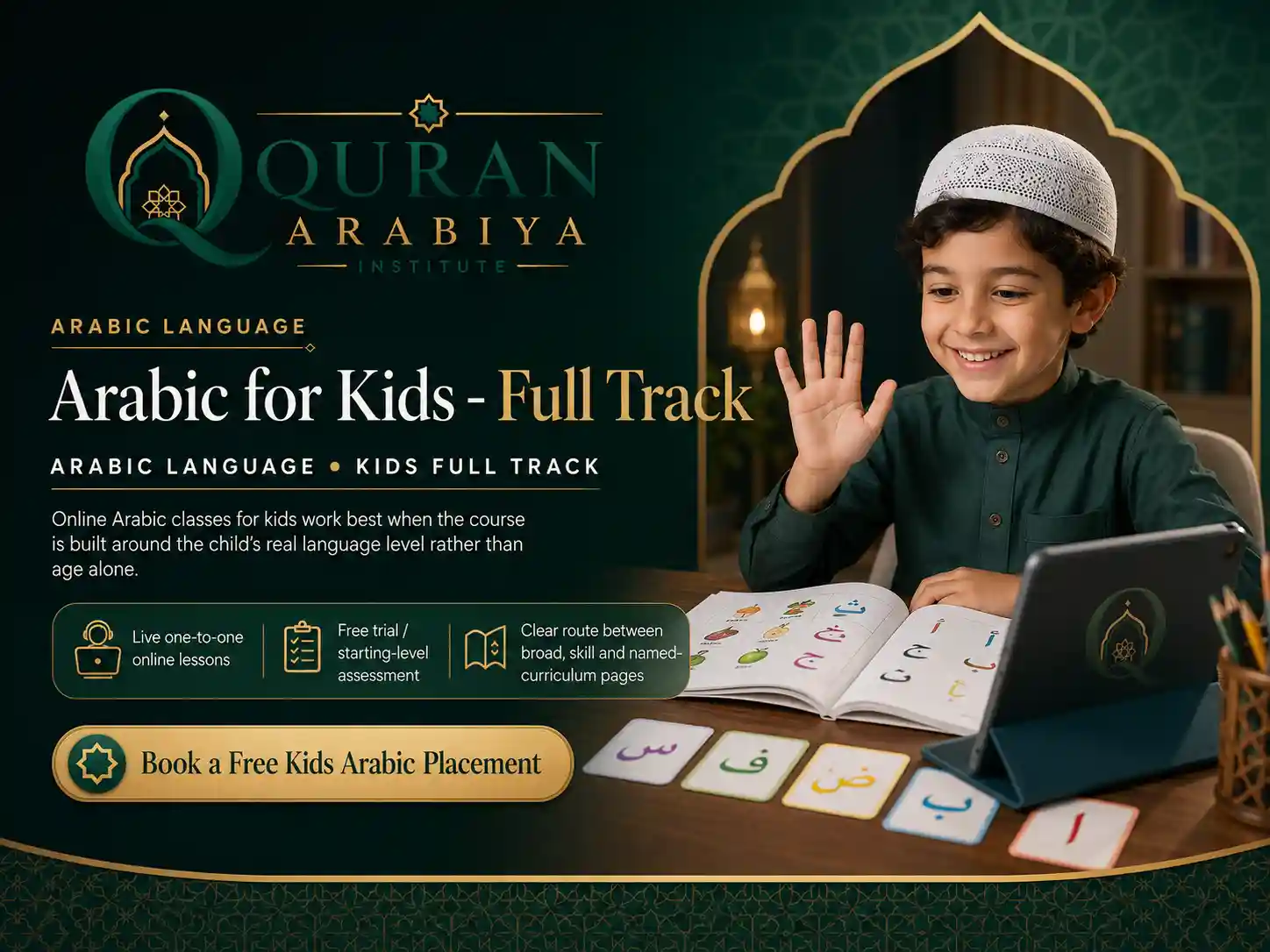
Online Arabic classes for kids work best when the course is built around the child’s real language level rather than age alone. One learner may recognise letters but have little vocabulary; another may speak some Arabic at home but struggle to read; a third may read slowly yet avoid forming sentences. This full track brings reading, writing, listening, speaking and vocabulary into one connected Fusha plan, with live one-to-one teaching and a free trial used to identify the most useful starting point.
A child’s Arabic level is rarely captured by “beginner” or by age. The teacher can check script recognition, reading, listening, basic vocabulary, ability to answer simple questions and willingness to speak. A heritage learner may understand far more than they can produce, while a non-Arabic-speaking child may need every skill built from the beginning.
The purpose of the free trial is to turn that mixed profile into a practical starting plan: which skill needs the most support, which skill can be used as a strength, and what kind of practice will keep the child active rather than passive.
A child’s Arabic level is rarely captured by “beginner” or by age.
Children remember language better when one lesson idea appears in several forms. A small set of words can first be heard in a short exchange, then spoken, recognised in a sentence, and finally used in a simple writing task. The skills reinforce one another instead of feeling like four unrelated school subjects.
This loop also reveals hidden gaps. A child who can read a word may not understand it; a child who recognises it while listening may still be unable to retrieve it in speech. The teacher can then target the missing connection.
A useful check is whether the learner can reuse the same language with less support in a different task. That transfer matters more than simply recognizing the example that was practised in the lesson.
Fusha Arabic for children should not become a course where the teacher speaks and the child only repeats. The learner needs frequent, low-pressure chances to answer, choose, describe, ask and build short sentences with the vocabulary already studied.
At early levels, speaking can be supported with pictures, sentence frames and choices. As confidence grows, the support is reduced so the child begins to produce more independently.
Children remember language better when one lesson idea appears in several forms. A small set of words can first be heard in a short exchange, then spoken, recognised in a sentence. The aim is to turn the same language into usable reading, listening, speaking or writing rather than leave it as a completed exercise.
Fusha Arabic for children should not become a course where the teacher speaks and the child only repeats. The learner needs frequent, low-pressure chances to answer, choose, describe, ask and build short sentences with the vocabulary already. The aim is to turn the same language into usable reading, listening, speaking or writing rather than leave it as a completed exercise.
Reading development is not complete when a child can pronounce the letters. The course gradually connects accurate decoding with meaning: recognising common words quickly, following a short sentence, answering a simple question and later reading short age-appropriate passages with understanding.
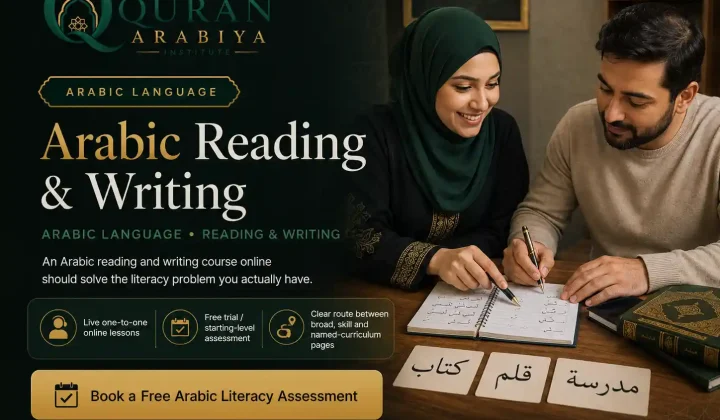
If the child still needs a dedicated script foundation, the teacher can recommend the Arabic Reading & Writing route rather than allowing the full-track page to become a duplicate literacy course.
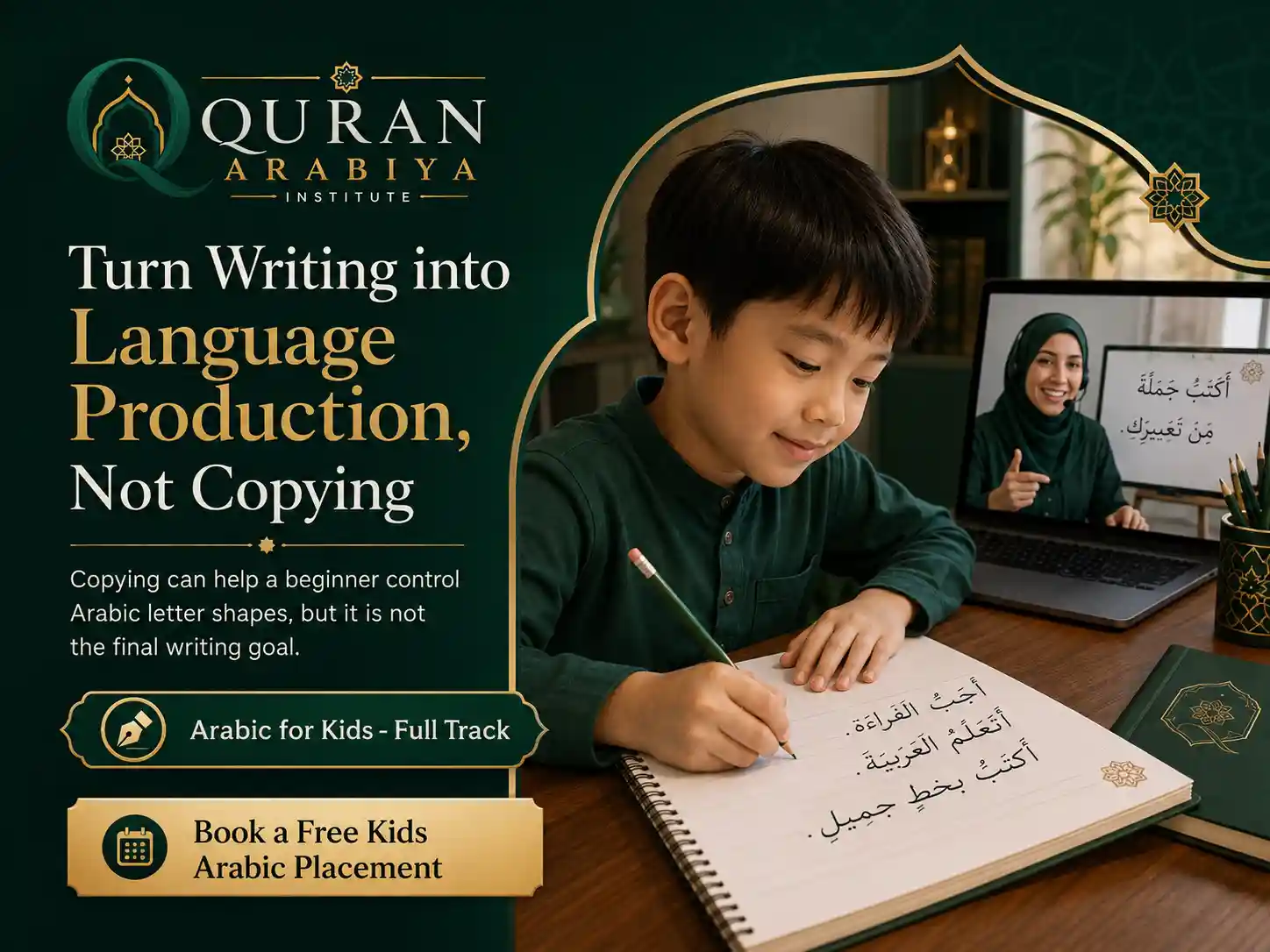
Copying can help a beginner control Arabic letter shapes, but it is not the final writing goal. The progression should move toward completing meaningful phrases, rearranging words, writing answers, describing a picture and eventually producing short connected sentences.
Writing gives the teacher a clear view of vocabulary, spelling and sentence structure at the same time. It also helps the child slow down enough to notice patterns that may disappear during fast oral practice.
A useful check is whether the learner can reuse the same language with less support in a different task. That transfer matters more than simply recognizing the example that was practised in the lesson.
Children do not need long isolated vocabulary lists. Words are more useful when organised around a situation or idea—family, school, food, daily routines, places, actions—and immediately reused in questions, mini-dialogues, reading and writing.
Review should test retrieval, not only recognition. Seeing a picture and producing the word, answering a new question with an old phrase, or using the same vocabulary in a different sentence gives stronger evidence that the language is becoming usable.
Grammar supports accuracy, but a young learner does not need every rule presented as abstract terminology. The teacher can first help the child notice a pattern in examples, use it in a controlled sentence, compare correct and incorrect forms, and only add terminology when it helps understanding.
This keeps grammar connected to communication. Learners who later need deep Nahw and Sarf have separate advanced Arabic paths, so this page should keep grammar age-appropriate and functional.
Children do not need long isolated vocabulary lists.
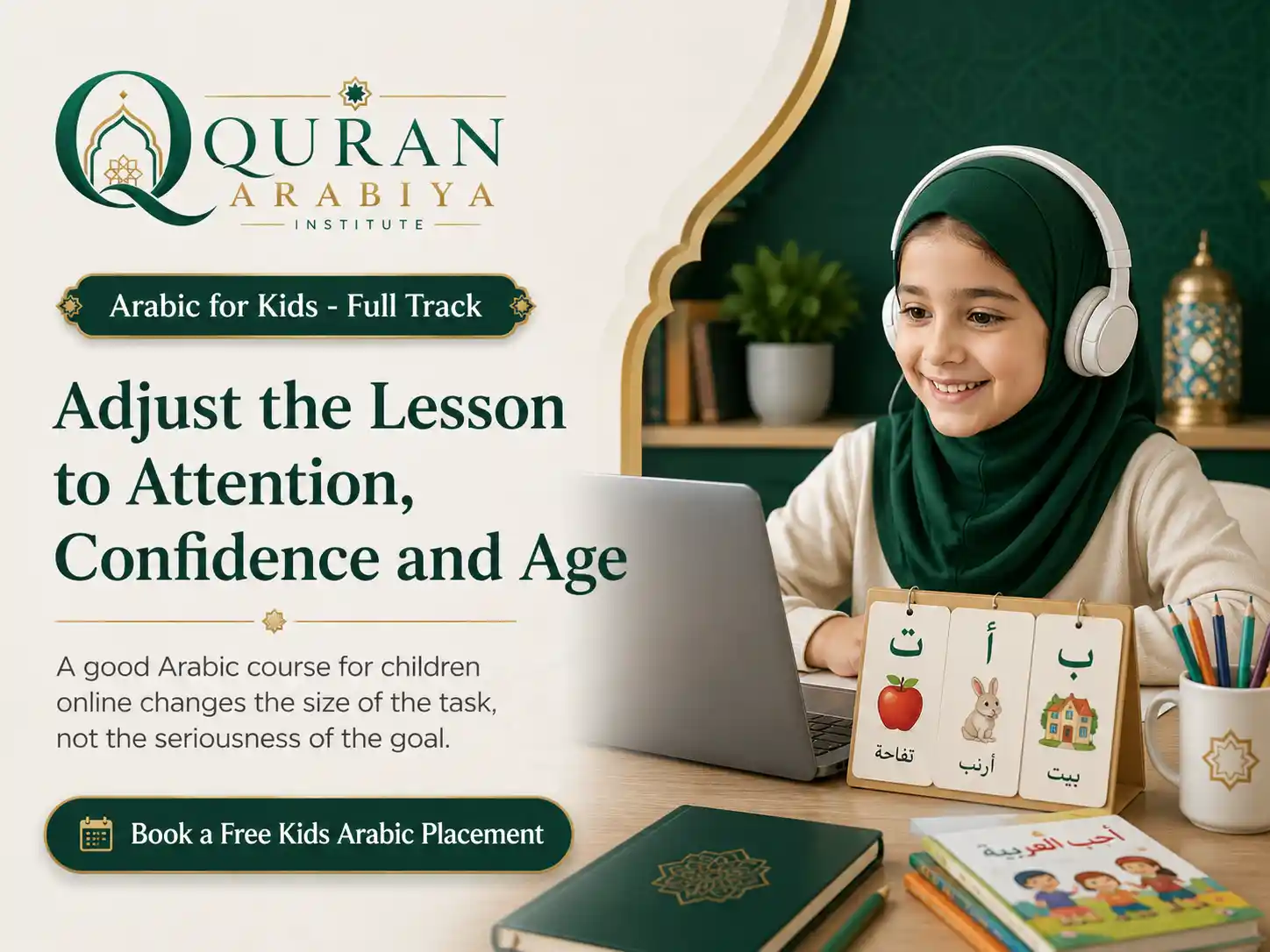
A good Arabic course for children online changes the size of the task, not the seriousness of the goal. Younger learners may need shorter cycles, more visual prompts and quick changes between listening, speaking and reading. Older children can handle longer texts, more explicit grammar and independent preparation.
One-to-one teaching makes it possible to slow down when a child is confused, increase challenge when a task is too easy, and give shy learners more speaking time without comparison with a group.
Parents need more useful feedback than “we finished Unit 4.” Progress can be described in observable language: reads connected words with fewer prompts, answers five familiar questions in Fusha, writes three linked sentences, or remembers target vocabulary after a week.
Those indicators make home support easier. A parent can reinforce a small review goal without having to teach the lesson or correct every Arabic detail themselves.
A good Arabic course for children online changes the size of the task, not the seriousness of the goal. Younger learners may need shorter cycles, more visual prompts and quick changes between listening, speaking and reading. The aim is to turn the same language into usable reading, listening, speaking or writing rather than leave it as a completed exercise.
A parent can reinforce a small review goal without having to teach the lesson or correct every Arabic detail themselves. Those indicators make home support easier. The aim is to turn the same language into usable reading, listening, speaking or writing rather than leave it as a completed exercise.
Consistency between lessons matters more than assigning heavy homework. A child might review a small vocabulary set, read a short passage aloud, answer two oral questions, listen to a short recording or write a few target sentences.
The teacher can adapt the task to the child’s age and schedule. The purpose is spaced retrieval and confidence, not turning Arabic into a second school workload.
This full track is the best fit when several skills need to grow together. If the child’s only problem is literacy, pronunciation, a specific textbook curriculum or a narrow conversational goal, a specialist page can offer a clearer route.
Keeping those routes separate is also important for SEO: this page owns the complete child Fusha journey, while Al-Arabiyyah Lil-Nashi’in owns its named curriculum and the Reading & Writing page owns focused literacy.
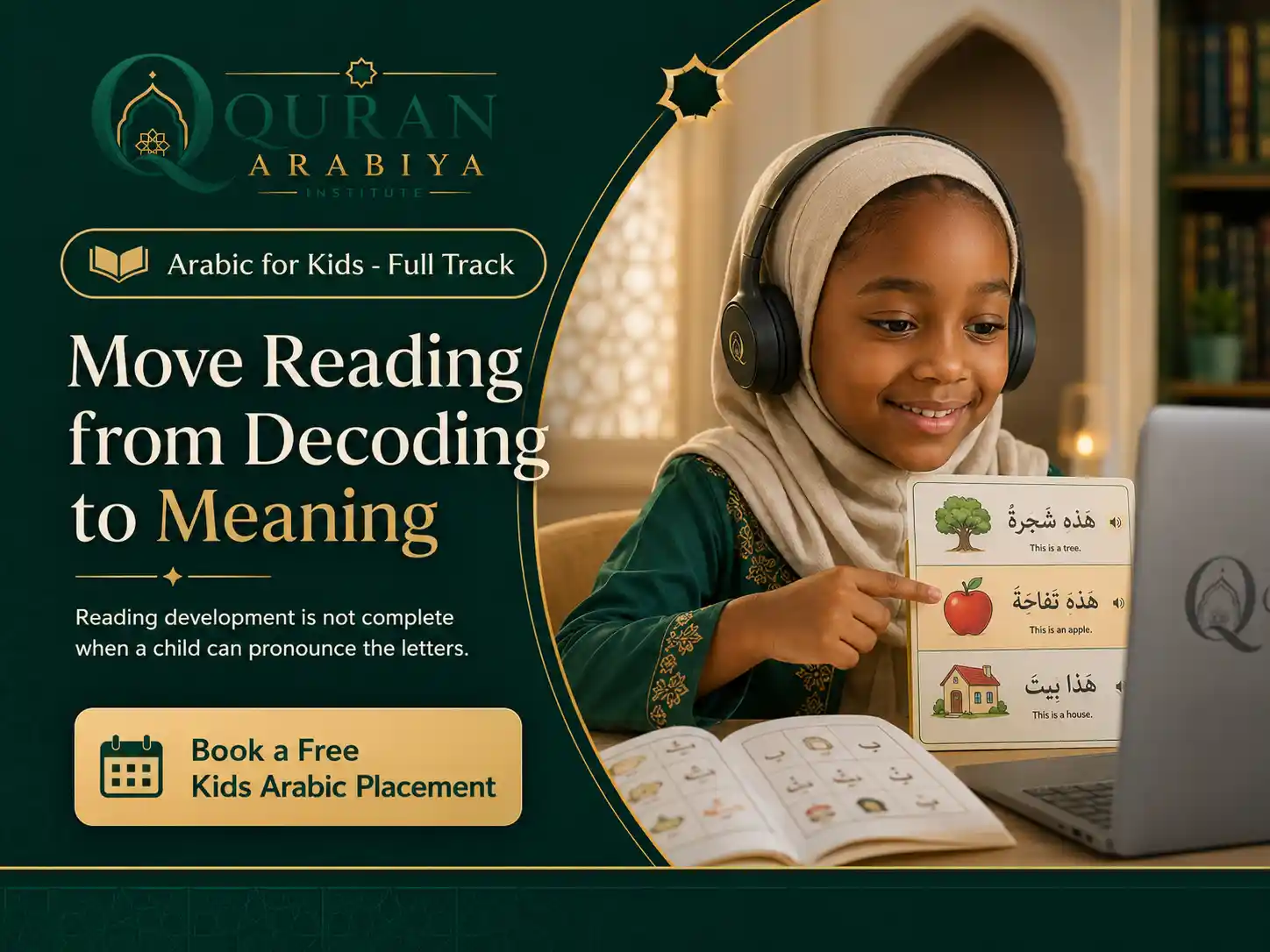
During the free trial, the teacher can sample reading, listening, vocabulary and speaking in a way appropriate to the child. Parents can also share the learner’s background, goals, previous books and any frustration with past study.
The result should be a starting recommendation: what to study first, which course route fits, and what the first short-term language goal should be.
Give your child a clear Arabic starting point instead of guessing between books and levels. Book a free trial so the teacher can identify the strongest and weakest language skills and recommend a practical Fusha path.
This full track is built around Fusha / Modern Standard Arabic. Egyptian Arabic has its own separate course so the two intents do not become mixed.
Yes. Placement can begin with letter and sound recognition. If the child mainly needs literacy foundations, the teacher may recommend the dedicated Arabic Reading & Writing route before or alongside broader language work.
Yes. The full track is designed to connect speaking and listening with reading, writing and vocabulary rather than treating Arabic as a reading-only subject.
Grammar is introduced through useful patterns and examples, then named or explained more explicitly as the learner matures. The aim is accurate language use without unnecessary overload.
Look for observable skills: fewer reading prompts, more independent answers, stronger vocabulary recall, longer sentences and better understanding of short texts. Progress feedback should describe those changes.
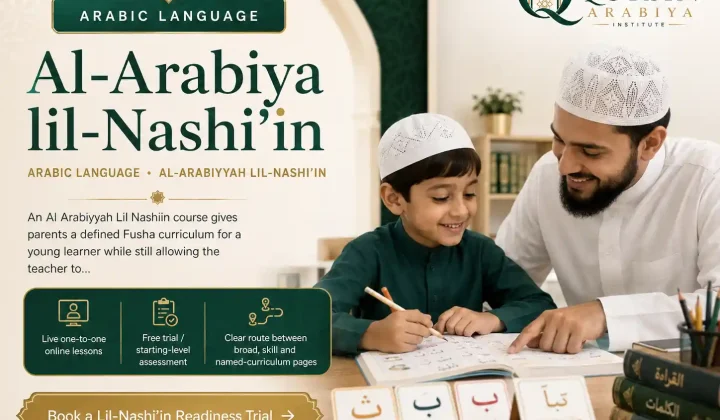
No. The full track is a broad, personalized child Fusha pathway. Al-Arabiyyah Lil-Nashi’in is a separate textbook-series course for families who specifically want that curriculum.
They may study similar content, but level, attention and pace can differ. Separate placement is the safest way to decide what each learner actually needs.
Parents of children and teens who want more than alphabet decoding or a single textbook: a structured Arabic language path adjusted to age, current level and attention.
Not automatically. The free assessment can show which skills are already stable and where the first real gap appears, so a returning learner can avoid unnecessary repetition while a beginner receives the foundation that is actually needed.
The balance should follow the course intent and the learner profile rather than force equal time in every lesson. The teacher can reuse the same vocabulary and structures across several skills so one activity strengthens another instead of becoming a disconnected module.
Grammar is used to make Arabic clearer and more accurate at the depth appropriate to this course. If the learner’s main goal becomes advanced Nahw, Sarf, Quranic Grammar or a named classical text, that deeper intent belongs in the Advanced Arabic category.
Yes. A learner may understand much more than they can read or produce, while another may remember the script but little vocabulary. One-to-one placement lets the teacher build from that uneven profile rather than assume that every student labelled “intermediate” has the same strengths.
The trial can sample the skills most relevant to the course, clarify the learner’s goal, previous study and preferred schedule, and identify the first practical target. It is a course-fit step rather than a promise of a fixed completion time or guaranteed fluency level.
Progress should appear in what the learner can do with less prompting, not only in completed units. A useful checkpoint is whether the learner can use the main skill with increasing independence.
If you are considering online Arabic classes for kids, begin with the language task you actually want Arabic to unlock. The free trial can map the learner’s strongest and weakest skills, then route the plan toward a broad Fusha path, a named curriculum or a specialist skill without forcing every learner through the same sequence.