

For many families, the search for online Quran tuition UK starts with a practical problem: a child goes to madrasah but still guesses at joined letters, a teenager repeats the same Tajweed mistakes, or an adult wants to return to the Quran without learning in a large group. The answer is not automatically “more lessons”. It is finding the right teaching format, a safe tutor, a realistic timetable and evidence that recitation improves. This UK guide compares those choices, explains fees in pounds and gives you a test to use before paying.
Quran Arabiya is a New York–based online institute, not a UK classroom. Families looking for individual support can explore its Online Quran Classes in the UK. You can also book a free trial to discuss a learner’s current reading, teacher preference and a workable UK-time schedule before deciding on a plan.
Online Quran Tuition UK: What Does It Actually Mean?
Online Quran tuition in the UK usually means a live teacher helping a student read, recite, revise or memorise the Quran over a video connection. Some providers teach individually; others teach small groups. It is different from watching recorded recitations because the tutor can hear a mistake, demonstrate a correction and check whether the learner can repeat it independently.
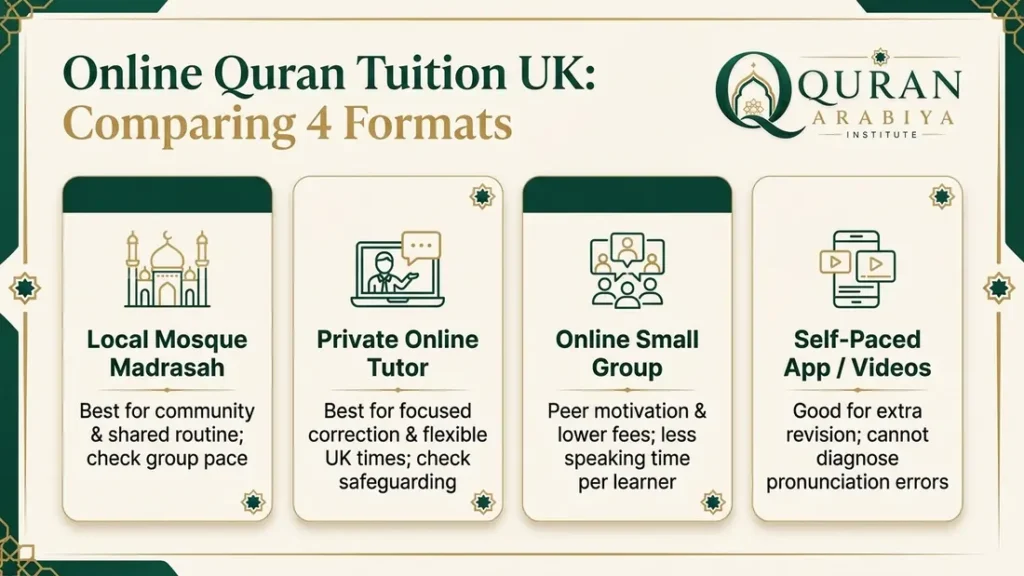
| Option | Strongest advantage | Trade-off to check | Often suits |
|---|---|---|---|
| Local mosque madrasah | Community, shared routine and in-person role models | Group pace, travel and varying time for individual correction | Families prioritising community alongside Quran study |
| Private online tutor | More speaking time, specific correction and flexible location | Screen fatigue; safeguarding and teaching quality must be checked | Readers with identifiable errors, busy adults or children needing focused support |
| Online small group | Peer motivation, sometimes lower per-person fees | Less time for each learner to recite and be corrected | Learners comfortable at a similar level |
| Self-paced app or videos | Convenient revision and listening practice | Cannot reliably diagnose a learner’s individual sound production | Extra practice, not a full substitute for feedback |
Who Benefits Most: Children, Teenagers, Sisters and Adults?
A useful teacher chooses the starting skill, not merely a course labelled “beginner” or “advanced”. A confident 12-year-old who reads fluently may need careful Tajweed transfer; an adult who recognises letters but cannot join them needs decoding practice.
Young beginners: Look for manageable chunks, clear letter sounds, an engaging manner and a brief explanation to parents of what to practise. The academy’s Online Quran Classes for Kids page describes age-appropriate reading, correction and memorisation pathways.
Women and sisters: If a female teacher is important to you, ask before the trial and confirm that the tutor you meet is the tutor you may continue with. Privacy, comfort and a respectful learning environment matter as much as the timetable.
Adults returning after a long break: A patient teacher can assess reading privately without making you restart material you already know. The Online Quran Classes for Adults course page explains a placement-first approach for uneven reading and Tajweed skills.
How a Good Online Quran Lesson Works
The strongest lessons contain more learner recitation than teacher monologue. A tutor listens to a short passage, identifies the most important error, gives a correct model, lets the student try again and checks the skill later without prompting.
Here is a suggested, not academy-prescribed, half-hour lesson model:
| Minutes | What happens | Evidence of learning |
|---|---|---|
| 0–5 | Review yesterday’s short passage | Errors are noted without starting the lesson again |
| 5–10 | Diagnose one recurring issue | The learner can hear or recognise the difference |
| 10–20 | Model, imitate and practise in several words | Fewer prompts are needed on a second attempt |
| 20–27 | Try the same skill in unfamiliar text | The correction transfers beyond the original example |
| 27–30 | Set one home task and a retest point | The student knows precisely what to practise |
The Two-Reading Test: A Practical Example
Suppose a learner reads a short passage smoothly but repeatedly shortens a long vowel. A tutor first asks for an unprompted reading, then models the required length and invites a second attempt. Two days later the student tries a different line containing the same feature. If the error returns, the goal remains consistency, not adding more memorisation.
It also reflects the Quranic emphasis on measured recitation in Surah Al-Muzzammil 73:4. A qualified teacher should choose suitable examples and verify their pronunciation.
Safeguarding: Questions UK Parents Must Ask Before Booking
Safeguarding should be a decision criterion, not a badge on a sales page. Parents need to know who teaches, how the organisation checks staff, who can contact the child, whether sessions can be observed and what happens if a concern arises. The NSPCC guidance for tutors and UK government guidance for parents using tuition services provide a useful basis for these questions.
| Ask the provider | A useful, specific answer should explain | Warning sign |
|---|---|---|
| Who has checked the teacher? | Identity, relevant references, appropriate criminal-record checks where applicable, and who assessed suitability | “All our teachers are trusted” with no detail |
| What child-protection policy applies? | Behaviour boundaries, reporting procedure and safeguarding contact | No written process or named contact |
| Can a parent sit in or observe? | Practical parent visibility suitable to the child’s age and privacy | Parents actively discouraged from checking |
| May staff message my child privately? | Clear approved channels and limits on one-to-one contact outside lessons | Personal social-media contact without safeguards |
| Are lessons recorded? | Whether recording occurs, consent, access, storage and deletion | Unclear handling of children’s recordings |
| What if there is a complaint? | Who receives concerns, response process and escalation route | The teacher is the only person you can contact |
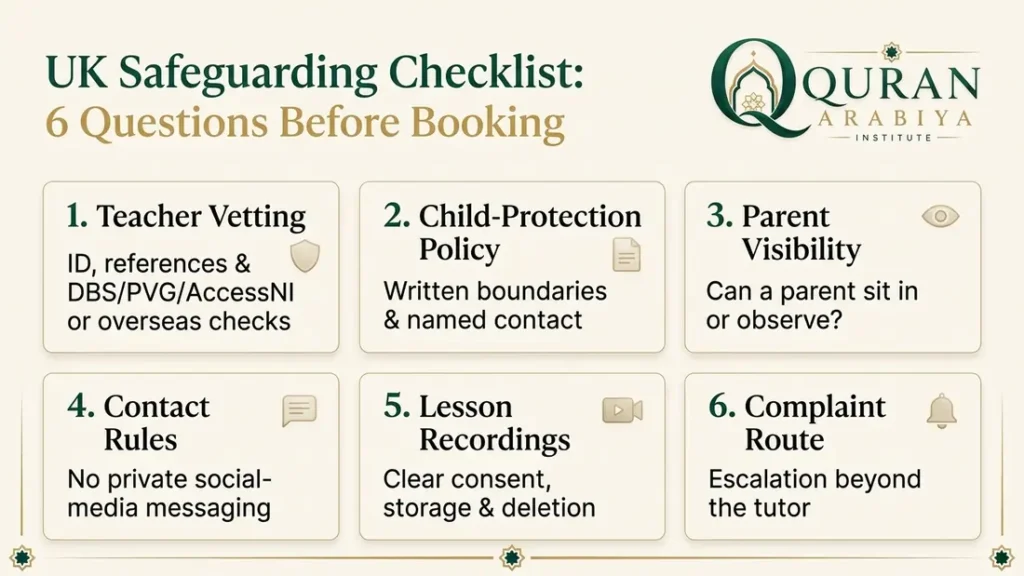
Important UK distinction: DBS checks apply in England and Wales, PVG checks to regulated roles in Scotland and AccessNI in Northern Ireland. The type of check available or required depends on the role and legal eligibility; an enhanced DBS is not a universal certificate every overseas tutor automatically holds. If a tutor teaches from abroad, ask what alternative vetting, references, supervision and reporting arrangements exist.
For additional family-level online safety guidance, see the UK Safer Internet Centre’s resources for parents.
Fit Tuition Around School, Madrasah, GCSEs and UK Time
A sustainable timetable depends on your child’s actual week, not just the provider’s available slots.
| Learner situation | Timetable to test | What to avoid |
|---|---|---|
| Primary pupil already attends weekday madrasah | One or two short private sessions on lighter days | Consecutive late evenings |
| GCSE student | Short maintenance or revision sessions, fewer new targets near exams | Intensifying Hifz just before assessments |
| Adult on shifts | Two recurring windows with a clear missed-lesson policy | Paying for slots that change every week |
| Parent with young siblings | Separate focused time or an age-suitable group | Assuming one child’s pace suits everyone |
In 2027 the UK clocks move forward on Sunday 28 March and back on Sunday 31 October. When a tutor is outside Britain, confirm whether your displayed lesson slot follows GMT/BST or a fixed overseas clock. The official UK clock-change dates make this easy to check.
The Joint Council for Qualifications lists 10 May to 18 June 2027 as the common GCSE examination window; individual subjects differ. School terms and half-terms vary by council and school: check your local dates rather than assuming one national half-term week.
For Ramadan planning in February and March, the academy’s Ramadan 2027 UK guide looks at fasting hours and family routines; it serves a different purpose from this tuition buyer’s guide.
How Much Does Online Quran Tuition Cost in the UK?
Published UK prices vary with lesson length, weekly frequency and format. Figures below are examples from advertised UK provider plans checked in November 2026, not a national average or Quran Arabiya’s rates. A £25 headline price is not automatically cheaper than £45 if it buys significantly less live teaching. The fair comparison is paid tuition time, teacher attention and policies—not only the amount taken from your account each month.
| Publicly listed example | Live lessons in the stated plan | Total tuition | Equivalent cost per live hour |
|---|---|---|---|
| £25 plan | 8 × 30-minute individual lessons | 4 hours | £6.25 |
| £32 plan | 8 × 30-minute individual lessons | 4 hours | £8.00 |
| £45 plan | 12 × 30-minute individual lessons | 6 hours | £7.50 |
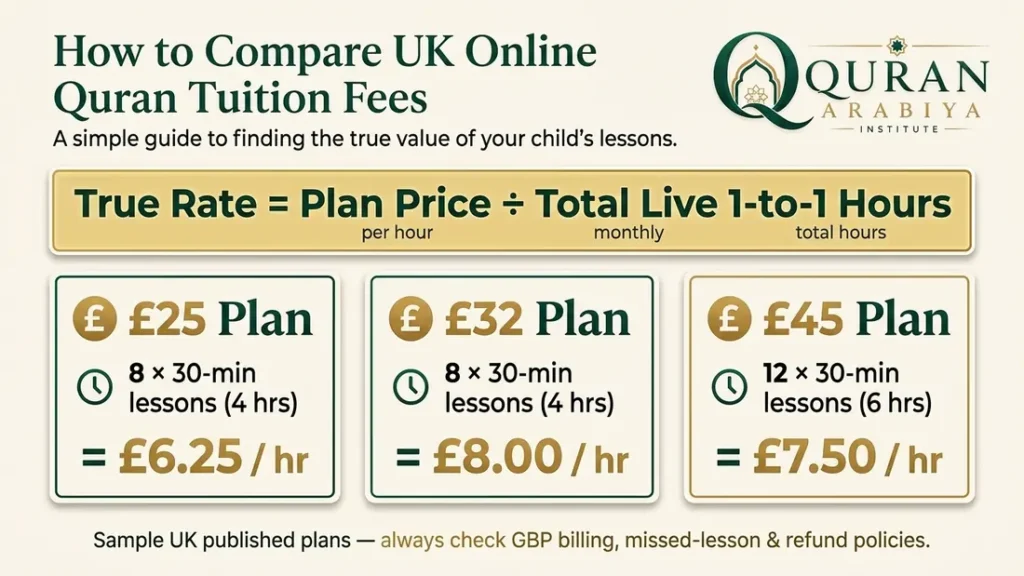
Method: Divide the advertised plan price by the total hours of live one-to-one tuition. These figures come from individual published provider listings; actual billing periods, discounts, tutor qualifications and lesson availability differ. Verify current terms before buying. They are shown here to teach comparison, not to recommend the providers or imply these are Quran Arabiya fees.
For a quote in pounds, ask whether the provider bills in GBP, converts at checkout or charges in another currency. Quran Arabiya’s pricing calculator currently displays USD and a complete four-week total according to programme, lesson length and frequency. Compare that four-week amount with other four-week plans; do not treat a live exchange-rate conversion as a guaranteed GBP charge or add an assumed payment method.
Calculate the Real Value, Not Just the Rate
Use plan price ÷ total scheduled live hours as a first check. Then ask how missed lessons, bank holidays, a tutor change, siblings, refunds and any materials affect what you receive.
One-to-One Versus Online Group Tuition: Which Should You Choose?
Group lessons can encourage confidence and community, especially when learners have similar skills. One-to-one tuition offers more opportunity for immediate correction, which is valuable when mistakes are persistent or the child is hesitant to read aloud.
Review the decision after four weeks instead of assuming one arrangement must last for years.
The First-Trial Scorecard: Questions to Ask and What to Watch
Bring one short familiar passage to the trial and ask the teacher to listen before recommending a package. A trial should let you observe the teaching, not just hear a programme description.
| Check during the trial | Look for this evidence |
|---|---|
| Diagnosis | The tutor identifies one or two clear starting skills from actual reading |
| Correction | You hear a model, a second attempt and a specific explanation |
| Learner comfort | The child can ask questions without embarrassment or pressure |
| Parent visibility | You know the contact and safeguarding rules, not just the tutor’s name |
| Next step | You receive a level, first practice target and a realistic schedule |
Suggested decision test: If you leave knowing only the monthly price, you do not yet have a learning plan. If you leave knowing the exact error to practise, how it will be retested, who to contact and the total cost for a realistic schedule, you can compare choices fairly.
Quran Arabiya’s free trial is presented as an opportunity to meet a teacher, discuss the level and decide on the next learning route; ask any safeguarding or billing questions directly before enrolment.
A Four-Week Progress Check for Parents
One of the most common disappointments is hearing “your child is doing well” without being able to tell what changed. You do not need a complicated dashboard. Ask the teacher to document a baseline, one correction target and a short follow-up reading after four weeks. Keep the example small enough to test in a new passage.
| Checkpoint | Parent-friendly question |
|---|---|
| Week 1: Baseline | Which repeated error or weak reading skill did we notice? |
| Week 2: Guided improvement | Can the learner correct it when reminded? |
| Week 3: Independent practice | Can they notice and correct it without a prompt? |
| Week 4: Transfer | Can they use the same skill correctly in unfamiliar lines? |
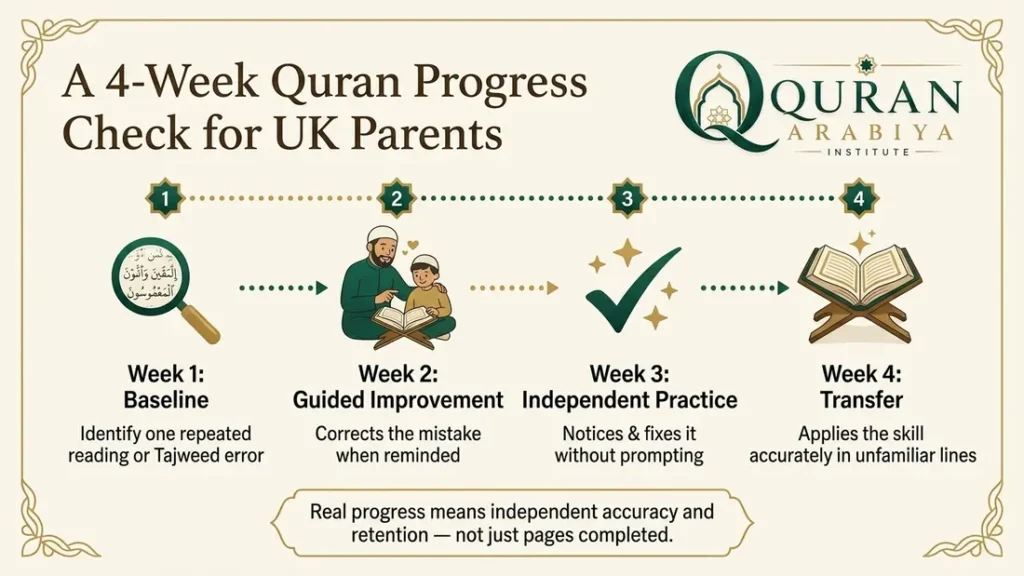
Progress in memorisation should include retention after a gap, not just the ability to repeat new verses immediately after the teacher.
Conclusion
Good online Quran tuition UK families can trust comes down to four decisions: choose the right learning goal, check safeguarding carefully, compare the full cost of live teaching and demand a way to recognise improvement. The right tutor should help a learner recite more accurately and confidently without crowding out school, work or community life. Start with a passage, a few practical questions and a realistic timetable; then explore Quran Arabiya’s UK classes or arrange a free trial to assess the fit before committing.
Frequently Asked Questions
What is online Quran tuition UK and how does it work?
It is live Quran teaching delivered remotely to UK learners, either individually or in groups. Students read aloud, receive feedback and practise between lessons. Ask whether the teacher corrects recitation in real time rather than relying only on videos.
How much should private online Quran lessons cost in the UK?
Published 2026 provider examples include plans of £25 or £32 for eight 30-minute lessons and £45 for twelve. Compare the real teaching minutes, conditions and quality. These examples are not a verified UK-wide average or Quran Arabiya’s prices.
Are online Quran tutors required to have an enhanced DBS check?
Not universally. The appropriate check depends on the role, jurisdiction and eligibility; overseas tutors may not hold a UK certificate. Ask the provider to explain its teacher screening, references, safeguarding policy and complaint route.
Can my child attend a local madrasah and have online Quran tuition?
Yes. A single focused online lesson can help with a recurring reading or Tajweed issue while the child continues to benefit from local community learning. Coordinate targets so the two teachers do not give conflicting homework.
Are online Quran classes suitable for adult beginners?
Yes, provided the tutor assesses the adult’s actual level without forcing a child’s syllabus. A useful plan might focus first on connected reading, pronunciation or rebuilding confidence before introducing advanced Tajweed.
Can I request a female Quran teacher for myself or my daughter?
Quran Arabiya’s UK page says learners can request a male or female teacher. Confirm the teacher preference, availability and the person who will teach the ongoing sessions during the trial process.
Can lessons fit around GCSEs and UK half-terms?
Often, but the provider must confirm specific times and any pause or rescheduling policy. GCSE exam dates and school holidays vary by learner; test a lighter revision plan during the busiest weeks.
Should I choose 30-minute or 60-minute Quran sessions?
Shorter sessions often suit young children, focused reading repair or busy beginners. Longer lessons may help more mature learners working on memorisation or detailed Tajweed. Choose the duration that produces attentive practice, not the longest option available.
How do I know whether Quran tuition is working?
Use a baseline reading and one measurable goal. Retest the same skill without prompting and then in a new passage after several weeks. Progress means independent accuracy and retention, not just more pages completed.
What should I ask during a Quran tuition free trial?
Ask the teacher to assess a passage, identify the first skill to improve, explain safeguarding arrangements, confirm timetable and true total price, and describe how progress will be reviewed. Do not enrol on a vague promise alone.
References
- NSPCC Learning — Safeguarding and Child Protection for Tutors
- Department for Education — Using After-School Clubs, Tuition and Community Activities
- Department for Education — Safeguarding Guidance for Out-of-School Providers
- UK Safer Internet Centre — Resources for Parents and Carers
- GOV.UK — When Do the Clocks Change?
- GOV.UK — School Term and Holiday Dates
- JCQ — Exam Key Dates and Timetables
- Quran.com — Surah Al-Muzzammil 73:4