Ten Qiraat Course Online to Study the Canonical Readings with Advanced Recitation Training

The Ten Qiraat are a transmitted discipline of Quran recitation, not a menu of accents or interchangeable pronunciation choices. A serious Ten Qiraat course online begins by teaching the structure of transmission, checking recitation readiness and then studying the canonical readings through controlled principles and oral practice. Because this is advanced study, the page should be explicit about prerequisites, route discipline and the difference between learning Qiraat, completing a program and receiving an Ijazah.
قراءات01MapQira’ah to Riwayah02StudyUsul and Farsh03RouteChoose the correct pathway04TransmitPreserve attribution

Ten Qiraat Is an Advanced Transmission Science, Not a Collection of Pronunciation Variants

Each canonical Qira’ah is attributed to an Imam and transmitted through recognized narrators and further routes. Differences are learned through disciplined attribution, not by selecting whichever form seems easier. Qiraat classes online therefore need text-based organization plus direct oral correction. A 10 Qiraat course online should make that transmission discipline explicit from the beginning.
Qira’ah

A canonical reading is associated with a recognized Imam. The teacher keeps attribution and route explicit so comparison never becomes uncontrolled mixing, while keeping the correction target narrow and clear. Move forward when the taught route is accurate, attributed and free from mixing.
Ten Qiraat course online - 1

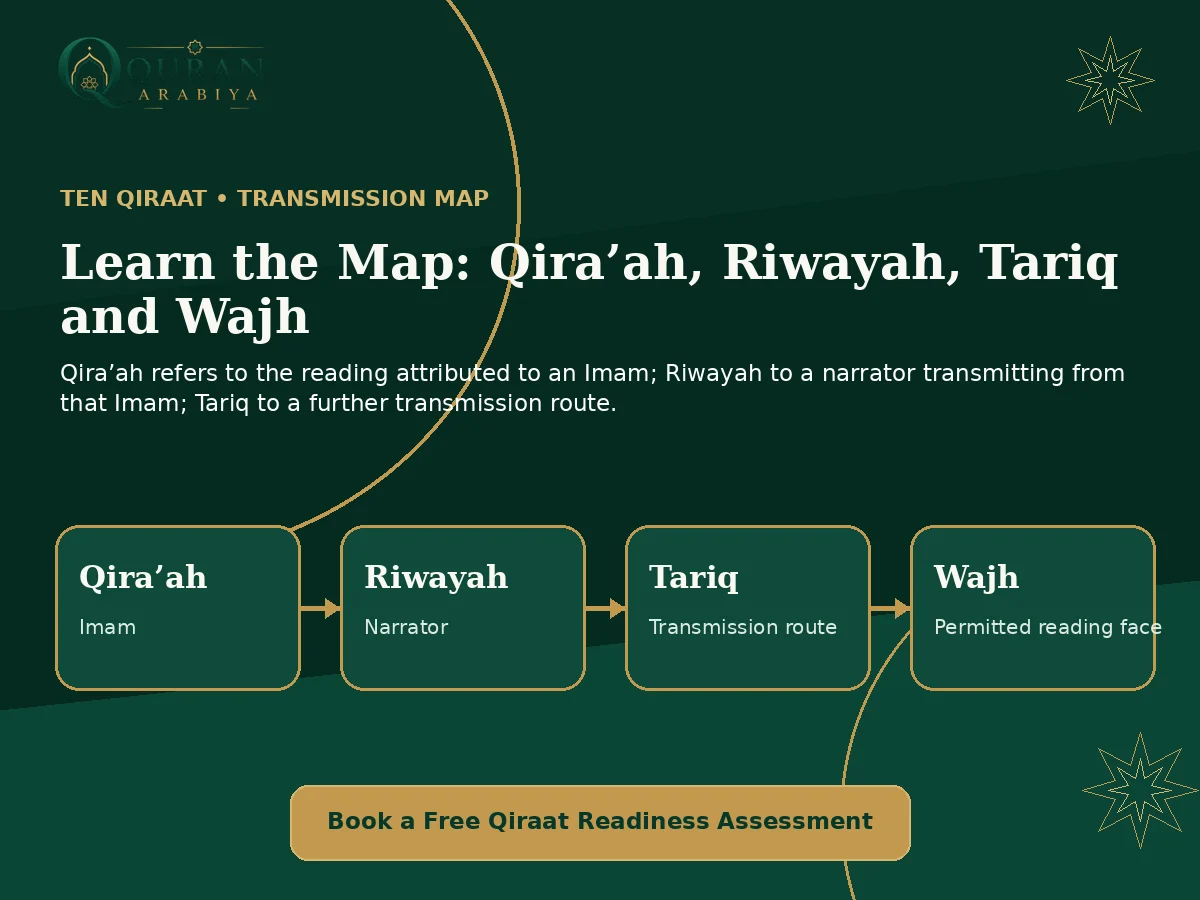
Learn the Map: Qira’ah, Riwayah, Tariq and Wajh

Qira’ah refers to the reading attributed to an Imam; Riwayah to a narrator transmitting from that Imam; Tariq to a further transmission route; and Wajh to a permitted reading face within controlled context. The technical detail deepens later, but this hierarchy should be clear early because it prevents uncontrolled mixing.
MapAttributeReciteRetest

Meet the Ten Imams and Their Famous Narrators

A practical orientation map is: Nafi‘—Qalun and Warsh; Ibn Kathir—Al-Bazzi and Qunbul; Abu ‘Amr—Al-Duri and Al-Susi; Ibn ‘Amir—Hisham and Ibn Dhakwan; ‘Asim—Shu‘bah and Hafs; Hamzah—Khalaf and Khallad; Al-Kisa’i—Abu al-Harith and Al-Duri; Abu Ja‘far—Ibn Wardan and Ibn Jammaz; Ya‘qub—Ruways and Rawh; Khalaf al-‘Ashir—Ishaq and Idris. This organizes the field; it does not replace oral study.
Nafi‘

Famous narrators include Qalun and Warsh.

Usul

Recurring principles organize patterns that appear across many Quran locations. The teacher keeps attribution and route explicit so comparison never becomes uncontrolled mixing, while keeping the correction target narrow and clear. Move forward when the taught route is accurate, attributed and free from mixing.
Study Usul and Farsh Together

Usul covers recurring principles that apply across many locations; Farsh covers word-specific/location-specific differences. Studying only Usul leaves gaps, while memorizing isolated Farsh without a system fragments the subject. The course can maintain a personal Usul map and attach Farsh to Quran context.

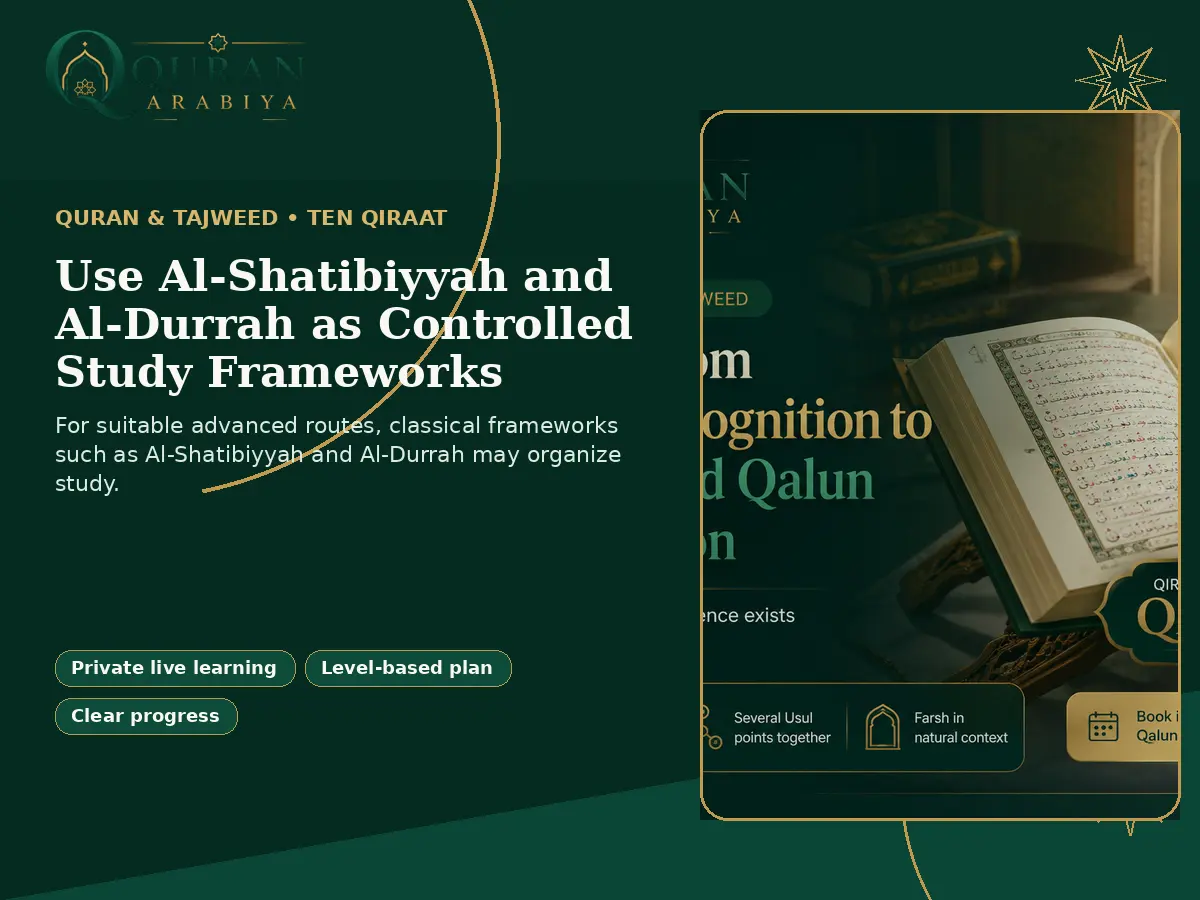
Use Al-Shatibiyyah and Al-Durrah as Controlled Study Frameworks

For suitable advanced routes, classical frameworks such as Al-Shatibiyyah and Al-Durrah may organize study. A Shatibiyyah and Durrah Qiraat course should still be taught through qualified explanation and recitation, not self-study poetry. Exact route/text requirements should be confirmed after assessment.
GoalLevelScheduleMatch
Ten Qiraat course online - 2
Individual Riwayah

Some learners should master one narration before wider comparison. The teacher keeps attribution and route explicit so comparison never becomes uncontrolled mixing, while keeping the correction target narrow and clear. Move forward when the taught route is accurate, attributed and free from mixing.
Choose the Right Route: Individual Riwayah, Minor Ten or Advanced Combined Study

Not every learner should begin by combining all readings. Some benefit from mastering an individual Riwayah first; others may be ready for a recognized Ten Qiraat route. The selected route should be named before training begins and its transmission boundaries kept visible.

Compare Readings Without Mixing Unauthorized Options

Comparison is useful when it clarifies a difference, but it can also create accidental blending. The teacher can mark which form belongs to which Riwayah and ask the learner to read consistently within one route before switching deliberately. This discipline is essential for anyone who wants to learn Ten Qiraat properly.
ObserveIdentifyPracticeRetest
Ten Qiraat course online - 3
Ten Qiraat course online - 4

Build Oral Precision with a Qualified Specialist Teacher

Qiraat cannot be reduced to charts. The learner needs to hear transmitted recitation, reproduce it and receive correction. Written notes organize knowledge; oral supervision protects performance and attribution.
GoalLevelScheduleMatch

Pass a Qiraat Readiness Assessment Before Choosing the Route

A strong candidate should have stable Quran reading and Tajweed and be ready for advanced terminology and disciplined practice. The assessment can clarify the current Riwayah, previous study and goal: individual narration, wider canonical study or eventual Ijazah.

Course Completion and Ijazah Are Not the Same

An advanced Qiraat course can teach substantial material without automatically conferring Ijazah. Formal authorization depends on the qualified teacher, specific route and the learner meeting the required recitation standard.

What Progress Should Look Like

A clear transmission map before detailed comparison.
Systematic Usul/Farsh study.
Route discipline that prevents mixing.
Direct oral correction with a specialist.
A readiness-based route choice.

Start with a Free Trial

Request a free Qiraat readiness assessment. Recite in your current Riwayah and explain previous Tajweed/Qiraat study so the teacher can recommend the correct advanced route.

Frequently Asked Questions

No. They are canonical transmitted readings of the Quran with recognized chains and controlled recitation differences.

You should have strong, stable recitation foundations; the assessment determines whether more preparation is needed.

Usul are recurring principles; Farsh are specific word/location differences. Both are required for systematic study.

Qalun is one of the famous narrators from Imam Nafi‘. The dedicated Qalun page studies that Riwayah in depth.

No. Ijazah is teacher authorization dependent on the selected route and accepted standard.

The teacher should assess strong Tajweed, current recitation, Arabic/Qiraat background where relevant, retention and the learner’s ability to keep transmitted options separate. The assessment also helps choose the correct route.

No. Some learners should master an individual Riwayah before wider comparison, while others may be ready for a recognized Minor Ten or more advanced combined route.

They help define where a transmitted option belongs and under what route it may be performed. This prevents treating every known variant as freely interchangeable.

Usul gives recurring principles, while Farsh attaches word-specific variations to Quran locations. A strong program keeps both connected to oral recitation and attribution.

They can provide controlled classical frameworks for recognized study routes, depending on the teacher and program. The exact matn and route should be confirmed rather than assumed.

Use a clear personal map, name the Riwayah and route, practise under qualified oral supervision and compare only when the comparison serves a specific learning purpose.

Qalun is part of the wider map, but a learner whose primary intent is one Riwayah should use the dedicated Qalun page rather than turning the Ten Qiraat course into a single-Riwayah course.

No. Course study, a completion certificate and Ijazah are distinct outcomes. Formal authorization depends on the qualified teacher accepting the required oral standard and route.

Yes. Matching for Qiraat should consider the exact reading, route, learner readiness, schedule and the teacher’s verified authorization in the material being taught.
KEEP LEARNING

Continue with a Course That Fits Your Next Step

Start the Right Quran Path with a Free Trial

Use the assessment to confirm whether Ten Qiraat Program is the right route for the learner’s current level and goal.
Chat with us