These can stay on a lighter maintenance cycle. The teacher checks it through recall, transitions and targeted review rather than simple familiarity, while keeping the correction target narrow and clear. Move forward when random recall improves and the plan can shift toward maintenance.
Protect recent Hifz before it decays. The teacher checks it through recall, transitions and targeted review rather than simple familiarity, while keeping the correction target narrow and clear. Move forward when random recall improves and the plan can shift toward maintenance.

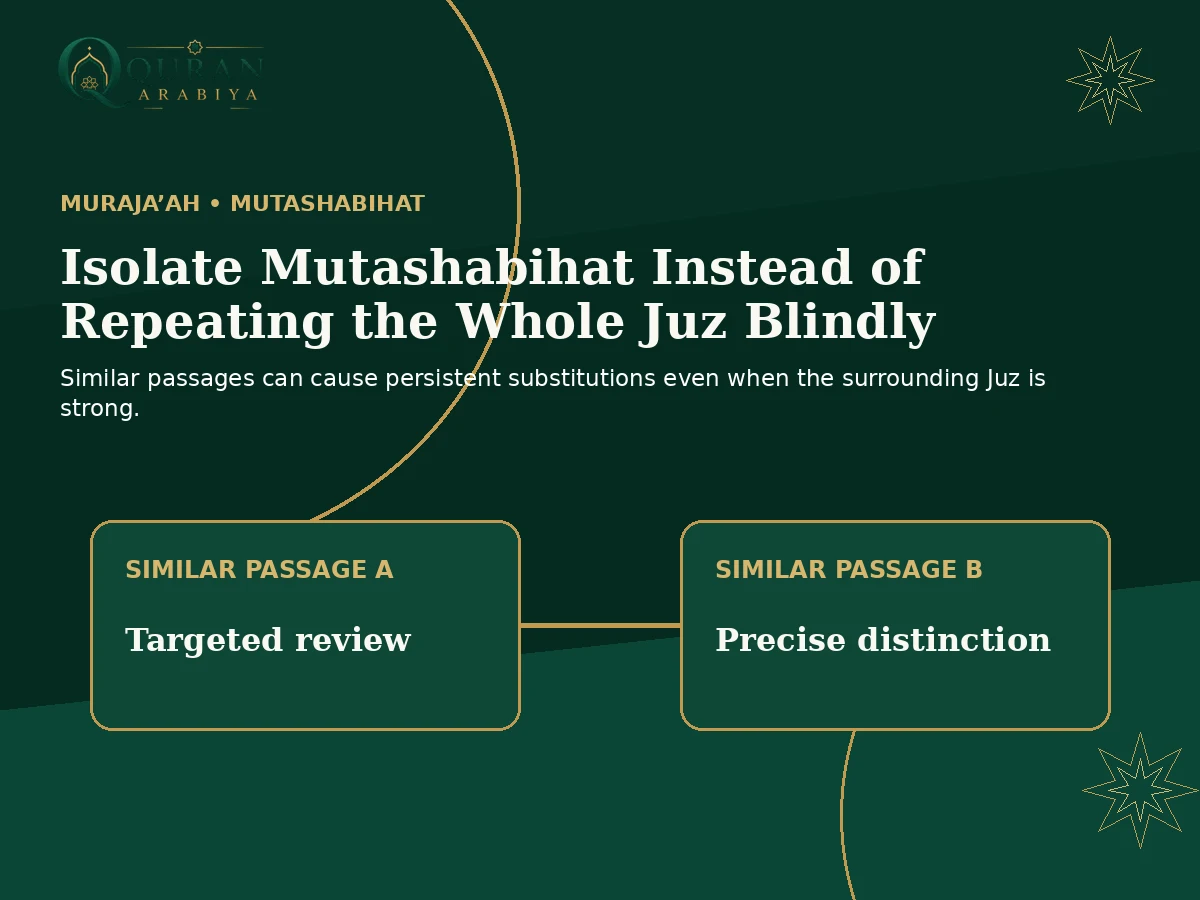
Put similar passages side by side instead of repeating the whole Juz blindly. The teacher checks it through recall, transitions and targeted review rather than simple familiarity, while keeping the correction target narrow and clear. Move forward when random recall improves and the plan can shift toward maintenance.
It can support them, but the primary intent is revision of existing Hifz. If new memorization is the main goal, use a Hifz course.
No. Strong, fragile and weak sections often need different frequencies.
Mutashabihat can be isolated and compared directly so distinguishing words and transitions become clearer.
Yes when continuing to add would worsen instability in older Hifz.
No. Partial memorizers can also need a structured revision system.
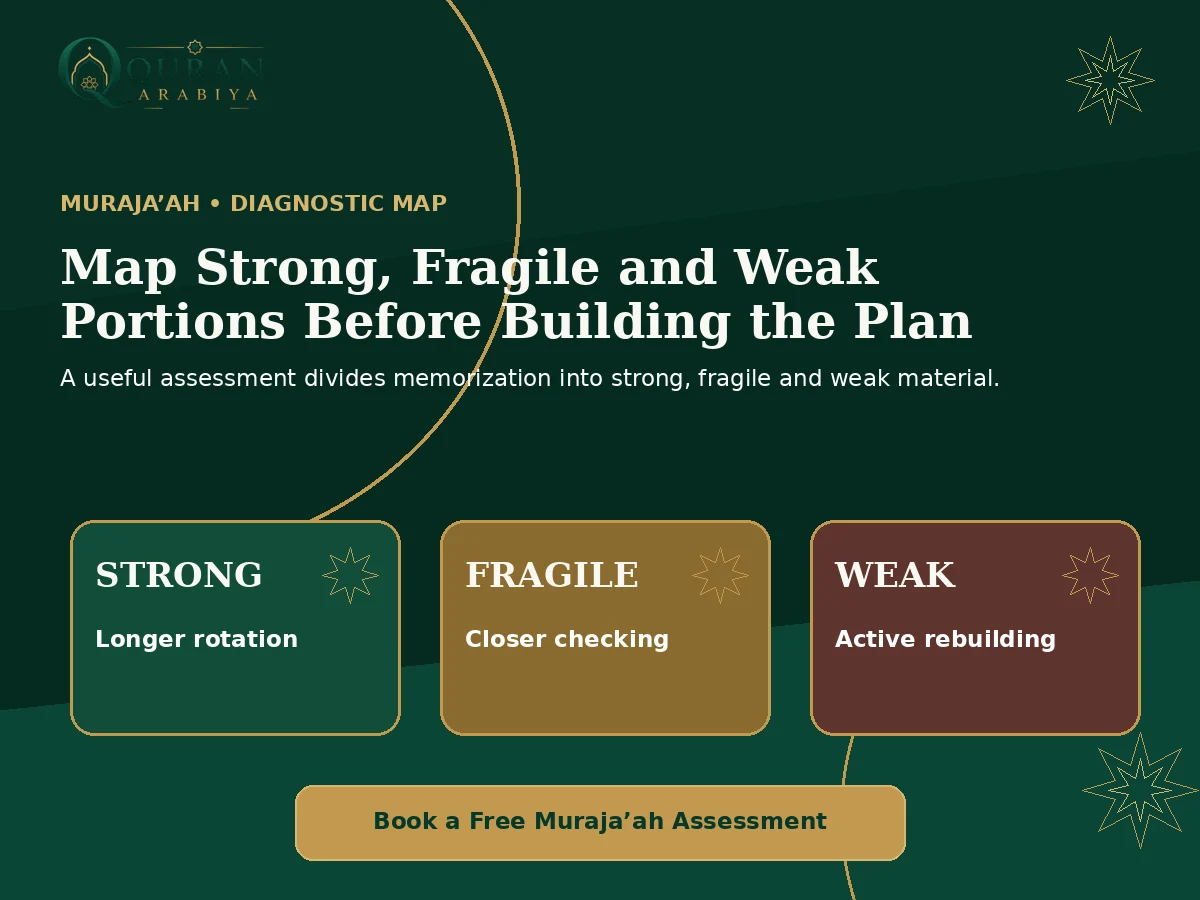
The teacher can sample different Juz and classify portions as strong, fragile or weak. That map helps determine frequency and repair priorities instead of revising everything equally.
Recent, medium-term and older Hifz are reviewed on different cycles because they do not have the same memory strength. The layers are adjusted as recall becomes stronger or weaker.
Mutashabihat can be isolated and compared directly so the learner sees the word, phrase or transition that distinguishes the passages. This is often more useful than repeating a whole Juz blindly.
Random starts, page transitions, Surah boundaries and continuation from cues are useful. They show whether the memorization is retrievable without relying only on sequence.
Yes. Separating memory errors from pronunciation and Tajweed errors makes the repair plan more precise and prevents every problem from being labelled as weak Hifz.
Pause or reduce new memorization when the review load is no longer realistic or older material is weakening faster than it can be repaired. The goal is to restore stability first.
Yes. Muraja’ah is not only for complete Huffaz; it is useful whenever already-memorized Quran needs a deliberate maintenance system.
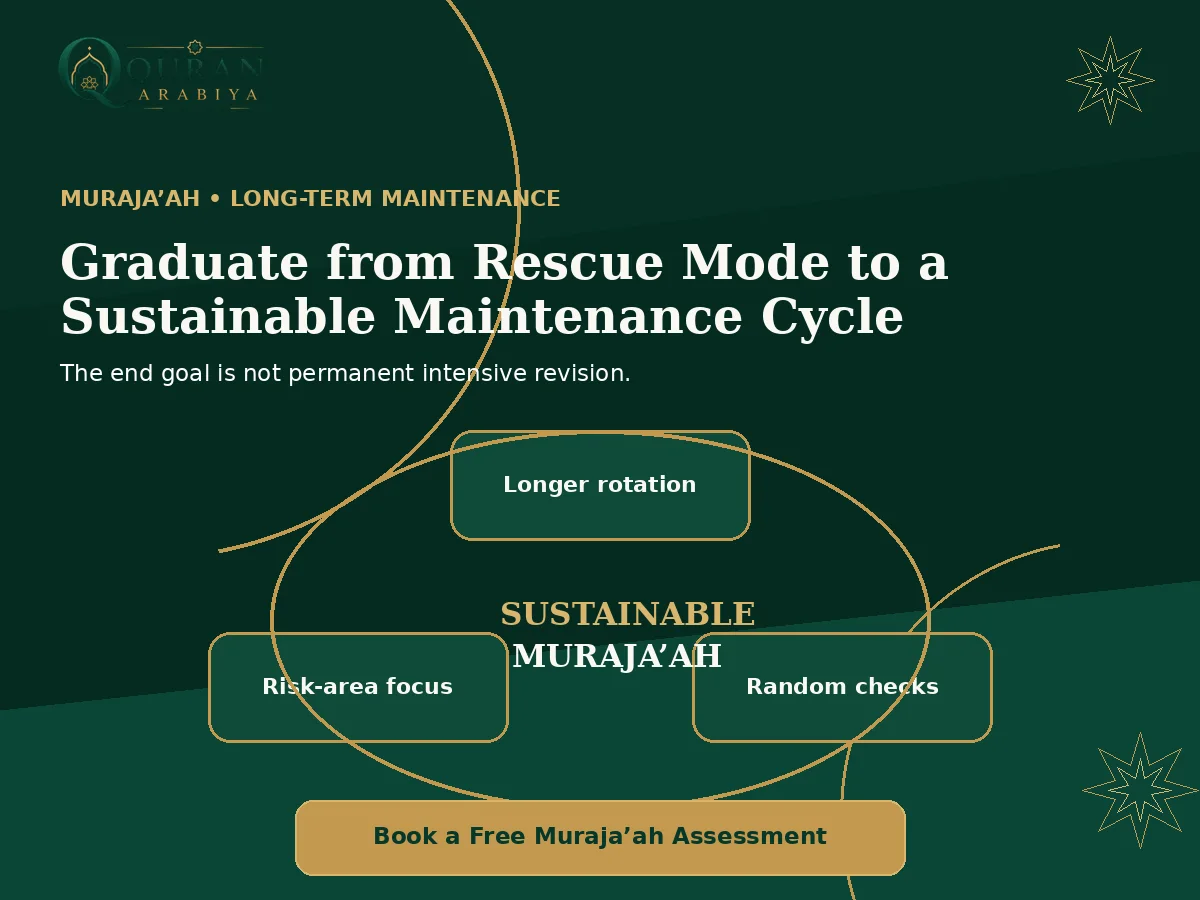
Weak portions become more stable, random recall improves and the learner can move from intensive repair to a predictable maintenance cycle. The review plan becomes lighter and more sustainable.
Yes. The cycle should respond to actual recall, not stay fixed when the learner’s memory profile changes.