Quran Memorization Classes for Kids with Structured Hifz, Review & Long-Term Retention

Quran memorization is not strong because a child can repeat a new page today. It is strong when the child can return to it later, start from different places, connect passages and recite with the same accuracy after new material has been added. These Quran memorization classes for kids are built around that standard: correct first, memorize in a realistic load, then protect the memorization with deliberate review.
احفظ01CorrectFix the ayah first02New HifzAdd a realistic portion03ReviewProtect recent work04RetainKeep older Hifz available

Memorization Is Only Successful When It Stays

Immediate repetition can make progress look faster than it is. Long-term Hifz requires delayed recall. The teacher should revisit material after time has passed and listen for hesitation, skipped words, substitutions and weak transitions. Quran Hifz lessons for children become stronger when progress is measured by what the child can still retrieve rather than by what was repeated once. Families who want to memorize Quran online for kids should therefore judge success by delayed recall, not only first-day repetition.
Immediate repetition

A child may repeat well today without having stable Hifz yet.
Click a row to read what the indicator means in this course.

Build a Hifz Plan Around the Child’s Real Capacity

The right new portion depends on age, reading accuracy, school workload, current Hifz and available review time. A Quran memorization course for children should be allowed to slow down when retention weakens rather than protect an artificial completion date. The trial and early sessions can help estimate a realistic starting load. That is why online Hifz classes for kids should begin with capacity and retention, not a fixed weekly page promise.

Correct the Ayat Before Repetition Fixes a Mistake

Repetition strengthens whatever the child repeats—including errors. Before a passage is repeated heavily, the teacher can model it, hear the first attempts and correct wording, pronunciation and key Tajweed issues. Tajweed supports accurate Hifz here, but it remains secondary to the memory goal.
FocusPracticeCheckProgress
Quran memorization classes for kids - 1
New Hifz

Add a small new portion that can be corrected and repeated accurately. The teacher keeps it inside the Hifz-and-review routine and checks it again after a delay, while keeping the correction target narrow and clear. Move forward when recall stays accurate and the review load remains realistic.

Balance New Hifz, Recent Review and Older Revision

A structured Hifz program for kids online should divide memory work into layers: new material, recent portions that are not yet fully secure, and older Hifz that needs maintenance. The ratio changes as the child’s memorization grows. When older portions weaken, new work can be reduced temporarily.

Keep Tajweed Inside Hifz Without Turning It into a Tajweed Course

The teacher can correct recurring sounds and rules that affect the current passage. If those errors are broad enough to need dedicated practice, the family should be linked to Kids Tajweed. This keeps the pages distinct: Hifz owns memory and retention; Tajweed owns pronunciation and rule application as the primary skill.
ListenModelApplyTransfer
Quran memorization classes for kids - 2
Random start

Begin from a selected ayah rather than always from the first line. The teacher keeps it inside the Hifz-and-review routine and checks it again after a delay, while keeping the correction target narrow and clear. Move forward when recall stays accurate and the review load remains realistic.

Use Retention Checks, Random Starts and Transition Practice

Strong recall is flexible. The teacher can ask the learner to begin from a selected ayah, continue from a cue, move across a page transition or connect sections. Random starts expose memory that depends too heavily on always beginning from the first line. The purpose is diagnosis, not pressure.

Give Parents a Useful Role Without Making Review Stressful

Parents can help protect a regular review window, listen to a short assigned section when possible and report practical obstacles. They do not need to become Tajweed teachers. A simple weekly target—new portion, revision portion and fragile section—gives the family a useful support role.
MapReviewTestMaintain
Quran memorization classes for kids - 3
Quran memorization classes for kids - 4

Slow Down New Hifz When Retention Starts to Weaken

Sometimes the best memorization decision is to add less. If a child is losing older Surahs, mixing passages or needing heavy prompting, the teacher can reduce new material and rebuild review. Learners whose main issue is already-memorized Quran should be routed to the Muraja’ah page.
CorrectMemorizeReviewRecall

What Progress Should Look Like

A personalized Hifz load based on actual capacity.
Correct recitation before heavy repetition.
A visible new/recent/old review system.
Retention testing beyond immediate recall.
A parent-friendly home support plan.

Start with a Free Trial

Book a free trial to assess reading, current memorization, recall strength and realistic review capacity before deciding the starting Hifz load.

Frequently Asked Questions

There is no responsible universal amount. It depends on reading accuracy, retention, review time and the child’s wider schedule.

Yes. Review is part of Hifz because new memorization is not secure unless older portions remain retrievable.

Yes, where it affects accurate memorization. If Tajweed becomes the main need, a specialist course may be recommended.

New Hifz can be reduced while weak material is repaired; a dedicated Muraja’ah route may be more suitable.

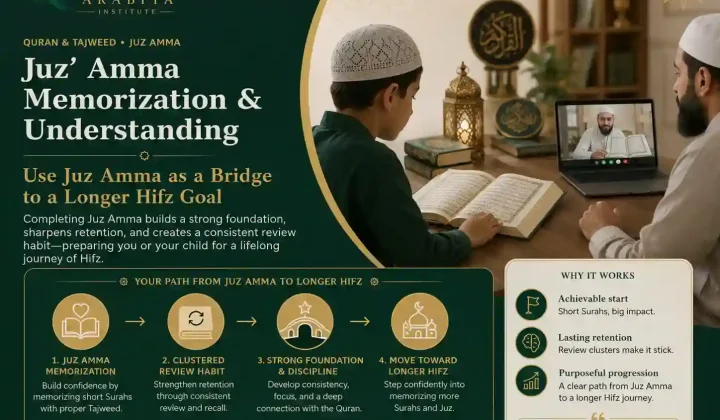
Yes when appropriate; the Juz Amma page is the best route if that limited milestone plus simple understanding is the main goal.

The amount should reflect the child’s reading accuracy, school load, attention, current retention and available review time. A smaller portion that stays is better than a fast target that weakens earlier Hifz.

The ayah should be corrected before repeated practice makes the error harder to remove. Tajweed correction remains part of Hifz, while memorization and retention stay the primary goal.

The plan should include older revision alongside new and recent work. Random starts, transitions and delayed recall help show whether the Surahs are independently available.

Yes. If older Hifz is becoming fragile, reducing the new portion can protect the review system until retention becomes stable again.

Parents can support the specific review target and encourage a calm routine rather than testing large amounts unexpectedly. The teacher should keep the practice goal clear and manageable.

Yes, when used gently and at the right level. Starting from selected ayat helps reveal whether the child knows the text independently or is relying only on sequence.

Yes. Existing memorization can be checked for accuracy and retention first, then the teacher can decide whether to repair, review or add new work.

Use the revision program when the main issue is already-memorized Quran becoming unstable rather than building new Hifz. The two pages intentionally own different goals.

Yes. Share age, level, memorization goal, schedule and teacher preference during matching. The final match depends on suitable availability.

KEEP LEARNING

Continue with a Course That Fits Your Next Step

Start the Right Quran Path with a Free Trial

Use the assessment to confirm whether Quran Memorization (Hifz) for Kids is the right route for the learner’s current level and goal.
Chat with us