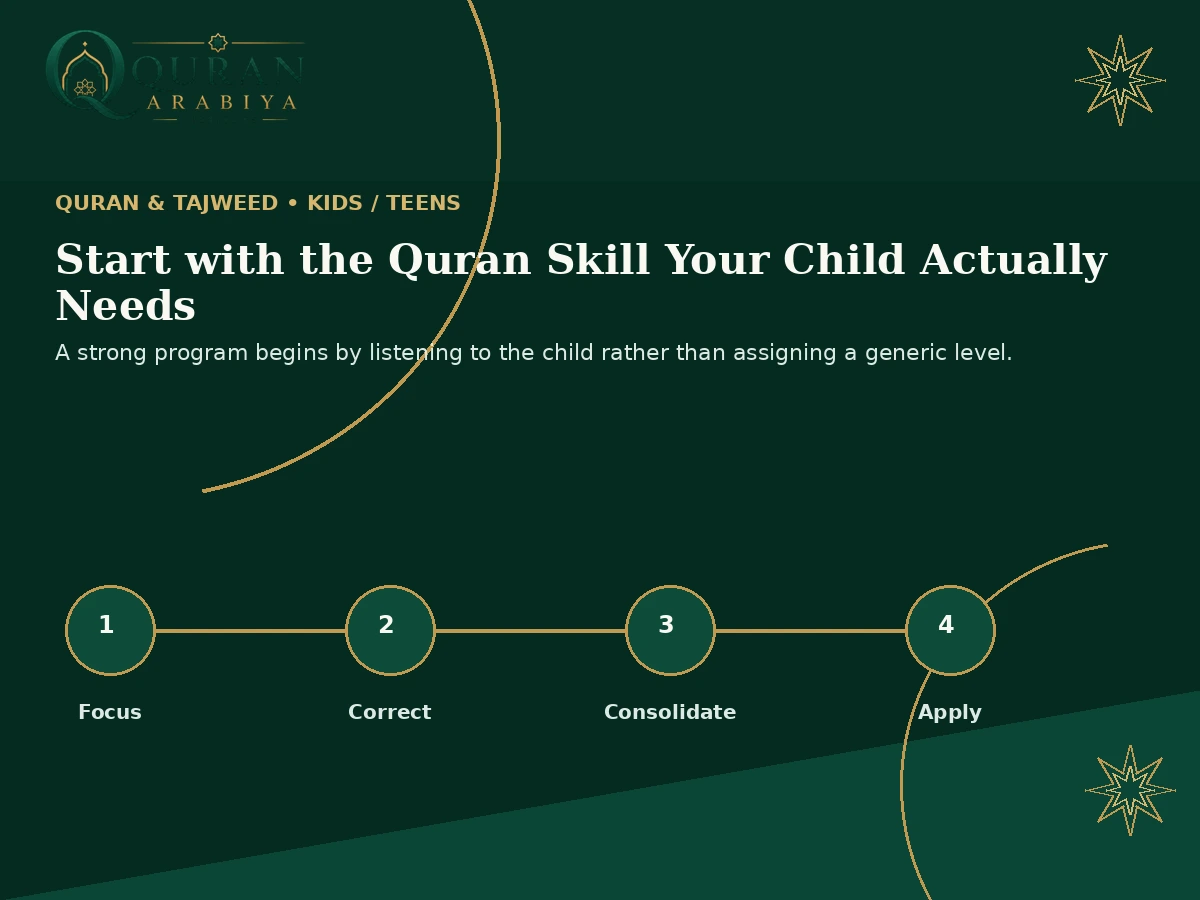
Build dependable letter, joining and vowel awareness before adding more complex work. The teacher practises it at the child’s current level, then retests it in a fresh Quran example, while keeping the correction target narrow and clear. Move forward when the child can use it with fewer prompts without weakening the foundation.


New Hifz grows only when review can protect earlier work.
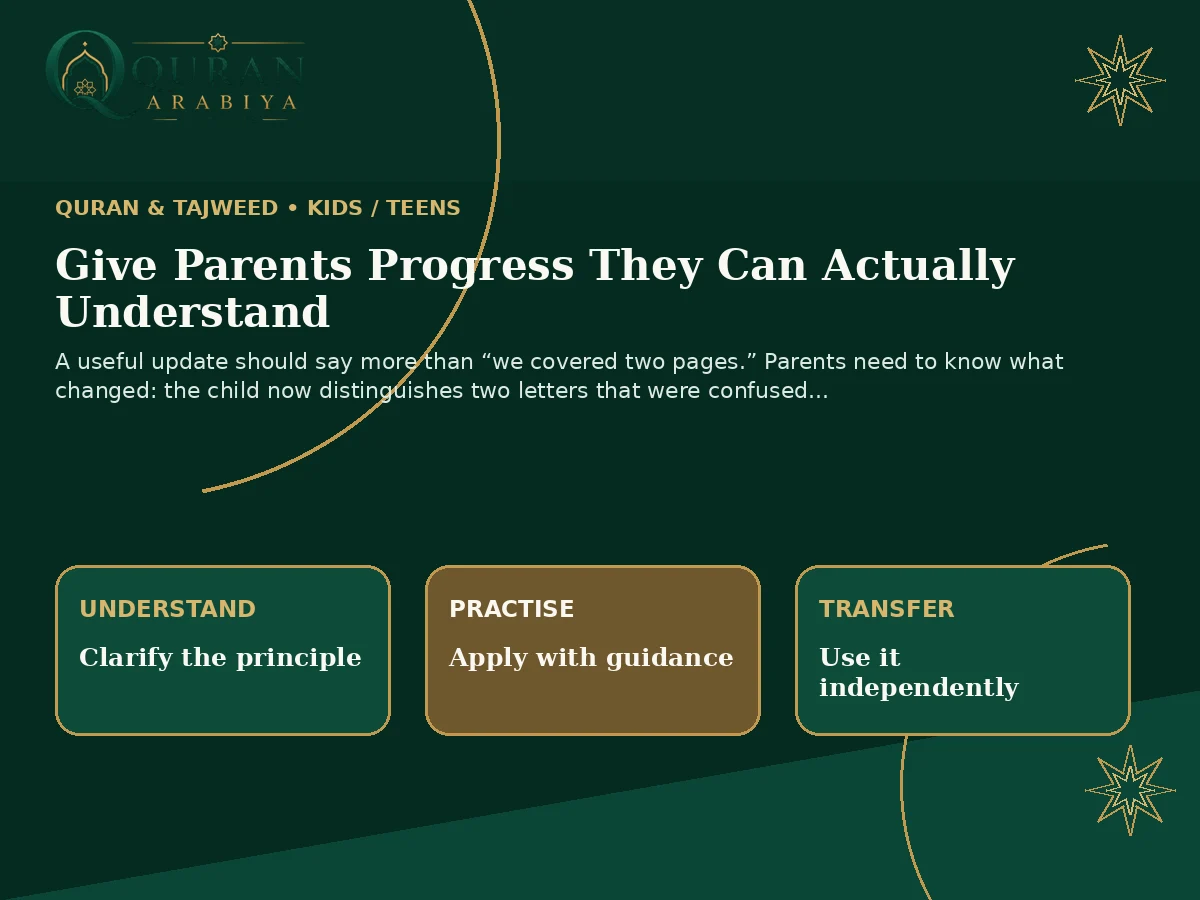
Progress shows when the child reads more with fewer prompts.
Choose reading first when decoding is the main bottleneck. The teacher practises it at the child’s current level, then retests it in a fresh Quran example, while keeping the correction target narrow and clear. Move forward when the child can use it with fewer prompts without weakening the foundation.
Yes. A child who is still learning letters or basic Quran reading can begin from that foundation.
No. The full track gives access to a complete pathway, but the active focus should match the child’s current need.
A preference can be requested and matched subject to availability and schedule fit.
Track observable skills such as reading independence, recurring-error reduction, Tajweed application and retention—not only pages covered.
The teacher can skip unnecessary foundation work and assess whether the next bottleneck is fluency, pronunciation, Tajweed or Hifz.
The teacher can listen to the child, identify the strongest current need and recommend whether the first focus should be reading, Tajweed, Hifz or a balanced route. The trial is also a chance to check teaching fit before regular lessons begin.
Reading foundations should take priority when decoding, vowels or connected reading are unstable. The broader full track can still be the right home, but specialist reading work may be recommended when that is clearly the bottleneck.
Move when reading is sufficiently stable and pronunciation or applied Tajweed has become the main goal. The specialist page can then give correction and recitation practice more room without turning the full track into a deep Tajweed course.
Move when new memorization and long-term retention become the primary objective. A dedicated Hifz route can give more lesson time to new portions, recent review, older revision and recall checks.
Yes. A child may begin with reading, then shift toward Tajweed or Hifz as the foundation becomes stronger. The sequence should follow actual readiness rather than a fixed timetable.
Short, specific practice is usually more useful than a broad homework list. The teacher can identify one reading, recitation or review target so the family knows exactly what to reinforce between lessons.
Only when their levels and goals are close enough for the same learning priorities. A private one-to-one plan is designed around the individual child, so siblings may need different starting points even when they study the same broad course.
The teacher can shorten tasks, vary the practice mode and keep correction focused when attention drops. The child should spend most of the lesson reading, repeating, identifying, correcting or recalling rather than listening passively.
Yes. A male or female teacher preference can be shared during matching, while the final match also depends on age, level, course goal, schedule and current availability.