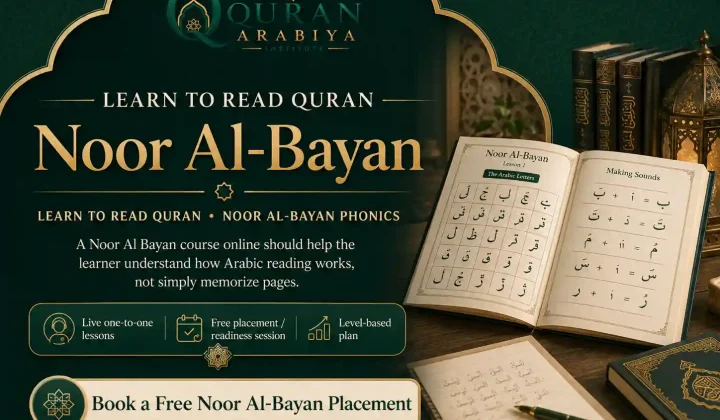
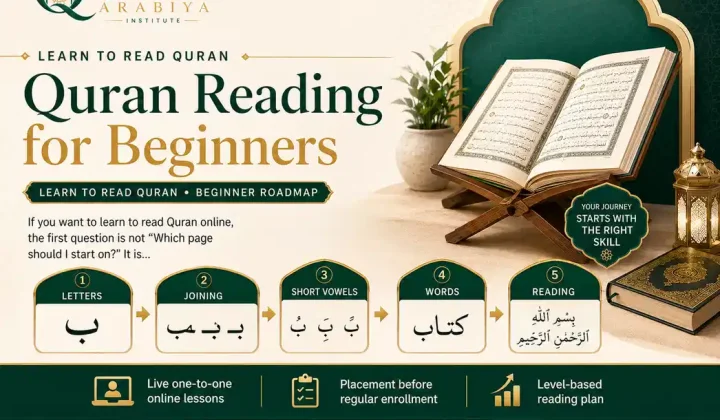
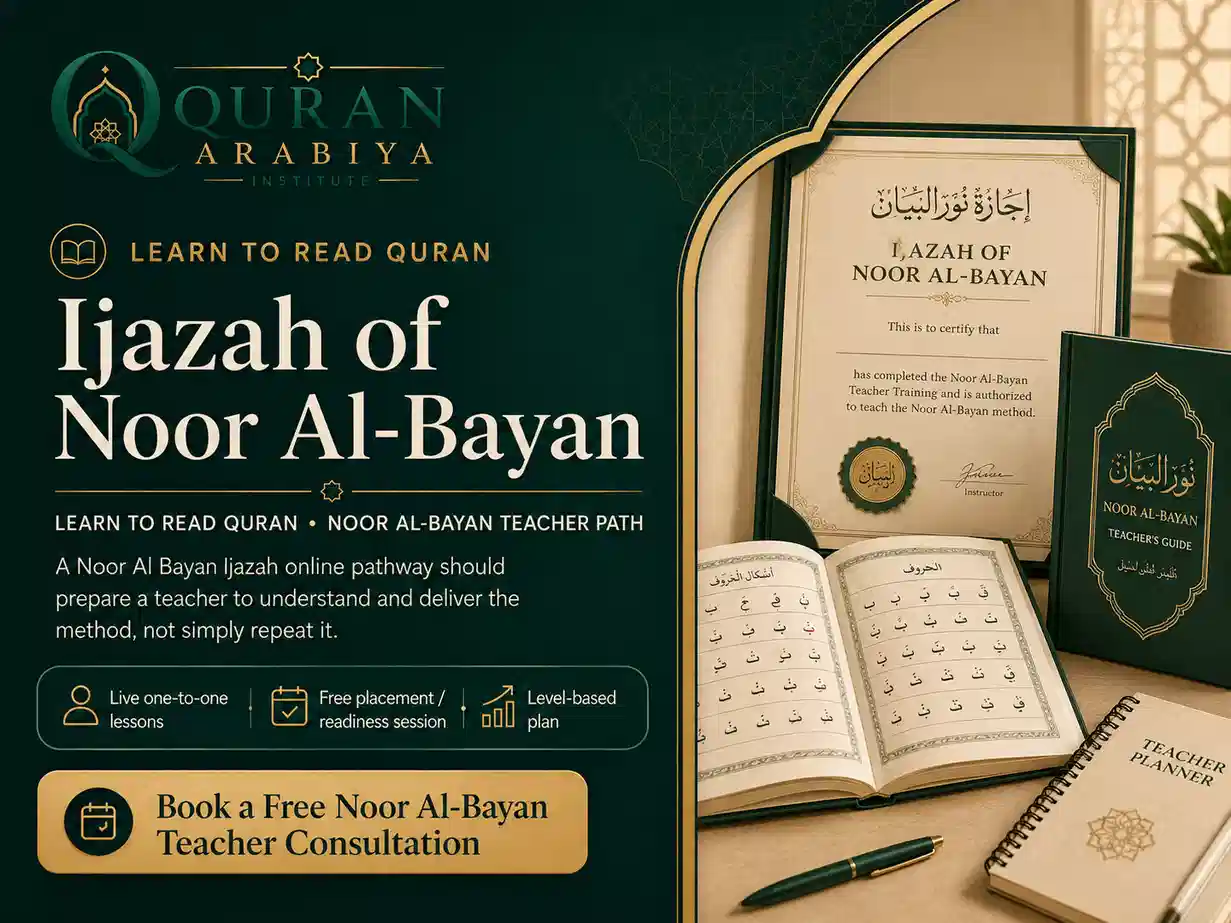
A Noor Al Bayan Ijazah online pathway should prepare a teacher to understand and deliver the method, not simply repeat it. The candidate needs to see the phonics architecture behind the sequence, identify why a learner is stuck, choose an exercise that targets the actual problem, and know how to move from guided blending toward independent reading. Quran Arabiya Institute should treat the free session as a teacher-readiness consultation and state the exact certification/authorization route only after the assigned qualified teacher confirms it.
The regular Noor Al Bayan page teaches a learner how to read. The teacher-level page asks a different question: can you explain the method, diagnose errors and guide another person through it without making them dependent on your prompts?
That distinction is essential for SEO and for educational honesty. A longer beginner course is not automatically a teacher qualification.
Start by understanding the letter-sound and blending architecture behind Noor Al Bayan. In live one-to-one practice, the teacher asks the candidate to explain how visual recognition, sound, vowels and blending connect rather than treating the pages as isolated activities. This stage is ready when the candidate can justify the sequence and identify what each stage is meant to unlock.
A candidate should have sufficiently strong Arabic/Quran reading for the level they intend to teach. If pronunciation or decoding is unstable, the responsible next step is personal correction before formal teacher preparation.
The exact threshold belongs to the authorized teacher or institution, so the public page should describe readiness without inventing a universal exam score.
Noor Al Bayan is more useful to a teacher when the stages are understood as a system: visual letter recognition, sound mapping, vowels, blending, connected forms, word construction and progressively independent reading.
Knowing the purpose of each stage helps the teacher skip, review or expand material intelligently instead of teaching every learner with the same page-by-page script.
A learner who says the wrong word may be making a visual error, a pronunciation error, a vowel error or a blending error. Each cause needs a different correction.
The Noor Al Bayan teacher course should train the candidate to identify the smallest failing skill and design a short corrective task before returning to the full word or sentence.
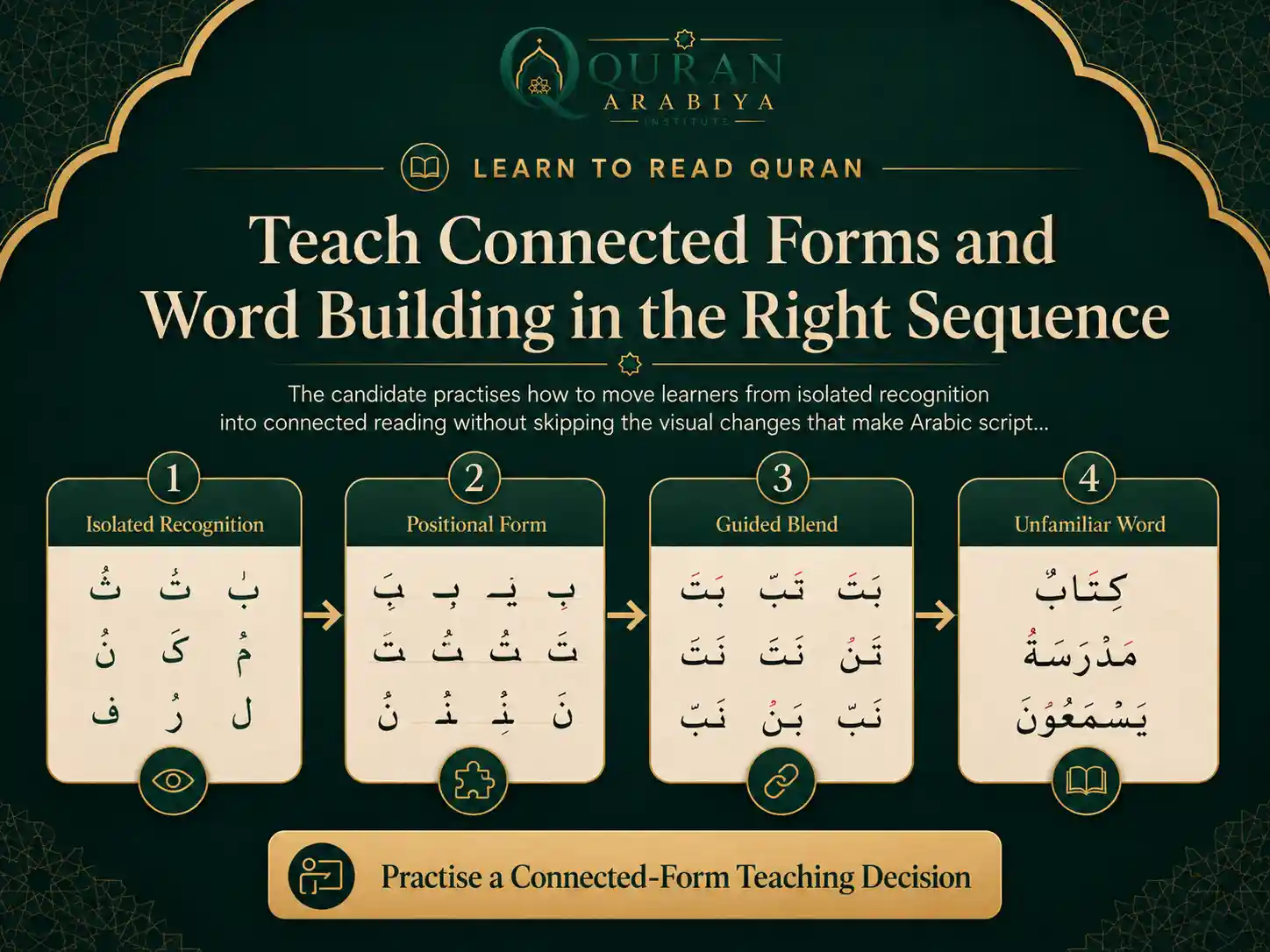
The candidate practises how to move learners from isolated recognition into connected reading without skipping the visual changes that make Arabic script difficult for beginners.
Teaching practice should include how much modeling to give, how to fade support, and how to use unfamiliar examples to prove that the learner is truly decoding.
Start by adapting Noor Al Bayan for children without weakening the reading objective. In live one-to-one practice, the teacher uses shorter turns, visible scaffolding and carefully limited new variables while preserving the same phonics sequence. This stage is ready when the child stays active and the method remains recognizable rather than becoming a collection of games.
See the phonics system behind the sequence.
Some Noor Al Bayan implementations include writing, spelling or dictation. At teacher level, the important skill is knowing why the tool is being used: perhaps to strengthen letter discrimination, sound-symbol mapping or recall.
Quran Arabiya should not promise these components unless they are part of the confirmed route. If they are included, the candidate should learn when they help and when they distract from the learner’s primary reading goal.
The sequence may be similar, but teaching decisions change with the learner. A child may need shorter cycles and visual variety; an adult may need concise phonics explanation; a non-Arabic speaker may require explicit sound contrasts and more listening.
A certified Noor Al Bayan instructor—where that authorization is genuinely granted—should be able to adapt presentation without changing the underlying reading target.
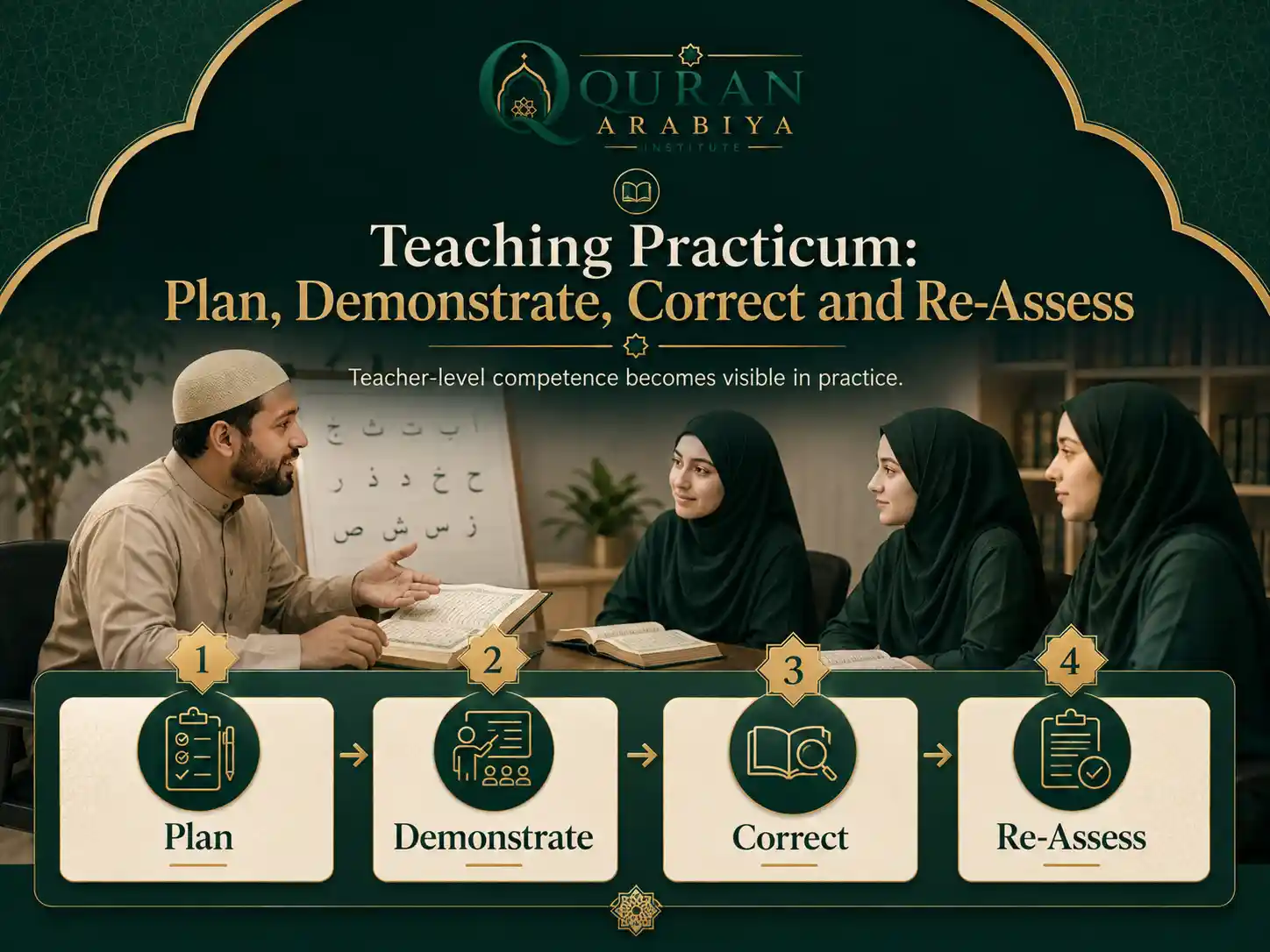
Teacher-level competence becomes visible in practice. The candidate can prepare a short lesson objective, teach the pattern, respond to a realistic error and then re-test the learner with a new example.
This cycle makes the Noor Al Bayan teaching Ijazah more meaningful than simply answering theory questions about the book.
Assessment may include method knowledge, accurate reading, lesson sequencing, error diagnosis and a teaching demonstration. The exact components must be confirmed by the authorized teacher responsible for the program.
If Quran Arabiya offers a formal Noor Al Bayan teacher certification, the page should list the real standard once it is verified rather than importing another institute’s requirements.
Noor Al Bayan certification online can describe very different credentials in the market. An Ijazah is an authorization from an authorized issuer within a defined scope; a completion certificate may simply document attendance or study.
The page should state which one Quran Arabiya actually offers, who issues it, what it permits the holder to teach or transmit, and whether any sanad is included.
The free trial should check teacher-level fit: a reading sample, selected method stages, an explanation task and perhaps a small correction scenario. The candidate then receives a clear recommendation for preparation or entry.
No authorization should be promised before the issuing teacher confirms the candidate’s route and standard.
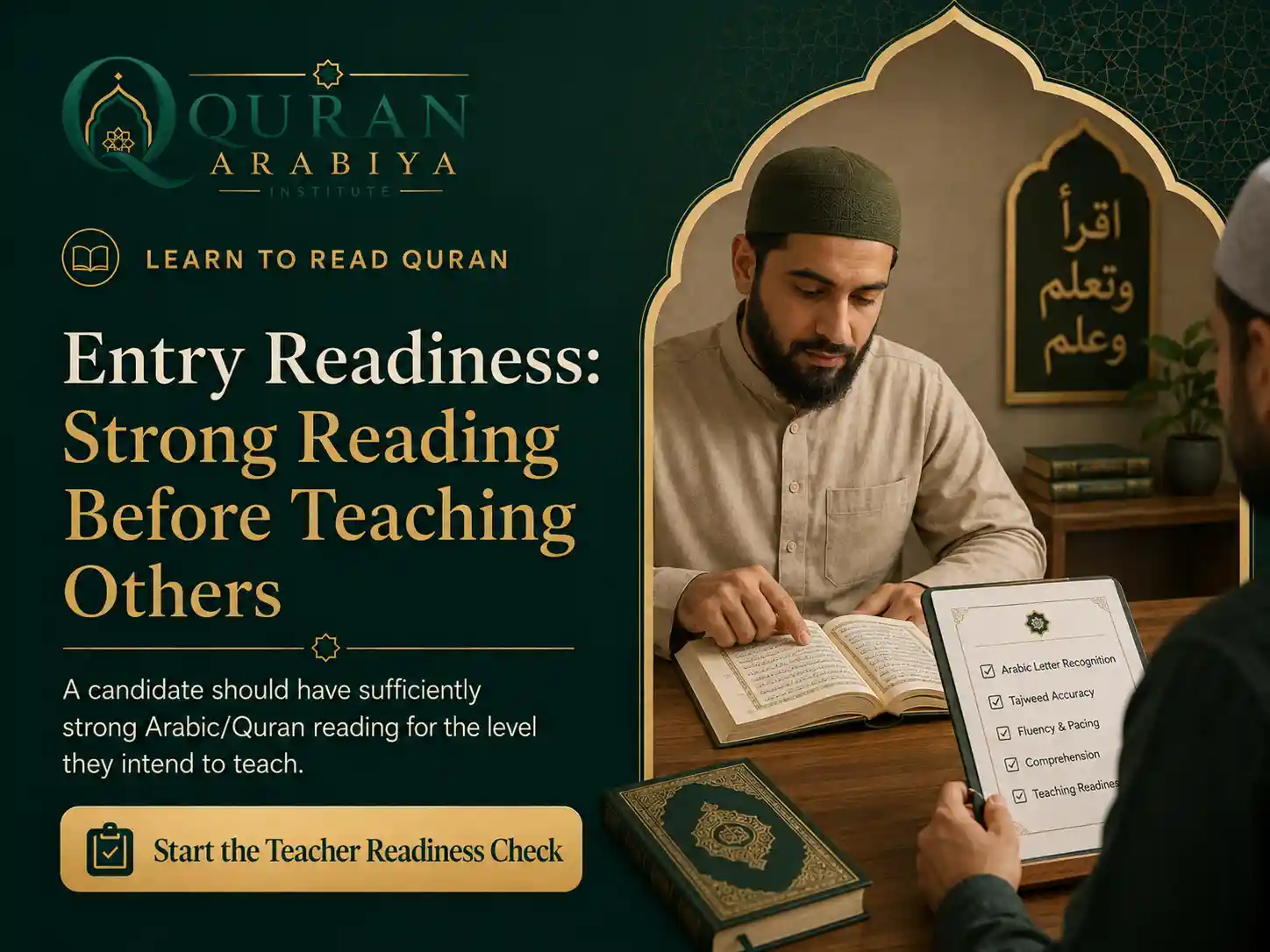
If you want to teach Noor Al Bayan with more than page familiarity, start with a teacher-readiness consultation. Confirm your reading, method knowledge, pedagogy gaps and the exact authorization route with the qualified issuer.
It should cover the method and, depending on the verified program, may include teaching competence. Quran Arabiya must state the real issuing authority, assessment and scope.
It is an authorization related to teaching/transmitting the method, issued only by someone qualified to grant it and only after the candidate meets that issuer’s requirements.
No. Course attendance and formal authorization are not the same. Final certification or Ijazah must depend on verified assessment.
No. Strengthen personal reading first. Teacher-level work assumes a stable foundation.
It can, and a practicum would add real value, but Quran Arabiya should publish it only if the assigned program actually includes supervised demonstration or assessment.
Both are teacher-level method pages, but Noor Al Bayan training should emphasize its own phonics/literacy architecture and teaching decisions rather than duplicating the Noorani sequence.
That cannot be assumed. The exact nature of the authorization, any sanad, and the issuing teacher must be confirmed before publication or enrollment.
No. Completion, attendance, certification and formal authorization should be kept separate. The qualified teacher must confirm the exact assessment, issuer, scope and authorization requirements for the selected route.
A candidate should already read strongly enough to focus on phonics architecture, learner diagnosis and teaching decisions rather than basic personal reading repair. The readiness consultation can identify any foundation work first.
You should be able to distinguish whether hesitation comes from visual shape recognition, sound production, vowel response, joining or blending. That diagnosis should guide the exercise instead of repeating an entire page automatically.
Yes, when the confirmed Noor Al Bayan route uses them as literacy or diagnostic tools. The candidate should understand when they support reading and when they would distract from the learner’s actual objective.
The method target may stay the same while explanation, pace, repetition and examples change. A strong candidate should show that adaptation without turning the lesson into a different curriculum for each age group.
Yes. The assigned qualified teacher should verify the issuer, scope, prerequisites, assessment standard, sanad if any and certificate terms. The academy should not promise a universal authorization format before that confirmation.
Yes. State the teacher-level goal during the consultation so the academy can consider appropriate qualifications, availability, schedule and the exact route before enrollment is finalized.
If you are considering Noor Al Bayan Ijazah online, start with a live assessment rather than choosing a level by guesswork. The teacher can confirm the first useful skill, the best-fit route and the next step without making promises that depend on individual progress.