A Baghdadi Qaida course online is useful for learners who benefit from seeing every step of a word being built instead of being asked to jump quickly from letter recognition to whole-word reading. The traditional Baghdadi approach is often taught through deliberate oral spelling and repetition: identify the letter, read the sign attached to it, combine the sound, then build the word. Quran Arabiya Institute can use the free trial to see whether that analytical style fits the learner’s current reading problem.
In an Al Qaida Al Baghdadiyyah course, the learner is not expected to “just know” how a complex form becomes a sound. The teacher slows the construction down so each letter and sign has a clear role.
This can be especially helpful for a beginner who gets lost when several symbols appear at once or who has previously memorized examples without understanding how they were decoded.
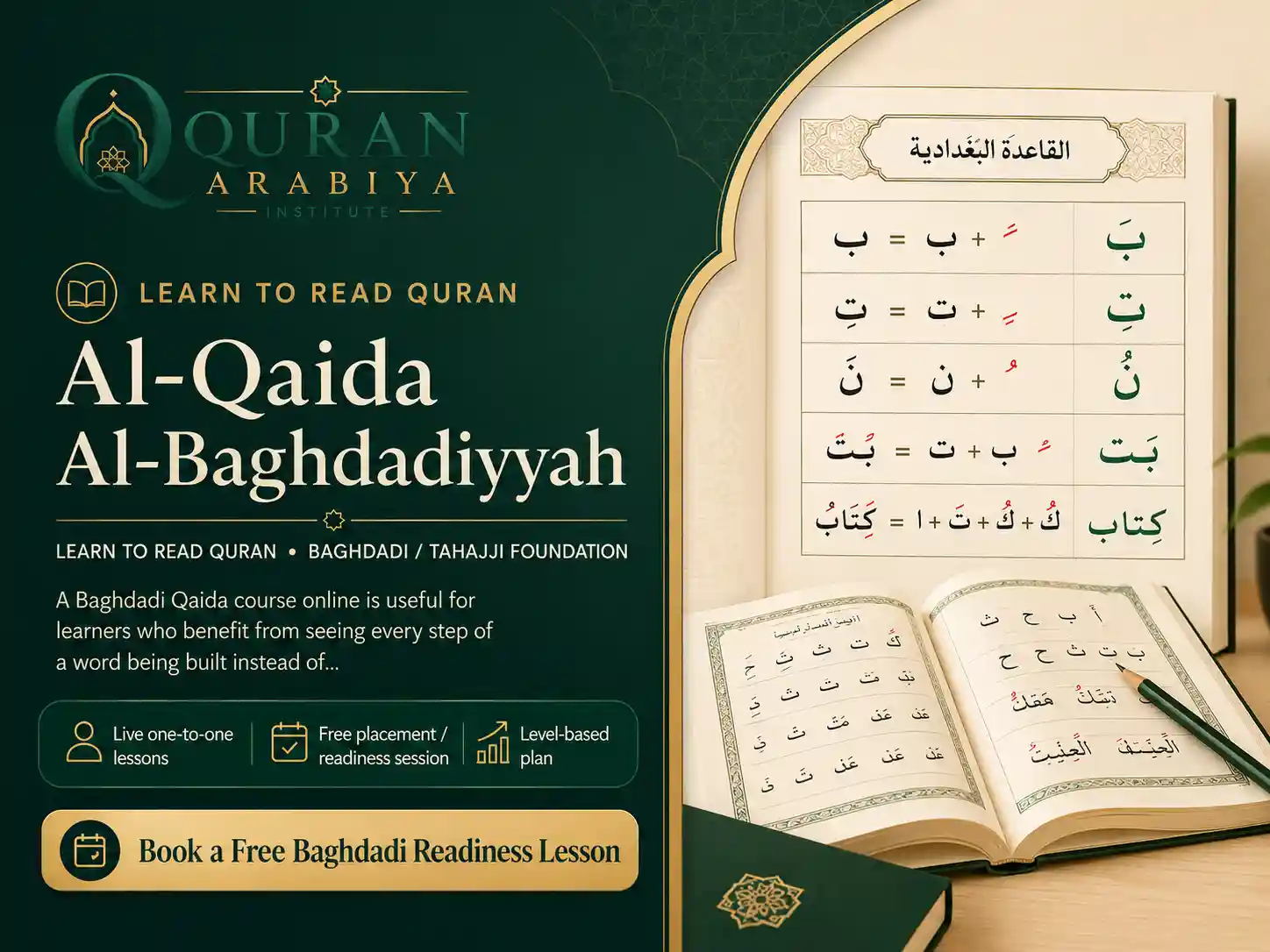
Start by identifying the exact letter before a complex form is treated as a whole word. In live one-to-one practice, the teacher slows the construction enough for each letter to have a clear role instead of allowing a visual guess. This stage is ready when the learner can identify the unit even when the surrounding combination changes.
Tahajji can be explained simply as analytical oral spelling. The learner identifies the letter and its reading condition, then combines the pieces into the sound or word instead of guessing the whole form.
The exact terminology and classroom routine can vary by teacher and edition, but the educational purpose stays the same: make the decoding process conscious before asking it to become automatic.
Early Baghdadi Qaida classes can use small combinations where only one variable changes. As the learner stabilizes, letters, vowels and joining patterns are combined into increasingly realistic word structures.
The teacher should keep older patterns active while adding new ones so progress remains cumulative rather than a sequence of disconnected chapters.

Repetition builds familiarity, but familiarity is not the same as reading. A student may reproduce a line perfectly because the sound sequence is memorized. That is why the teacher needs to rearrange examples or introduce an unseen combination.
If the learner can reconstruct the new example using the same spelling logic, the Baghdadi method Quran reading skill is transferring.
Small units are an ideal place to repair pronunciation. The teacher can separate a difficult letter, compare it with a close sound, then reconnect it to the vowel or word without waiting until the student is reading a long verse.
The goal is practical sound accuracy. Detailed advanced Tajweed remains outside this foundation page.
Start by using detailed analytical steps when a learner becomes lost inside a whole word. In live one-to-one practice, the teacher makes each letter and reading mark visible in the reasoning before asking for direct reading. This stage is ready when the learner understands how the sound was built instead of memorizing a teacher-supplied answer.
Make the construction of the sound explicit before it becomes automatic.
The method can suit learners who like explicit steps, patient repetition and teacher-led analysis. It may also help a learner who becomes overwhelmed when a method moves too quickly from recognition to whole-word reading.
Learner fit matters more than age. Some children enjoy the predictable routine, while some adults appreciate understanding exactly how the sound was constructed.
A learner who already blends confidently may not need to restart with detailed analytical spelling. Someone who needs broader phonics and literacy may fit Noor Al Bayan; someone focused mainly on Quran-oriented sound-to-script progression may fit Noorani.
The point of the category is choice with boundaries: each method has a distinct teaching route, and the placement lesson should select the shortest sensible route to the learner’s goal.

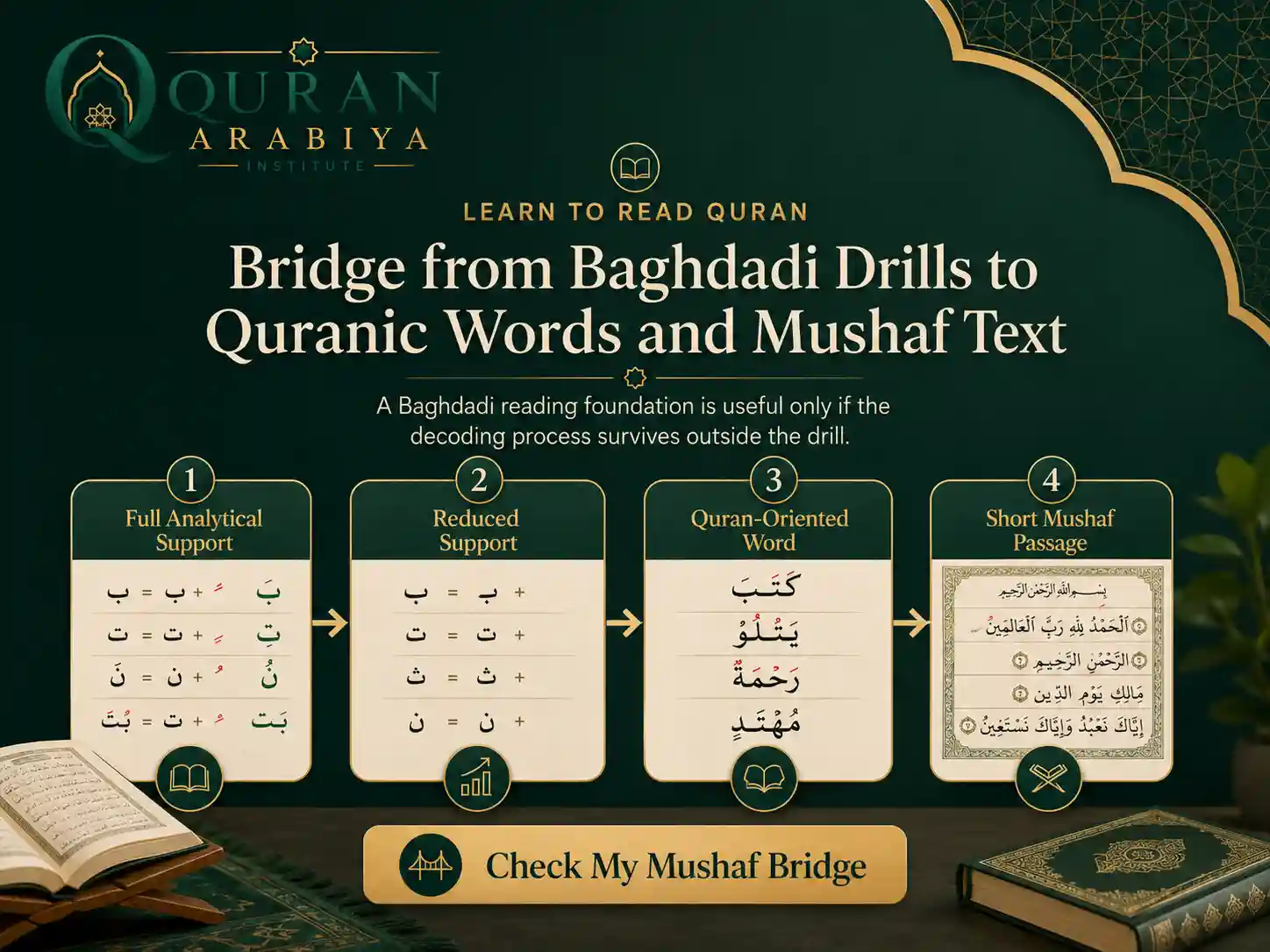
Qaida Baghdadiyah lessons are only useful if the decoding process eventually survives outside the drill. The course therefore needs a staged transfer into Quranic words and short passages once the core patterns are ready.
The teacher reduces verbal spelling support gradually. The learner begins doing more of the decoding internally until the Mushaf is read as text, not as a sequence that always requires the full teaching chant.
Progress can be checked through accuracy on previously taught patterns, unfamiliar examples, mixed-order reading and a short Quranic sample. The teacher also observes how much prompting is needed.
Because the lesson is one-to-one, the amount of analytical spelling can be increased when the learner is confused and reduced as independence improves.
If you want to learn Baghdadi Qaida online, the trial can compare what happens when the learner receives a whole-word prompt versus a step-by-step spelling prompt. The teacher can see which style produces clearer understanding and better recall.
That makes the method recommendation evidence-based instead of choosing a Qaida name at random.
If whole-word reading still feels like guessing, try a method that makes the construction visible. Book a free Baghdadi readiness lesson and see whether analytical spelling gives you the missing bridge.
The course builds beginner Arabic/Quran decoding through letters, signs, joining, analytical spelling, word construction and gradual transfer into Quranic reading.
Yes. They can start from the script foundation, especially for learners who benefit from explicit step-by-step spelling.
Its traditional teaching is strongly associated with analytical oral spelling and deliberate construction of the reading pattern before the learner reads the whole form.
No. Repetition should support decoding. Good instruction also tests new and rearranged examples so memorized chanting is not mistaken for reading.
Yes. The method can be taught privately and the teacher can reduce any child-oriented presentation while keeping the analytical sequence.
It can support correct pronunciation and early reading rules, but advanced Tajweed should remain a separate specialist course.
When you can decode taught patterns in unfamiliar examples and read selected Quranic text with decreasing verbal spelling support.
It can be understood as analytical oral spelling: identify the letter, notice the reading mark, construct the sound and then read the whole form. The purpose is to make the decoding process visible before it becomes automatic.
No. Detailed oral spelling is a scaffold, not the final reading goal. As recognition and construction become reliable, the teacher should gradually reduce the verbal support so the learner can decode internally and read more directly.
The teacher introduces unseen or rearranged examples that use the same decoding logic. If the learner can reconstruct a new form without hearing it first, the repetition is supporting reading rather than only memory.
No. Learner fit matters more than age. Adults who prefer explicit steps and patient analysis can also benefit, while presentation and examples can remain age-appropriate in private lessons.
You may not need a full Baghdadi sequence. The assessment can check whether a shorter repair, another method or direct Mushaf practice is more efficient than returning to detailed analytical spelling.
Yes. Mention the method during teacher matching so experience, current learner level, schedule and teacher preference can be considered together, subject to availability.
The next step is guided transfer into Quranic words and Mushaf text, followed by fluency work when decoding is stable but pacing remains difficult. The teacher should recommend the next route from observed performance.
If you are considering Baghdadi Qaida course online, start with a live assessment rather than choosing a level by guesswork. The teacher can confirm the first useful skill, the best-fit route and the next step without making promises that depend on individual progress.