Islamic history for beginners can feel impossible when fourteen centuries are presented as a wall of names and dynasties. This course begins differently: with a simple chronological map, a small set of terms and the major transitions that allow a newcomer to understand where the Prophetic era, Rashidun, Umayyad, Abbasid and later Muslim worlds fit.
The purpose is orientation, not compression of the full history course. A student should finish with a mental framework strong enough to place later study correctly and choose which era deserves a deeper specialist course.
Islamic history for beginners becomes confusing when every lesson introduces a new ruler, city and battle without showing where it belongs. The first task is a simple map: the Prophetic period, the Rightly Guided Caliphs, the Umayyad era, the Abbasid era and the way later Muslim regions and states develop from that foundation.
This is an introduction to Islamic history, not a race through every century. The learner should be able to see the order of the main early eras before they are asked to remember individual dates.
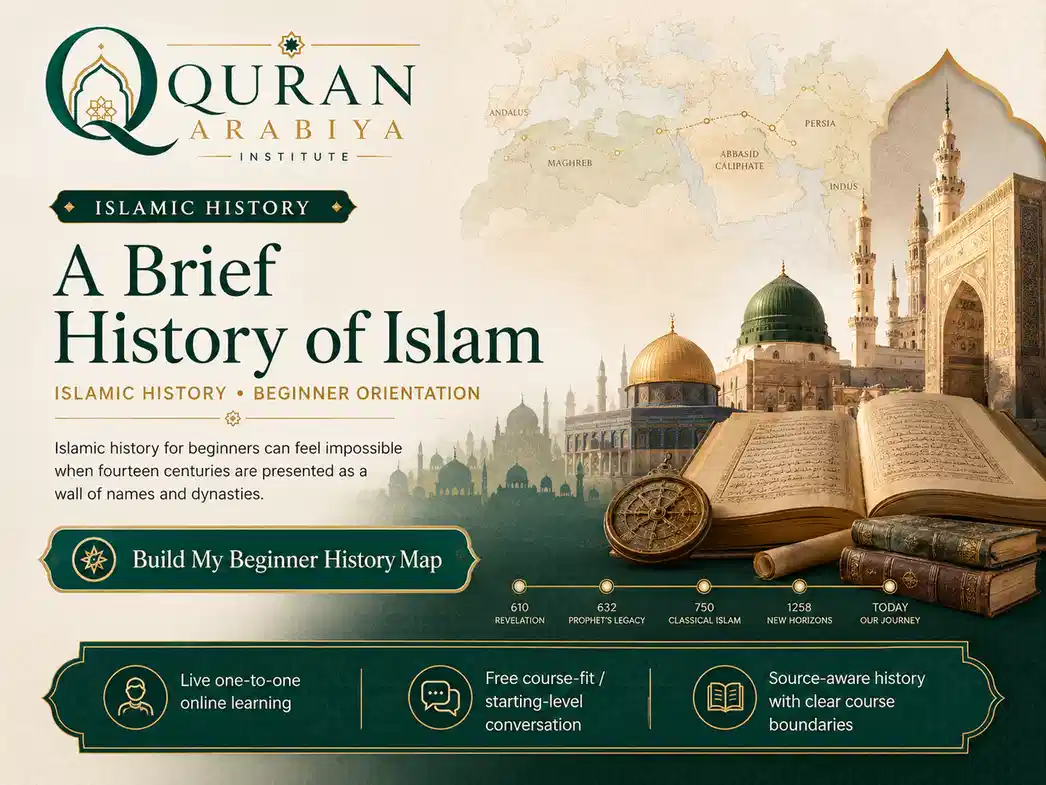
Islamic history for beginners becomes confusing when every lesson introduces a new ruler, city and battle without showing where it belongs. The first task is a simple map: the Prophetic period. The aim is to connect the detail to its wider chronology and historical context.
Words such as Seerah, Sahabah, caliph, caliphate, dynasty, fitna, Umayyad, Abbasid and civilization appear constantly in books and lectures. A beginner course should define them in plain language and reuse them until the student can follow a normal historical discussion.
That vocabulary makes Islamic history basics easier because the learner stops spending mental energy decoding the label and can focus on what actually changed.
A useful study habit is to keep a short cause → event → consequence note. That makes chronology easier to remember without reducing history to dates.
The early Muslim story changes scale quickly. The community formed around the Prophet ﷺ in Makkah and Madinah is followed by the Rashidun period, then large dynastic states. Each transition brings new questions about leadership, administration, geography, language and diverse populations.
A beginner Islamic history course should explain these changes at a high level without turning into a specialist course on the Rashidun, Umayyads or Abbasids.
The community formed around the Prophet ﷺ in Makkah and Madinah is followed by the Rashidun period, then large dynastic states. Each transition brings new questions about leadership, administration, geography, language and diverse populations. The aim is to connect the detail to its wider chronology and historical context.
A simple review method asks the same questions repeatedly: Who held political authority? Where was the main center? What major expansion or challenge occurred? What changed in administration, scholarship or society? What should a beginner remember?
That repeated framework helps Muslim history for beginners compare periods without memorizing disconnected lists.
Caliphs and dynasties organize the timeline, but Muslim history also includes scholars, cities, trade, language, education, law, art, architecture, family life and cross-cultural exchange. Even an introductory course should show that civilization is not the same thing as a royal succession list.
This creates a natural bridge to the Islamic Golden Age course, where intellectual and cultural history becomes the main focus.
The section should finish with one short recap in the learner’s own words so the new detail stays connected to the wider historical framework.
A simple review method asks the same questions repeatedly: Who held political authority?
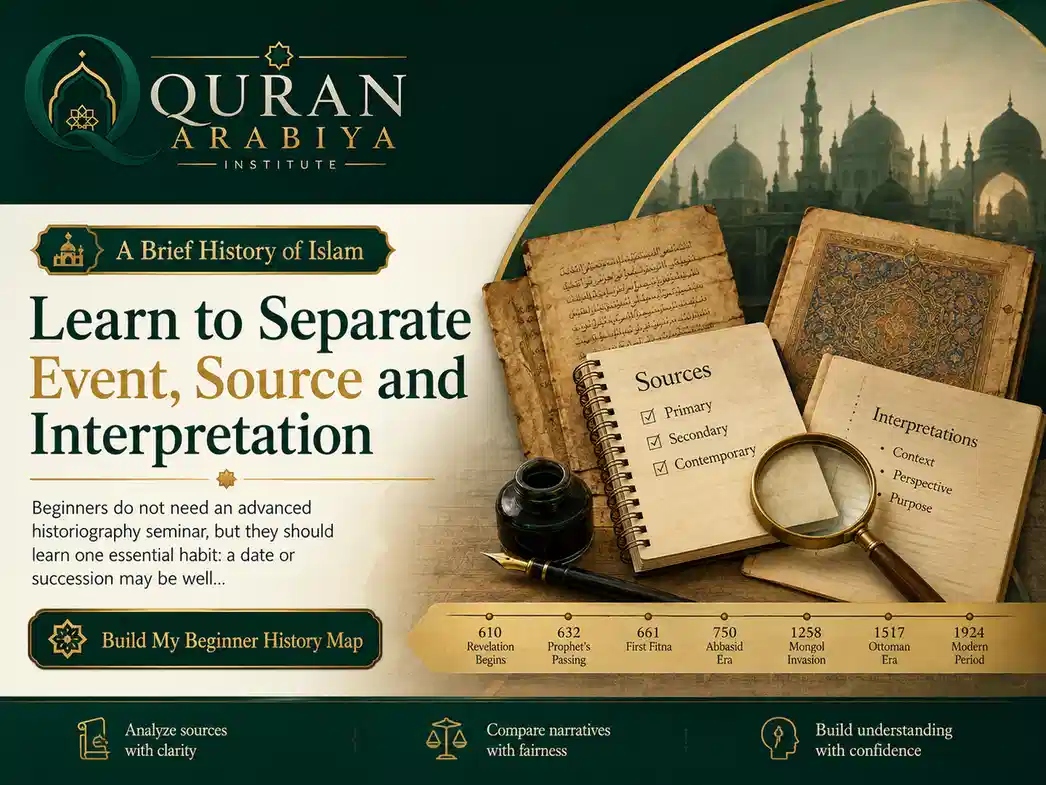
Beginners do not need an advanced historiography seminar, but they should learn one essential habit: a date or succession may be well established while a claim about someone's secret motive may be debated. Historical narratives can reflect the source, school and period in which they were written.
This small habit makes introductory Islamic civilization course discussion more responsible, especially when the class reaches civil wars or contested political events.
The purpose of a brief course is orientation. By the end, a learner should know whether they are most interested in Seerah, the Sahabah, the Rashidun, Umayyad or Abbasid history, the Golden Age or a comprehensive long-form history program.
That next-step map prevents the beginner page from expanding until it competes with every specialist course.
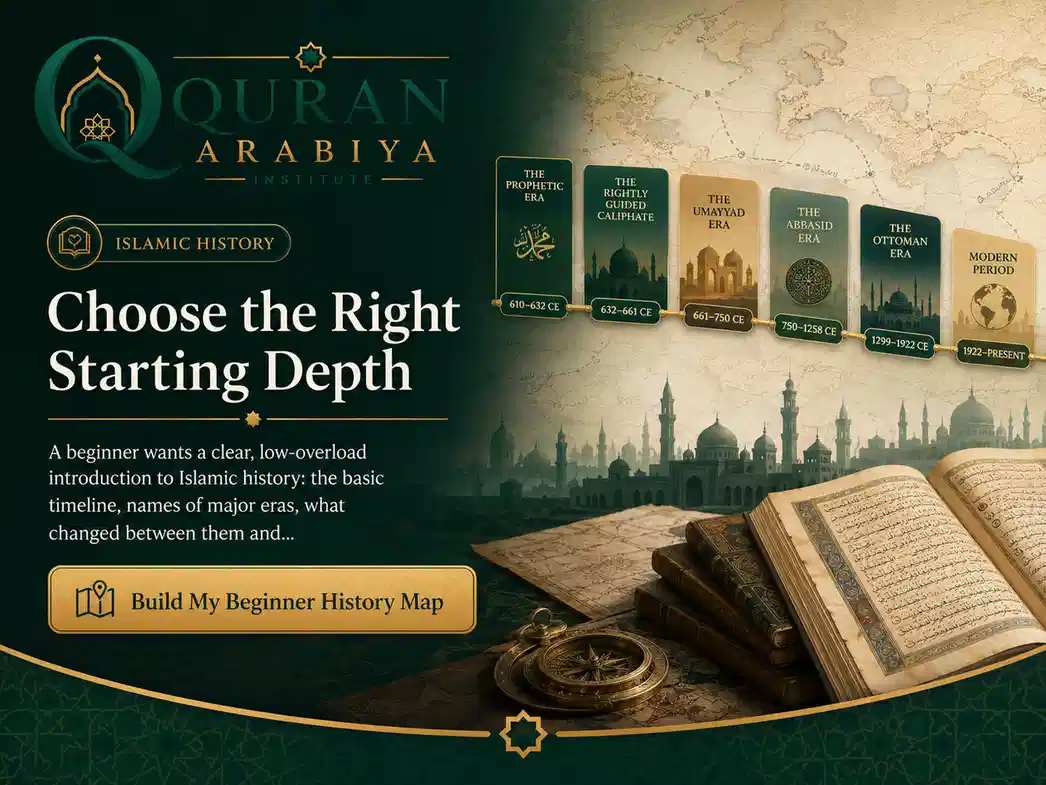
Place the main early eras of Islamic history in a clear chronological order.
Define essential terms such as caliphate, dynasty, Sahabah, Umayyad and Abbasid.
Explain at a high level what changed between the Prophetic, Rashidun, Umayyad and Abbasid periods.
Recognize that political history is only one part of Muslim civilization.
Choose the most suitable specialist or full-history course for the next stage.
Book a free trial if Islamic history currently feels like a collection of unfamiliar names and empires. The teacher can check what you already know, build a simple starting timeline and confirm whether the brief overview or the full course is the better fit.
Yes. The page is intentionally designed as an orientation route. The teacher can explain terminology and chronology without assuming prior historical study.
The beginner page gives the big picture with lower detail. The full course owns deeper chronology, cause-and-effect, wider periods and more sustained historical analysis.
Dates can anchor chronology, but the main goal is to understand sequence, eras and turning points. A good beginner course does not measure learning by date memorization alone.
It can include a concise Prophetic foundation, while detailed Seerah remains a separate specialist course.
That depends on which part of the timeline interests you. The trial or final review can route you to Seerah, Rashidun, Umayyad, Abbasid, Golden Age or the full history program.
Adults, teens, new Muslims and returning learners who feel lost when people mention Rashidun, Umayyads, Abbasids, Baghdad or the Golden Age and want an intelligible starting framework.
The starting point does not have to be lesson one. In a live one-to-one setting, the teacher can identify what is already clear, locate the first real gap and adjust the depth without changing the course’s central historical focus.
Chronology is used as an organizing spine rather than a memorization target. Timelines, cause-and-consequence notes and short recaps help the learner explain how one event prepares the next and why a turning point matters.
The course should distinguish well-established chronology from interpretive or disputed details and avoid turning a debated reading into a marketing promise. Where the source document flags caution, the teacher can explain that difference rather than flatten it into certainty.
Arabic is not assumed as a universal prerequisite for this category. If a selected text, edition or reading route requires a particular language level, that should be confirmed during the course-fit conversation before regular study begins.
The academic focus stays intact while explanation, pacing and depth can change. One-to-one teaching allows the teacher to spend more time on names, relationships, maps, source questions or analytical discussion according to the learner’s age and prior study.
The conversation can clarify age, prior knowledge, preferred depth, learning goal and suitable scheduling before the route is chosen. It is a starting-level discussion, not a promise of a fixed syllabus length or certificate.
Progress should become visible in explanation, sequence and context rather than page count alone. A useful checkpoint is whether the learner can place the main early eras of islamic history in a clear chronological order. define essential terms such as caliphate, dynasty, sahabah, umayyad and abbasid.
The next step depends on the intent this page deliberately does not absorb. Do not promise the same depth as History of Islam – Full Course. Avoid long lists of rulers, battles and dates. Specialist detail must be routed outward. The teacher can use the final lessons to identify the most logical sibling course instead of stretching this page beyond its purpose.
If Islamic history currently feels like a collection of unfamiliar names and dynasties, this course gives you a simple chronological map first. By the end, you should be able to place the Prophetic, Rashidun, Umayyad and Abbasid periods in order and choose the era you want to study in greater depth next.