An Arabic rhetoric course online begins where ordinary grammar is no longer enough. Two sentences can both be grammatically correct and still differ in emphasis, imagery, implication, order and suitability for a particular context. Balagha gives the learner tools to explain those differences.
This broad course studies the three major lenses commonly associated with the discipline—Ma'ani, Bayan and Badi'—without being tied to one textbook. The emphasis is analytical: understand the literal structure first, then explain why the expression works the way it does.
An Arabic eloquence course should begin by separating two questions. Grammar asks whether the structure is sound and what relationships hold the sentence together. Rhetoric asks why a particular structure, order, level of explicitness or image is appropriate in context.
That distinction prevents students from treating Balagha as advanced grammar with more terminology. The subject is about expressive choice after the basic language has been understood.
An Arabic eloquence course should begin by separating two questions. Grammar asks whether the structure is sound and what relationships hold the sentence together. The aim is to make the analysis repeatable in a fresh Arabic example rather than leave the rule as terminology remembered in isolation.
A Bayan Maani Badi course is easier to navigate when the student knows what kind of question each lens asks. Ma'ani focuses on expression in relation to context and communicative purpose. Bayan explores ways meaning can be represented and clarified through relationships such as simile and metaphorical expression. Badi' examines additional semantic and verbal features that contribute to style.
The teacher can keep returning to this map whenever a new term is introduced so that terminology accumulates inside a coherent system.
A useful check is whether the learner can explain the relationship, test it on a fresh example and correct the reasoning when the first analysis fails. That is stronger evidence than recalling the rule name alone.
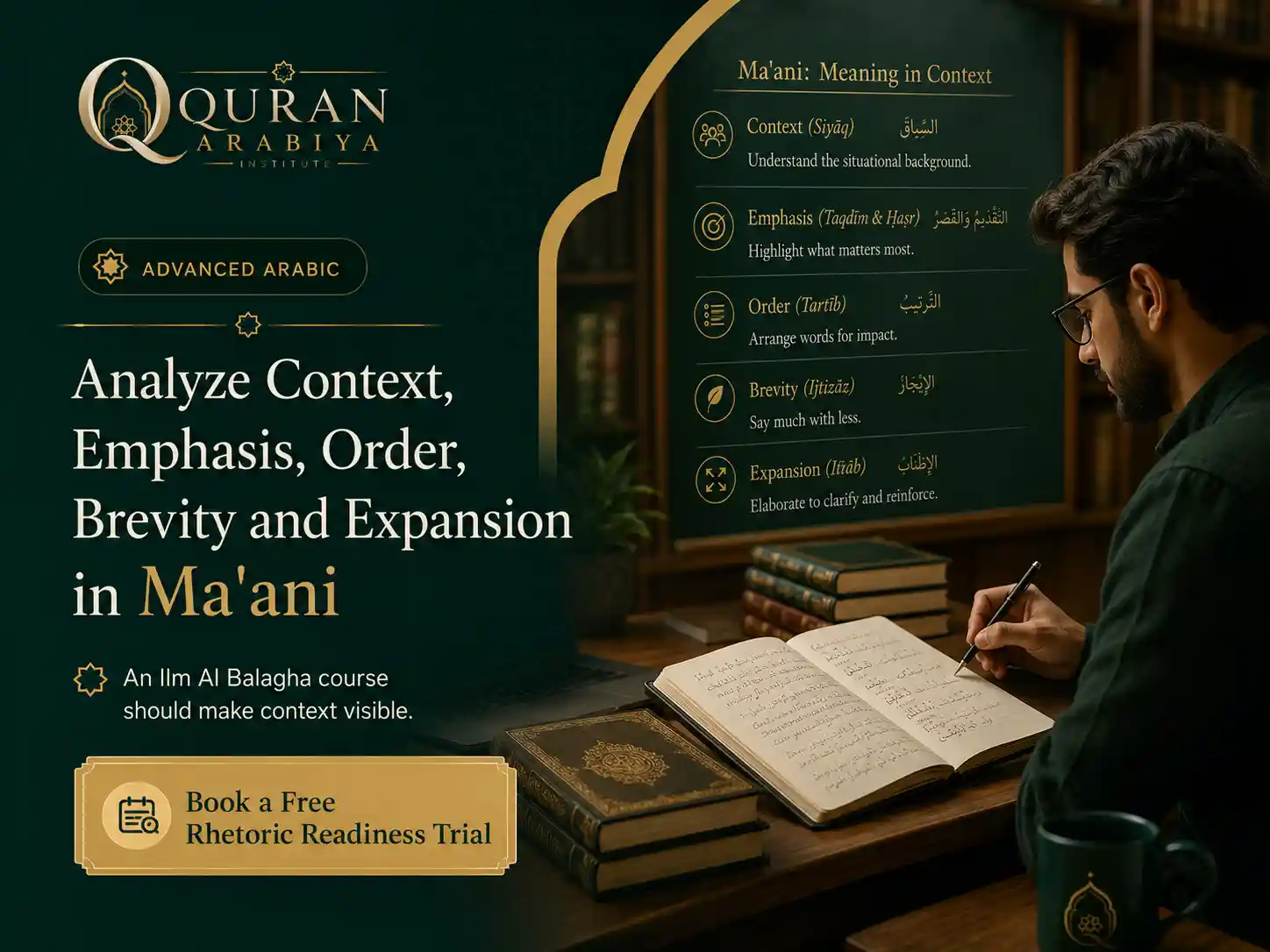
An Ilm Al Balagha course should make context visible. Why is information stated explicitly here but omitted elsewhere? Why is an element brought forward? What does emphasis add? When is brevity powerful, and when does expansion serve the listener better?
Students compare examples where the grammar remains acceptable but the communicative effect changes. This trains judgment rather than memorization.
A Bayan Maani Badi course is easier to navigate when the student knows what kind of question each lens asks. Ma'ani focuses on expression in relation to context and communicative purpose. The aim is to make the analysis repeatable in a fresh Arabic example rather than leave the rule as terminology remembered in isolation.
Arabic Balagha classes online should go beyond finding a simile word. The learner identifies the two sides of a comparison, the shared relationship and what happens when parts of the comparison are suppressed or transformed. Kinayah requires attention to what is directly stated and what is implied through the expression.
The goal is to explain the image and its effect in precise Arabic or clear analytical language, not simply attach a label.
Badi' is often remembered as a list of attractive devices. A stronger approach asks what a semantic or sound-based pattern contributes in the actual passage. Does contrast sharpen a point? Does parallelism create balance? Does wordplay depend on a genuine relationship or merely resemble one superficially?
This prevents the course from rewarding label-hunting without comprehension.
A useful check is whether the learner can explain the relationship, test it on a fresh example and correct the reasoning when the first analysis fails. That is stronger evidence than recalling the rule name alone.
Arabic Balagha classes online should go beyond finding a simile word. The learner identifies the two sides of a comparison, the shared relationship and what happens when parts of the. The aim is to make the analysis repeatable in a fresh Arabic example rather than leave the rule as terminology remembered in isolation.

Classical Arabic rhetoric classes become much more useful when learners repeatedly compare alternatives. The teacher can change order, add or remove emphasis, replace a direct statement with an image, or expand a concise phrase. The learner then explains what changed and which context might favor each option.
This comparison habit creates a transferable method for reading unfamiliar texts.
The course can use carefully selected examples from Quranic Arabic, Hadith, poetry and classical or high-register prose. Each genre brings different opportunities for rhetorical observation. However, a linguistic observation about a sacred text does not automatically become a complete interpretation.
When context, authenticity, legal meaning or Tafsir is required, the teacher should distinguish that additional discipline from the rhetorical point being studied.

Rhetoric can also improve production when used carefully. Advanced learners may rewrite a sentence for stronger emphasis, choose between direct and figurative expression, or adapt wording to a different audience while preserving grammatical accuracy.
The purpose is not ornamental writing for its own sake. It is control: knowing why you chose one form over another and being able to explain the effect.
The free trial can test whether the learner can comfortably understand a short formal passage before discussing its rhetorical effect. The teacher may ask for a literal paraphrase, identify one grammatical relationship and then compare two formulations.
If literal comprehension is still too slow, the learning recommendation may begin with grammar or classical reading. If the foundation is strong, the teacher can decide whether the broad rhetoric course or the Al-Balagha Al-Wadiha textbook route better matches the student's goal.
What Progress Should Look Like
Use Ma'ani, Bayan and Badi' as analytical categories rather than a memorized list.
Explain how context, emphasis, order or imagery changes the effect of an expression.
Analyze selected figurative and stylistic features with clearer evidence.
Compare alternative formulations and justify a rhetorical preference.
Apply rhetorical awareness to advanced reading and controlled formal-Arabic production.
Start With a Free Trial & Placement Lesson
Book a free trial to show the teacher what you can already do, where the current bottleneck is and what you want the course to unlock. The trial can be used as a real placement and learning sample: you participate in a short task, receive correction, and leave with a clearer recommendation for the next step rather than being forced into a fixed starting point.
Rhetoric can also improve production when used carefully. Advanced learners may rewrite a sentence for stronger emphasis, choose between direct and figurative expression, or adapt wording to. The aim is to make the analysis repeatable in a fresh Arabic example rather than leave the rule as terminology remembered in isolation.
Book a free trial to show the teacher what you can already do, where the current bottleneck is and what you want the course to unlock. The trial can be used as a real placement and learning sample: you participate in a short task, receive correction, and leave with a clearer recommendation for the next step rather than being forced into a fixed starting point.
Frequently Asked Questions
This is the broad discipline-based route through Ma’ani, Bayan and Badi’. Al-Balagha Al-Wadiha is a dedicated textbook course with its own example-and-exercise sequence.
Yes, a solid grammar and reading foundation is highly advisable. Rhetorical analysis assumes the literal sentence is already reasonably clear.
Quranic examples may be studied linguistically and rhetorically, but the course is not a substitute for Tafsir or the wider Islamic sciences.
It can help advanced learners make more deliberate choices about emphasis, imagery, order and audience, provided their grammar and vocabulary are already strong.
No. It can support students of Arabic language, literature and classical texts as well as Islamic studies, depending on the examples and goals selected with the teacher.
Adults and advanced teens with solid formal Arabic comprehension and grammar who want a broad rhetoric framework for Quranic, literary and classical-text study or more precise formal expression.
That does not automatically mean you need to restart from the beginning. The free trial can test reading comfort, sentence awareness and the prerequisite skill most relevant to this course, then route you to a foundation course only when the gap would block useful advanced study.
Traditional terminology matters because it gives the learner a precise analytical language, but memorizing labels is not the final test. The stronger outcome is being able to recognize the construction, explain why the term applies and use the same reasoning on a new example.
Your teacher may use Quranic or classical examples when they serve the rhetoric skill you are studying, without turning the lesson into Tafsir or a general grammar class.Quranic language analysis is not presented as Tafsir, and a named-text course does not assume an unverified commentary, edition or fixed reading list.
It allows the teacher to see the exact step where analysis breaks down: vocabulary, form recognition, grammatical relation, parsing, rhetorical reasoning or reading stamina. The lesson can then spend time on that bottleneck and test it again in a fresh example before moving on.
No. Choose this course if you want a broad study of Arabic rhetoric and Balagha. If you specifically want to work through Al-Balagha Al-Wadiha as a textbook, use the dedicated book-based course instead. Do not turn this course into Tafsir, literary history or a general grammar program.
The trial can check readiness, prior study, goals and the most useful starting point for this specific subject. It does not guarantee a certificate, fixed syllabus length, particular book edition or teacher qualification that has not been independently confirmed.
Progress should show up in analysis and transfer, not page count alone. A useful checkpoint is whether the learner can use the main skill with increasing independence.
The next route should follow the skill this page intentionally does not absorb. Own the broad rhetoric discipline. The Al-Balagha Al-Wadiha page owns the named-textbook route. Do not turn this course into Tafsir, literary history or a general grammar program. The teacher can recommend the most logical sibling course once the present objective is stable.
If you are considering Arabic rhetoric course online, begin with the analytical skill that is currently breaking down: form, sentence relation, parsing, rhetoric or reading transfer. The free trial can check readiness and route the learner without inventing an edition, commentary, certificate or fixed advanced outcome that has not been verified.