An Nahw Al Wadih course online gives learners a different entry into Arabic grammar from a compressed classical matn. The strength of the route is its example-led method: observe several sentences, notice what changes, formulate the rule and then practice until the pattern becomes usable.
This page is intentionally built around that learning experience rather than around claims about a particular edition or number of book parts. The exact volume and starting lesson should be selected after placement.
Good Al Nahw Al Wadih lessons begin with language the learner can inspect. Instead of hearing a long definition first, the student compares examples, highlights the recurring structure and answers guided questions about what is happening.
Only then is the formal rule named and organized. This sequence reduces the gap between 'I know the term' and 'I can see the rule in a sentence,' which is especially useful for learners who have found abstract grammar difficult before.

Good Al Nahw Al Wadih lessons begin with language the learner can inspect. Instead of hearing a long definition first, the student compares examples, highlights the recurring structure and answers guided questions. The aim is to make the analysis repeatable in a fresh Arabic example rather than leave the rule as terminology remembered in isolation.
An Nahw Al Wadih explanation should make the student's thinking visible. What do the examples have in common? Which word changed? What caused the change? Does the proposed rule still work when the vocabulary is different?
The teacher can ask the student to state the rule in simple language before refining the technical wording. That creates understanding first and terminology second.
A useful check is whether the learner can explain the relationship, test it on a fresh example and correct the reasoning when the first analysis fails. That is stronger evidence than recalling the rule name alone.
Nahw Wadih exercises should move beyond selecting the right answer. Begin with identification, then completion, transformation, correction and finally sentence creation. Each step removes some support and asks the learner to produce more of the grammar independently.
The teacher should track the reason for mistakes. A wrong ending may come from a vocabulary misunderstanding, a missed governor or confusion between two syntactic roles. Correcting the cause is more useful than correcting the final vowel alone.
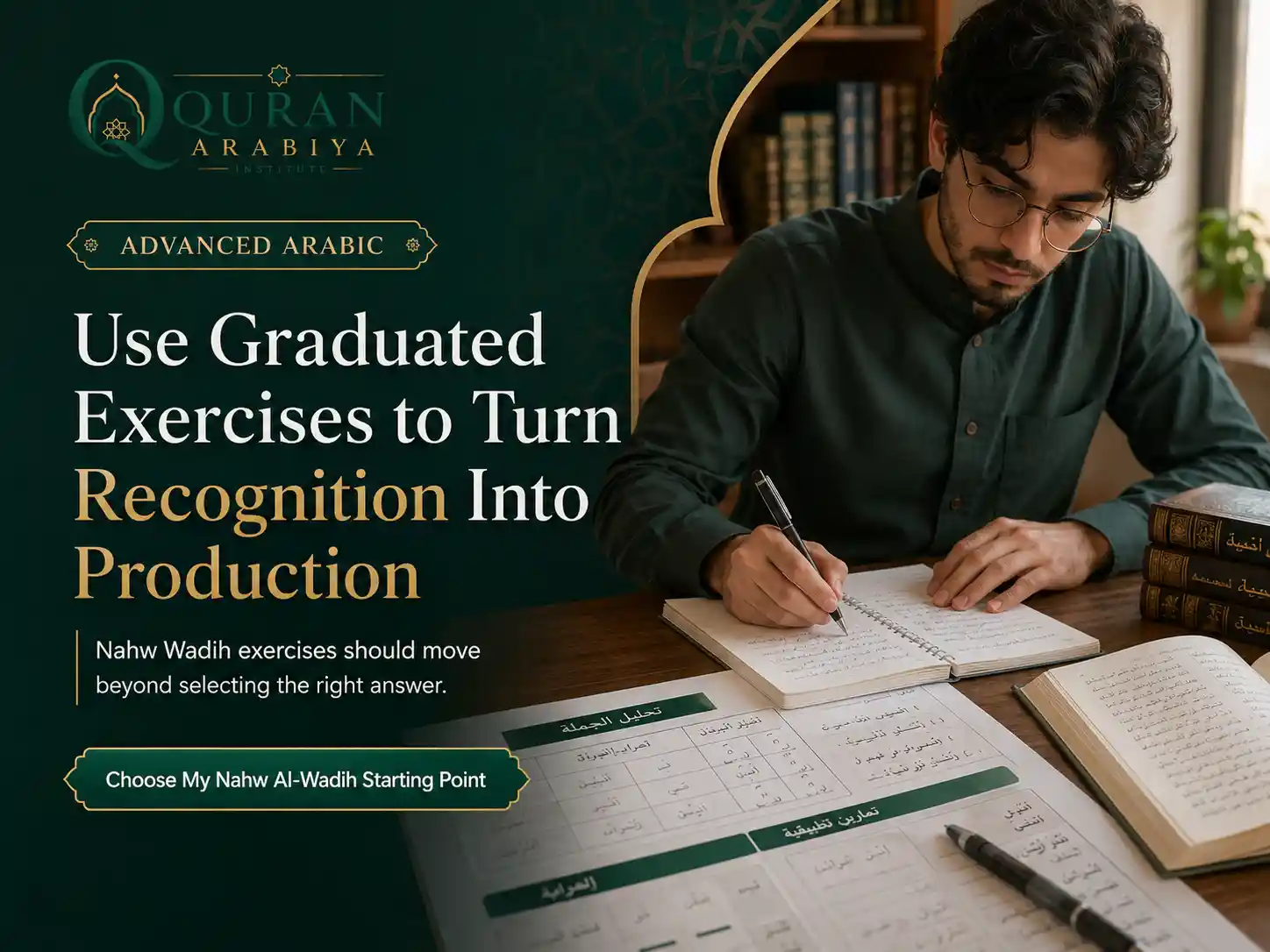
Nahw Wadih exercises should move beyond selecting the right answer. Begin with identification, then completion, transformation, correction and finally sentence creation. The aim is to make the analysis repeatable in a fresh Arabic example rather than leave the rule as terminology remembered in isolation.
A Nahw Al Wadih textbook course can become mechanical if exercises are treated as isolated blanks. To prevent that, lessons can reuse new vocabulary in short meaningful sentences and ask the learner to modify number, gender, tense, definiteness or sentence type while preserving grammatical accuracy.
This gives grammar a productive purpose and helps the student see why the same rule matters in reading, writing and formal expression.
Grammar mastery requires cumulative practice. A rule studied several chapters ago should return inside later examples rather than disappearing after its exercise page. Your teacher can mix earlier and newer grammar targets so you have to decide which rule applies without being told in advance.
This is a stronger test than completing a block of exercises where every item obviously belongs to the same chapter.
A useful check is whether the learner can explain the relationship, test it on a fresh example and correct the reasoning when the first analysis fails. That is stronger evidence than recalling the rule name alone.
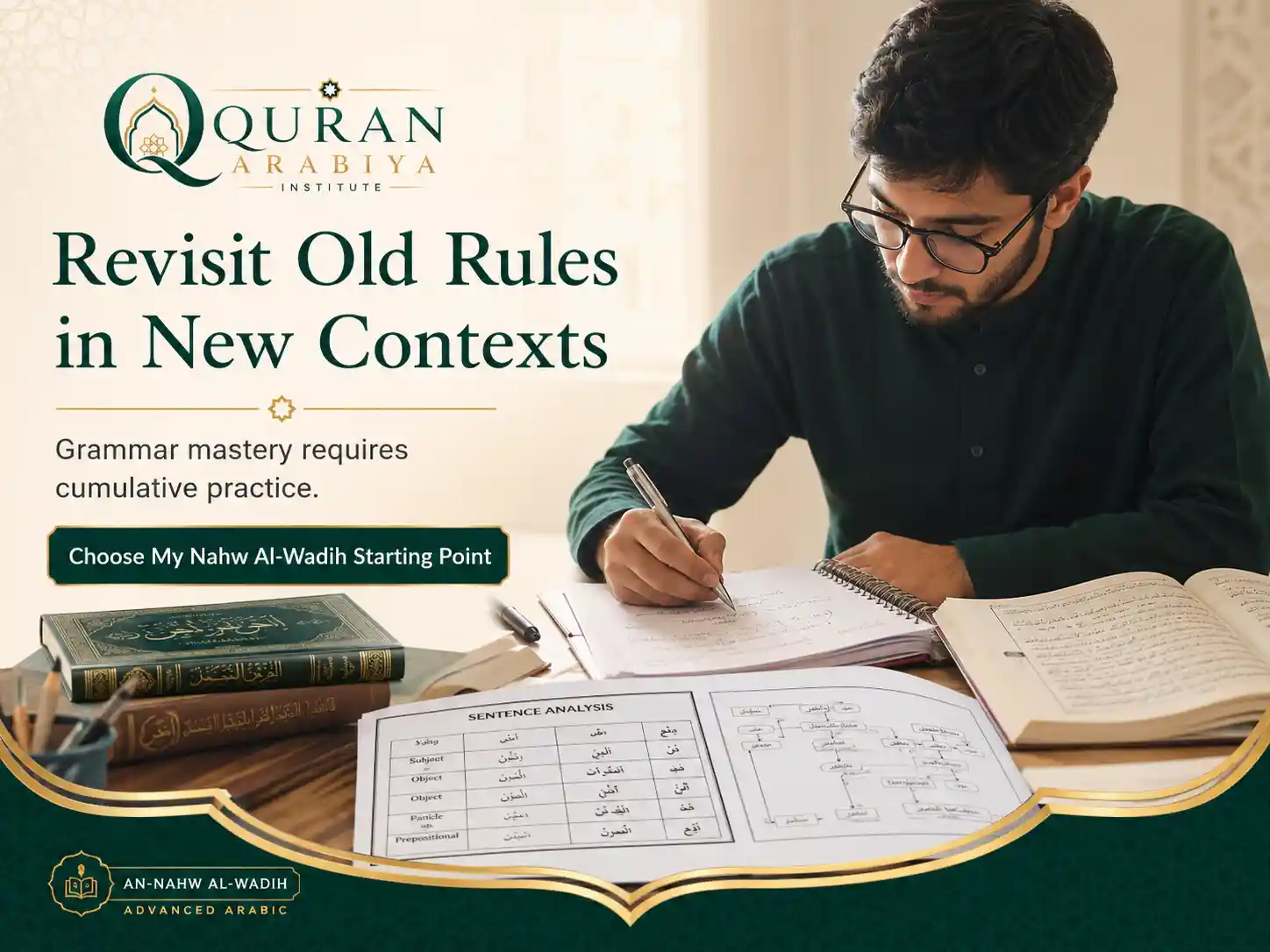
A rule studied several chapters ago should return inside later examples rather than disappearing after its exercise page. Your teacher can mix earlier and newer grammar targets so you have to decide which rule applies without being told in advance. The aim is to make the analysis repeatable in a fresh Arabic example rather than leave the rule as terminology remembered in isolation.
As the learner becomes stronger, examples can contain more than one grammatical relationship. Instead of being told exactly what to analyze, the student marks the main sentence, identifies familiar roles and explains selected endings.
This creates a natural bridge from textbook exercises to independent grammar analysis while keeping the page distinct from the dedicated Quran I'rab course.
Al Nahw Al Wadih classes online may suit a learner who needs many concrete examples, exercises and gradual discovery. Ajrumiyyah may suit someone pursuing a compact traditional matn, while Alfiyyah belongs to a much more advanced stage.
These are not competing claims about which book is 'best.' They are different pedagogical routes. Placement should match the route to the learner's foundation, age, goals and preferred way of studying.

The free trial can include a short reading and grammar task to identify whether the learner needs introductory examples or can enter at a later point. This is especially important because An-Nahw Al-Wadih is published and taught in different editions and level structures.
The academy should confirm the exact edition used before publishing detailed textbook or volume claims. The trial then places the student inside that confirmed curriculum.
What Progress Should Look Like
Infer a grammar pattern from examples before seeing the formal rule.
Explain why a rule applies, not only select the correct answer.
Complete increasingly open-ended grammar and sentence-building tasks.
Retain earlier rules through cumulative mixed practice.
Transfer textbook grammar into less guided reading and analysis.
Start With a Free Trial & Placement Lesson
Book a free trial to show the teacher what you can already do, where the current bottleneck is and what you want the course to unlock. The trial can be used as a real placement and learning sample: you participate in a short task, receive correction, and leave with a clearer recommendation for the next step rather than being forced into a fixed starting point.
Book a free trial to show the teacher what you can already do, where the current bottleneck is and what you want the course to unlock. The trial can be used as a real placement and learning sample: you participate in a short task, receive correction, and leave with a clearer recommendation for the next step rather than being forced into a fixed starting point.
Frequently Asked Questions
That should be confirmed in the academy’s teaching plan and matched to your placement. This page intentionally avoids inventing a fixed edition or part sequence.
It uses a different pedagogy. An-Nahw Al-Wadih is often approached through examples and exercises, while Ajrumiyyah is a concise classical matn. The better route depends on the learner.
Different editions and teaching arrangements may serve different learners. The academy should place the student by age and level rather than making one universal audience promise.
Yes, grammatical analysis can be introduced and increased as the learner progresses, but the page remains a textbook-based Nahw course rather than the dedicated Quran I’rab program.
The academy should confirm the exact materials and access method before publication. The content does not assume a purchase arrangement that has not been verified.
Kids/teens or adults depending on the edition/level ultimately used, especially learners who benefit from concrete examples and structured exercises more than a compressed classical matn.
That does not automatically mean you need to restart from the beginning. The free trial can test reading comfort, sentence awareness and the prerequisite skill most relevant to this course, then route you to a foundation course only when the gap would block useful advanced study.
Traditional terminology matters because it gives the learner a precise analytical language, but memorizing labels is not the final test. The stronger outcome is being able to recognize the construction, explain why the term applies and use the same reasoning on a new example.
Examples can be selected where they support the stated language objective, but the page keeps its scope clear. Quranic language analysis is not presented as Tafsir, and a named-text course does not assume an unverified commentary, edition or fixed reading list.
It allows the teacher to see the exact step where analysis breaks down: vocabulary, form recognition, grammatical relation, parsing, rhetorical reasoning or reading stamina. The lesson can then spend time on that bottleneck and test it again in a fresh example before moving on.
The trial can check readiness, prior study, goals and the most useful starting point for this specific subject. It does not guarantee a certificate, fixed syllabus length, particular book edition or teacher qualification that has not been independently confirmed.
Progress should show up in analysis and transfer, not page count alone. A useful checkpoint is whether the learner can use the main skill with increasing independence.
If you are considering An Nahw Al Wadih course online, begin with the analytical skill that is currently breaking down: form, sentence relation, parsing, rhetoric or reading transfer. The free trial can check readiness and route the learner without inventing an edition, commentary, certificate or fixed advanced outcome that has not been verified.