A Madinah Arabic course online appeals to learners who want to understand how Arabic sentences work, build a strong vocabulary base and read increasingly structured Arabic through the well-known Madinah Books. The course is strongest when grammar is not treated as a list of labels. A live teacher can help you notice the pattern, understand why it matters, build your own examples and then recognise it inside new reading.
The Madinah route is widely chosen for systematic formal Arabic, especially by learners who value grammar, vocabulary and access to classical or Islamic-text language. It gives a clear progression and repeated exposure to core sentence structures.
It is not the only path to Arabic and it should not be marketed as the same experience as a conversation-first curriculum. Knowing that fit before enrolment prevents frustration.

The Madinah route is widely chosen for systematic formal Arabic, especially by learners who value grammar, vocabulary and access to. It gives a clear progression and repeated exposure to core sentence structures. The aim is to turn the same language into usable reading, listening, speaking or writing rather than leave it as a completed exercise.
Grammar study becomes unnecessarily difficult if the learner is still struggling to identify letters or decode every word. The trial can therefore check basic Arabic reading and determine whether the student is ready to work directly from the textbook.
If script remains the bottleneck, the Arabic Reading & Writing course can repair that foundation first.
A useful check is whether the learner can reuse the same language with less support in a different task. That transfer matters more than simply recognizing the example that was practised in the lesson.
A lesson can begin with several sentences from the book, ask the learner to notice what changes, then introduce the rule that explains the pattern. The learner immediately produces new examples rather than ending with a definition.
This sequence keeps grammar connected to meaning and helps the student remember why the rule exists.
Grammar study becomes unnecessarily difficult if the learner is still struggling to identify letters or decode every word. The trial can therefore check basic Arabic reading and determine whether the student is ready to work directly from. The aim is to turn the same language into usable reading, listening, speaking or writing rather than leave it as a completed exercise.
A lesson can begin with several sentences from the book, ask the learner to notice what changes, then introduce the. The learner immediately produces new examples rather than ending with a definition. The aim is to turn the same language into usable reading, listening, speaking or writing rather than leave it as a completed exercise.
Vocabulary from the books becomes more useful when it is actively recalled and reused. The teacher can ask for contrasts, categories, short translations only where helpful, and original sentences that force the learner to retrieve the word.
Words connected to Quranic or Islamic contexts can be explained linguistically without turning the language class into Tafsir, Hadith or Fiqh study.
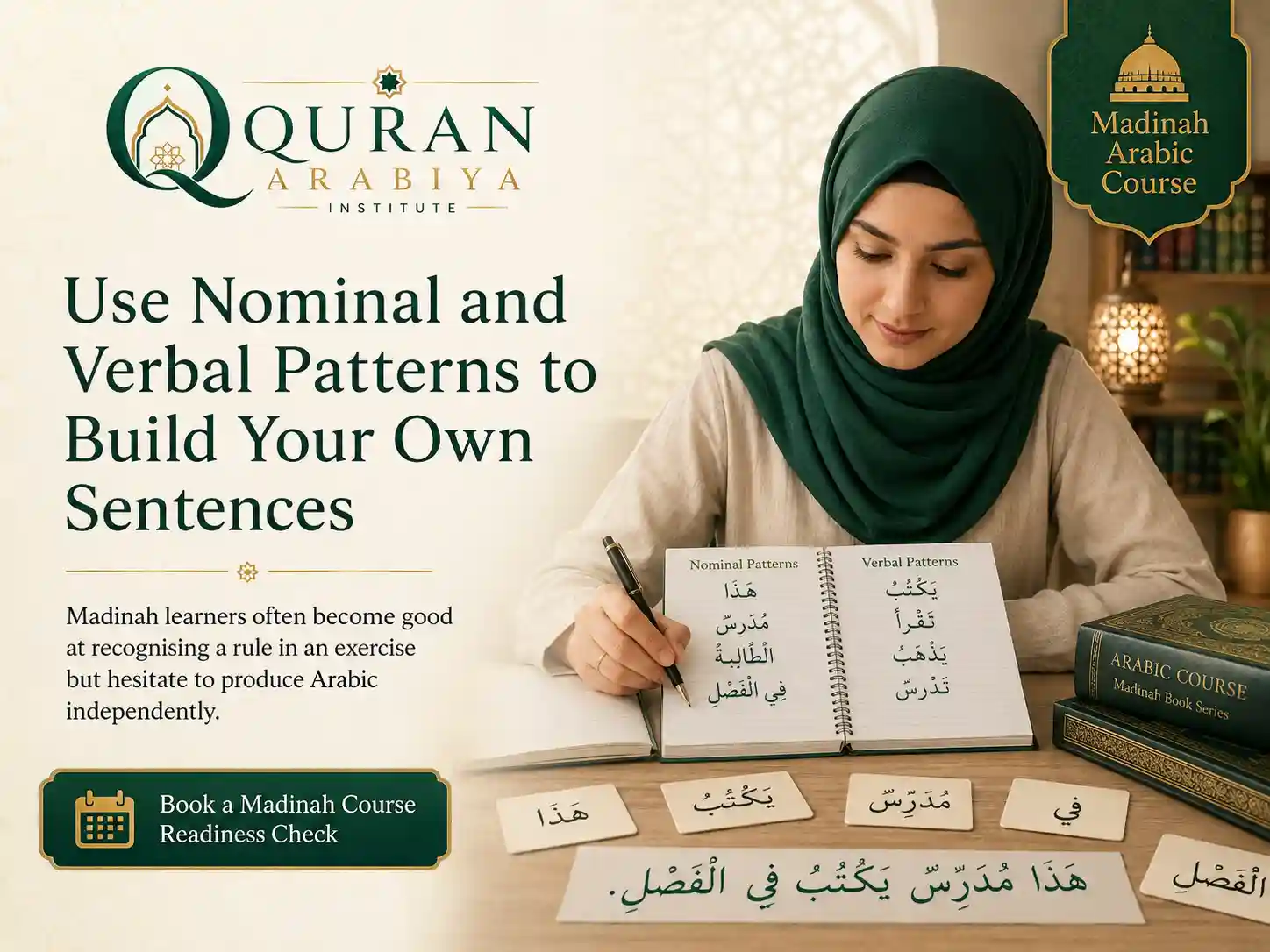
Madinah learners often become good at recognising a rule in an exercise but hesitate to produce Arabic independently. Short sentence-building tasks close that gap: change the subject, change number or gender, replace a prepositional phrase, or turn a model into a personal statement.
Production gives the teacher immediate evidence of whether the grammar is understood or merely familiar.
A useful check is whether the learner can reuse the same language with less support in a different task. That transfer matters more than simply recognizing the example that was practised in the lesson.
Reading practice should preserve meaning. The learner identifies the main idea, follows relationships between words and phrases, and answers comprehension questions before analysing every possible grammatical detail.
At higher stages, selected parsing can support accuracy, but exhaustive I’rab belongs to the advanced grammar/Quranic grammar pages.
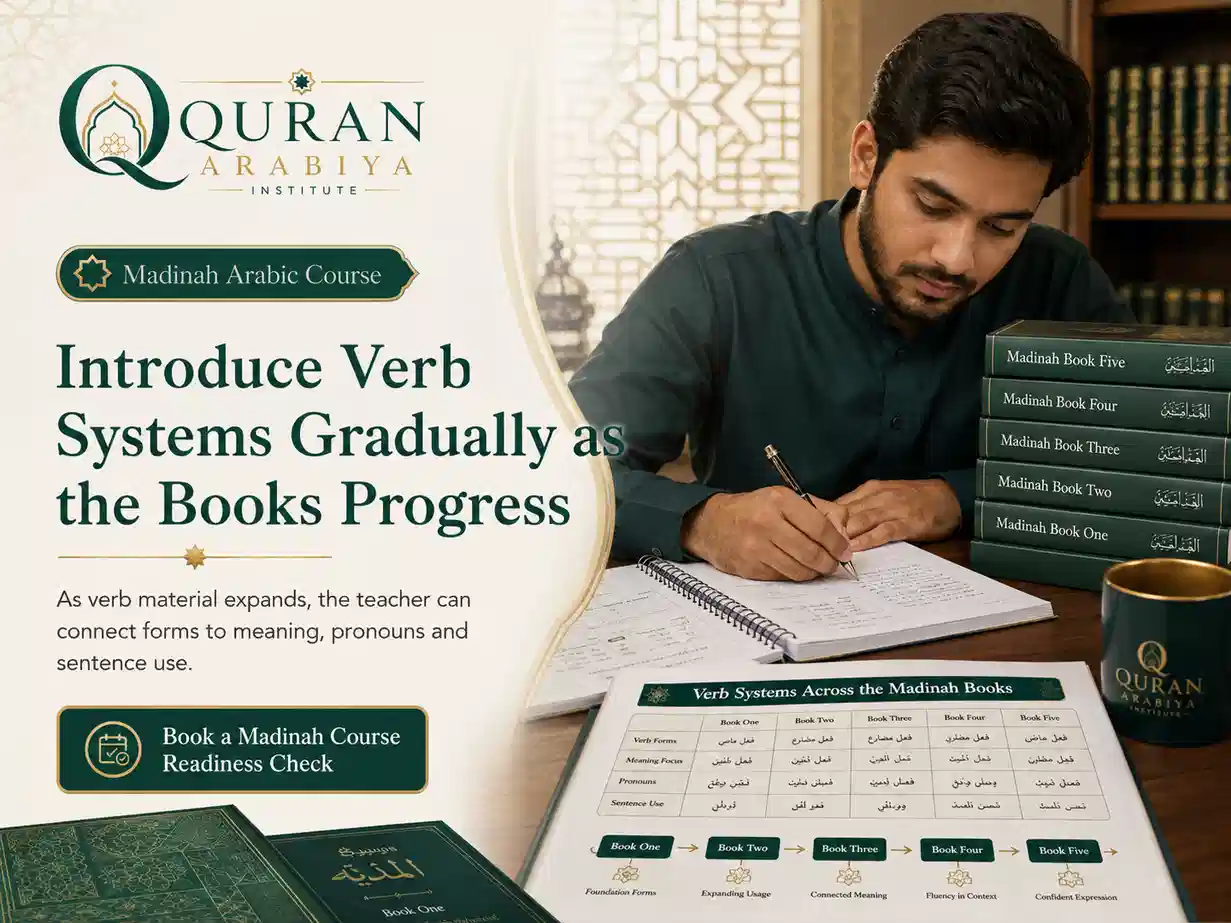
As verb material expands, the teacher can connect forms to meaning, pronouns and sentence use. Tables are useful references, but the learner should also retrieve forms in short phrases and recognise them in reading.
The course avoids front-loading advanced morphology that belongs in the Advanced Arabic Morphology or Nahw & Sarf courses.
The learner identifies the main idea, follows relationships between words and phrases, and answers comprehension questions before analysing every possible. At higher stages, selected parsing can support accuracy, but exhaustive I’rab belongs to the advanced grammar/Quranic grammar pages. The aim is to turn the same language into usable reading, listening, speaking or writing rather than leave it as a completed exercise.
English can confirm meaning and explain difficult points, especially for beginners, but the learner should increasingly connect Arabic directly with Arabic examples, images, situations and paraphrase.
This reduces dependence on word-by-word translation and prepares the student for longer formal texts.
Before moving forward, the teacher can check whether the learner can identify the target structure in unfamiliar sentences, produce an original example, understand a short passage containing it and recall core vocabulary after a delay.
Those checks are stronger than “we completed the exercise page” and allow pacing to follow mastery rather than another provider’s fixed hours.
English can confirm meaning and explain difficult points, especially for beginners, but the learner should increasingly connect Arabic directly with. This reduces dependence on word-by-word translation and prepares the student for longer formal texts. The aim is to turn the same language into usable reading, listening, speaking or writing rather than leave it as a completed exercise.
Before moving forward, the teacher can check whether the learner can identify the target structure in unfamiliar sentences, produce an. Those checks are stronger than “we completed the exercise page” and allow pacing to follow mastery rather than another. The aim is to turn the same language into usable reading, listening, speaking or writing rather than leave it as a completed exercise.
As the learner becomes comfortable with the main books, the next need may be dedicated Nahw, Sarf, Quranic Grammar, Ajrumiyyah, Balagha or classical text reading. The Madinah page should prepare for that transition without trying to own all of those search intents.
Internal links can route advanced learners to the specialist course that matches the new bottleneck.
Madinah is a natural choice for learners who enjoy explicit grammar and formal/classical reading foundations. Bayna Yadaik emphasises integrated communication and dialogue; Al-Takallum is a modern communicative MSA series with its own progression.
There is no single “best” curriculum independent of the learner’s goal and preferred learning style.
The free trial can include a short reading sample and basic structure questions, then discuss whether you want grammar depth, communication or broader Fusha. This helps prevent choosing Madinah simply because it is famous.
If it fits, the teacher can identify a realistic entry point in the books and the first grammar-vocabulary goals to stabilise.
Choose Madinah because its learning logic matches your goal, not just because the books are famous. Book a free trial to check reading readiness, current grammar knowledge and the right entry point.
They are the well-known Durus al-Lughah al-Arabiyyah materials associated with Dr. V. Abdur Rahim and widely used to teach Arabic to non-native speakers through progressive grammar, vocabulary and reading.
A basic reading foundation makes the course much more efficient. The free trial can determine whether you are ready or need literacy support first.
The teacher can include oral sentence production and questions, but the main market strength of the Madinah route is structured formal grammar, vocabulary and reading rather than conversation-only training.
The commonly used core course is known as a three-volume series. Exact academy pacing and supporting materials should be confirmed separately.
It can strengthen grammar and vocabulary that help with formal and Quran-related Arabic, but it is not the same as a dedicated Quranic Arabic, Tafsir or Quranic Grammar course.
Madinah is generally more grammar-conscious and reading-oriented; Bayna Yadaik is strongly integrated around communication and dialogue. Both can develop multiple skills with a good teacher.
That depends on your goal. Common next routes include advanced Nahw/Sarf, Quranic grammar, classical text reading or broader speaking and writing practice.
Teens and adults, especially learners interested in stronger formal/classical Arabic foundations and reading Islamic or Quran-related texts, who are comfortable with a more grammar-conscious textbook approach.
Not automatically. The free assessment can show which skills are already stable and where the first real gap appears, so a returning learner can avoid unnecessary repetition while a beginner receives the foundation that is actually needed.
The balance should follow the course intent and the learner profile rather than force equal time in every lesson. The teacher can reuse the same vocabulary and structures across several skills so one activity strengthens another instead of becoming a disconnected module.
Grammar is used to make Arabic clearer and more accurate at the depth appropriate to this course. If the learner’s main goal becomes advanced Nahw, Sarf, Quranic Grammar or a named classical text, that deeper intent belongs in the Advanced Arabic category.
Yes. A learner may understand much more than they can read or produce, while another may remember the script but little vocabulary. One-to-one placement lets the teacher build from that uneven profile rather than assume that every student labelled “intermediate” has the same strengths.
The trial can sample the skills most relevant to the course, clarify the learner’s goal, previous study and preferred schedule, and identify the first practical target. It is a course-fit step rather than a promise of a fixed completion time or guaranteed fluency level.
Progress should appear in what the learner can do with less prompting, not only in completed units. A useful checkpoint is whether the learner can use the main skill with increasing independence.
If you are considering Madinah Arabic course online, begin with the language task you actually want Arabic to unlock. The free trial can map the learner’s strongest and weakest skills, then route the plan toward a broad Fusha path, a named curriculum or a specialist skill without forcing every learner through the same sequence.