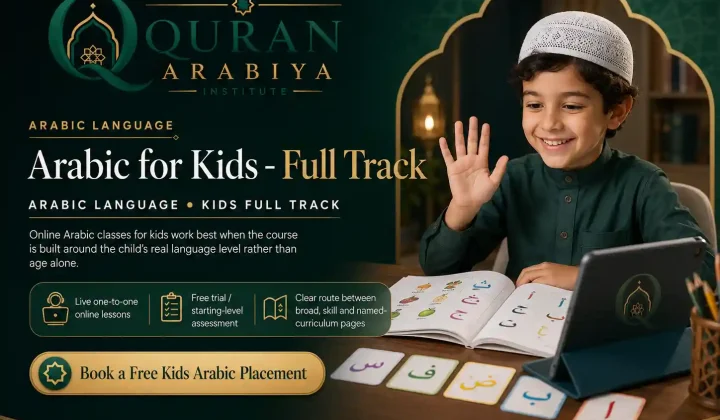
An Al Arabiyyah Lil Nashiin course gives parents a defined Fusha curriculum for a young learner while still allowing the teacher to respond to the child in front of them. The value is not simply owning the textbook series. It comes from turning the lessons into active vocabulary, understandable reading, short speaking and guided writing, then checking whether those skills still work when the page changes. A free trial can be used to confirm whether the child is ready for the series and where to begin.
A published series gives the child continuity and gives parents a visible route through topics and language structures. It can reduce the feeling that every lesson is an unrelated activity.
The teacher still needs flexibility. A child may need extra phonics, more oral repetition or faster movement through material they already know, so the book remains the spine rather than the entire teaching method.
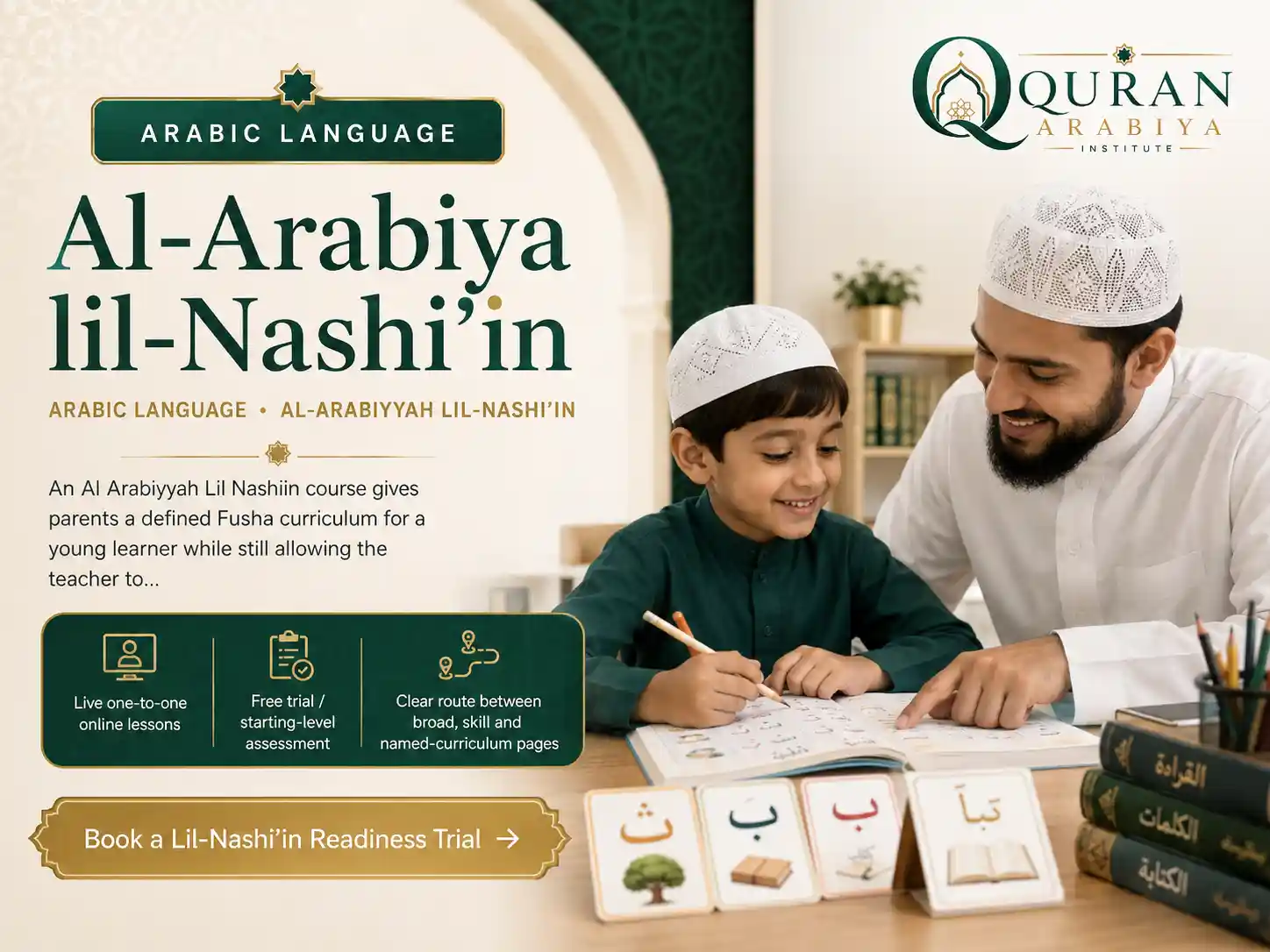
A published series gives the child continuity and gives parents a visible route through topics and language structures. It can reduce the feeling that every lesson is an unrelated activity. The aim is to turn the same language into usable reading, listening, speaking or writing rather than leave it as a completed exercise.
Placement should look at more than age. The teacher can check whether the child recognises Arabic script, understands basic classroom words, can answer simple questions and is ready to work from a structured book page.
If the child is not yet ready, a short foundation in reading or a broader kids track may be more successful before entering the series.
A useful check is whether the learner can reuse the same language with less support in a different task. That transfer matters more than simply recognizing the example that was practised in the lesson.
Young learners need meaning before long explanation. New words can be tied to pictures, actions, familiar situations and short questions, then repeated in several small tasks during the lesson.
The teacher can return to the same vocabulary later without showing the original page so the child learns to retrieve the word rather than recognise the picture only.
The teacher can check whether the child recognises Arabic script, understands basic classroom words, can answer simple questions and is. If the child is not yet ready, a short foundation in reading or a broader kids track may be. The aim is to turn the same language into usable reading, listening, speaking or writing rather than leave it as a completed exercise.
Young learners need meaning before long explanation.
Children can use Fusha from early stages through short responses, choices, description and mini-dialogues. Sentence frames reduce pressure while the language is new; the frames are gradually removed as confidence grows.
The goal is not a memorised dialogue recital. The teacher changes details and asks follow-up questions to see whether the child can adapt the language.
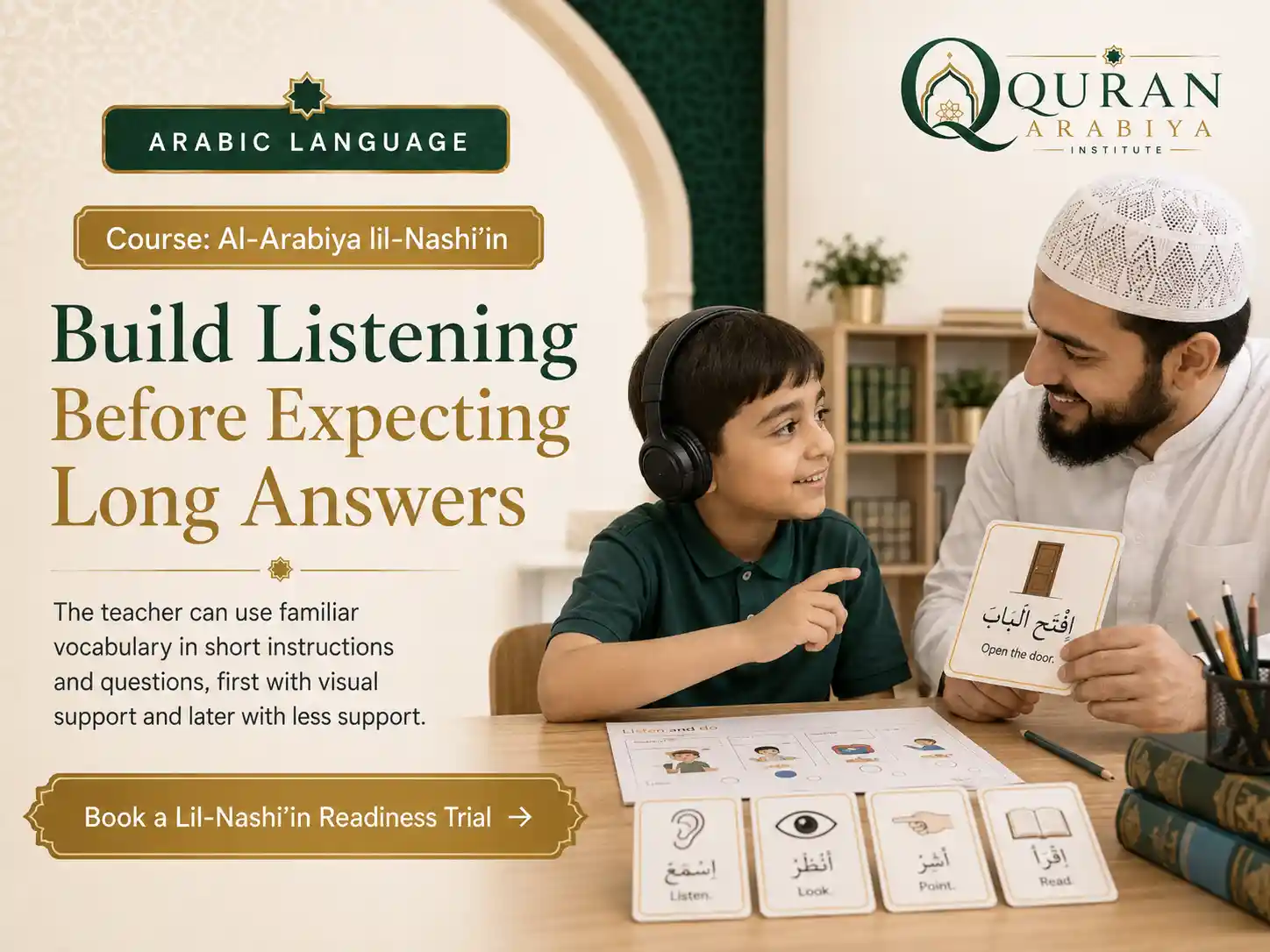
The teacher can use familiar vocabulary in short instructions and questions, first with visual support and later with less support. This helps the child connect the sound of Fusha with meaning rather than relying only on text.
Listening also prepares speaking: children respond more naturally when they have heard the pattern several meaningful times.
A useful check is whether the learner can reuse the same language with less support in a different task. That transfer matters more than simply recognizing the example that was practised in the lesson.
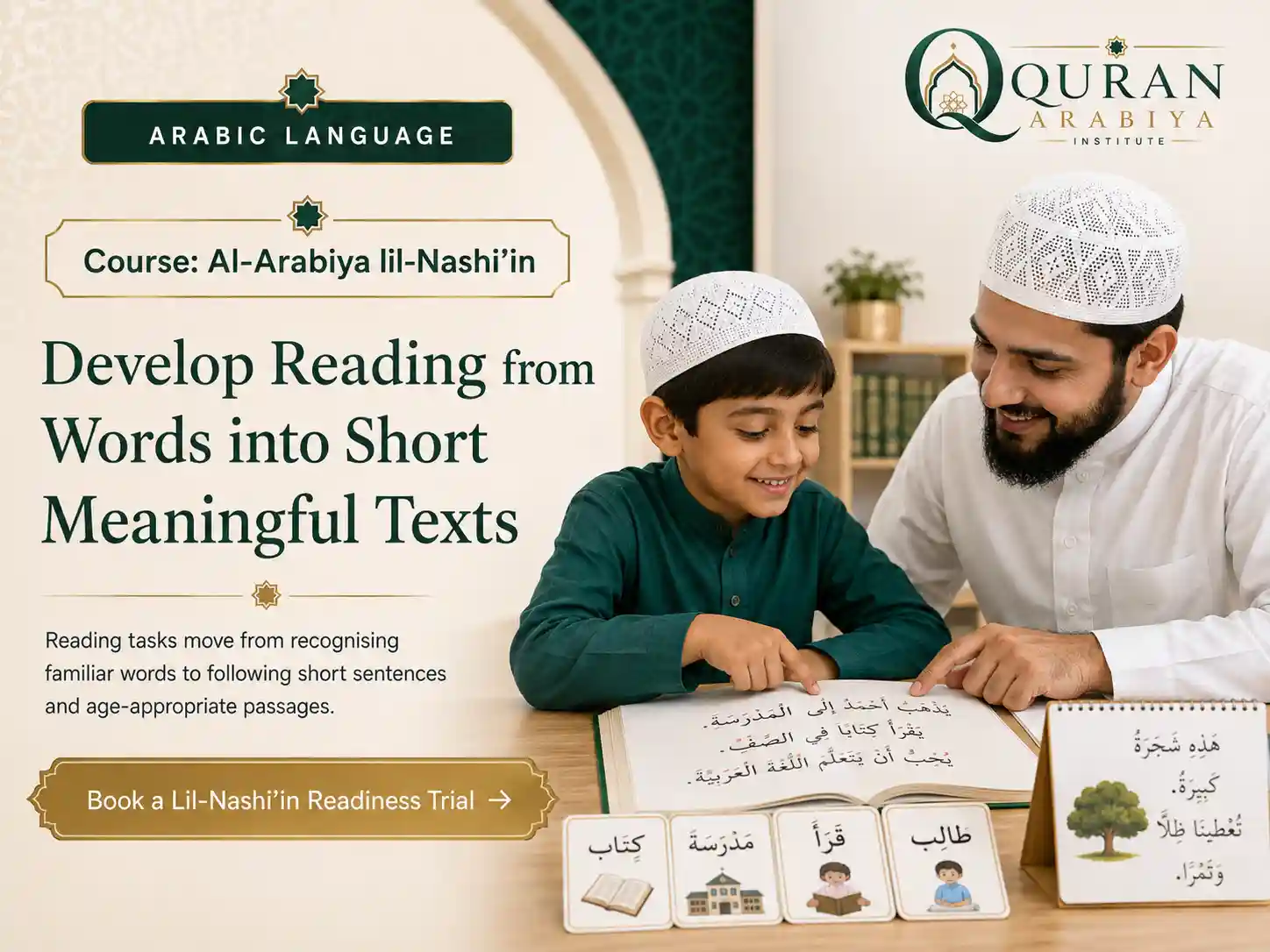
Reading tasks move from recognising familiar words to following short sentences and age-appropriate passages. Comprehension questions confirm that the learner is not simply pronouncing the line.
If script mechanics are still the main difficulty, the Arabic Reading & Writing course can provide a more focused foundation instead of slowing the whole named curriculum.
Writing may begin with tracing or copying for a child who needs motor familiarity, then progress to word completion, sentence construction, short answers and simple descriptions using the current vocabulary.
The amount of writing should match age and attention. The purpose is retrieval and language control, not filling a large number of workbook pages.
Reading tasks move from recognising familiar words to following short sentences and age-appropriate passages. Comprehension questions confirm that the learner is not simply pronouncing the line. The aim is to turn the same language into usable reading, listening, speaking or writing rather than leave it as a completed exercise.
Young learners can notice agreement, pronouns, basic verb patterns and sentence relationships through examples before receiving heavy terminology. The teacher can ask the child to choose, compare and build new examples.
This keeps grammar useful and prevents the course from turning into Advanced Arabic material before the child has enough language to use it.
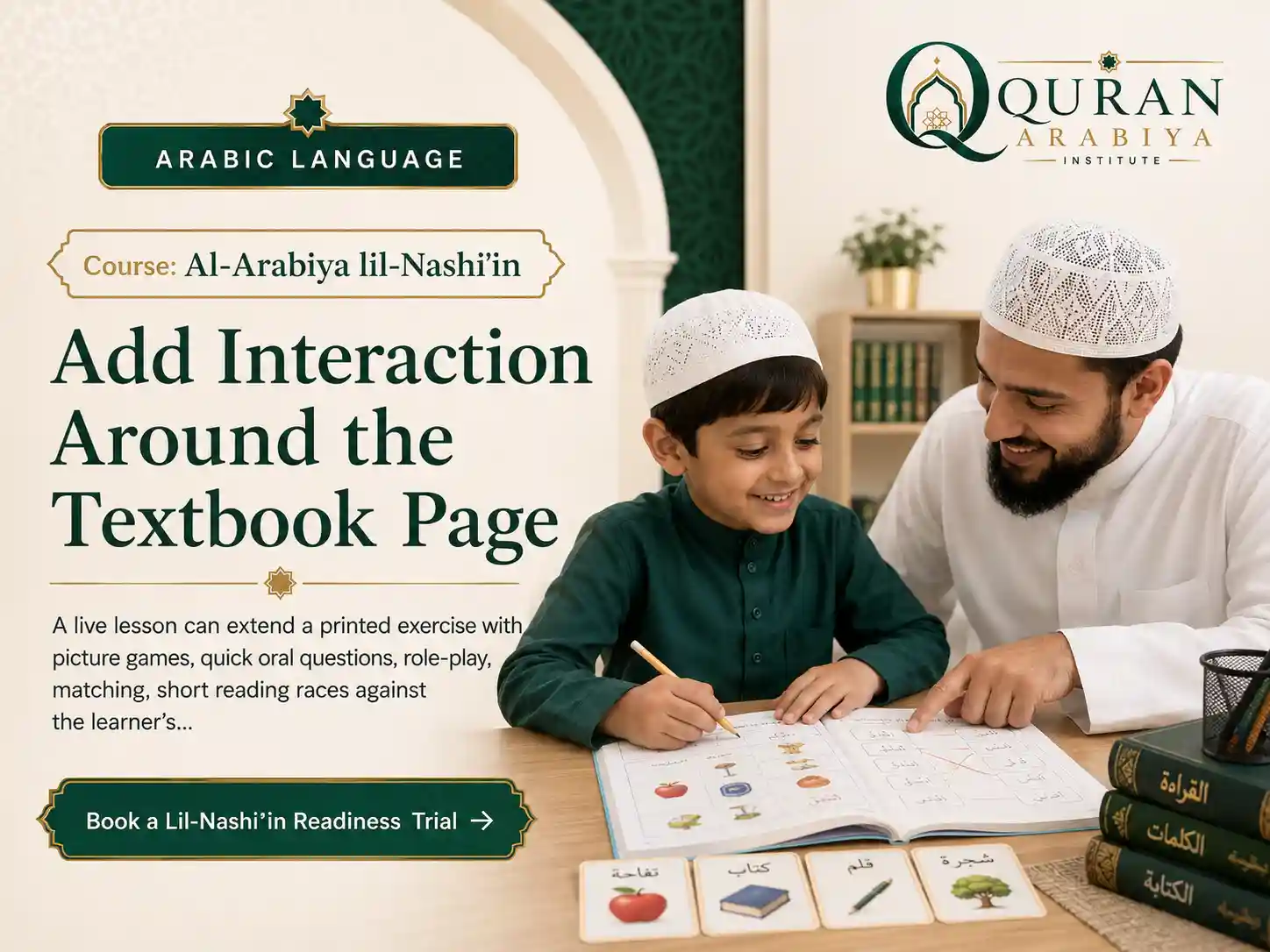
A live lesson can extend a printed exercise with picture games, quick oral questions, role-play, matching, short reading races against the learner’s own previous performance and simple retrieval challenges.
Those activities should serve the language objective rather than distract from it. The book provides the target; interaction helps the child process and reuse it.
Young learners can notice agreement, pronouns, basic verb patterns and sentence relationships through examples before receiving heavy terminology. The teacher can ask the child to choose, compare and build new examples. The aim is to turn the same language into usable reading, listening, speaking or writing rather than leave it as a completed exercise.
A live lesson can extend a printed exercise with picture games, quick oral questions.
Parent feedback can describe what the child can now do: understand familiar questions, use target vocabulary without a prompt, read a short passage, form a sentence pattern or write a few connected ideas.
This is more useful than reporting only a book page or nominal level, especially because different schools package the published series differently.
Choose this page when the parent specifically wants the Al-Arabiyyah Lil-Nashi’in series and values a textbook sequence. Choose the Kids Full Track when the child needs a more flexible blend of curricula or several skills require different starting points.
Keeping that distinction clear prevents both pages from competing for the same parent intent.
The trial can sample reading, listening and simple spoken response while the parent explains previous Arabic study and the child’s learning style. The teacher can then recommend whether to begin in the series, review a foundation or choose the broader child path.
No universal number of levels or completion time should be promised until the exact edition and academy implementation are confirmed.
If you want a structured youth textbook path without losing the benefits of personal teaching, book a free trial. The teacher can check whether Al-Arabiyyah Lil-Nashi’in fits your child and identify the most useful entry point.
It is an Arabic-learning series designed for young learners and used to build Fusha progressively through vocabulary, language structures and multiple skills.
Not necessarily. Placement should determine where the learner’s reading, vocabulary and comprehension match the curriculum.
Different providers package the published material differently. Quran Arabiya should confirm the exact edition and internal level mapping before publishing a fixed number.
Yes. Speaking can be developed through short questions, guided dialogue and re-use of unit vocabulary rather than reading the book silently.
Yes, at an age-appropriate level. Patterns should be connected to usable sentences rather than taught as advanced theory.
Lil-Nashi’in is a named textbook-series course. The Kids Full Track is broader and can be personalised across several materials and skill needs.
Possibly, depending on the edition and teacher plan, but a focused literacy foundation may be recommended first if script difficulty would prevent the child from benefiting from the book.
Parents of young non-native learners who want a progressive textbook-based Arabic course rather than a fully custom child-language track.
Not automatically. The free assessment can show which skills are already stable and where the first real gap appears, so a returning learner can avoid unnecessary repetition while a beginner receives the foundation that is actually needed.
The balance should follow the course intent and the learner profile rather than force equal time in every lesson. The teacher can reuse the same vocabulary and structures across several skills so one activity strengthens another instead of becoming a disconnected module.
Grammar is used to make Arabic clearer and more accurate at the depth appropriate to this course. If the learner’s main goal becomes advanced Nahw, Sarf, Quranic Grammar or a named classical text, that deeper intent belongs in the Advanced Arabic category.
Yes. A learner may understand much more than they can read or produce, while another may remember the script but little vocabulary. One-to-one placement lets the teacher build from that uneven profile rather than assume that every student labelled “intermediate” has the same strengths.
The trial can sample the skills most relevant to the course, clarify the learner’s goal, previous study and preferred schedule, and identify the first practical target. It is a course-fit step rather than a promise of a fixed completion time or guaranteed fluency level.
Progress should appear in what the learner can do with less prompting, not only in completed units. A useful checkpoint is whether the learner can use the main skill with increasing independence.
If you are considering Al Arabiyyah Lil Nashiin course, begin with the language task you actually want Arabic to unlock. The free trial can map the learner’s strongest and weakest skills, then route the plan toward a broad Fusha path, a named curriculum or a specialist skill without forcing every learner through the same sequence.