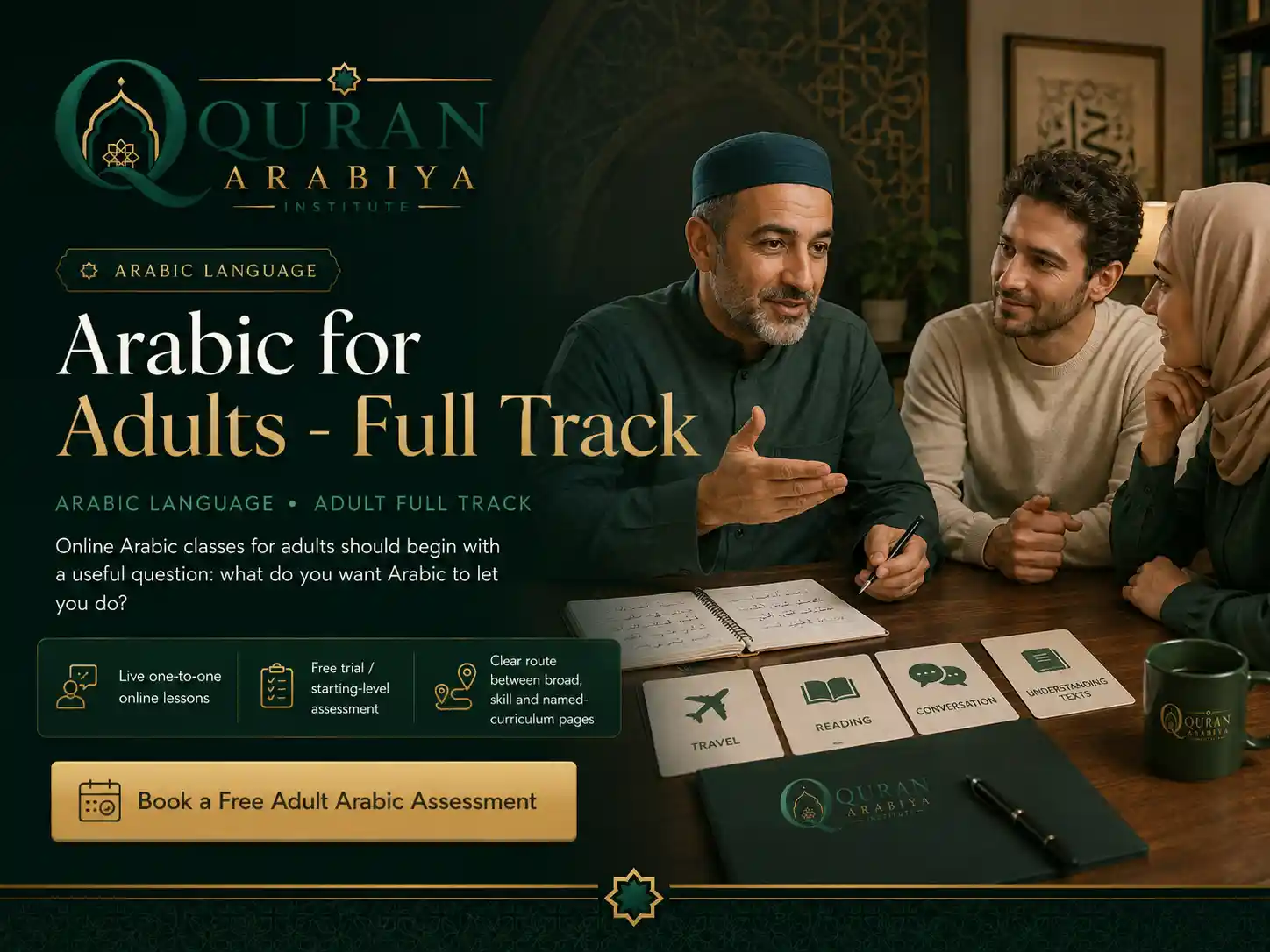
Online Arabic classes for adults should begin with a useful question: what do you want Arabic to let you do? An adult learning for Quran understanding, travel, family communication, formal reading or long-term language mastery may need a different balance of skills. This full track builds Fusha through a structured but personal plan, with live one-to-one lessons and a free assessment used to identify your current reading, vocabulary, comprehension and speaking level before the course direction is fixed.
“Learn Arabic” can mean very different things. Some learners want to read confidently, some want formal conversation, some need Arabic for Islamic study, and some want a complete language foundation. The first planning step is to rank those goals rather than trying to give every skill equal weight from day one.
A clear goal helps the teacher choose material, lesson balance and practice. It also makes progress measurable: the student can judge improvement against the use-case that motivated the study.
Some learners want to read confidently, some want formal conversation, some need Arabic for Islamic study, and some want a. The first planning step is to rank those goals rather than trying to give every skill equal weight from. The aim is to turn the same language into usable reading, listening, speaking or writing rather than leave it as a completed exercise.
Adults often have uneven Arabic. You may read the script but understand little, recognise many Quranic words but not everyday Fusha, or understand a teacher yet freeze when asked to answer. A short placement sample across reading, listening and production shows where the real bottleneck lies.
This prevents unnecessary restarting. Returning learners can repair specific gaps while complete beginners receive the foundations they actually need.
A useful check is whether the learner can reuse the same language with less support in a different task. That transfer matters more than simply recognizing the example that was practised in the lesson.
Instead of studying reading, speaking, listening and writing as unrelated modules, the course can reuse the same vocabulary and structures across all four. A short dialogue may become a listening task, a speaking model, a reading passage and the basis for a brief written response.
This creates repeated contact with the same language in different forms and improves transfer beyond memorised exercises.
Adults often have uneven Arabic.
Instead of studying reading, speaking, listening and writing as unrelated modules, the course can reuse the same vocabulary and structures. A short dialogue may become a listening task, a speaking model, a reading passage and the basis for a. The aim is to turn the same language into usable reading, listening, speaking or writing rather than leave it as a completed exercise.
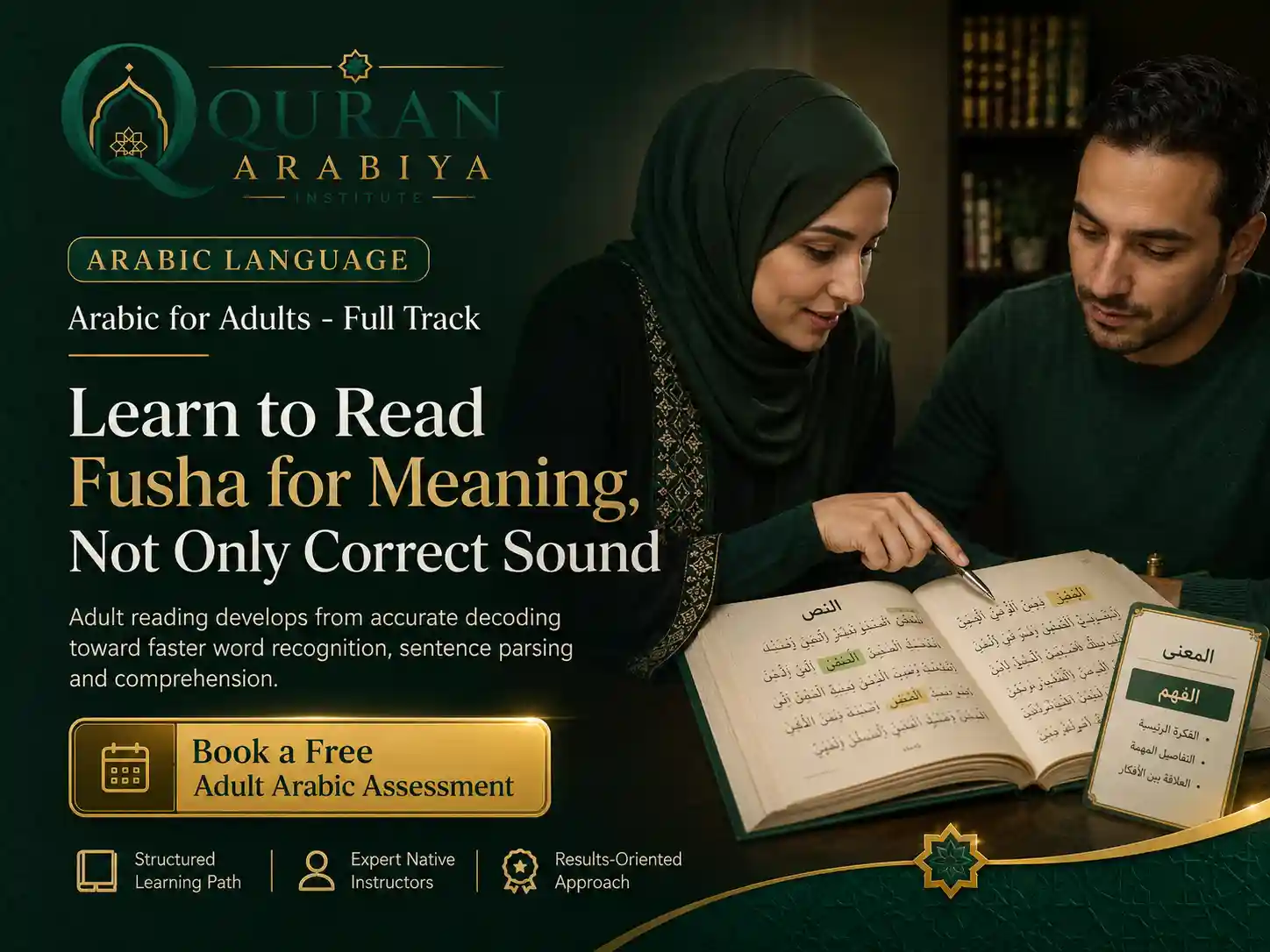
Adult reading develops from accurate decoding toward faster word recognition, sentence parsing and comprehension. The learner practises identifying the main idea, noticing how endings or particles affect relationships, and using context rather than translating every word one by one.
If the dominant problem is script and spelling rather than language comprehension, the dedicated Arabic Reading & Writing course can provide a more focused route.
Many adults delay speaking until they believe their grammar is “good enough.” A better approach is controlled production from the first usable vocabulary: answer a question, expand an answer, describe a routine, compare two things, ask for clarification and retell a short idea.
The teacher can protect accuracy without making the student wait for perfection. As vocabulary and grammar grow, the speaking tasks become less scripted.
A useful check is whether the learner can reuse the same language with less support in a different task. That transfer matters more than simply recognizing the example that was practised in the lesson.

Knowing a word on paper does not guarantee that you will recognise it at natural speaking speed. Listening practice can begin with short, controlled Fusha and gradually introduce longer utterances, different sentence patterns and less predictable questions.
The student learns to catch key information, tolerate unknown words and respond from meaning rather than mentally translating every syllable.
Writing makes gaps visible. A learner who can say a sentence with support may discover uncertainty about spelling, agreement or word order when writing it independently. Short guided writing therefore becomes a diagnostic and consolidation tool.
Progress can move from sentence completion and short answers to connected paragraphs, depending on level and goal. The separate literacy course remains available for learners whose primary target is reading and writing itself.
Knowing a word on paper does not guarantee that you will recognise it at natural speaking speed. Listening practice can begin with short, controlled Fusha and gradually introduce longer utterances, different sentence patterns and less predictable. The aim is to turn the same language into usable reading, listening, speaking or writing rather than leave it as a completed exercise.

Adults often appreciate explicit grammar, but explanation should lead to use. A rule is more memorable when the learner has just met the pattern in a text, compares examples, applies it in new sentences and receives correction.
Deeper specialist study of Nahw, Sarf, Ajrumiyyah or advanced morphology belongs in the Advanced Arabic category. The full track uses enough grammar to make the learner more accurate and independent.
Vocabulary grows through retrieval and reuse, not by collecting large lists. New words are grouped around topics and functions, then revisited in speaking, listening, reading and writing over several lessons.
High-value words can be tracked by whether the learner can understand them, recall them without a prompt and use them in a new sentence. Those are different levels of mastery.
Adults often appreciate explicit grammar, but explanation should lead to use.
Vocabulary grows through retrieval and reuse, not by collecting large lists. New words are grouped around topics and functions, then revisited in speaking, listening, reading and writing over several lessons. The aim is to turn the same language into usable reading, listening, speaking or writing rather than leave it as a completed exercise.
Useful milestones might include holding a short Fusha exchange without switching to English, understanding the main idea of a graded passage, writing a coherent paragraph, or following a teacher’s explanation with fewer repetitions.
Those tasks show whether the learner is becoming more independent. Completing pages can support the plan, but it is not the final measure.
The full track fits learners who need several skills to develop together. A complete beginner focused specifically on formal MSA can choose the MSA Beginners page; someone who mainly freezes in speech may choose Arabic Conversation; a learner committed to Bayna Yadaik, Madinah, Al-Kitab Al-Asasi, Ibn Saud or Al-Takallum should use that curriculum page.
Egyptian Arabic is intentionally separate because its everyday spoken target differs from formal Fusha.
The free trial can combine a short level check with a discussion of why you are learning Arabic, previous study, preferred pace and the type of material you respond to best. That gives the teacher enough evidence to recommend a course direction rather than guessing from a form.
You can then begin with a short-term target—such as building a core speaking base, repairing reading, or completing the first structured level—and review the plan as your needs change.
Stop choosing Arabic material by trial and error. Book a free assessment to map your current skills, clarify your goal and receive a starting plan for Fusha that matches how you actually need to use the language.
Yes. Complete beginners can start from the foundations. The trial helps determine whether you should enter the broad adult track or a more focused beginner/literacy course.
This full track is Fusha / Modern Standard Arabic. Egyptian Arabic has a separate dialect course focused on everyday Egyptian speech.
Yes. A one-to-one plan can weight skills according to your goal while still keeping enough reading, listening and structure to support long-term progress.
Not necessarily on this broad track. If you specifically want Bayna Yadaik, Madinah, Al-Kitab Al-Asasi, Ibn Saud or Al-Takallum, each has its own course page and clearer curriculum identity.
No. Placement should identify which skills are still usable and which have become unstable so the teacher can repair gaps rather than restart automatically.
Explanations can be adjusted to the learner’s level and communication needs. The long-term goal is to increase useful Arabic exposure while keeping difficult concepts clear.
Choose the beginner-MSA page when your primary intent is a clearly defined entry-level Modern Standard Arabic program. Choose this full track when you want a broader all-level personalized Arabic journey.
Adult beginners, returning learners, heritage learners and Muslim adults who want a structured Arabic path but do not necessarily want to commit to one named textbook series.
Not automatically. The free assessment can show which skills are already stable and where the first real gap appears, so a returning learner can avoid unnecessary repetition while a beginner receives the foundation that is actually needed.
The balance should follow the course intent and the learner profile rather than force equal time in every lesson. The teacher can reuse the same vocabulary and structures across several skills so one activity strengthens another instead of becoming a disconnected module.
Grammar is used to make Arabic clearer and more accurate at the depth appropriate to this course. If the learner’s main goal becomes advanced Nahw, Sarf, Quranic Grammar or a named classical text, that deeper intent belongs in the Advanced Arabic category.
Yes. A learner may understand much more than they can read or produce, while another may remember the script but little vocabulary. One-to-one placement lets the teacher build from that uneven profile rather than assume that every student labelled “intermediate” has the same strengths.
The trial can sample the skills most relevant to the course, clarify the learner’s goal, previous study and preferred schedule, and identify the first practical target. It is a course-fit step rather than a promise of a fixed completion time or guaranteed fluency level.
Progress should appear in what the learner can do with less prompting, not only in completed units. A useful checkpoint is whether the learner can use the main skill with increasing independence.
If you are considering online Arabic classes for adults, begin with the language task you actually want Arabic to unlock. The free trial can map the learner’s strongest and weakest skills, then route the plan toward a broad Fusha path, a named curriculum or a specialist skill without forcing every learner through the same sequence.