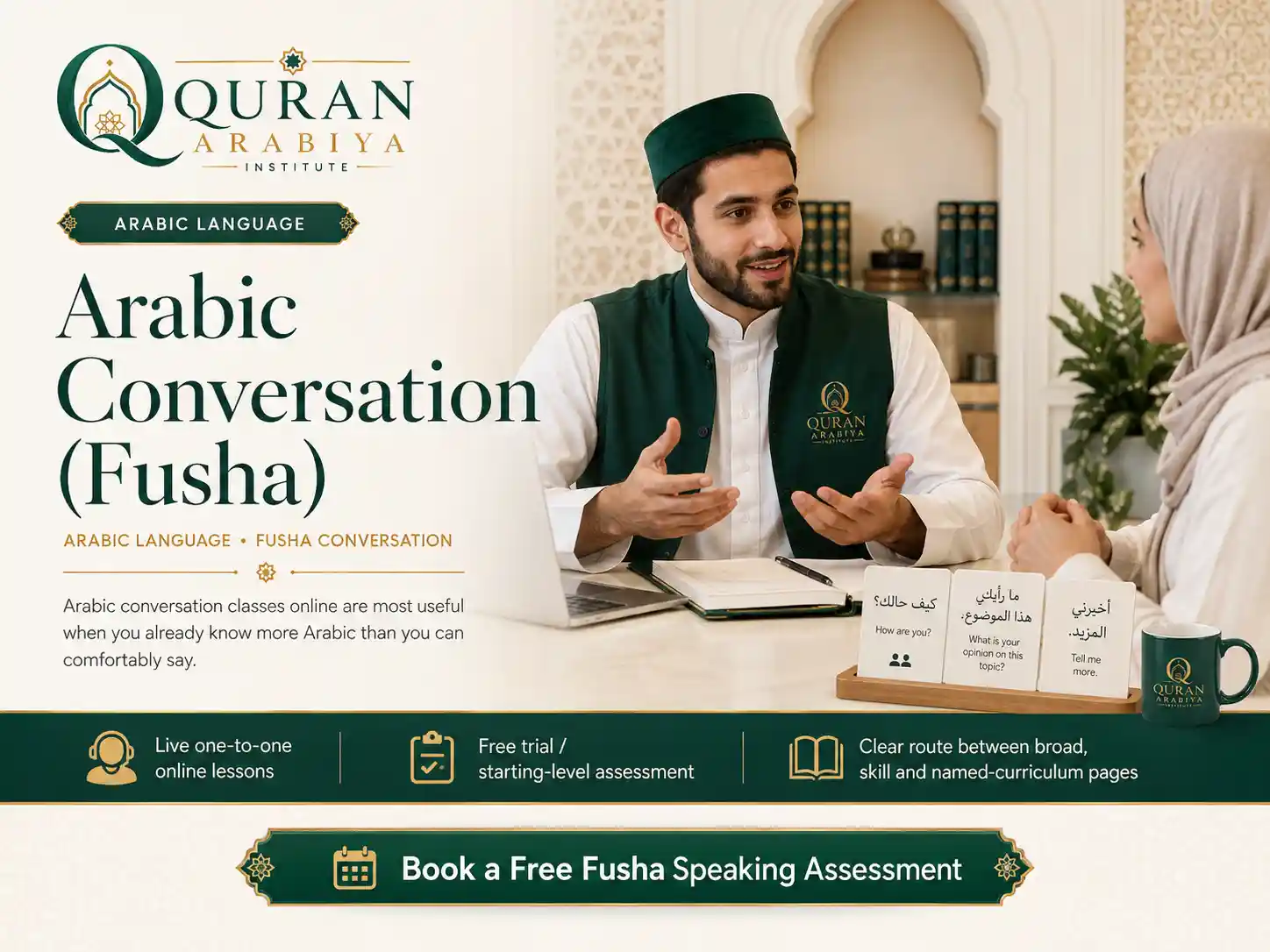
Arabic conversation classes online are most useful when you already know more Arabic than you can comfortably say. The problem may be slow retrieval, fear of mistakes, translating from English, weak listening or knowing grammar only on paper. This Fusha speaking course gives those passive skills a place to become active through guided one-to-one conversation, immediate feedback and repeated use of the same language in new situations.
A learner can hesitate for different reasons: the right word is not active, the sentence pattern is uncertain, the question was not understood quickly enough, or the learner is self-correcting every word before speaking. A short conversation sample helps separate those causes.
The teacher can then choose the right intervention—retrieval drills, listening work, sentence frames, pronunciation correction or freer conversation—rather than simply giving another vocabulary list.
A learner can hesitate for different reasons: the right word is not active, the sentence pattern is uncertain, the question. A short conversation sample helps separate those causes. The aim is to turn the same language into usable reading, listening, speaking or writing rather than leave it as a completed exercise.
Useful Fusha conversation grows from things you repeatedly need to do: introduce yourself, describe, compare, explain a reason, ask for clarification, narrate a simple event, give an opinion, agree or disagree and ask follow-up questions.
Each function can begin with a small set of reusable expressions. Once those frames become familiar, the learner changes the content while keeping the structure available under speaking pressure.
A useful check is whether the learner can reuse the same language with less support in a different task. That transfer matters more than simply recognizing the example that was practised in the lesson.
Recognising a word in a text is easier than producing it in a live conversation. Active vocabulary practice therefore uses timed recall, picture or situation prompts, question-answer cycles and repeated use across several topics.
The teacher can deliberately bring older vocabulary back into new conversations so the learner stops depending on the most recent lesson only.
Useful Fusha conversation grows from things you repeatedly need to do: introduce yourself, describe, compare, explain a reason, ask for. Each function can begin with a small set of reusable expressions. The aim is to turn the same language into usable reading, listening, speaking or writing rather than leave it as a completed exercise.
Recognising a word in a text is easier than producing it in a live.
Conversation is not speaking alone. You need to understand enough of the other person’s turn to respond without translating every sentence. Lessons can use short teacher prompts, rephrased questions and progressively less predictable exchanges.
When the learner misses meaning, the teacher can model clarification strategies in Arabic rather than immediately switching to English. That builds real conversational survival skills.
Open conversation can be frustrating when the learner has no linguistic support. A better progression begins with choices, substitutions and sentence starters, then moves to role-play, short descriptions, retelling and finally less scripted discussion.
The support is reduced as the learner proves they can retrieve the language independently.
A useful check is whether the learner can reuse the same language with less support in a different task. That transfer matters more than simply recognizing the example that was practised in the lesson.

Not every mistake should interrupt a sentence. The teacher can correct high-priority errors immediately when they block meaning or reinforce a harmful pattern, while noting smaller errors for a short feedback pause after the speaking turn.
The learner then repeats or reformulates the idea using the correction. That final re-use step is what converts feedback into a speaking habit.
Conversation lessons can target grammar that repeatedly affects meaning or confidence: agreement, common verb forms, question structures, pronouns, prepositions and sentence linking at the learner’s level.
The purpose is application. Learners who want systematic Nahw and Sarf study have dedicated advanced courses, so this page should not become a grammar textbook.
The teacher can correct high-priority errors immediately when they block meaning or reinforce a harmful pattern, while noting smaller errors. The learner then repeats or reformulates the idea using the correction. The aim is to turn the same language into usable reading, listening, speaking or writing rather than leave it as a completed exercise.

Conversation includes pronunciation feedback on sounds, vowel length and clarity when they affect intelligibility. The teacher can isolate a recurring problem briefly, then put the corrected form back into the sentence.
A learner who needs systematic articulation, phonemic contrasts, stress and intonation should move to the Arabic Pronunciation course, which owns that specialist intent.
Speaking once about “my family” can produce a rehearsed answer. Real fluency appears when the same vocabulary and structures survive in a new task: compare two families, explain a family routine, ask questions about another person, or tell a short related story.
Topic recycling changes the communicative job while preserving part of the language. That encourages flexible use rather than script memorisation.
Conversation includes pronunciation feedback on sounds, vowel length and clarity when they affect intelligibility. The teacher can isolate a recurring problem briefly, then put the corrected form back into the sentence. The aim is to turn the same language into usable reading, listening, speaking or writing rather than leave it as a completed exercise.
Speaking once about “my family” can produce a rehearsed answer.
Progress can be tracked through practical changes: longer turns, fewer English switches, faster answers to familiar question types, more follow-up questions, clearer repair after a mistake and greater ability to discuss an unfamiliar but accessible topic.
Those indicators are more useful than counting how many conversation themes have been “covered.”
This page is best when the main bottleneck is using formal Arabic in speech. If you need balanced beginner reading, writing, listening and speaking, choose MSA Beginners. If you want natural everyday Egyptian speech, choose the Egyptian Arabic course.
That distinction protects both learner expectations and the SEO intent of each page.

In the free trial, the teacher can ask simple level-appropriate questions and observe listening speed, vocabulary retrieval, sentence building and pronunciation. You do not need to prepare a perfect speech.
The result can be a focused speaking plan: the two or three patterns that would make the biggest difference to your next conversations.
If Arabic is in your head but not yet available in your mouth, start with a real speaking sample. Book a free trial to identify what slows your Fusha conversation and build the practice around that bottleneck.
They are focused on Fusha / Modern Standard Arabic conversation. Egyptian Arabic has a separate dialect course.
Some foundation makes a conversation-focused course more productive. Complete beginners may be better placed in the MSA Beginners or Adult Full Track first, depending on the assessment.
No. Correction can be prioritised so important errors are fixed without stopping every sentence. Smaller points can be reviewed after the speaking turn and then reused.
Yes. Listening and response are trained together because real conversation depends on understanding the other person quickly enough to answer.
Only the grammar needed to make your spoken Fusha clearer and more accurate. It is not a full grammar-specialist course.
Conversation owns active speaking and listening interaction. Pronunciation owns detailed sound production, articulation, stress and intonation.
A one-to-one lesson can adapt practice topics to your useful contexts as long as the language target remains appropriate to your current level.
Teens and adults who can understand or study Arabic but hesitate, translate mentally, lack active vocabulary or need structured Fusha speaking and listening practice.
Not automatically. The free assessment can show which skills are already stable and where the first real gap appears, so a returning learner can avoid unnecessary repetition while a beginner receives the foundation that is actually needed.
The balance should follow the course intent and the learner profile rather than force equal time in every lesson. The teacher can reuse the same vocabulary and structures across several skills so one activity strengthens another instead of becoming a disconnected module.
Grammar is used to make Arabic clearer and more accurate at the depth appropriate to this course. If the learner’s main goal becomes advanced Nahw, Sarf, Quranic Grammar or a named classical text, that deeper intent belongs in the Advanced Arabic category.
Yes. A learner may understand much more than they can read or produce, while another may remember the script but little vocabulary. One-to-one placement lets the teacher build from that uneven profile rather than assume that every student labelled “intermediate” has the same strengths.
The trial can sample the skills most relevant to the course, clarify the learner’s goal, previous study and preferred schedule, and identify the first practical target. It is a course-fit step rather than a promise of a fixed completion time or guaranteed fluency level.
Progress should appear in what the learner can do with less prompting, not only in completed units. A useful checkpoint is whether the learner can use the main skill with increasing independence.
If you are considering Arabic conversation classes online, begin with the language task you actually want Arabic to unlock. The free trial can map the learner’s strongest and weakest skills, then route the plan toward a broad Fusha path, a named curriculum or a specialist skill without forcing every learner through the same sequence.