

Ramadan 2027 in Canada is expected to begin on Monday, February 8, 2027, according to the Fiqh Council of North America’s published calendar. For Muslim families from Toronto and Montreal to Calgary, Edmonton and Vancouver, the month will arrive during the Canadian winter. Daylight hours are shorter than in a summer Ramadan, but fasting times still vary by city, latitude and prayer-time calculation method. This guide brings together the expected dates, city-by-city fasting estimates, school considerations and practical ways to prepare your family’s Quran routine.
Important: These dates are calendar projections, not a final moon-sighting announcement. Confirm the beginning and end of Ramadan with the mosque or Islamic authority your family follows.
Explore Online Quran Classes in Canada if you would like a teacher-guided Quran plan that fits your local Canadian time zone.
When Is Ramadan 2027 Expected to Begin in Canada?
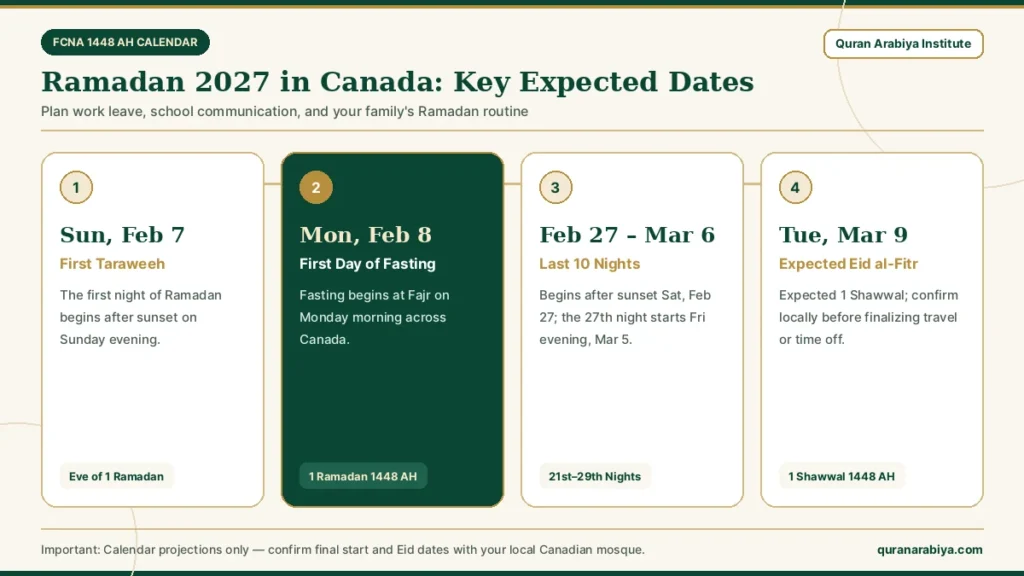
The Fiqh Council of North America (FCNA) calendar lists 1 Ramadan 1448 AH as Monday, February 8, 2027, and 1 Shawwal (Eid al-Fitr) as Tuesday, March 9, 2027. On this calendar, the first Taraweeh prayer would take place after sunset on Sunday, February 7, and the first fast would begin at Fajr on Monday morning.
These dates are useful for planning school communication, work leave, family visits and Quran goals. They should still be treated as expected dates. Islamic months follow the lunar calendar, and Muslim communities may use different accepted methods to determine when a month begins. A mosque that waits for a local crescent-sighting announcement may confirm a date that differs from a pre-calculated calendar.
| Ramadan milestone | Expected date on the FCNA calendar | Planning note |
|---|---|---|
| First Taraweeh | Evening of Sunday, February 7 | The first Ramadan night begins after sunset. |
| First day of fasting | Monday, February 8 | 1 Ramadan 1448 AH. |
| 27th day of Ramadan | Saturday, March 6 | The 27th night begins after sunset on Friday, March 5. |
| Expected Eid al-Fitr | Tuesday, March 9 | 1 Shawwal on the FCNA calendar. |
Many Muslims give special attention to the 27th night while seeking Laylat al-Qadr, but it is not accurate to state that Laylat al-Qadr is guaranteed to fall on one specific night. The last ten nights are the better period to protect for extra Quran recitation, dua, prayer and reflection. If your mosque begins Ramadan a day later, the dates of these milestones will also shift.
Why Canadian Mosques Sometimes Start on Different Days
There is no single announcement process followed by every Muslim community in Canada. Some mosques and Islamic organisations use a pre-calculated calendar, while others wait for a local crescent sighting or follow a particular regional or national moon-sighting body. These approaches reflect different scholarly criteria for applying the lunar calendar; a difference of one day does not automatically mean that one community has made an error.
FCNA explains that its calendar uses astronomical criteria to determine when a new Islamic month begins. Its published 1448 AH calendar gives February 8 for the start of Ramadan and March 9 for Eid al-Fitr. A community that follows a sighting-based process may wait for the relevant evening before announcing its date.
For family planning, ask your mosque which authority it follows, choose one local prayer timetable and keep flexibility around the first and last days. If you need time off, explain that the dates are expected and may be confirmed closer to the time. Check the Eid announcement separately rather than assuming every mosque will announce the same date.
Fasting Hours in Toronto, Montreal, Ottawa, Calgary, Edmonton and Vancouver
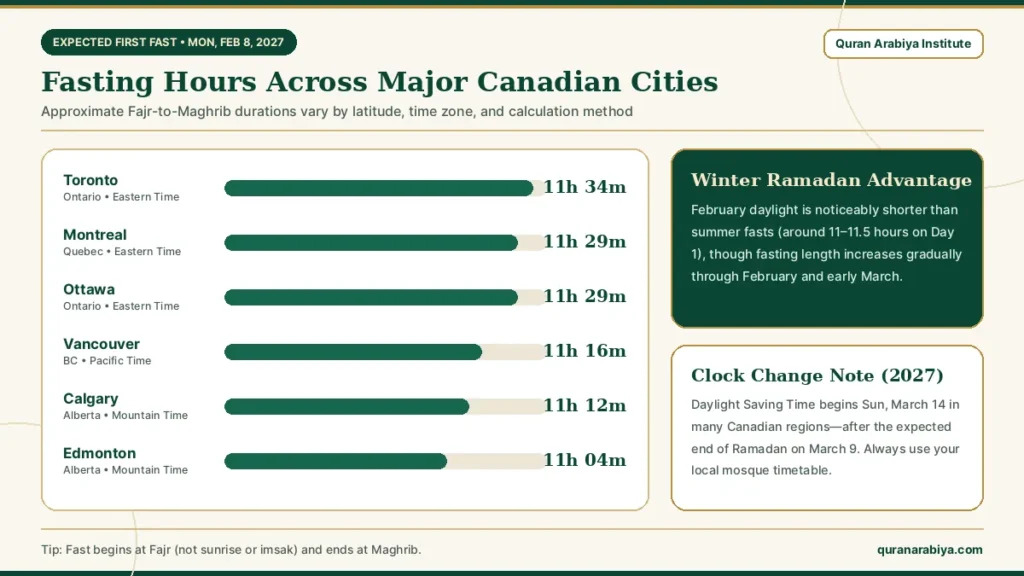
Canada’s size makes one national fasting timetable impractical. The time between Fajr and sunset changes with location, date and calculation method, so a Toronto timetable should not be used in Calgary or Vancouver. These published estimates are for the expected first fast, Monday, February 8, 2027; they are a planning reference, not a mosque-issued timetable.
| City | Province | Approximate first-day fast |
|---|---|---|
| Toronto | Ontario | 11 hours 34 minutes |
| Montreal | Quebec | 11 hours 29 minutes |
| Ottawa | Ontario | 11 hours 29 minutes |
| Calgary | Alberta | 11 hours 12 minutes |
| Edmonton | Alberta | 11 hours 4 minutes |
| Vancouver | British Columbia | 11 hours 16 minutes |
These are indicative durations; other calculators may differ. Download your mosque’s timetable or use a reliable prayer-time service with the calculation method your community follows. The fast begins at Fajr, not sunrise, and ends at Maghrib. If a timetable shows an earlier “imsak” precaution, check its notes so you do not confuse it with Fajr.
Why fasting times change across Canada
Toronto, Montreal and Ottawa use Eastern Time in winter; Calgary and Edmonton use Mountain Time; Vancouver uses Pacific Time. Halifax follows Atlantic Time, while Newfoundland has its own half-hour time zone. Canada has six official time zonse, so always state the city and local time when arranging lessons or family iftars. Fasting duration generally increases as daylight grows through February and March; this first-day comparison is only a snapshot.
A note about Canada’s March clock change
In 2027, daylight saving time begins in many Canadian regions on Sunday, March 14—after the expected end of Ramadan on March 9. Some places do not observe the change, and local rules vary. Families should use the current local timetable rather than manually adding or subtracting an hour from an older schedule.
Winter Ramadan in Canada: Short Days, Cold Weather and Energy
A February Ramadan brings shorter daylight than a summer month, but snow, icy sidewalks, cold mornings and early darkness can make travel to school, work or the mosque harder. Conditions vary: Environment and Climate Change Canada’s 1991–2020 normals show a February daily average near -5.9°C in Calgary, with an average daily minimum near -11.8°C. A cold snap around -15°C is possible in parts of the Prairies, not a forecast for every city.
Prepare suhoor ahead, keep water available between iftar and bedtime, and set out winter clothing before sleeping. Protect rest by agreeing on a realistic evening routine, check the forecast before outdoor tasks and choose a Quran goal the family can maintain. People with health conditions, medication needs or pregnancy should seek individual medical and religious guidance rather than relying on general online fasting advice.
Key Dates: Last Ten Nights, Laylat al-Qadr and Eid al-Fitr 2027
If your community follows the FCNA calendar and Ramadan begins on February 8, the last ten nights are expected to begin after sunset on Saturday, February 27, leading into the 21st night. The 27th night would begin after sunset on Friday, March 5. These are calendar projections; if your mosque begins a day later, your local dates will shift too.
Rather than building the entire plan around one night, make a simple routine for the whole final period:
- Choose a realistic amount of Quran to read each evening.
- Set aside a quiet time for dua and reflection.
- Attend Taraweeh or pray with family when practical.
- Help children take part in a calm, age-appropriate way.
- Keep charity and acts of kindness part of the family routine.
Eid al-Fitr is listed as Tuesday, March 9, 2027 on the FCNA calendar. Confirm the date with your mosque before finalising travel, family gatherings or time-off arrangements. If you need to request a day off, speak with your employer early and explain that the date is expected but depends on the lunar announcement followed by your community.
Fasting at School: What to Tell Your Child’s Teacher (Ontario, Alberta, BC)
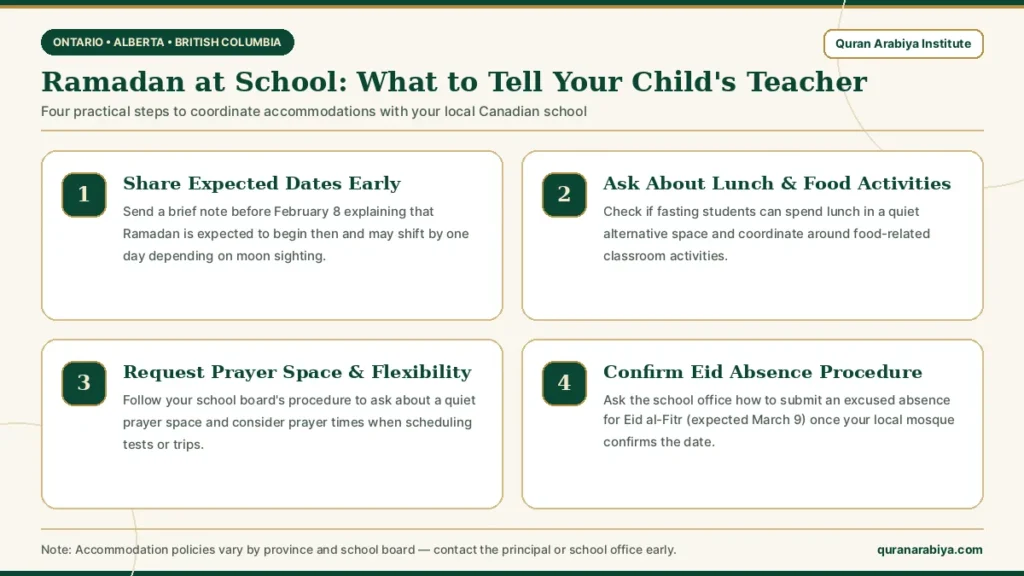
For children, Ramadan at school is often about helping teachers understand what a student may need. A child may be fasting, attending evening prayers or waking early for suhoor, so an early conversation gives the school time to discuss practical arrangements.
In Ontario, the Ontario Human Rights Commission’s policy on religious accommodation in schools explains that education providers have responsibilities to accommodate creed-related needs, subject to the applicable legal framework and undue-hardship limits. Its guidance discusses considering prayer times when scheduling tests, trips and activities, and identifying an appropriate space for prayer where needed. This does not mean every school automatically closes for all of Ramadan or Eid.
In Alberta, families should check the policy of their own school board. Edmonton Public Schools publishes an administrative regulation addressing requests for exemption from certain activities on religious grounds. The Calgary Board of Education also publishes guidance on religion in education. In British Columbia, district procedures can differ; for example, Cowichan Valley School District describes a collaborative accommodation plan developed with students and parents when a religious accommodation is needed.
What parents can tell the teacher
Send a short note explaining the expected dates and any specific need. Ask about food-related activities, the procedure for requesting prayer space where relevant, and how to request Eid absence once the date is confirmed. Do not assume a school has a blanket Ramadan policy; contact the principal or school office and follow the local board’s procedure.
A Ramadan Quran Routine for Busy Canadian Families
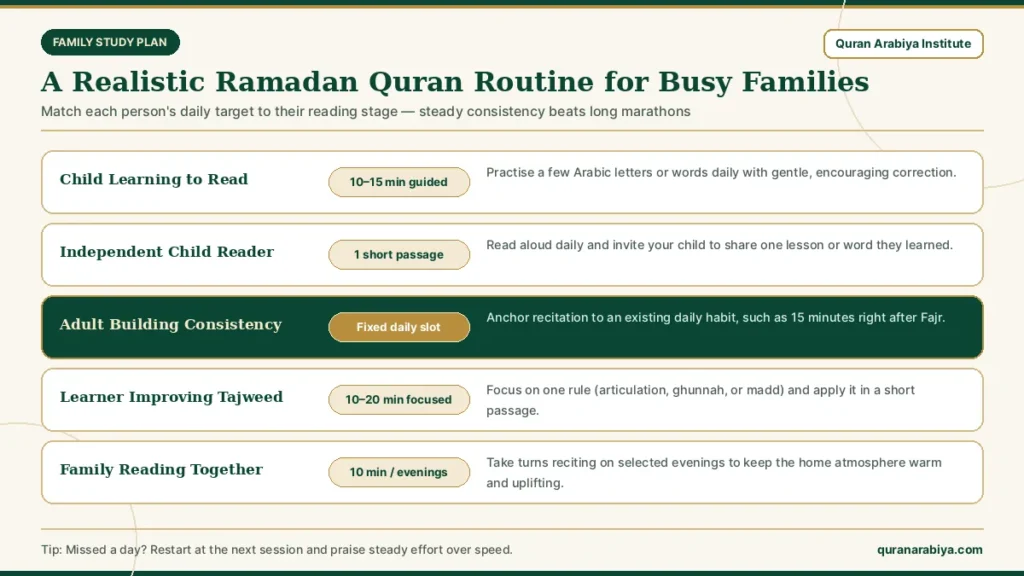
A useful family plan should fit a busy week of work, school, suhoor, iftar and evening prayer. The aim is to make Quran learning regular, not to turn every day into a long study session. Match each person’s goal to their level: a child learning Arabic letters needs a different target from an adult who reads fluently and wants to improve Tajweed.
| Learner | Realistic starting routine | How to make it useful |
|---|---|---|
| Child learning to read | 10–15 minutes of guided reading | Practise a few letters or words and correct gently. |
| Child who reads independently | A short daily passage | Ask the child to read aloud and share one thing learned. |
| Adult building consistency | A fixed daily reading time | Attach it to an existing routine, such as after Fajr. |
| Learner improving Tajweed | 10–20 minutes on one skill | Practise one rule, then apply it in a short passage. |
| Family reading together | 10 minutes on selected evenings | Take turns and keep the atmosphere encouraging. |
Keep the week varied: set a goal on Monday, practise reading on Tuesday, focus on one Tajweed point on Wednesday, listen and follow along on Thursday, reflect on Friday, let children share something they learned on Saturday and review on Sunday. If you miss a day, restart at the next session; praise effort and steady improvement rather than speed.
Getting Ready in January: Recitation and Tajweed Warm-Up
January is a useful time to prepare. A few weeks of steady practice can make daily recitation more comfortable, especially for learners returning after a break. Check whether you can read connected Quranic words, recognise easily confused letters, pronounce short vowels clearly and maintain a steady pace. Your answers help identify whether to work on reading foundations, fluency, Tajweed or memorisation.
Use four steps: review letters and vowel marks if needed; choose one Tajweed priority such as articulation, ghunnah or madd; apply it in connected Quranic passages; and keep a short list of recurring errors to practise and retest with a qualified teacher.
For guided feedback, explore Online Tajweed Classes. A teacher can listen to your recitation and identify priority areas; learners still developing reading fluency should strengthen that foundation before advanced Tajweed. Canadian families can also explore Online Quran Classes in Canada, with live one-to-one lessons arranged in the learner’s local time zone and a free trial to identify a suitable level.
Conclusion
Ramadan 2027 in Canada is expected to begin on Monday, February 8, with Eid al-Fitr expected on Tuesday, March 9 according to the FCNA calendar. Confirm the final dates through the mosque or moon-sighting authority your family follows, and use a timetable prepared for your own city and calculation method.
The best preparation is practical: check local announcements, plan for winter, communicate with school early and choose a Quran routine your family can maintain. If you would like a teacher to help you choose the right reading or Tajweed path, explore Online Quran Classes in Canada and book a free trial.
Frequently Asked Questions
When is Ramadan 2027 expected to start in Canada?
The FCNA calendar lists Monday, February 8, 2027 as 1 Ramadan 1448 AH. The first Taraweeh would be on the evening of Sunday, February 7. Follow your local mosque for its final announcement.
When is Eid al-Fitr 2027 in Canada?
The FCNA calendar lists Tuesday, March 9, 2027 as 1 Shawwal. Confirm the date with your mosque.
Will all Canadian mosques start Ramadan on the same day?
No. Some use a pre-calculated calendar; others wait for a local crescent sighting. Ask your mosque which method it follows.
How long will fasting last in Toronto, Montreal and Vancouver?
Published calculators estimate about 11 hours and 15–35 minutes for the first fast, depending on the city and calculation method. Use a local timetable for exact Fajr and Maghrib.
Do Canadian schools accommodate Muslim students during Ramadan?
Procedures vary by province and school board. Contact your child’s school early about prayer, activities and Eid absence.
How can families keep a Quran routine during Ramadan?
Choose a small daily target suited to each learner, attach it to a regular time and review progress weekly.
Can I take online Quran classes from anywhere in Canada?
Yes. See Online Quran Classes in Canada for the learning options and free-trial process.
References
- Fiqh Council of North America – Islamic Calendar
- Ramadan 2027 in Canada – City Fasting-Time Estimates
- Ontario Human Rights Commission – Policy Statement on Religious Accommodation in Schools
- Edmonton Public Schools – Exemption of Pupil from Activities on Religious Grounds
- Calgary Board of Education – Religion in Education
- Cowichan Valley School District – Administrative Procedures Manual
- Environment and Climate Change Canada – Calgary Climate Normals
- Natural Resources Canada – Time Zones in Canada